


Tezos Staking: Rewards, Unstaking, and Slashing Risk


Table of contents

To stake Tezos, first delegate your account to a baker that accepts stakers, then stake an amount of tez through the staking app at stake.tezos.com or a wallet such as Umami or Temple. Rewards start as soon as the tez is staked, and unstaking takes up to 4 days before the tez is spendable again. Staked tez is frozen and shares the baker's slashing risk, while delegated tez stays spendable and is not slashed but earns only a fraction of the rewards.
In July 2026, a Tezos community publication reported about 8.4 percent APY for staking and about 2.8 percent for delegation. Rates move with the share of tez that is staked and with baker fees, and many older guides describe rules that have since changed, so the details below matter more than any single figure.
How to Stake Tezos Step by Step
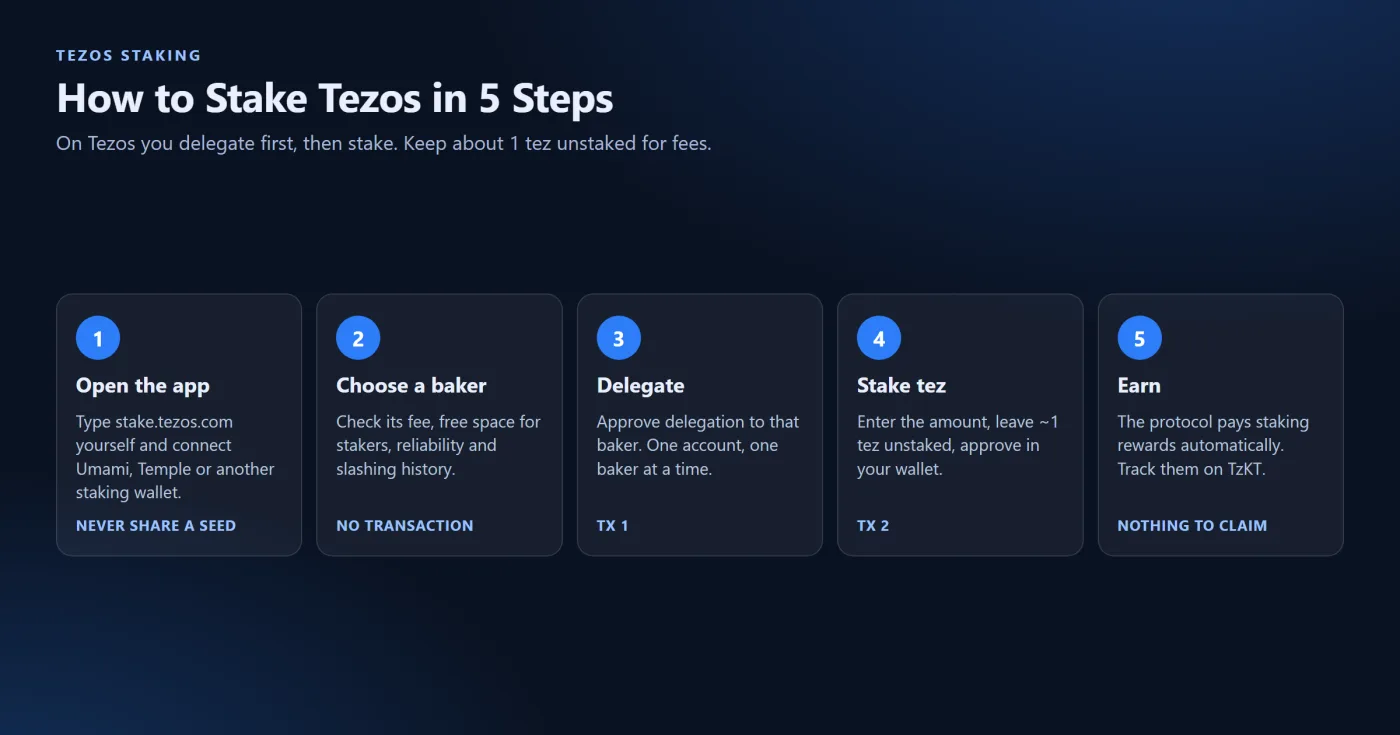
To stake Tezos, you'll need a wallet supporting staking, tez to stake, and about 1 tez remaining unstaked for future transactions.
-
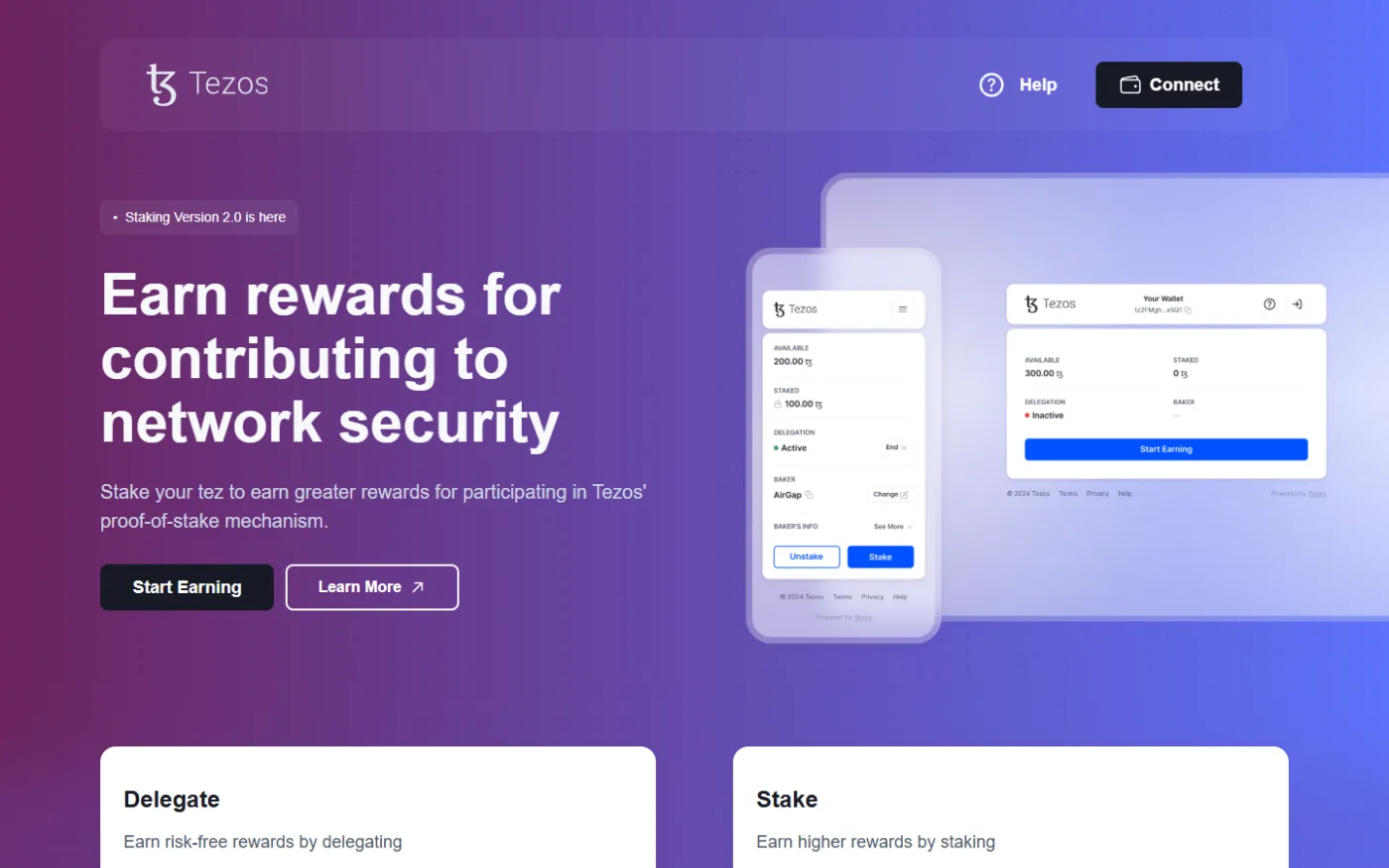
Go to the staking app at stake.tezos.com, typing the address yourself, and connect your wallet. Umami and Temple wallets support staking directly. Tezos official documentation warns against unknown websites asking you to sign the transaction, and there are no legitimate websites that need your seed phrase.
-
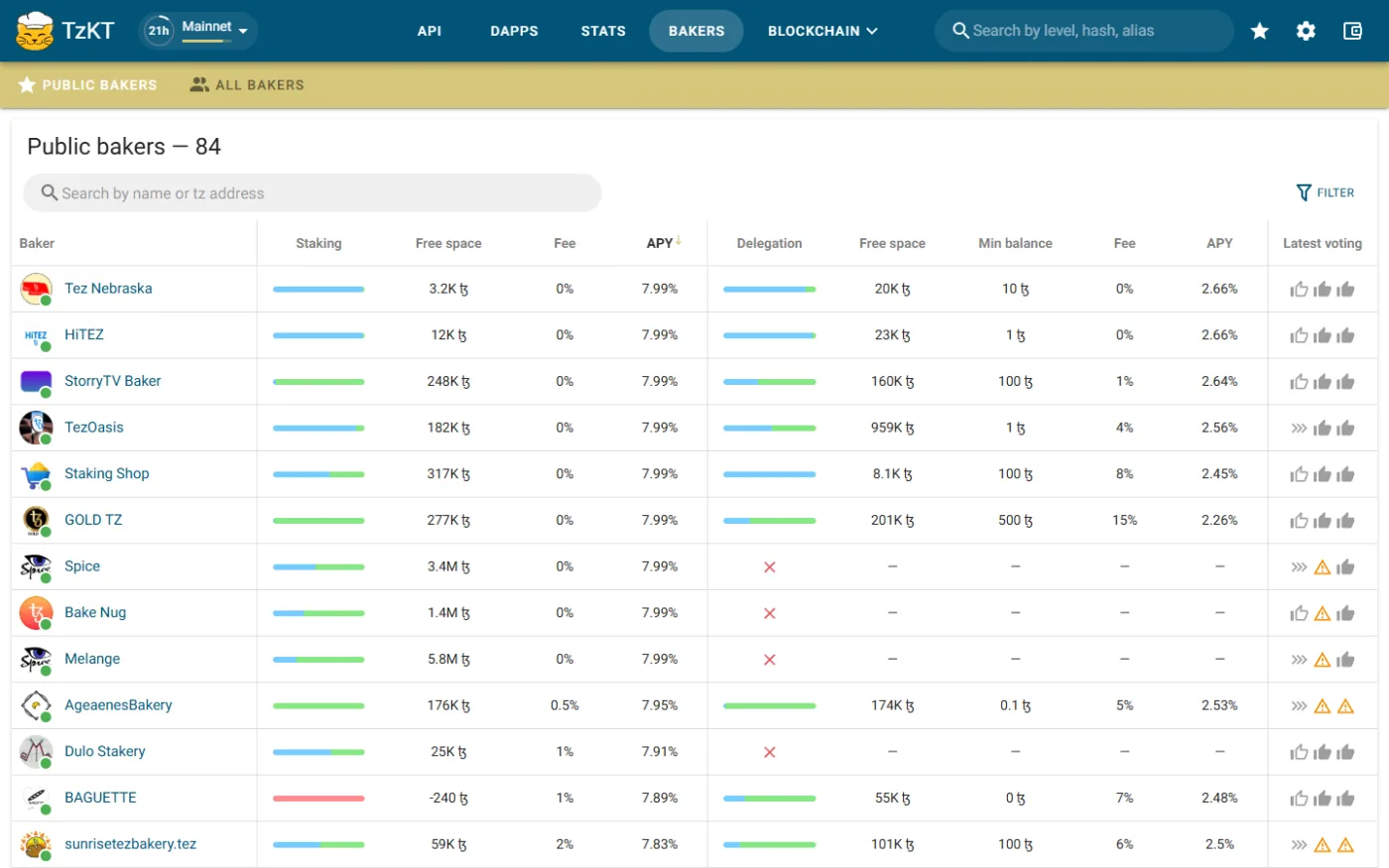
Choose a baker. The app shows the baker's fee and free space for staking. Also, according to Tezos official documentation, it makes sense to check baker's reliability and history of slashes.
-
Approve the delegation of your account to that baker. A Tezos account can have only one delegate at a time, and thus stake with only one baker at a time.
-
Enter the amount of tez you wish to stake, leaving around 1 tez unstaked, and approve the transaction in your wallet.
-
Check your rewards on a block explorer, like TzKT. The protocol distributes staking rewards automatically, and there is nothing to claim.
The user interfaces of wallets and exchanges differ and are not tested by this guide. Only user accounts can stake, because smart contracts can delegate but not stake tez.
How to Unstake Tezos
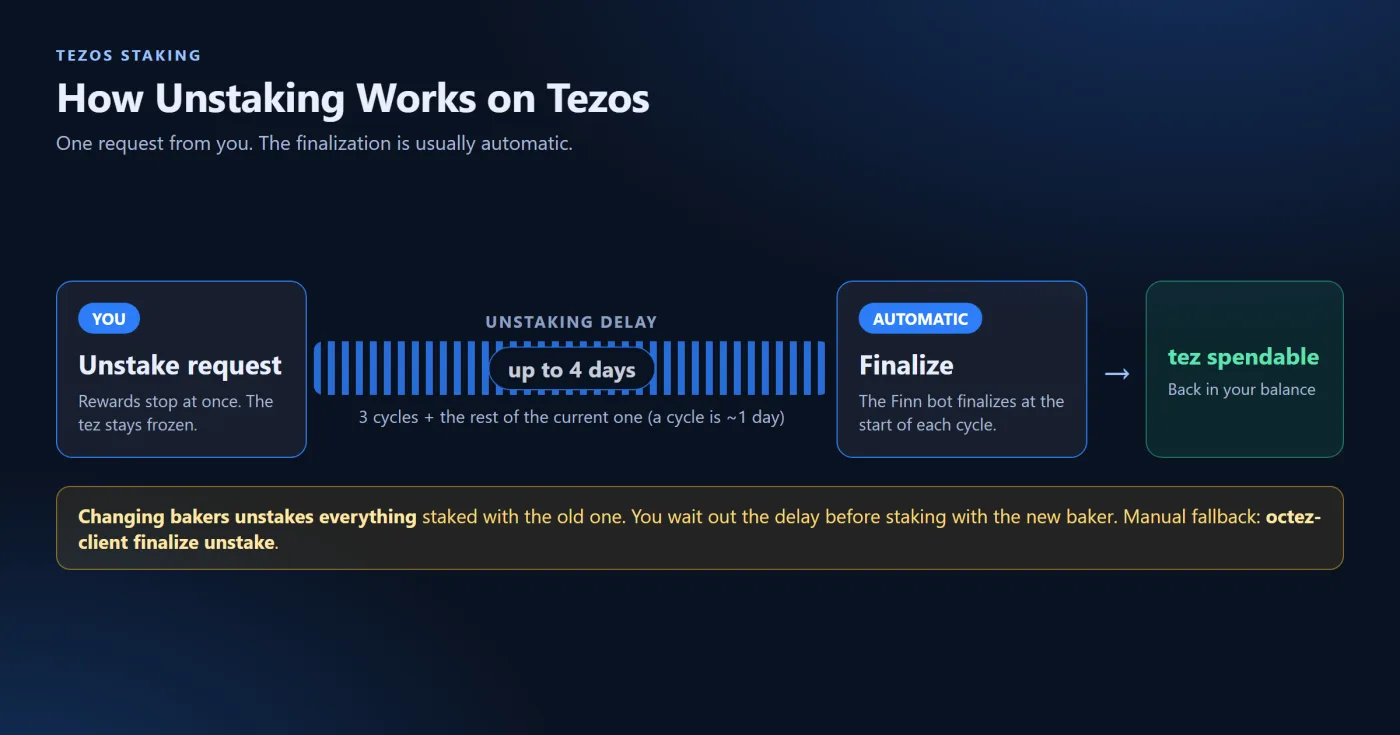
Unstaking has two parts. First, you make an unstake request. This immediately stops rewarding on the unstaked amount, but the tez is frozen. After up to 4 days of delay, which equals three cycles plus the remaining time in the current cycle, the tez is unfrozen and finally made spendable.
An automated bot called Finn finalizes unstake requests at the start of each cycle, so in most cases nothing more is needed. If it does not, you can finalize the request yourself with the Octez client command finalize unstake.
Changing baker while staked triggers an automatic unstake of everything staked with the old baker. Then, you need to wait for the unstaking delay and finalization before staking with the new baker.
Staking Versus Delegating
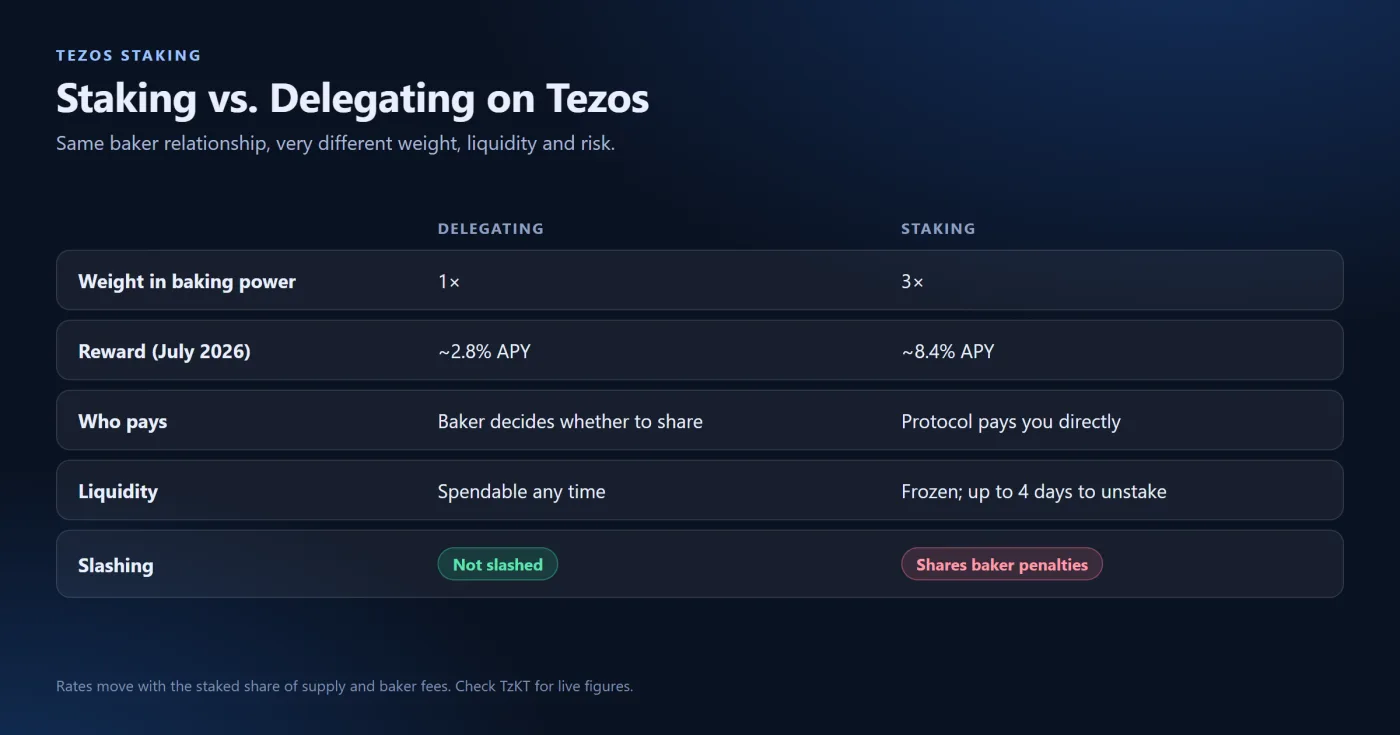
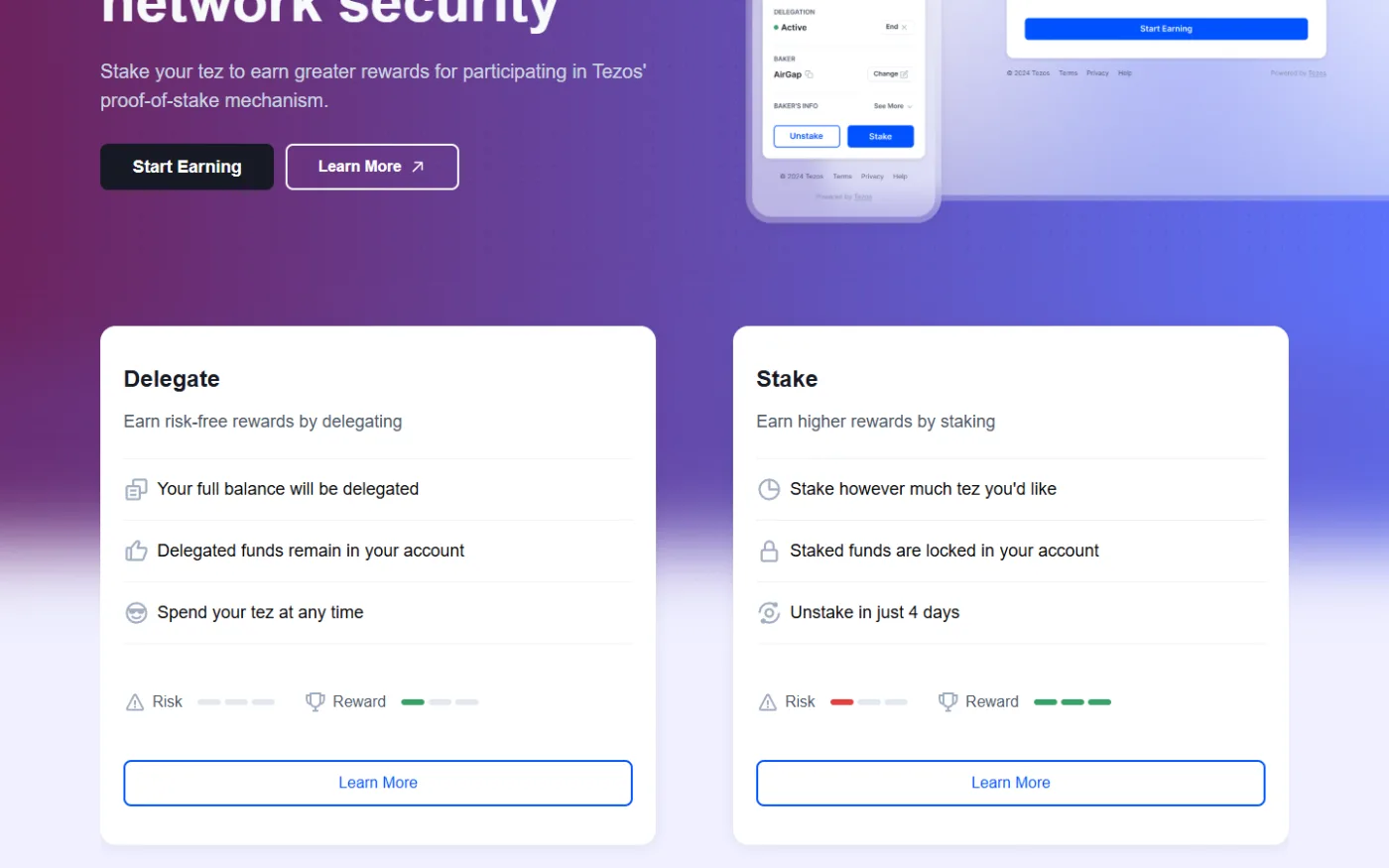
These two ways use the same mechanism of delegation, but differ in weights, risks, and payment.
-
Weight: the staked tez has triple the weight of the delegated tez when computing a baker's baking and voting power, and a Tezos community publication claims staking rewards are now three times higher than delegation rewards.
-
Payment: the protocol pays rewards to stakers directly. Rewards on delegated tez go to the baker, who chooses whether to redistribute them or not.
-
Liquidity: delegated tez remains spendable anytime, while staked tez is frozen till the end of the unstaking process.
-
Risk: delegators are not penalized when a baker misbehaves, while stakers lose a part of their stake, proportionate to the share of their weight in the baker's total.
Tezos documentation says the primary way users now earn rewards is to both delegate and stake, and that delegating without staking carries less risk but brings only a fraction of the rewards.
How Much Does Tezos Staking Pay?
According to the community report in July 2026, TzKT showed about 8.4 percent APY on staking and about 2.8 percent on delegation. Roughly 29 percent of the supply was staked and issuance was below 3 percent. The two rates are consistent with the three-to-one weighting, since 8.4 divided by 2.8 is 3. This report comes from the publication by the Tezos community itself and encourages staking, so it presents the network's own view on rewards.
How Adaptive Issuance Determines the Reward Rate
The Tezos protocol adjusts the issuance rate in order to push the staked share towards the 50 percent goal. According to the documentation, there is a band between 48 and 52 percent. Below it, the dynamic part of the rate increases, while above it the rate decreases. There is also an adaptive maximum, which reduces the maximum issuance rate depending on the staked share. In case the latter reaches or exceeds 50 percent, the maximum is 1 percent.
This means the rewards will be falling as more tez is staked, and rising when the staked share falls. The community report states that the issuance fell under 3 percent for the first time when the staking ratio increased.
Hypothetical Example
Suppose 1,000 tez earns the July 2026 rates for a year. Staking would give about 84 tez and delegation about 28 tez, before fees. If a baker keeps a 10 percent fee on the staker rewards, the staker will get about 75.6 tez, and the delegator will get whatever the baker decides to redistribute. This example is arithmetic and is not a forecast, because the reward rate depends on the staked share.
Why Other Websites Show Different Numbers
Different websites show different rates for Tezos staking. For instance, an exchange website shows about 2.84 percent, various aggregators show roughly 6.7 to 7.7 percent, and a staking website shows 7.84 percent APR with a 15 percent fee. The causes are likely different dates, different delegation or staking, different fees, and different custody terms, so check the date and the definition of any rate.
Choosing a Baker
Bakers set their own terms, and the protocol enforces them.
-
Fee: the share of staker rewards that the baker keeps. Changes to a baker's fee or limit take effect 5 cycles later.
-
Free space: the baker accepts external stake up to a certain multiple of its own stake, limited to 9 times. The default is 0, i.e., the baker accepts no external stakers.
-
Reliability: in case the baker misses baking opportunities, the rewards will decrease for the stakers.
-
History: check if the baker has been slashed before.
When the baker's limit is exceeded, the additional stake is considered delegated in terms of baking and voting power but is still slashable. A 2024 Tezos guide says this reduces rewards for all external stakers of that baker and leaves any redistribution to the baker, so check free space before you stake.
Slashing Risk on Tezos
The staked tez is a part of the baker's security deposit. In case the baker double-signs, the penalty is applied to the stakers too, proportionally to their weight. In case of double baking, this penalty equals 5 percent of the baker's stake. In case of double attestation, there is an adaptive formula. An isolated mistake costs little, but concerted attacks can cost up to 100 percent. A Tezos guide describes slashing as very rare, having occurred on a few occasions since launch.
Various educational websites still refer to the fixed 50 percent penalty for double attestation, which seems to be outdated, as the slashing is adaptive. Delegated tez is not slashed, which is the main reason delegation earns less.
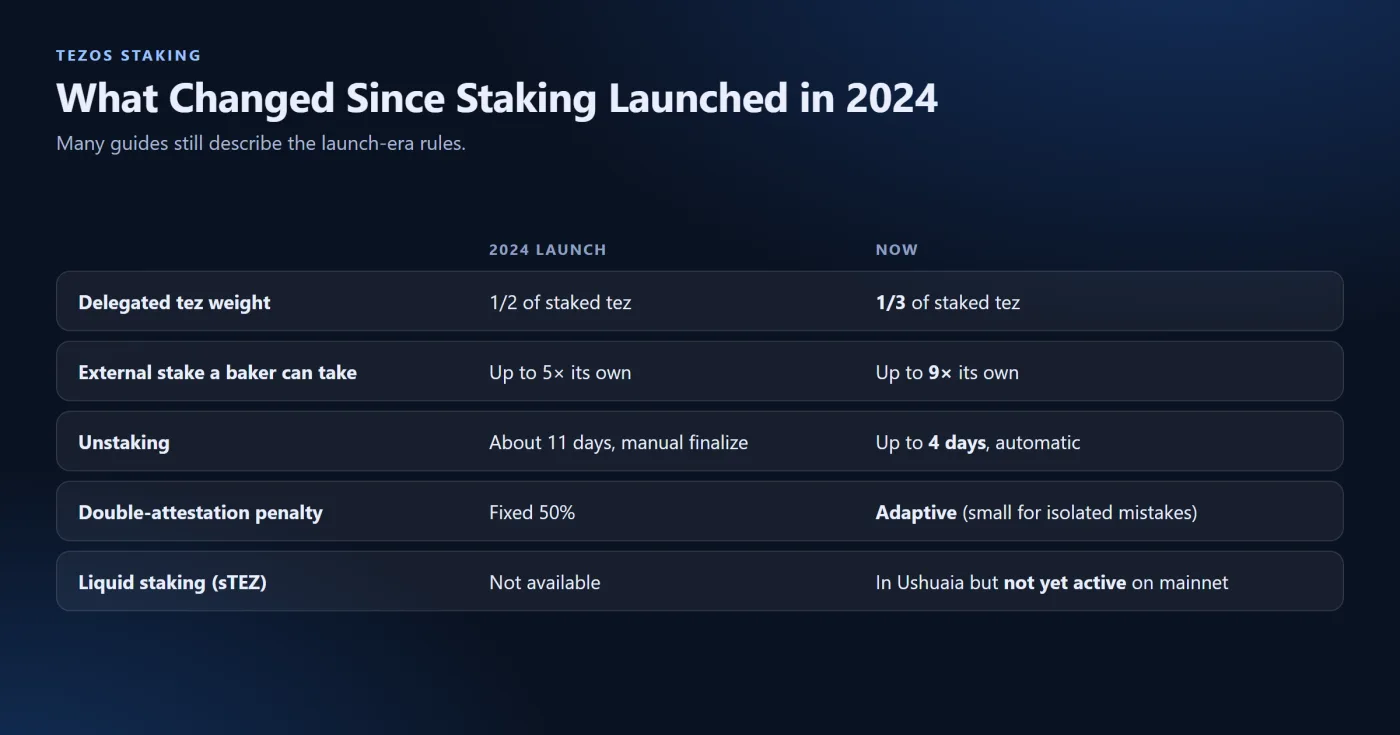
What Has Changed Since the 2024 Launch
Many of the guides were written at the moment when the staking appeared, and they were never updated.
-
The delegated tez had a half of the weight of the staked tez and now has one third.
-
The bakers could accept external stake of up to 5 times their own stake and can now accept up to 9 times.
-
The unstaking took about 11 days with a manual finalization and now takes up to 4 days with an automated one.
-
The double attestation penalty was fixed previously and now is adaptive.
Even the official Tezos 2024 staking guide has a note stating that the staking rewards are now three times delegation rewards, the cycles last 1 day, and unstaking finalizes automatically.
Liquid Staking and sTEZ
The Ushuaia protocol upgrade was activated on Tezos mainnet on June 30, 2026. But the feature of liquid staking introduced by this protocol, sTEZ, was not activated yet. It is a protocol-native token that gains value relative to tez as rewards accrue, available for testing, with mainnet activation targeted for a later upgrade called Protocol V. The stake is distributed among bakers automatically, and it has no governance voting power. so any page that presents sTEZ as available on mainnet should be treated with caution.
Exchange Staking versus Your Own Wallet
Tezos official documentation states that some exchanges allow you to stake via their interface. However, they may have their own terms and rewards, which may differ from staking directly. According to the community publication, the tez stored on exchanges probably earns less share because the exchange keeps a part of the rewards. The staking from your own wallet keeps the tez in your account, although it is frozen during staking.
What to Check Live Before Staking
Some of the parameters change over time and cannot be fixed in an article.
-
The current rates and the staked share of the supply on the block explorer, like TzKT.
-
The fee, free space, and reliability of your chosen baker in the staking app.
-
The unstaking delay in the staking app, because the protocol upgrades have changed it before.
-
Whether Tezos has activated a newer protocol, because Ushuaia was the current one when this was written.
Related guides


 Scroll to top