


NEAR Staking: Rewards, Unstaking Time, and Slashing


Table of contents
- How to Stake NEAR Step-by-Step
- How to Unstake and Withdraw NEAR
- What Is NEAR Staking and Who Protects It
- How Much Does NEAR Staking Pay?
- How to Choose a Staking Pool
- Is There Slashing on NEAR?
- Liquid Staking as an Alternative to Direct Staking
- Governance Token Locking Is Different from Staking
- What to Check Before Staking NEAR
- Related guides

To stake NEAR, deposit it into a validator's staking pool from a wallet that supports staking. Rewards begin after the next epoch, and getting your tokens back takes two steps: unstake, then withdraw once four epochs have passed, which NEAR's documentation puts at roughly 24 to 28 hours.
Rewards are variable and not guaranteed, and many guides quote outdated rates, because NEAR halved its maximum yearly inflation from 5 percent to 2.5 percent in late 2025. While staked, your NEAR sits in the pool's smart contract instead of your wallet, and sources disagree on whether NEAR currently slashes staked funds, as explained below.
How to Stake NEAR Step-by-Step
You need a NEAR account in a wallet that offers staking, the amount you want to stake, and a little extra NEAR to cover transaction fees.
-
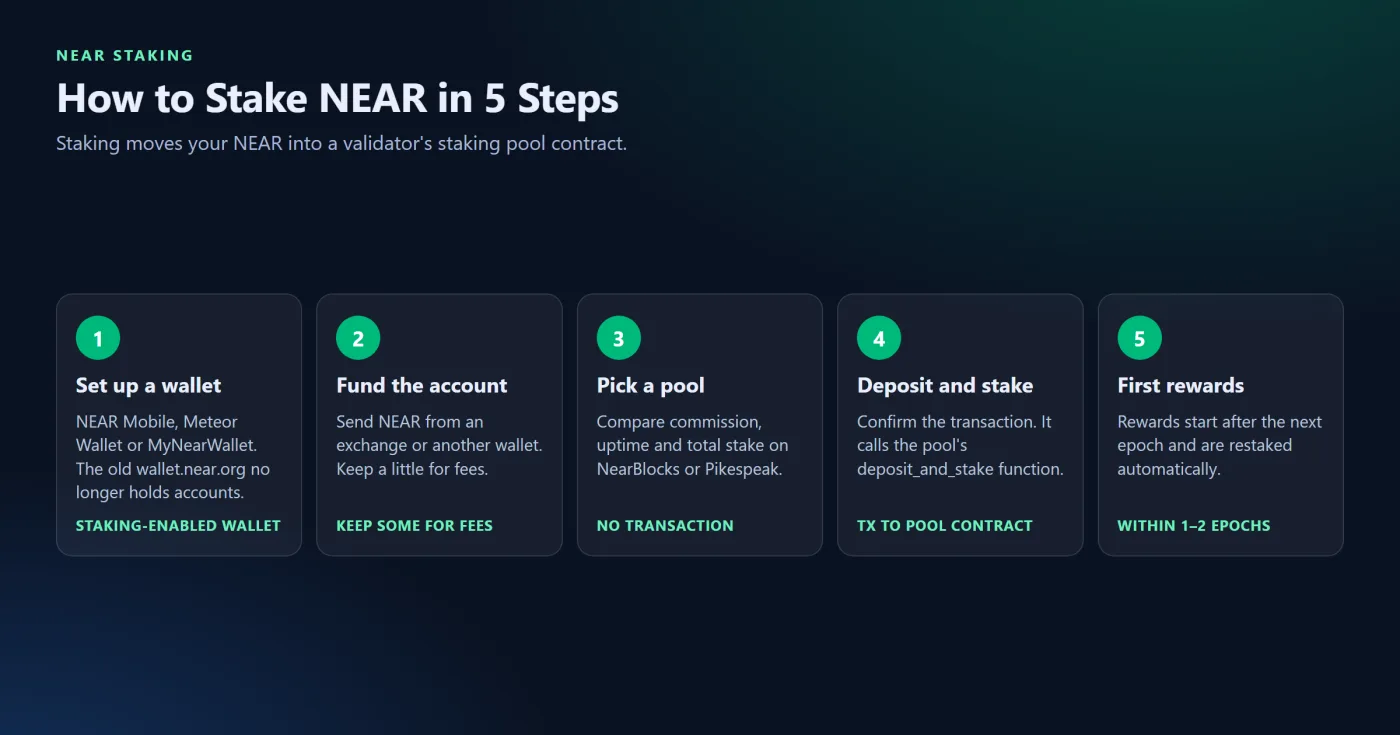
Set up a wallet. The old web wallet at wallet.near.org no longer holds accounts and now links to ecosystem wallets such as NEAR Mobile and Meteor Wallet. Staking guides from validator providers also describe the process in MyNearWallet.
-
Fund the account by sending NEAR from an exchange or another wallet to your NEAR account address.
-
Open the staking section and compare validator pools by commission, uptime, and total stake.
-
Enter an amount and confirm. NEAR's documentation shows this step as a call to the pool contract's deposit_and_stake function, which moves your NEAR into that contract.
-
Check your staked balance. NEAR's documentation says rewards start after the next epoch, and Kiln lists the first reward one epoch after the stake becomes active, so expect the first payout within roughly one to two epochs.
Wallet menus change, and this guide did not test any wallet interface, so read each confirmation screen before you approve a transaction. If your wallet does not have a staking screen, NEAR's documentation shows the same steps using the NEAR command-line interface. Staking only asks you to approve a transaction in your wallet, so a staking page that asks for your recovery phrase is not legitimate.
How to Unstake and Withdraw NEAR
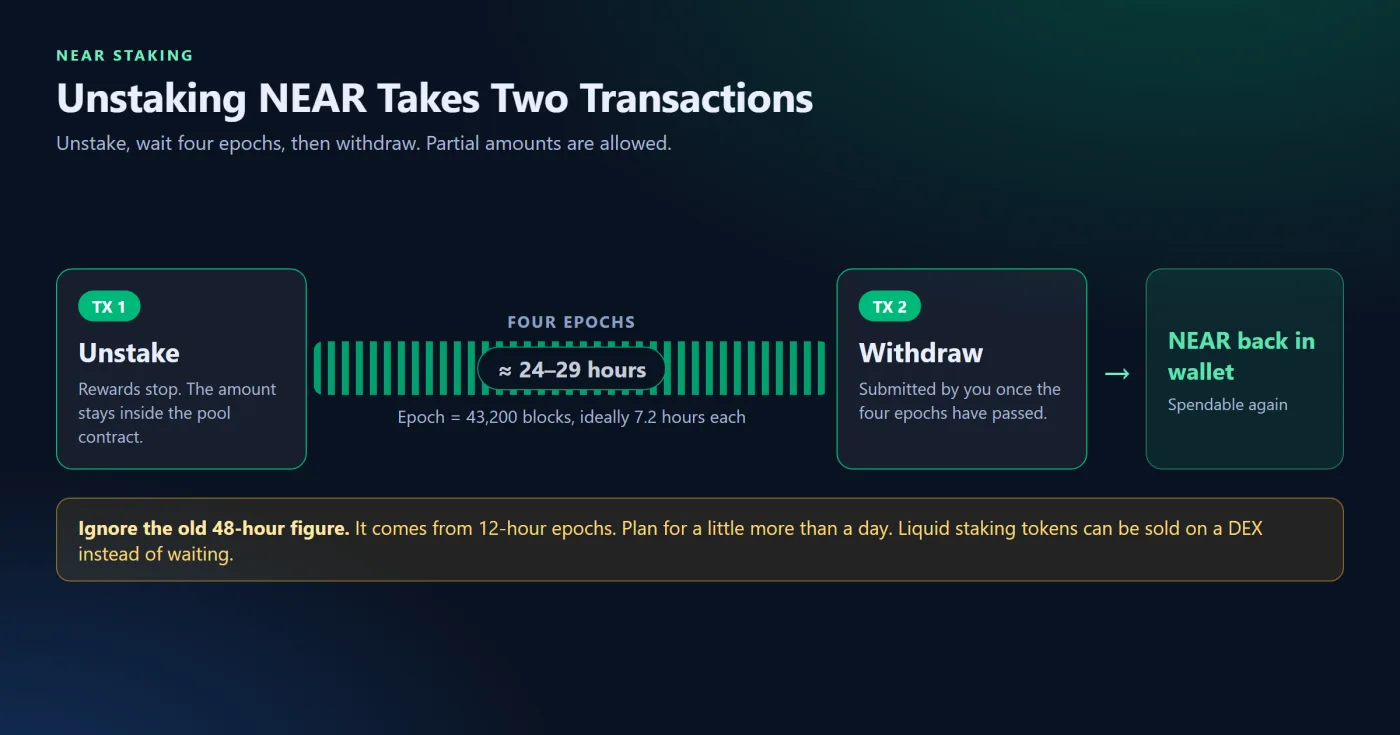
Unstaking takes two transactions, not one. The first asks the pool to unstake an amount, which can be a part of your balance, and the second withdraws it after the waiting period ends.
The wait is four epochs. NEAR's staking page estimates it at about 24 hours, and its liquid staking page at 24 to 28 hours. An epoch is 43,200 blocks, ideally 7.2 hours at 0.6-second blocks, so four epochs come to roughly 29 hours, and the staking provider Kiln lists 22.5 to 30 hours depending on when in an epoch you unstake. A few NEAR pages still say 48 hours, which appears to come from an older assumption of 12-hour epochs, so plan for slightly more than a day.
Tokens that are waiting to be withdrawn are no longer staked, and provider documentation says the last reward is the one earned before unstaking. The unstaked amount stays inside the pool contract until you submit the withdrawal.
What Is NEAR Staking and Who Protects It
NEAR is a proof-of-stake network. Holders choose active validators by delegating tokens to them, and validators earn newly issued NEAR each epoch, which delegators share after the validator's commission.
To join the active validator set, an operator needs enough stake to clear a seat price, which is set by the 300th-largest staking proposal and cannot fall below 25,500 NEAR. The top 100 validators produce blocks and chunks, and the others act as chunk validators. Near One, the team behind much of NEAR's core infrastructure, reports more than 300 active validators. As a delegator you never need to cover the seat price yourself, because your stake is added to a pool's total.
Staking Pools Are Smart Contracts
There is no direct delegation option in NEAR's protocol. Each validator creates a standard staking pool contract by using a factory that uses a whitelisted contract to protect delegators' funds and delegators send NEAR to that contract. In practice, your staked NEAR is held by the pool contract, whose source code is available on GitHub.
Epochs Determine Everything in NEAR
Everything in NEAR staking is counted in epochs. Validators stay fixed within an epoch, rewards are paid at epoch boundaries, and providers such as Kiln describe the rewards as automatically restaked. A deposit therefore starts earning after the next epoch, and an exit is measured in epochs as well, which is why wait times in hours differ slightly between sources.
How Much Does NEAR Staking Pay?
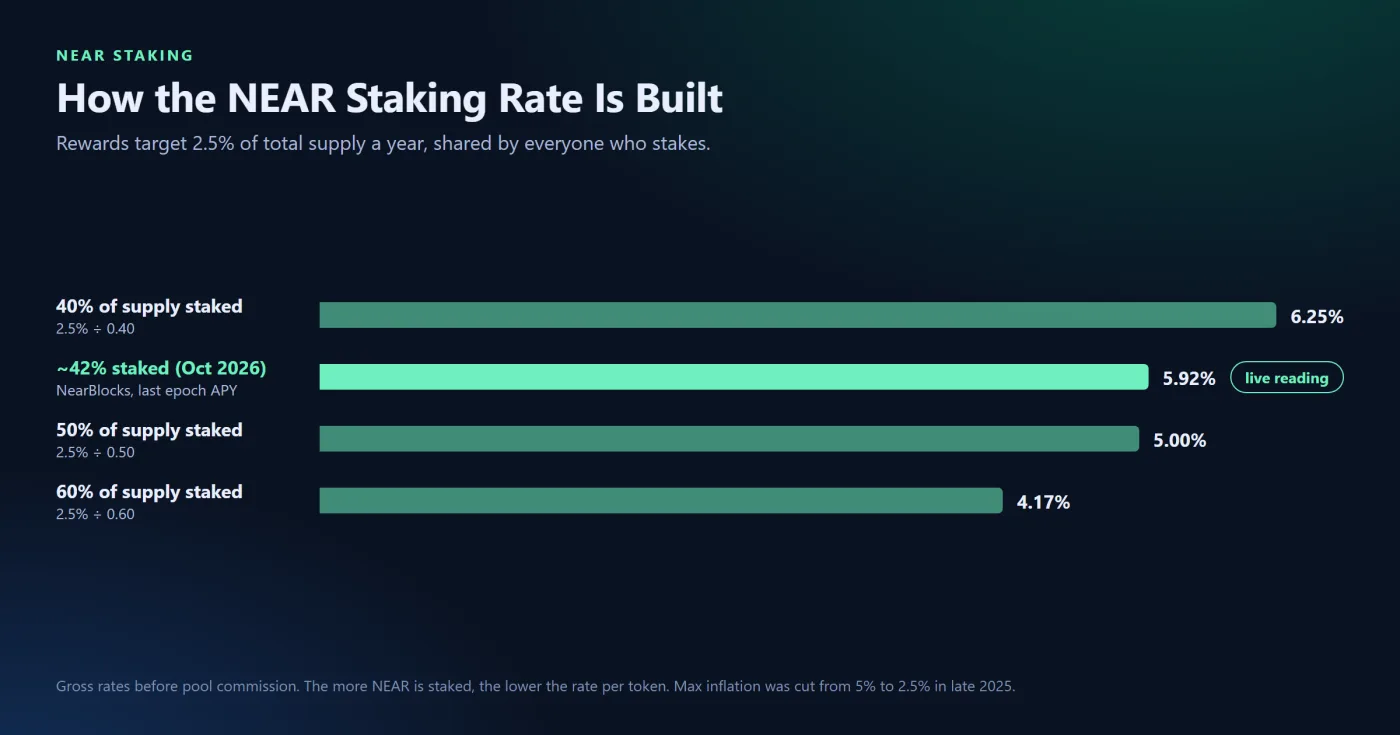
It is impossible to publish a fixed NEAR staking rate, because it depends on the percentage of supply that is staked and on what your pool charges. What can be documented is how the rate is built. NEAR's validator documentation says validator rewards target 2.5 percent of total supply per year and Near One announced the upgrade that cut the maximum inflation from 5 to 2.5 percent.
Because the reward pool is shared by everyone who stakes, the rate per staked token is roughly the pool divided by the share of supply that is staked. Near One estimated the staking rewards at 4.75 percent in case half of the supply stays staked. The following numbers are simple division and not predictions:
-
If 40 percent of supply is staked, 2.5 percent divided by 0.40 gives about 6.25 percent.
-
If 50 percent is staked, the result is 5.00 percent.
-
If 60 percent is staked, the result is about 4.17 percent.
Treat these as upper-bound sketches. Near One's estimate in case of 50 percent is slightly lower than the number that simple division provides, pools charge commission, and rewards compound every epoch, adding roughly 0.1 percentage point at those rates. As a hypothetical example, a pool charging 5 percent commission on a 4.75 percent gross rate leaves about 4.5 percent before compounding, or roughly 45 NEAR a year on 1,000 NEAR, before any change in the NEAR price.
Guides differ due to the time of publication. Comparison tables dated 2026 give 8 to 10 percent staking reward with an exit time of 36 to 52 hours, which fits the previous 5 percent inflation system and old epoch assumption, while a 2026 statistics roundup written after the upgrade cites roughly 4 to 5.2 percent. Always check the date and the staked portion of supply behind the number.
How to Choose a Staking Pool
Pools differ by several parameters that influence the reward and risks you face.
-
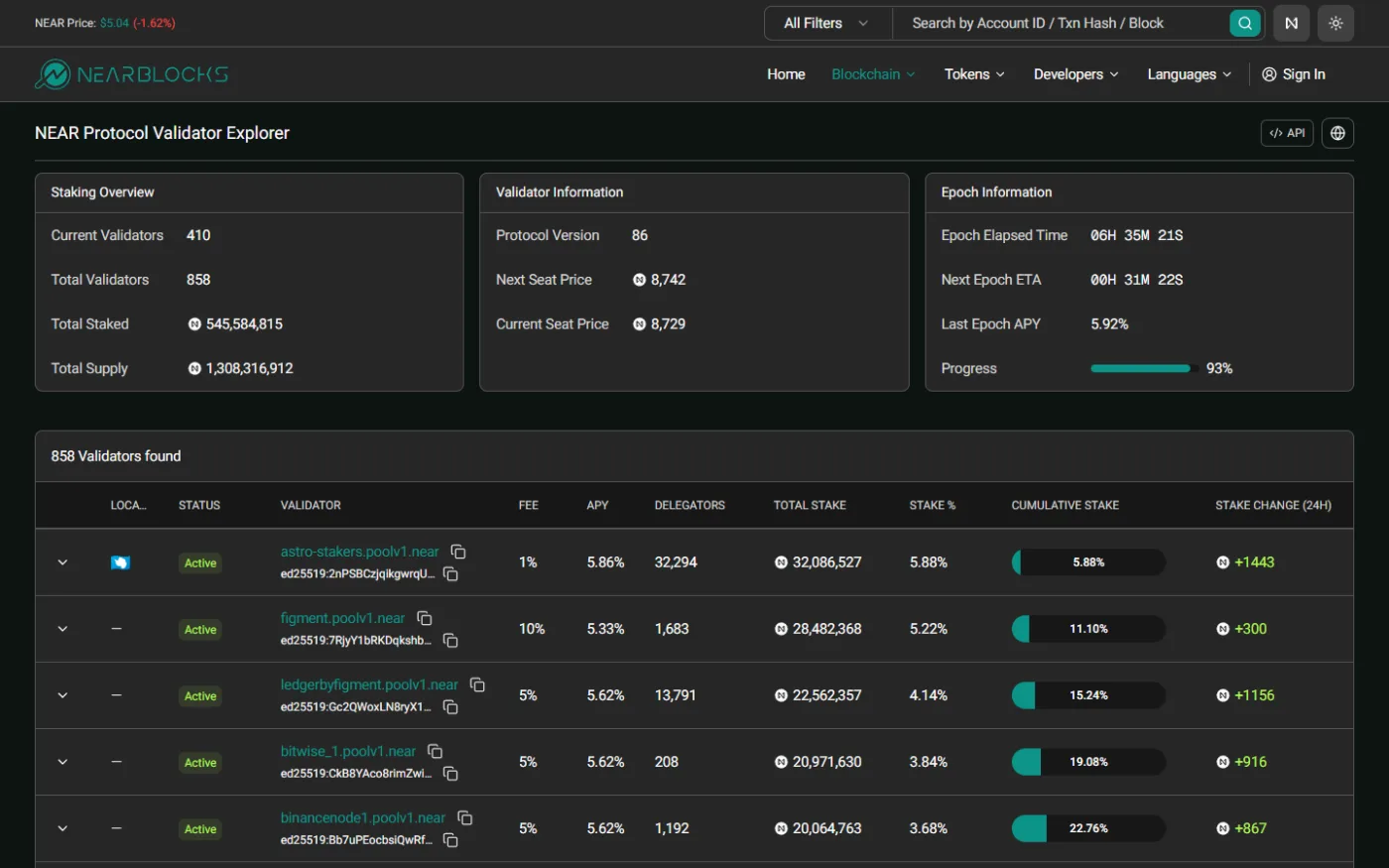
Commission is the percentage of rewards the operator keeps. NEAR's documentation says there is a contract method to display the commission and several explorers where you can compare it.
-
Uptime is important, because the protocol removes validators that do not produce enough blocks or chunks and the threshold in NEAR's documentation example is 90 percent of the expected output. Removal interrupts rewards for everyone staked with that validator.
-
Concentration is worth a look. Splitting a larger stake across two or three pools limits your reliance on one operator.
-
Ownership can be viewed in the contract as it reveals the owner account. To see the track record, use the explorers mentioned above.
NEAR's documentation says you should compare validators at NearBlocks, Pikespeak, and the community-maintained Near Staking site, emphasizing the importance of a good track record, uptime and reasonable commission rates.
Is There Slashing on NEAR?
Sources differ on that matter, and the question is important. NEAR's validator documentation describes slashing as part of the security model and says a validator found acting maliciously can lose stake. However, the protocol specification says that slashing is currently disabled, while Kiln refers to slashing as none and not implemented yet. Blockdaemon, another provider, states that slashing is active, although the same page gives a 12-hour epoch figure that conflicts with NEAR's own epoch page.
The most defensible reading is that slashing is part of the design but, according to the specification and several providers, is not currently enforced. That could change in a protocol upgrade, as the 2025 inflation change showed. Even without slashing, an unreliable validator costs delegators rewards, so pool quality still matters.
Liquid Staking as an Alternative to Direct Staking
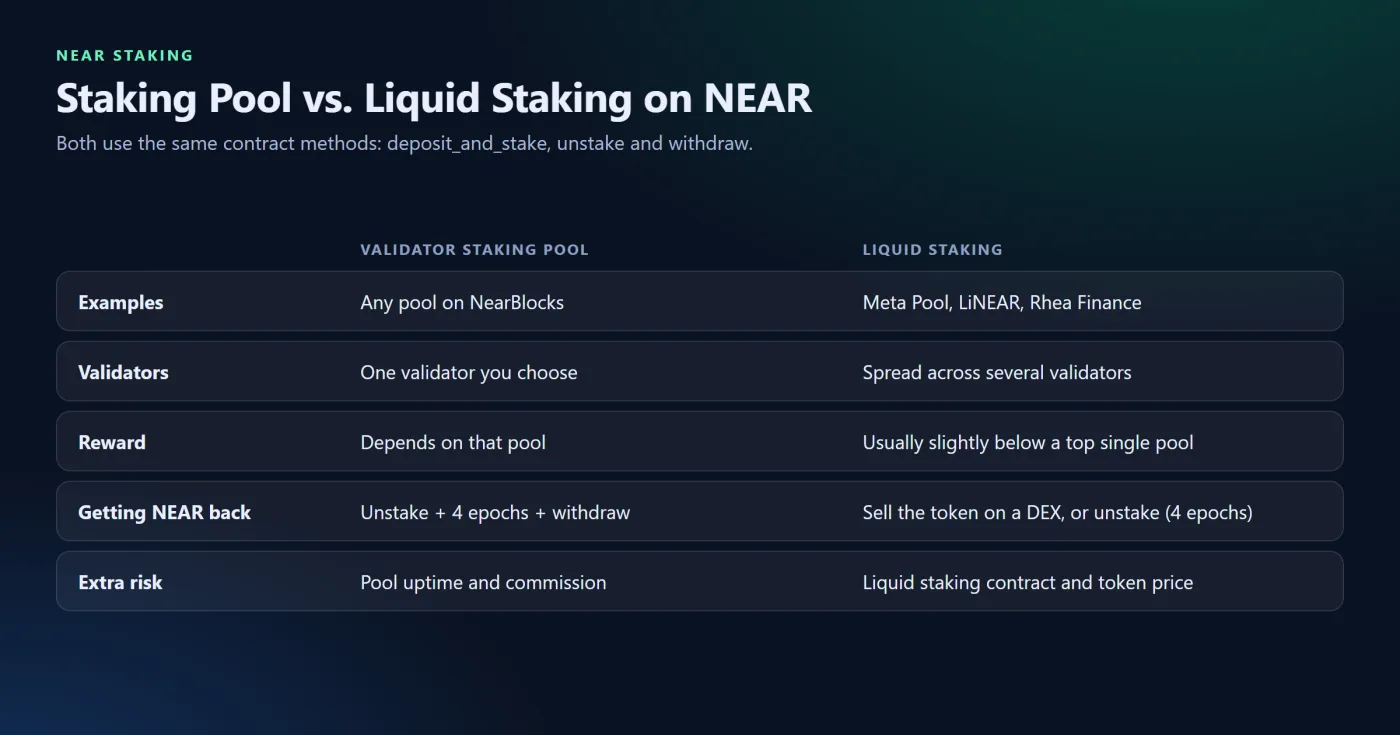
Liquid staking is a way to stake NEAR via a contract that issues a new token for your stake. NEAR's documentation mentions Meta Pool, Rhea Finance, and LiNEAR as providers, and the contract uses the same methods: deposit_and_stake, unstake and withdraw.
NEAR's documentation mentions two differences. Your NEAR stake is distributed between several validators, so the average reward is usually slightly lower than with one high-performing validator, but an outage at one validator matters less. Also, in case you need NEAR immediately, you can sell the liquid token on a decentralized exchange, instead of waiting four epochs. Unstaking via the contract still requires four epochs. Additional risk is trusting the liquid staking contract and market price of its token, which is not evaluated in this article.
Governance Token Locking Is Different from Staking
NEAR also has a governance mechanism called House of Stake, where holders lock NEAR to receive voting power and rewards, with longer locks giving more of both. According to a news report citing official sources, it was launched on the mainnet in October 2025. That lock is separate from delegating to a validator pool, and any rewards attached to it come from separate programs, so it does not change the staking-pool figures above.
What to Check Before Staking NEAR
Several factors change over time and cannot be fixed in an article.
-
The portion of NEAR supply that is currently staked, then calculate the rate as explained above.
-
The commission and uptime of your selected pool.
-
The exit time your wallet or pool shows, since epoch timing can drift from the ideal 7.2 hours.
-
The current slashing status in the protocol specification and pool operator documentation.
-
Whether protocol rules changed after the sources used here were read, because inflation was changed by an upgrade once already.
Related guides


 Scroll to top