


Algorand Staking: Rewards, Requirements, and Risks


Table of contents

To stake ALGO, you bring it online in Algorand's consensus, either by running your own participation node or by using a liquid staking app, a staking pool, or a delegated service. For independent node runners there is no lock-up and no slashing, and the ALGO stays in the wallet. Direct block rewards require an account balance between 30,000 and 70,000,000 ALGO and a 2 ALGO opt-in fee, so holders with less usually use liquid staking or a pool.
Published estimates are around 4.7 percent a year, but much of that appears to come from a Foundation bonus committed for about 24 months from January 2025, so the rate may fall when the bonus ends. Many older guides also describe governance rewards, which no longer exist.
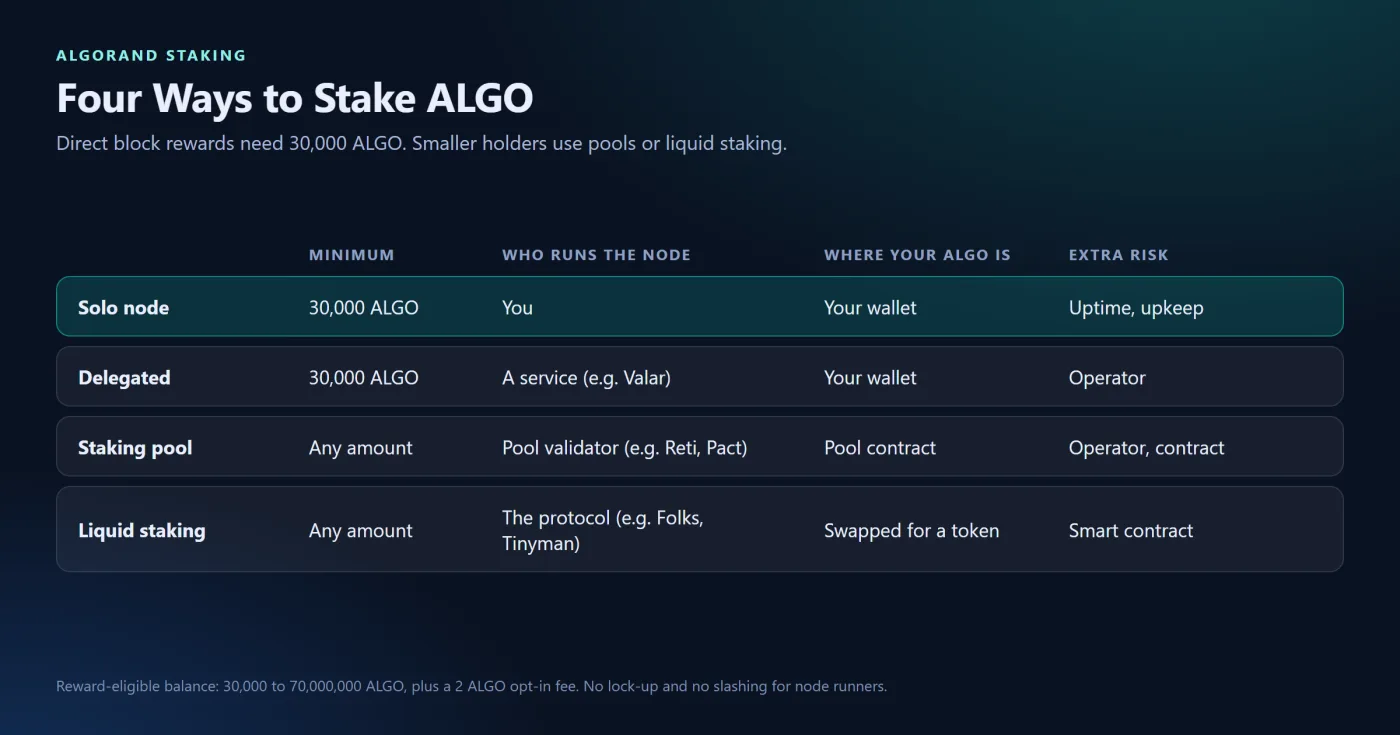
Four Ways to Stake Algorand
-
Solo staking runs your own node and requires at least 30,000 ALGO to be eligible for rewards, with a maximum of 70,000,000 ALGO.
-
Delegated staking lets a third party run the node while your ALGO stays in your wallet, and it has the same 30,000 ALGO minimum.
-
Staking pools let groups of holders participate together with any amount of ALGO and share the rewards the pool's validator earns.
-
Liquid staking takes a deposit of ALGO of any size and gives you a token that represents the stake and can be used elsewhere in decentralized finance.
The Algorand Foundation mentions Folks Finance, Tinyman, Messina, and CompX for liquid staking, Pact and Reti Pooling for pools, and Valar for delegated staking. Each service has its own terms and risks, and this article did not evaluate any of them.
How to Stake With Your Own Node
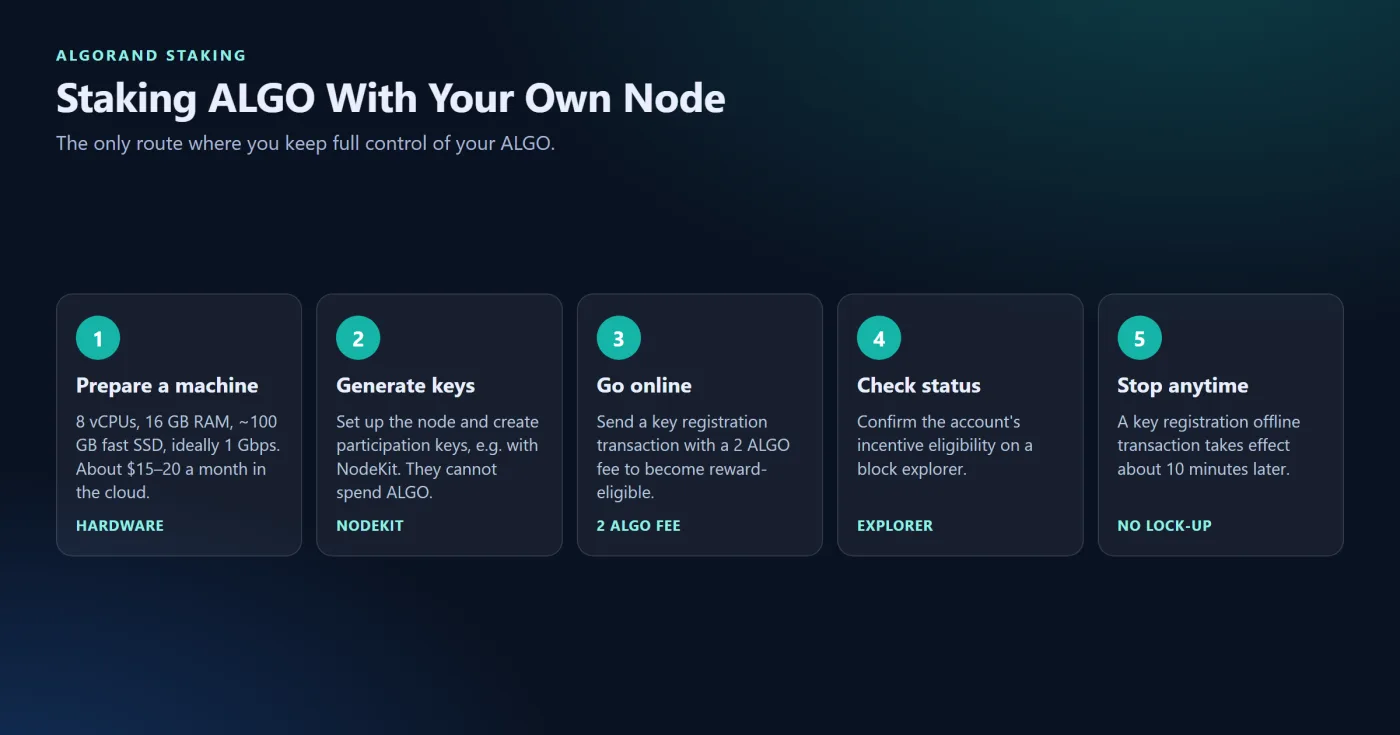
Running a node is the only route that keeps full control of the ALGO, and it works as follows.
-
Prepare a machine. The Foundation recommends at least 8 virtual CPUs, 16 GB of RAM, a fast SSD of around 100 GB, and a connection of ideally 1 Gbps, and it says a cloud machine of this size costs roughly 15 to 20 dollars a month.
-
Set up the node and generate participation keys, for example with the NodeKit tool the Foundation points to. These keys vote on blocks, and they are separate from the keys that spend your ALGO, so the account can even be on a hardware wallet.
-
Register the keys online with a key registration transaction. To receive block rewards you must set a 2 ALGO fee on this transaction, which marks the account as incentive-eligible.
-
Check eligibility on a block explorer, which shows the incentive status of an account.
-
To stop, send a key registration offline transaction, which takes effect about 10 minutes later.
A node needs steady uptime, as the next sections explain, and this guide did not test any node setup.
What Staking Means on Algorand
Algorand uses a pure proof-of-stake design. In this system, staking means making your ALGO count in consensus by bringing the account online, not locking tokens away. For each block, the protocol randomly selects a proposer and voting committees from all online accounts, with a probability based on their stake.
Because selection is random, a participating account earns only when it happens to propose a block. Blocks are finalized approximately every 2.8 seconds, according to the Foundation.
How Algorand Staking Rewards Work
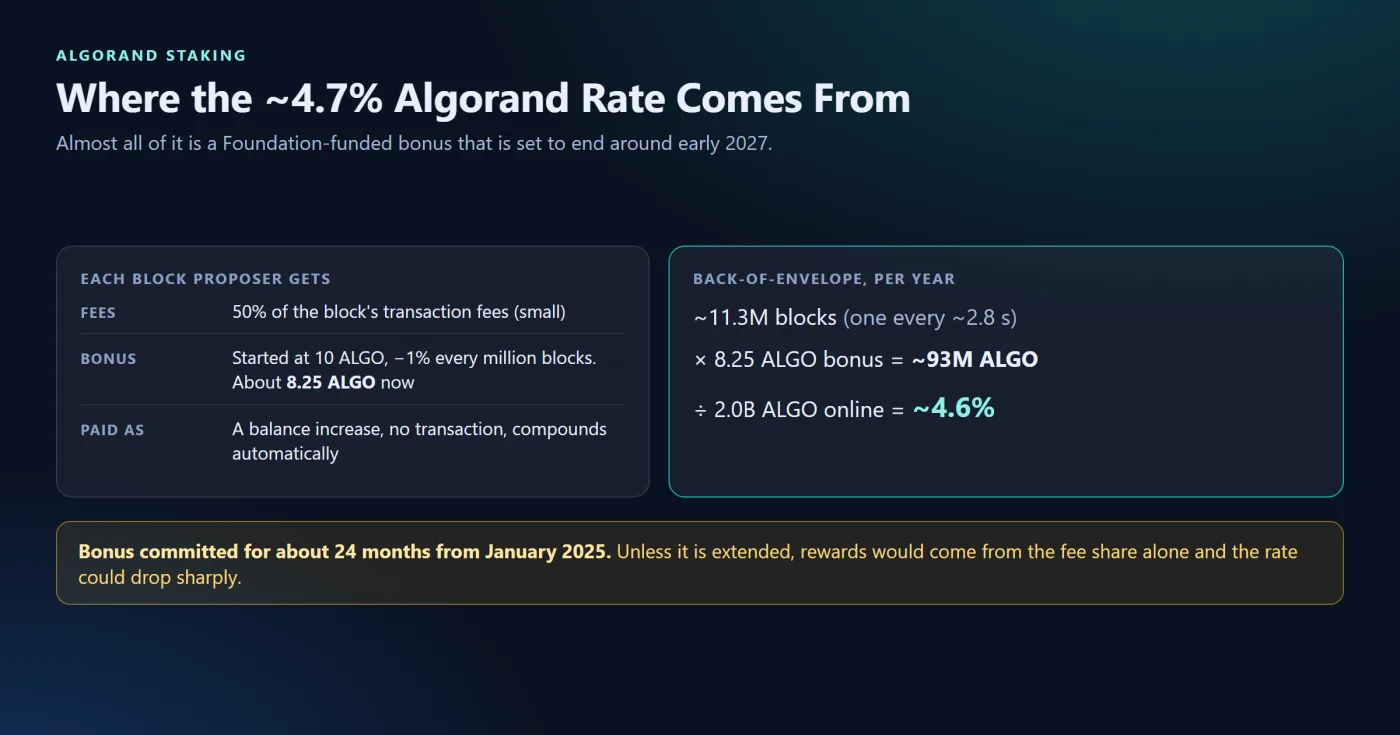
When an eligible account proposes a block, it receives a payout made of two parts. The first is 50 percent of the transaction fees in that block. The second is a bonus that started at 10 ALGO per block and decays by 1 percent every million blocks. The protocol documentation notes that this bonus is intentionally not sustainable from fees alone, and the Foundation funds it.
The payout is added to the account's balance and does not appear as a separate transaction. The Foundation describes the stake as compounding automatically, since the rewards raise the balance that counts in consensus.
How Much Does Algorand Staking Pay?
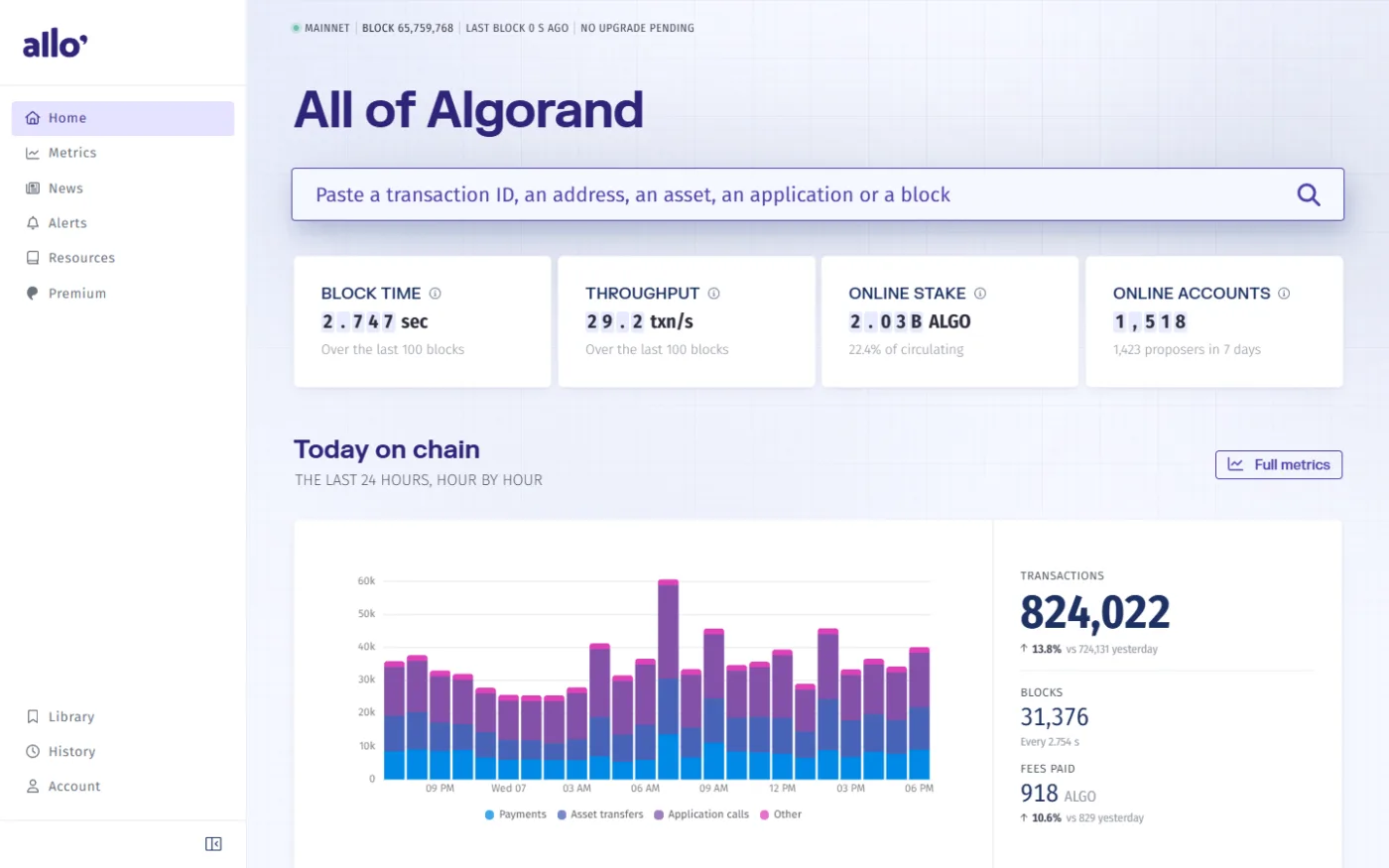
The aggregator, which provides data for the staking pages of Coinbase, showed an estimate of 4.73 percent annual reward, with 22 percent of the total supply staked and 2.0 billion ALGO online. As per the Coinbase staking page, Algorand staking is currently unsupported on the exchange, thus, the estimate refers to on-chain participation and not to any exchange product. Estimates differ by source and date, so check a current figure before relying on one.
Where the Rate Comes From
The reward rate is approximately the annual amount of bonus ALGO divided by the amount of ALGO online. Here are the calculations, using published parameters and assumptions, but not measurements.
-
With one block every 2.8 seconds, there are about 11.3 million blocks a year.
-
Given that the bonus program started around January 23, 2025 (the Foundation said January 2025, and one community post mentioned this date), there were about 19 million blocks, so the bonus rate is about 10 multiplied by 0.99 to the power of 19.2, that is approximately 8.25 ALGO per block.
-
This makes about 93 million ALGO per year, which is about 4.6 percent of 2.0 billion ALGO online.
This number is very close to the published 4.7 percent, which suggests that the bonus accounts for almost all of the rewards rate. The minor discrepancy might come from the fee share or from differences in the input numbers, and the size of fee income was not verified.
What Will Be After the Bonus Expires
The Foundation committed to the bonus for approximately 24 months from January 2025, which points to early 2027, and no extension was found in the sources reviewed. After that, rewards would come from the 50 percent fee share alone. Because the bonus alone accounts for nearly the whole published rate in the arithmetic above, fee income appears small, although it was not measured, so the rate could drop sharply unless the program is extended.
Hypothetical Example
Assume that we have an account with 30,000 ALGO under the same assumptions. It holds about 0.0015 percent of the stake online, so it should expect to propose about 169 blocks a year, that is approximately once in two days. At about 8.25 ALGO each, that is about 1,390 ALGO, or 4.6 percent. Actual results vary because proposers are chosen randomly, and this is an expected value and not a forecast.
Risks of Staking Algorand
Staked ALGO cannot be slashed, according to the Foundation, but the risks are different, not absent.
-
Suspension for poor uptime. An account gets suspended if it fails to propose for too long relative to its stake, or if it misses a periodic challenge to prove its node is running. Nodes can be expected to be challenged daily, and suspended account becomes ineligible for incentives until it registers again with 2 ALGO opt-in fee.
-
Operation overhead. A node needs monitoring and updates, and one that is online but not working weakens the network and earns nothing.
-
Third-party risks. Liquid staking, pools, and delegated services add the risks of smart contracts and operators that are not present in solo staking.
-
Time-limited rewards. The bonus is scheduled to end, as described above.
-
Rewards ceiling. Accounts with more than 70,000,000 ALGO cannot receive staking rewards.
Why Are Old Guides Outdated
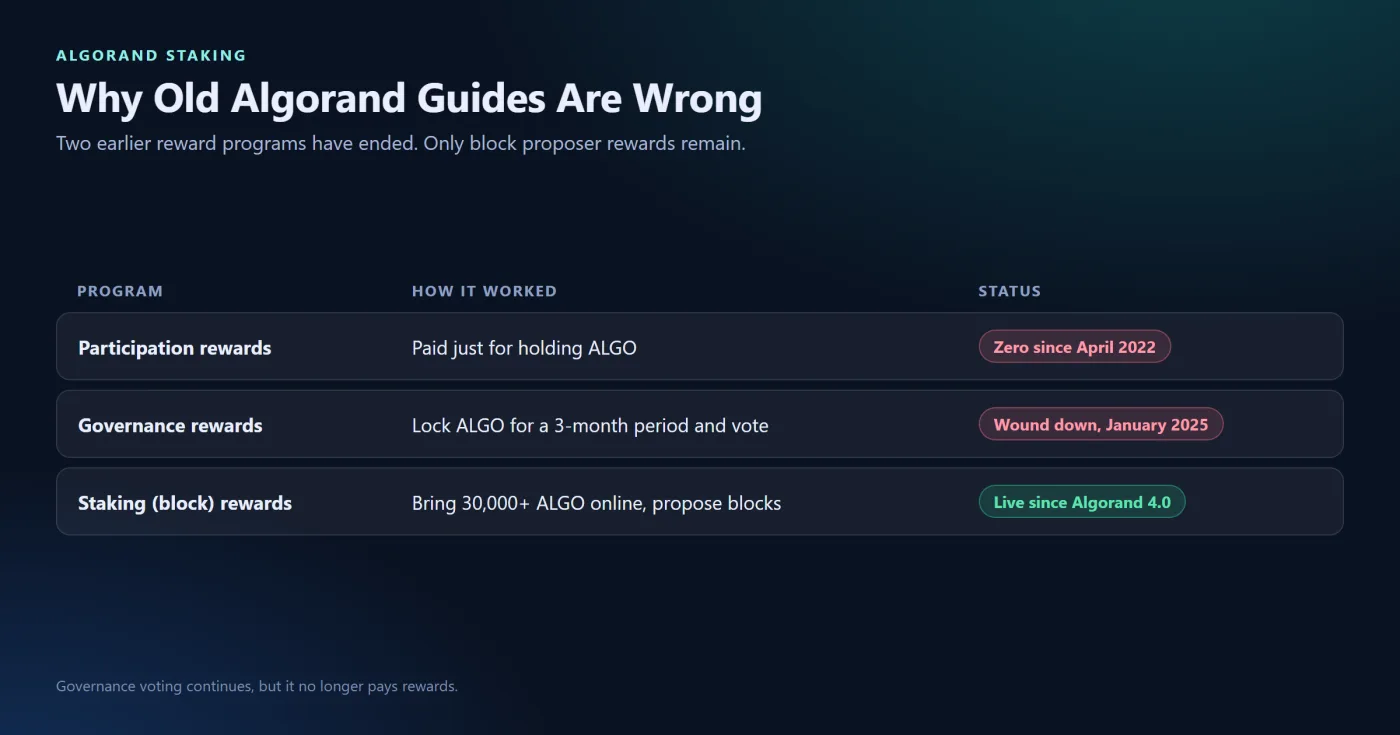
For some time, Algorand provided governance rewards to the holders who locked their ALGO for some period, and some guides still mention the rates from this program and three-month lock. The Foundation says governance rewards wound down once staking rewards launched with the Algorand 4.0 upgrade in January 2025. While voting is available, the participants do not receive any rewards.
Even earlier, the passive participation rewards for just holding ALGO dropped to zero in April 2022, according to the Foundation FAQ. Any guide that asks you to lock ALGO for a quarter for governance rewards describes a program that is no longer running.
What to Verify Live Before You Stake
-
The live estimate of the reward rate and the percentage of ALGO online, as the rate falls as the online stake increases.
-
The status of the Foundation bonus, whether it is active and unchanged.
-
The incentive eligibility of your account on a block explorer if you run a node.
-
The fees, terms, and custody conditions for any liquid staking, pool, or delegated service.
Related guides


 Scroll to top