


Sui Staking: Rewards, Unstaking, and Validator Choice


Table of contents
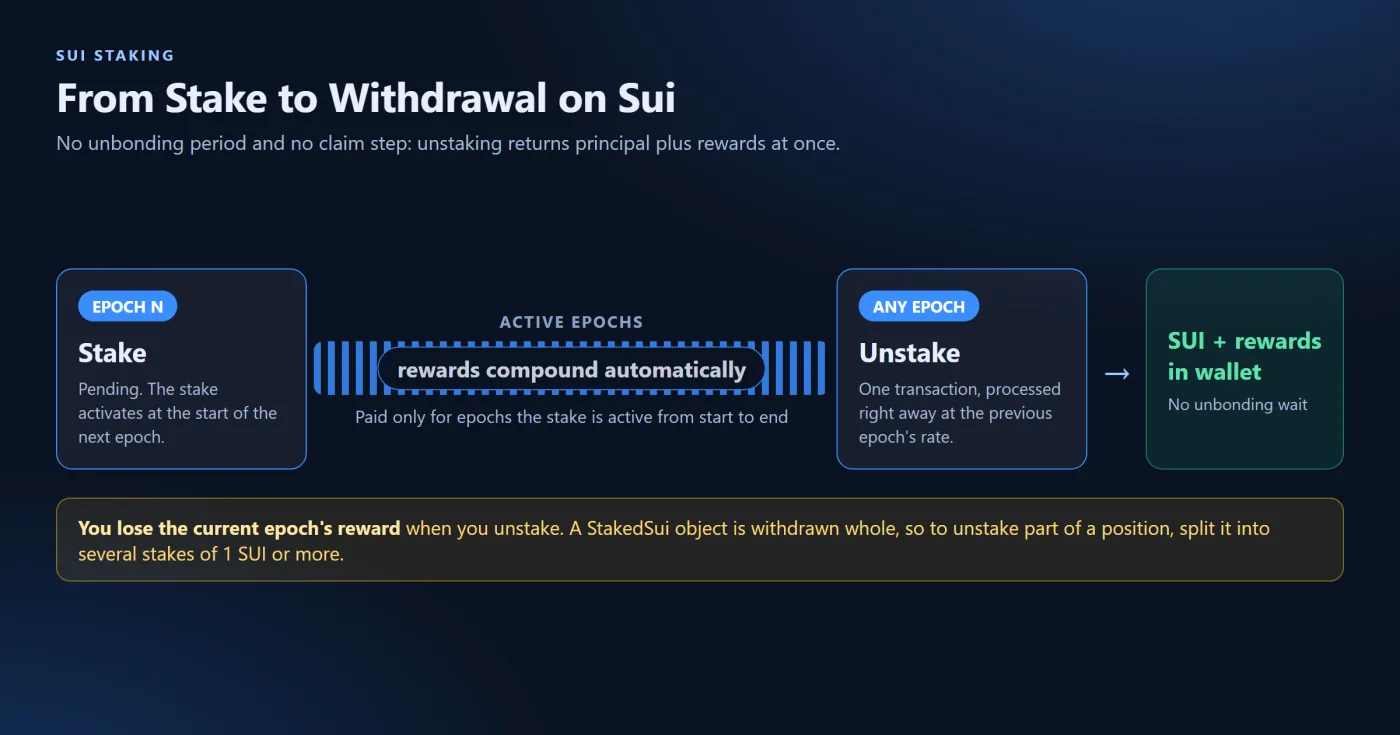
To stake SUI, delegate it to a validator from a Sui wallet such as Slush. The stake starts counting at the next epoch (about 24 hours later), rewards compound automatically, and unstaking returns your principal plus earned rewards in a single transaction, with no unbonding period described in Sui's documentation.
Rewards are modest and shrinking: when this was written in October 2026, Kraken's published estimate for staking SUI was up to 1.54 percent a year before commission, far below the 5 to 6 percent that older guides quote. Validator commission can change without notice, and a validator that is penalized loses its stakers' rewards for that epoch, so the validator you choose affects what you earn.
How to Stake SUI: Step-by-step Guide
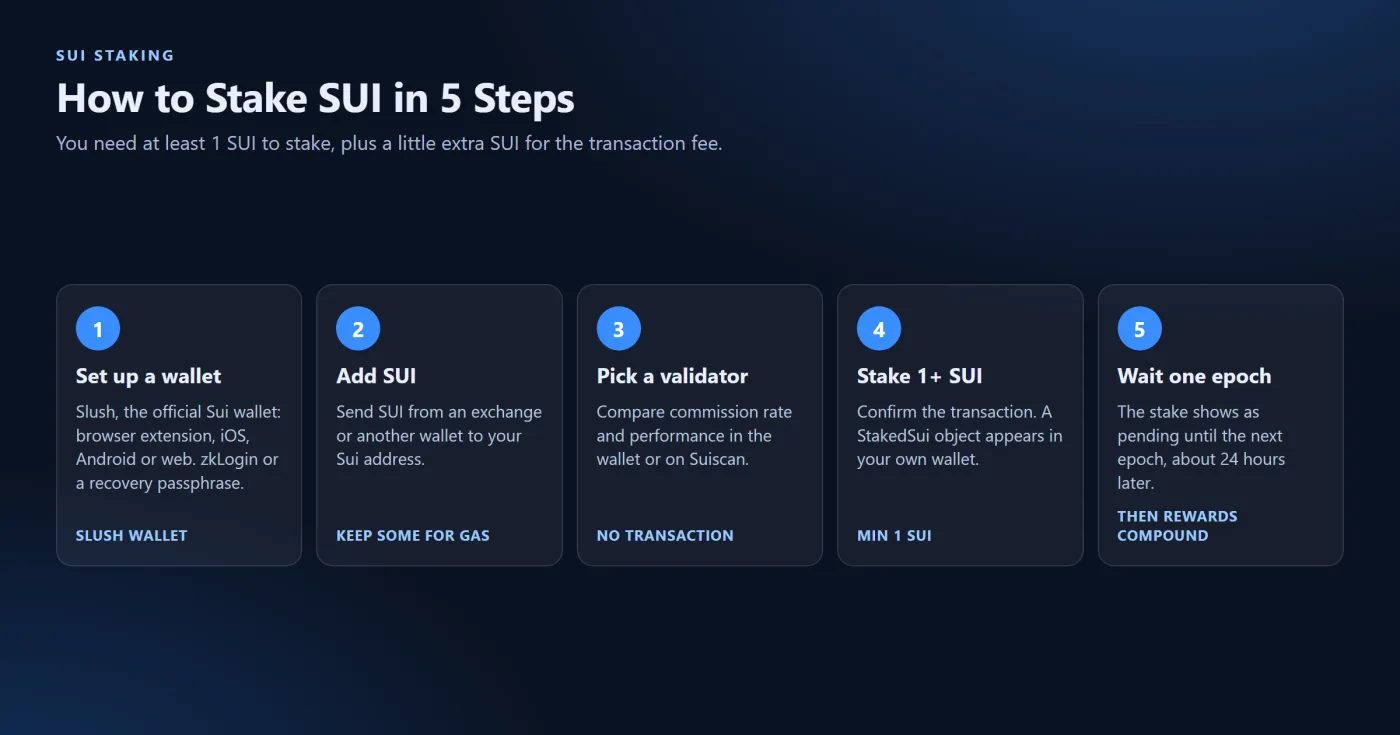
You need a Sui wallet, at least 1 SUI to stake, and a small extra amount of SUI to pay the transaction fee.
-
Set up a wallet. Slush, the official Sui wallet from Mysten Labs, is available as a browser extension, an iOS app, an Android app, and a web app, and it supports staking. You can sign in with a social account through zkLogin, or create an account with a recovery passphrase that you must back up yourself.
-
Add SUI to your wallet address by sending it from an exchange or another wallet.
-
Open the staking screen and compare validators by commission rate and performance, as described in the validator section below.
-
Enter an amount of at least 1 SUI and confirm. The transaction wraps your SUI in a StakedSui object that stays in your own wallet and records the validator's staking pool and the epoch in which the stake becomes active.
-
Expect the stake to show as pending until the next epoch begins. Rewards accrue only for epochs in which the stake is active for the entire epoch.
Wallet menus differ, and this guide did not test any wallet interface, so read each confirmation screen before you approve. Staking only asks you to approve a transaction, so a page that asks for your recovery phrase is not legitimate.
How to Unstake SUI and When the Funds Will Arrive
Unstaking is a single transaction calling the withdrawal method in Sui's system package. As the Sui validator documentation says, withdrawal is processed right away via the exchange rate from the previous epoch, and will return your principal with the rewards accrued until the previous epoch. You will not get the reward for the epoch when you unstake your SUI.
This means two things in practice: each StakedSui object is withdrawn entirely and, as per the Sui documentation, you will not be able to partially withdraw an active stake, so people who want to partially unstake split their SUI into multiple stakes of 1 SUI or more. There is also no separate claim step, because rewards are realized when you unstake.
Provider websites have different explanations of timing. For example, Kraken mentions 1-day bonded time in its staking product, and one provider says the funds will be unlocked only at the end of the epoch. Sui's documentation describes immediate processing at protocol level, so check the terms of any service that sits between you and the protocol.
What SUI Staking Rewards Consist of
At the end of each epoch, Sui pays staking rewards equal to stake subsidies plus gas fees. The stake subsidy comes from the pool of 1 billion SUI, which is 10 percent of the 10 billion SUI cap, distributed according to the published schedule. Gas fees depend on the usage of the network, and as per the Sui documentation, once the subsidy pool is depleted, fees will provide all staking rewards.
Each validator has a staking pool with its exchange rate, which increases as rewards are received. Since all SUI in the pool are considered stakes immediately, rewards compound automatically. The storage fund, responsible for funding the storage of data, also receives its share of rewards, but most of it will go to validators who pay their storage expenses.
How Much Will SUI Staking Rewards Pay?
There is no exact figure, but the published rates are low. The Kraken website accessed in October 2026 states up to 1.54 percent APY and says that this is an estimate of average rewards before commission. A secondary guide quoting an exchange estimate from December 2025 gives around 1.92 percent. The Sui documentation provides no yields, and the rate changes depending on the amount of SUI staked and network fees.
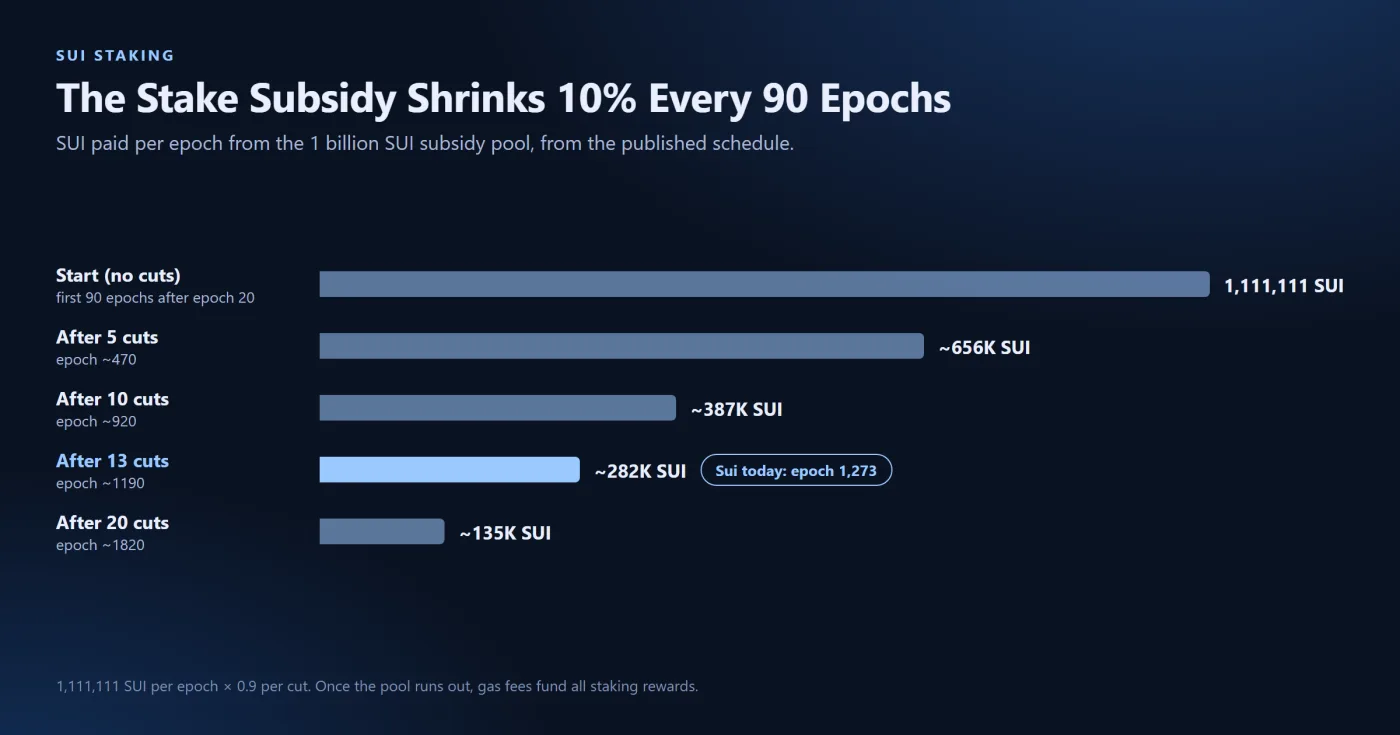
Old guides give about 6 percent yield. This refers to the launch period: one of the providers' websites still claims that the early stakers were expected to receive about 6 percent of returns, falling to 5.40 percent and then 4.86 percent as the subsidy is reduced by 10 percent every 90 days. The Sui network page confirms this schedule: 1,111,111 SUI per epoch in the first 90 epochs after epoch 20, and then a 10 percent reduction in every 90 epochs.
What the Subsidy Schedule Means
The following figures are calculated from the published schedule, with the amount per epoch equal to 1,111,111 multiplied by 0.9 for each cut.
-
Without reductions: 1,111,111 SUI per epoch.
-
After 5 reductions: about 656,000 SUI per epoch.
-
After 10 reductions: about 387,000 SUI per epoch.
-
After 13 reductions: about 282,000 SUI per epoch.
-
After 20 reductions: about 135,000 SUI per epoch.
According to Sui's documentation, a one-year investor cliff expired in May 2024, which implies a launch around May 2023. If every epoch lasted 24 hours, about 13 cuts would have occurred by October 2026, although the live epoch number was not checked. That subsidy comes to roughly 103 million SUI a year.
Just as a plausibility check, if 7 billion SUI were staked in total (roughly the amount equal to an example from Sui's documentation), that subsidy alone would equal about 1.5 percent, close to the rates providers publish. Fees and the storage fund change the real result, so this is an explanation of the order of magnitude, not a measurement.
Hypothetical Example
If 1,000 SUI earns a gross 1.5 percent a year and the validator's commission is 5 percent, then the staker keeps 1.5 percent times 0.95, which is 1.425 percent, or about 14.25 SUI over a year and roughly 0.04 SUI a day. Rewards are paid in SUI, so their value in other currencies depends on the SUI price.
Choosing a Validator
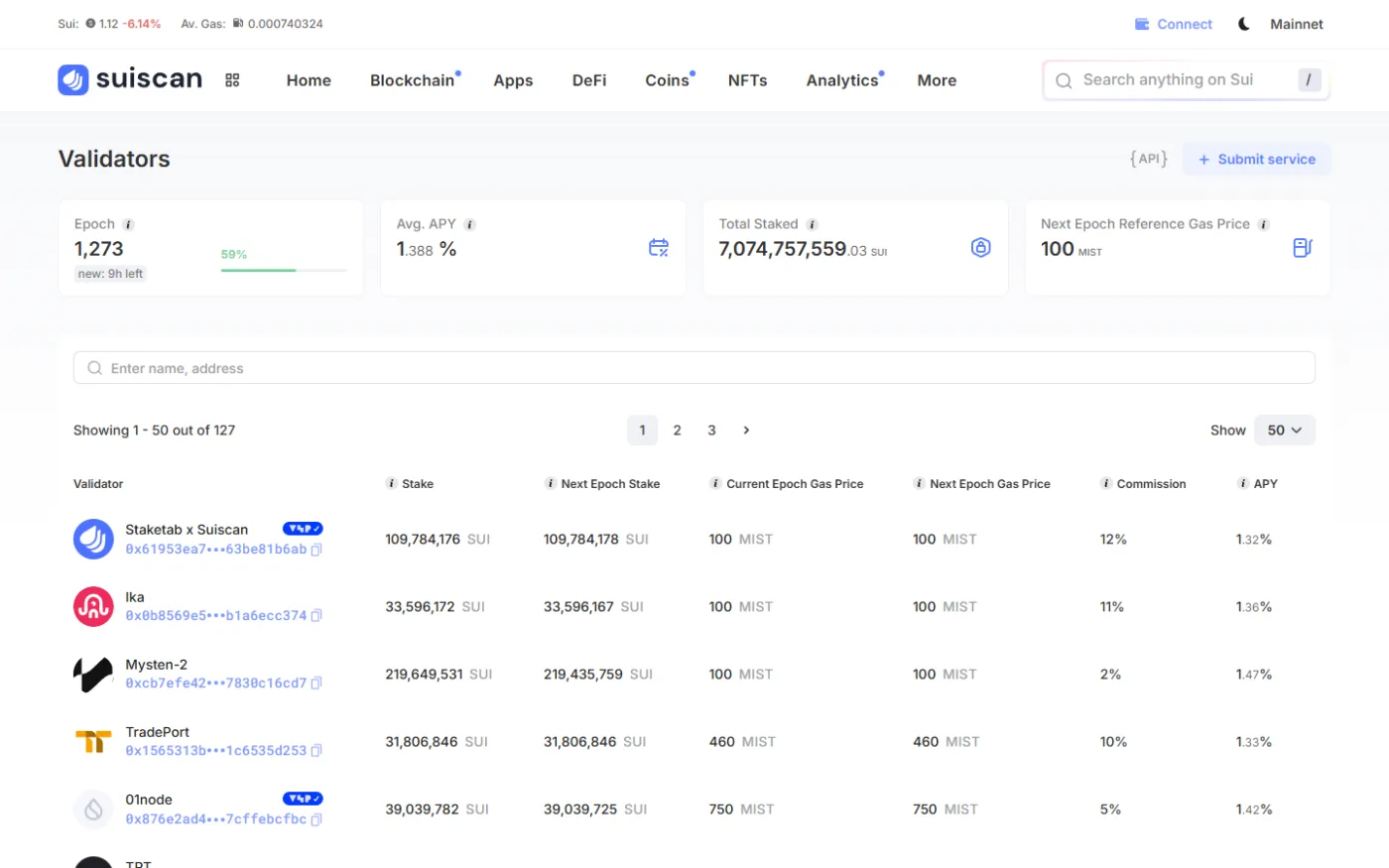
It is important to choose the validator properly since their offers and reliability vary. Mainnet has more than 100 validators, and the network limits any validator's voting power at 10 percent.
-
Commission is the share of your rewards the validator keeps. Sui's documentation states that a validator may change its commission in the future without warning, so you should check it occasionally.
-
Performance is judged by the tallying rule, in which validators score each other. A penalized validator gets no rewards for that epoch, and you also lose that epoch's rewards in case of withdrawal from a penalized validator.
-
You may find this information in wallets and in explorers like Suiscan mentioned in the Sui documentation as sources of commission and APY rates.
Can Your Staked SUI Be Slashed?
As per the Sui documentation, the penalty for poor validator performance is the loss of staking rewards in that epoch, and Sui's documentation does not mention any seizure of staked principal. The tallying rule is based on monitoring each other by validators, which Sui documentation calls the social equilibrium, and there is no limit on how many validators can receive a zero score in one epoch.
Provider websites are not consistent here. For example, Figment claims that the staked SUI cannot be slashed and only rewards are forfeited, though the same provider mentions elsewhere that a malicious validator may slash a portion of staked SUI and lists slashing as enabled. Treat the documented reward penalty as the supported position, and treat any loss of principal as unconfirmed.
Native, Exchange, and Liquid Staking
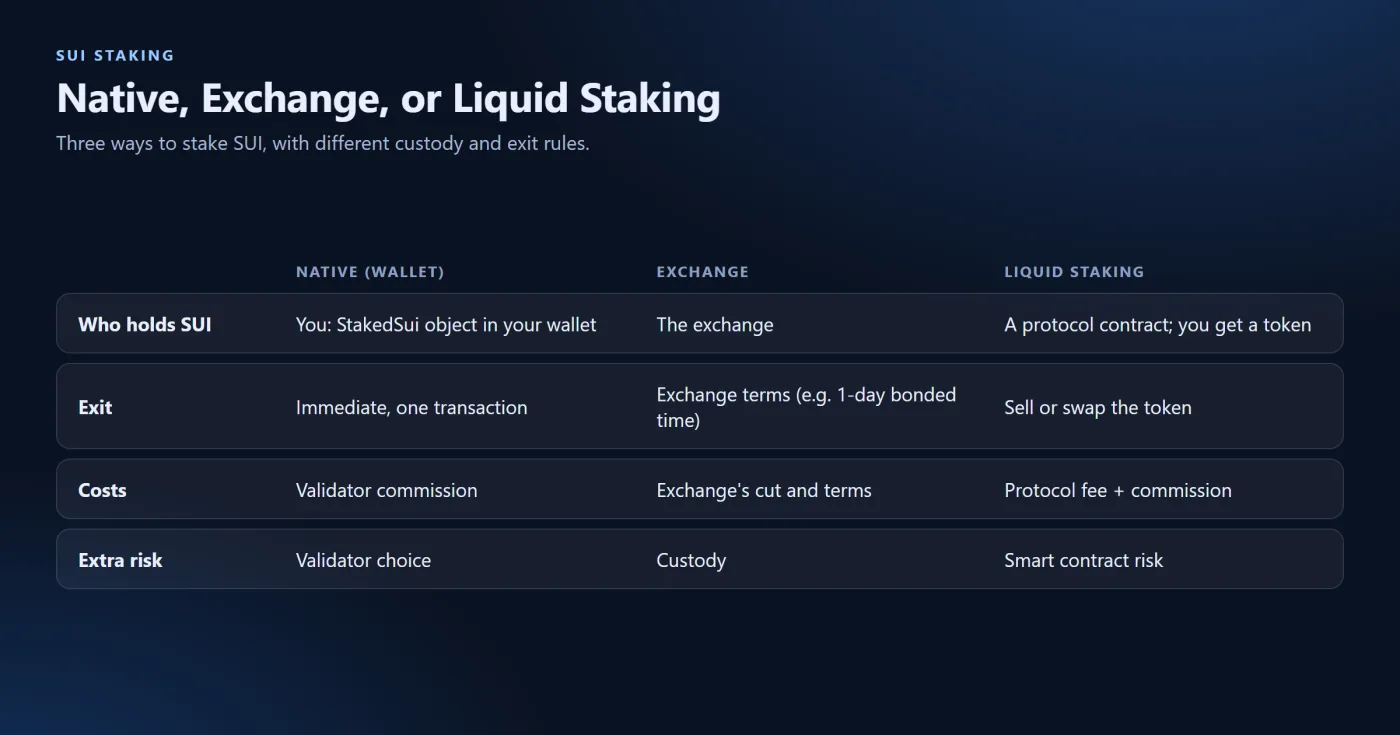
With native staking from the wallet, the StakedSui object remains in your wallet. Exchange staking is different since the exchange holds your SUI and sets its own terms, such as Kraken's weekly payouts and one-day bonded time, so its rules replace the protocol's.
Liquid staking is the third option: Sui implemented liquid staking support via SIP-6, and its framework lets a StakedSui object be converted into a fungible form after an initial warmup period, which allows protocols to issue a tradable token for a staked position. A provider guide cites Aftermath, Haedal, and SpringSui as examples. These tokens add protocol fees and smart contract risk that native staking does not have, and this article did not evaluate any of them.
Live Data to Verify Before Staking
Several details may change over time and cannot be fixed in this article.
-
The validator's current commission and performance in your wallet or an explorer.
-
The date and source of any reward rate you rely on since the subsidy will reduce every 90 epochs.
-
Whether Sui's documentation still describes immediate withdrawal, since some provider websites say an unbonding period could be introduced through governance.
-
Terms of an exchange or liquid staking service including fees, bonded time, and custody.
Related guides


 Scroll to top