


Polygon POL Staking: Rewards, Unbonding, and Risk


Table of contents
- How to Stake POL
- What Is Polygon Staking?
- Validators vs. Delegators
- How Polygon Staking Rewards Are Calculated
- The Unbonding Period and the Two-Step Procedure of Unstaking POL
- Does Polygon Staking Carry Slashing Risks for Delegators?
- From MATIC to POL: What Changed for Stakers
- Choosing a Validator
- Checking and Tracking Staking Rewards
- Liquid Staking Alternatives
- How Polygon Compares to Other Staking Networks
- Risks and Practical Considerations
- Related guides

Staking POL, Polygon's native token, means delegating it to a validator securing the Polygon PoS network in exchange for rewards commonly cited somewhere between roughly 2.5 and 6 percent APY. Delegated POL is not subject to slashing, but unstaking still requires waiting through an 80-plus checkpoint unbonding period, typically around 3 to 4 days, and then submitting a separate claim transaction before the funds actually return to a wallet.
That second step trips up a lot of people who assume tokens arrive automatically once the wait ends, which makes it worth understanding clearly before staking any amount.
How to Stake POL
-
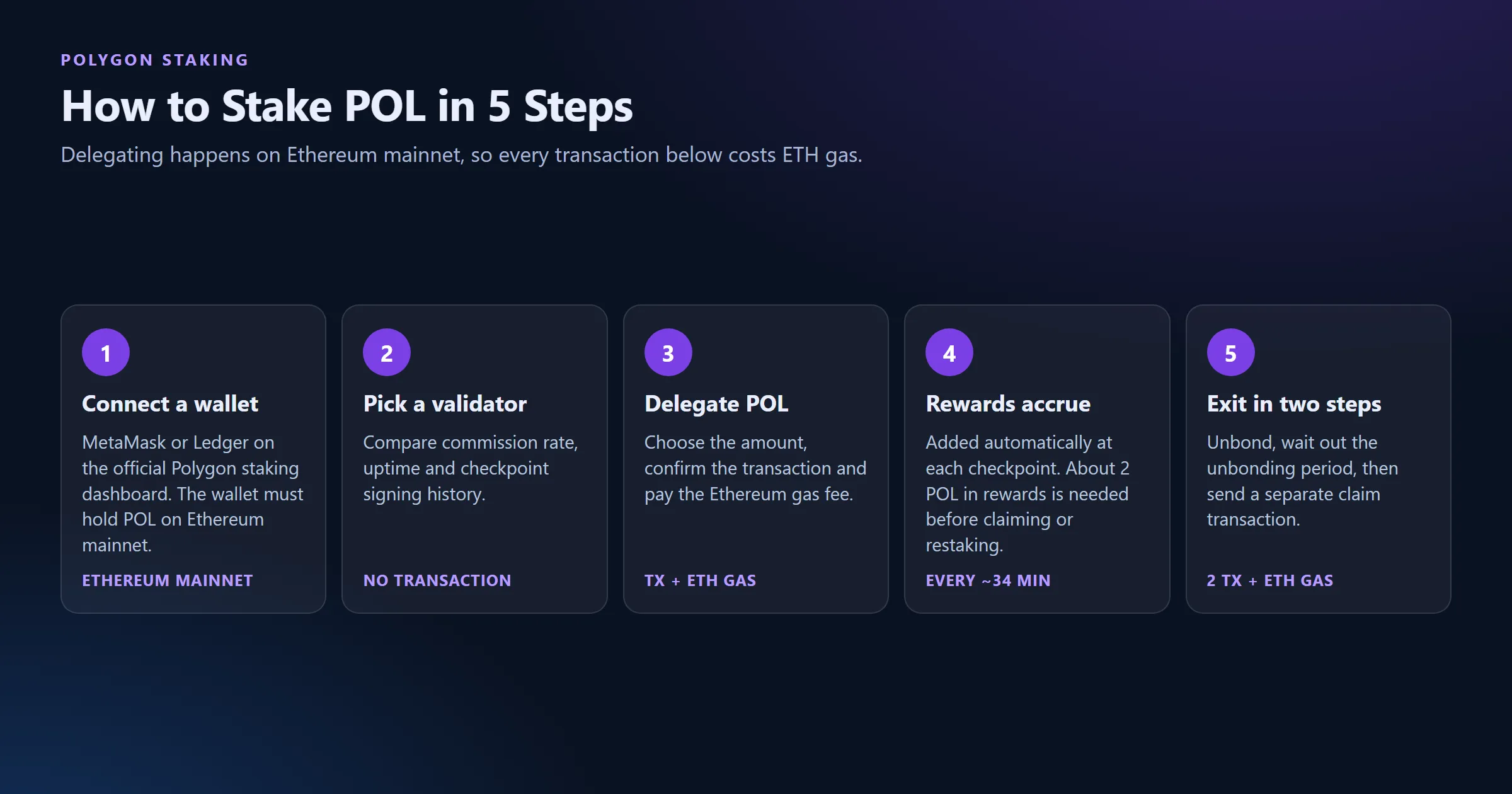
Connect a wallet, such as MetaMask or a Ledger hardware wallet, to the official Polygon staking dashboard, making sure the wallet holds POL on Ethereum mainnet, since staking contracts live there rather than on the Polygon PoS chain itself.
-
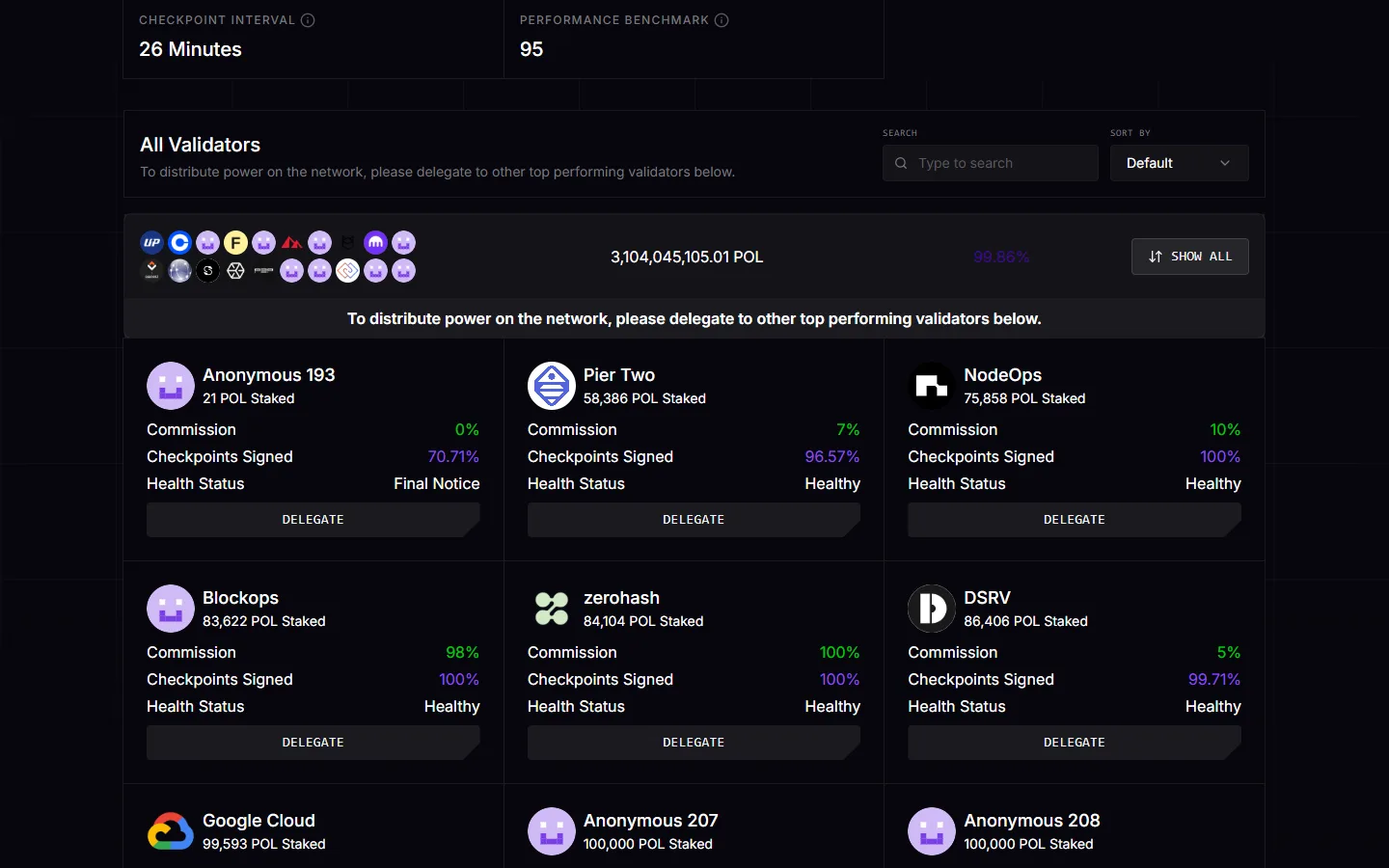
Browse the list of active validators, comparing commission rates, uptime, and checkpoint signing history before choosing one.
-
Delegate a certain amount of POL tokens to the selected validator, confirm the transaction, and pay the corresponding Ethereum gas fee.
-
Rewards accumulate automatically at each checkpoint, and a minimum of 2 POL in accumulated rewards is generally required before those rewards can be claimed or restaked.
-
To exit, submit an unbond transaction first, wait through the full unbonding period, then submit a separate claim transaction to actually withdraw the POL to the connected wallet.
Skipping that final claim step is the most common mistake people make, since the unbonding period ending does not automatically return funds on its own.
What Is Polygon Staking?
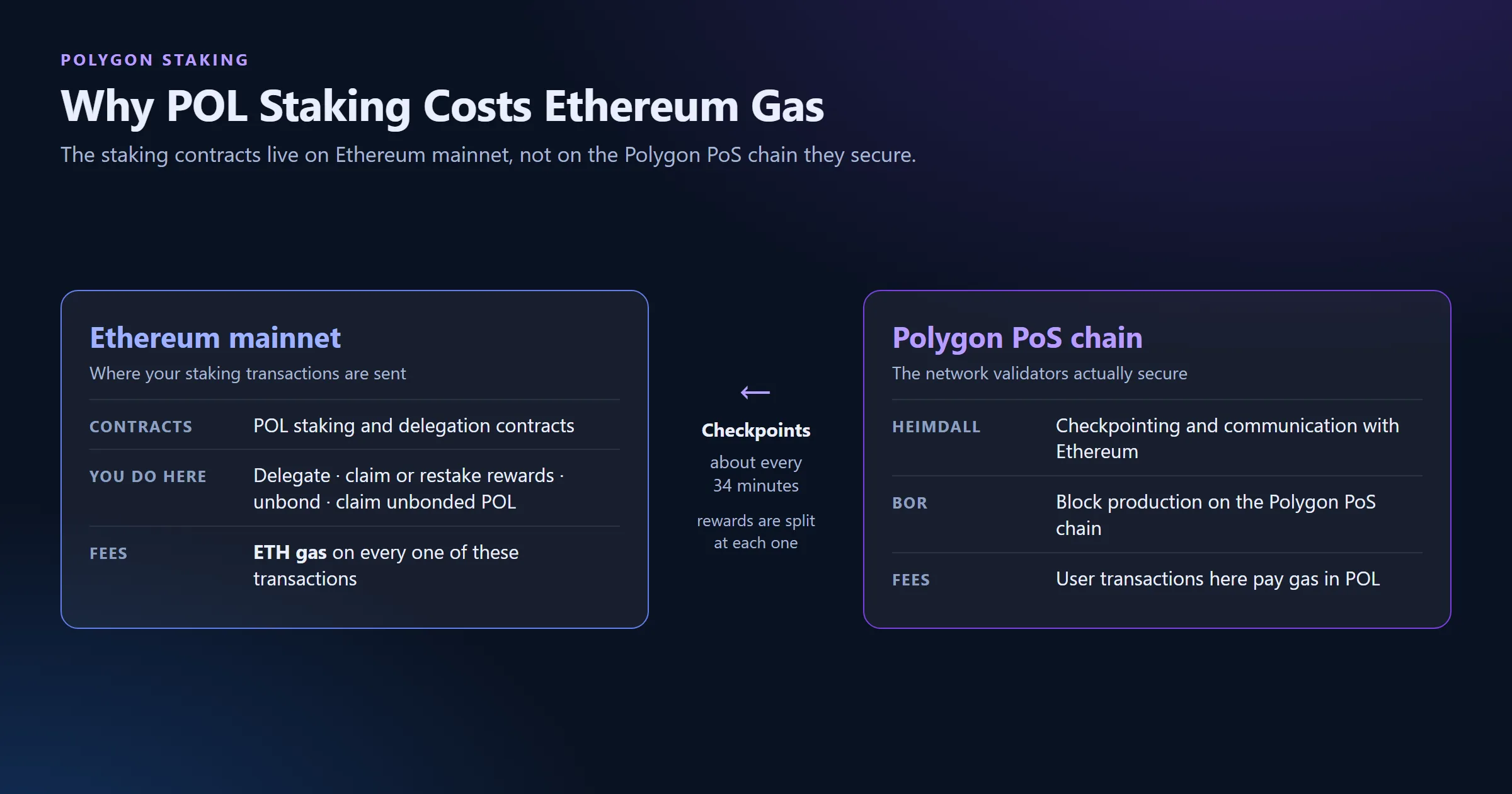
Polygon PoS secures its network through a proof-of-stake system where validators run two pieces of software working together: Heimdall, which handles checkpointing and communication with Ethereum, and Bor, which handles actual block production on the Polygon PoS chain. Validators stake POL as collateral to participate in this process, and delegators contribute additional POL to a validator's total stake without running any infrastructure themselves.
Unlike many other proof-of-stake networks, Polygon's staking contracts are deployed on Ethereum mainnet rather than on the Polygon PoS chain itself. This means staking, delegating, and claiming rewards all involve Ethereum gas fees, even though the actual transactions being secured happen on the separate Polygon PoS network.
Validators vs. Delegators
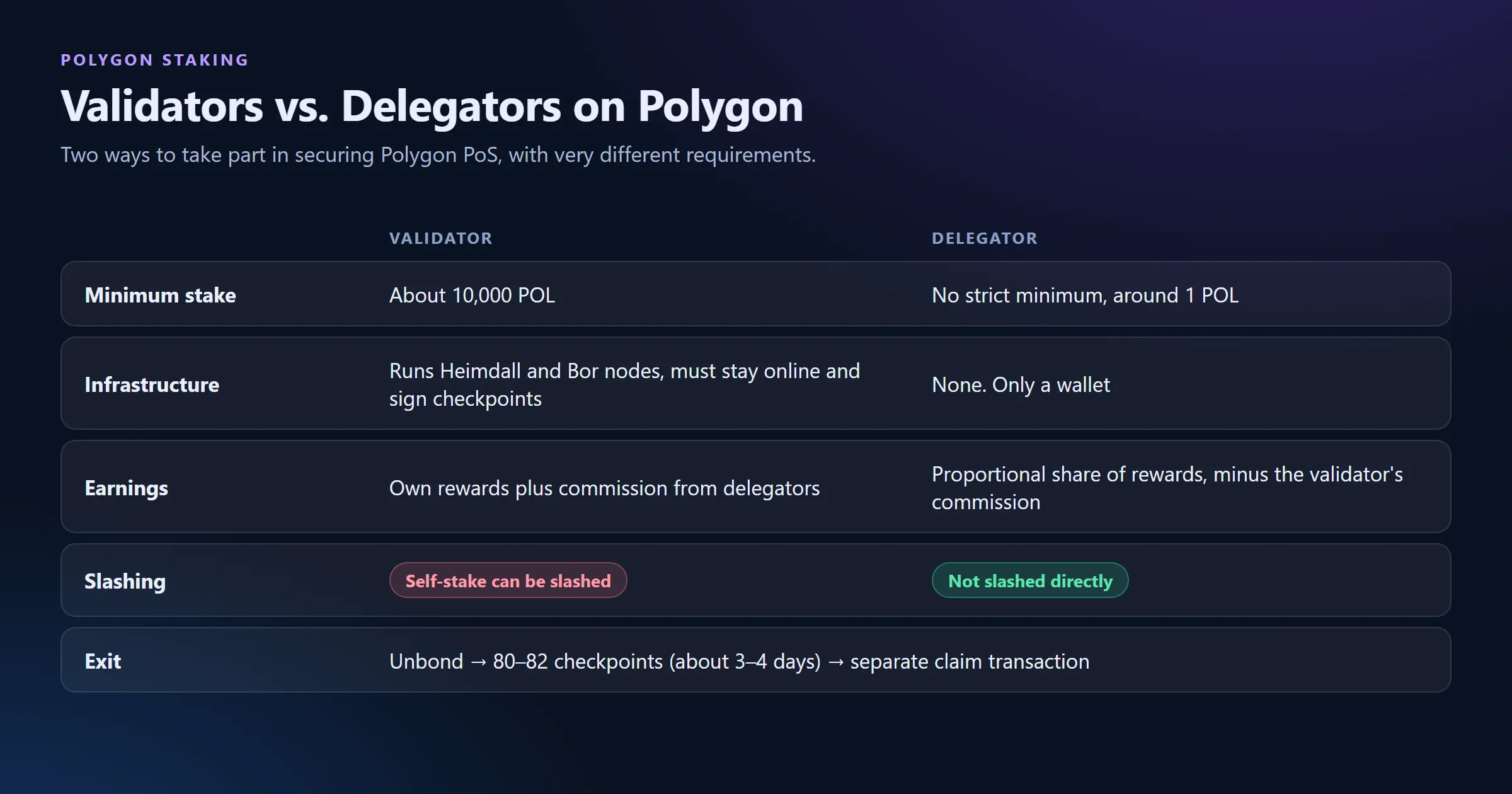
Running a validator node requires staking a substantial minimum amount of POL, commonly cited around 10,000 POL, along with maintaining reliable server infrastructure that stays online and signs checkpoints consistently. Validators earn rewards directly and also collect a commission from any delegators who stake POL through them.
Delegators avoid any technical requirement entirely, contributing POL to an existing validator's stake and receiving a proportional share of that validator's rewards, minus the validator's commission. This division allows a very large number of POL holders to participate in securing the network without needing to operate anything themselves, similar to how delegation works on several other major proof-of-stake networks.
How Polygon Staking Rewards Are Calculated
Rewards are distributed at every checkpoint, a submission that occurs roughly every 34 minutes, with the reward amount for that checkpoint split proportionally across all validators and delegators based on their share of the total staked pool. A validator's own commission rate is deducted from the gross reward before the remainder reaches its delegators.
The overall staking reward pool draws from a fixed allocation set aside when POL launched, representing 12 percent of the total 10 billion POL supply, specifically earmarked to fund staking rewards during the network's early years.
Over time, the design intends for a growing share of validator and delegator rewards to come from network transaction fees rather than this fixed allocation, similar to how many blockchain reward structures are designed to transition from inflation-funded to fee-funded over time.
The Unbonding Period and the Two-Step Procedure of Unstaking POL
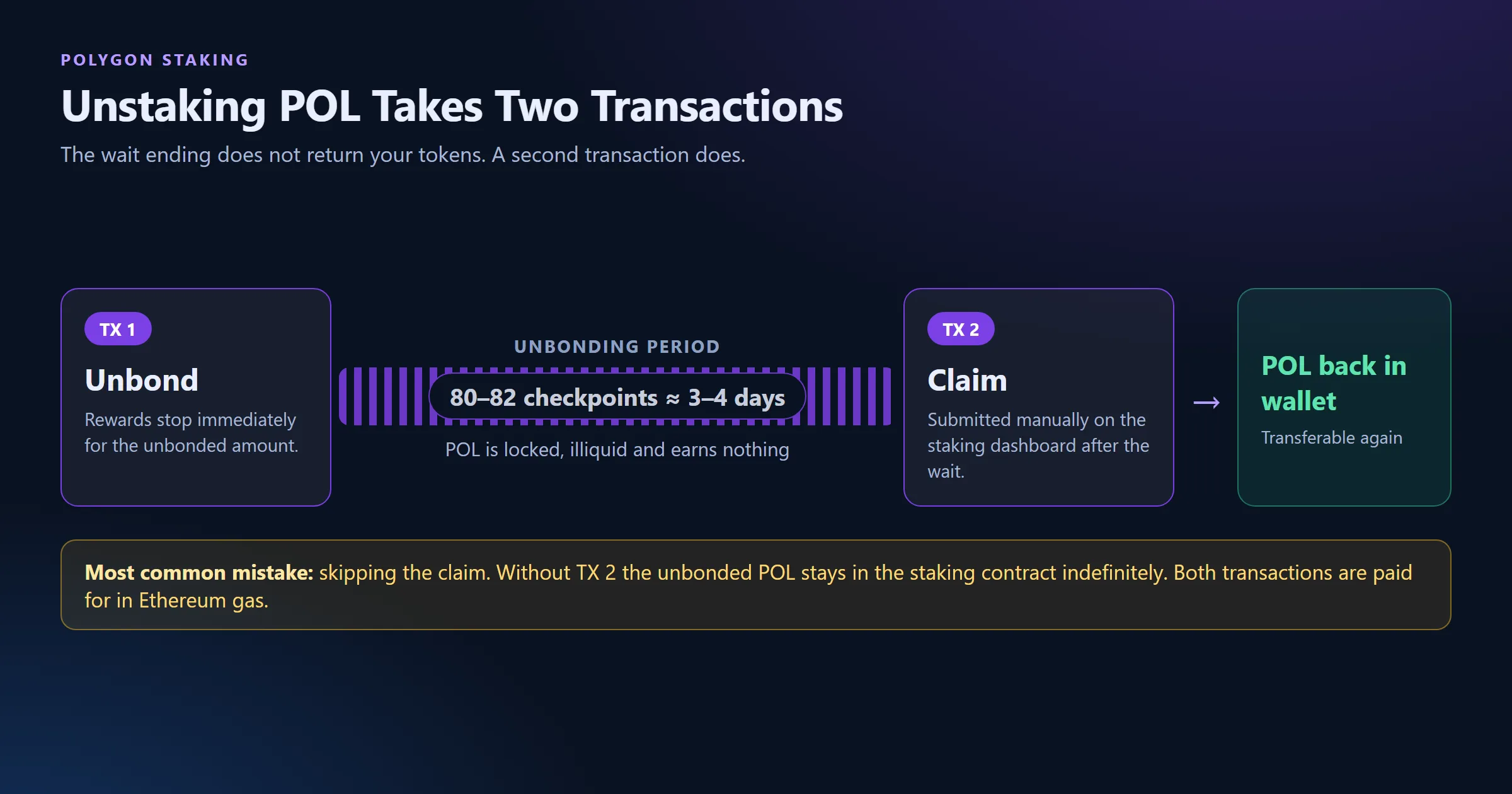
The process of unstaking POL is a two-step procedure. It starts with submitting an unbond transaction, which immediately stops that portion of the stake from earning further rewards and begins the unbonding period, commonly cited as 80 to 82 checkpoints, translating to roughly 3 to 4 days in practice.
However, the POL tokens will not go back to the connected wallet automatically. A separate claim transaction must be submitted to actually withdraw the unbonded tokens, and failing to realize this second step is required is one of the more common points of confusion for people staking POL for the first time. During the entire unbonding window, the affected POL is locked, illiquid, and earning nothing at all.
Does Polygon Staking Carry Slashing Risks for Delegators?
One detail that sets Polygon apart from several other major proof-of-stake networks is how slashing works. Slashing penalties on Polygon apply specifically to a validator's own self-staked POL rather than to the POL contributed by that validator's delegators, meaning a delegator's stake is not directly reduced if the validator they chose gets penalized for misbehavior or unreliability.
This does not make delegating entirely risk-free, since a slashed or poorly performing validator can still see reduced rewards, lose standing in the network, or become less reliable over time, indirectly affecting the delegators who chose it. But the direct financial penalty of slashing itself lands on the validator's own bonded stake rather than being shared proportionally across everyone who delegated to it.
From MATIC to POL: What Changed for Stakers
Polygon transitioned its native token from MATIC to POL in a migration that took place in 2024, intended to serve as the gas and staking token across an expanding family of Polygon-related chains rather than just the original PoS network alone. The core staking process itself remained unchanged through this transition.
Anyone who has not yet migrated existing MATIC tokens can generally still delegate MATIC directly, and staking rewards are paid out in POL regardless of which token was originally delegated. Migrating fully to POL is generally recommended going forward, since POL is the token the network's staking and gas systems are built around long term.
Choosing a Validator
A few parameters can be compared before delegating the tokens to a particular validator:
-
The commission rate of a validator shows the part of the gross reward that the validator retains before distributing the remainder, so comparing rates across validators affects the net return received.
-
Uptime and checkpoint signing history show how reliably a validator has participated in network operations, which affects how consistently rewards accumulate.
-
Total stake already delegated to a validator is worth considering as well, since spreading delegations across smaller, reliable validators supports a more decentralized validator set overall rather than concentrating stake around a handful of the largest operators.
Checking and Tracking Staking Rewards
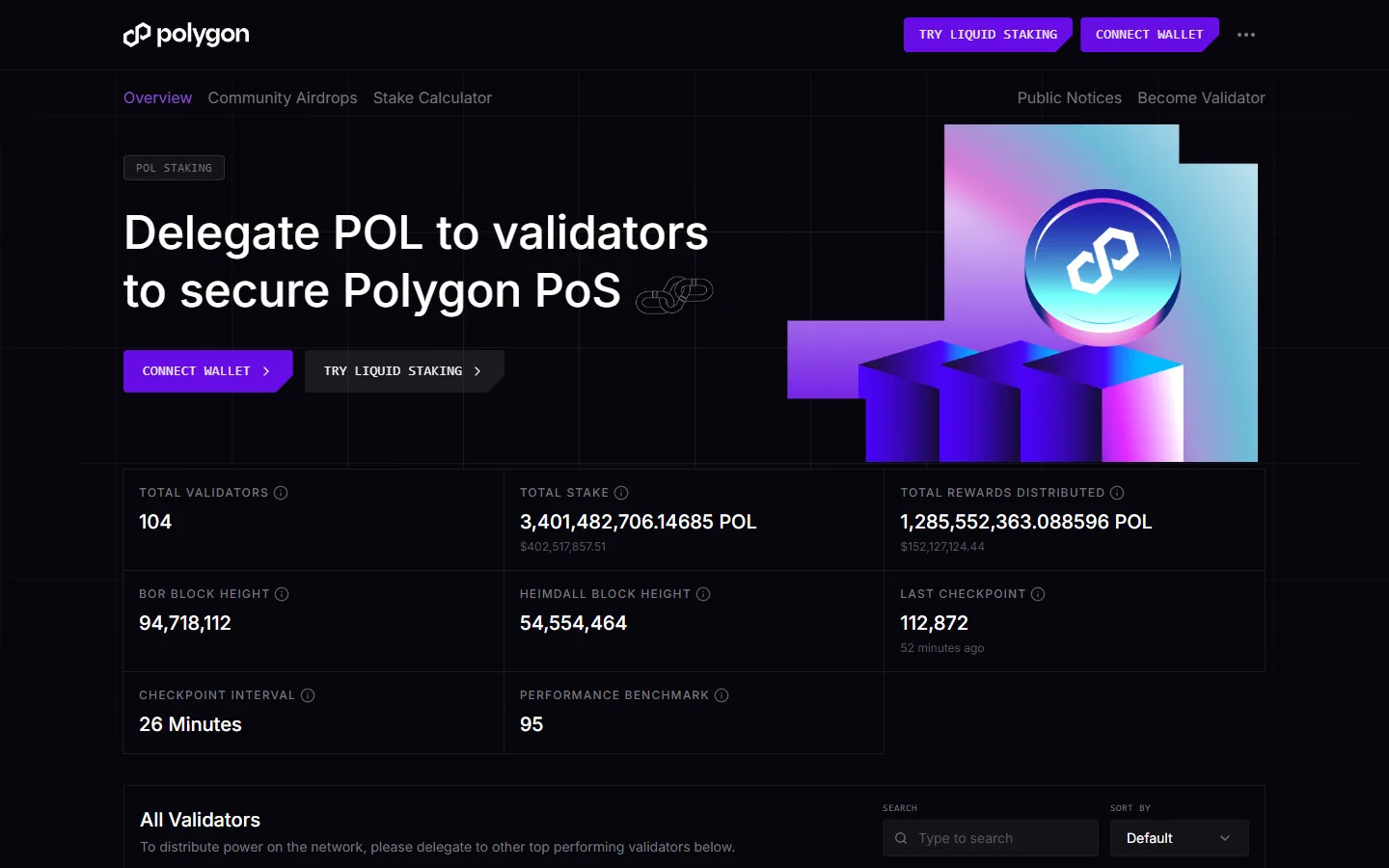
The official Polygon staking dashboard displays a delegator's current stake, accumulated rewards, and unbonding status directly, updating as new checkpoints are submitted roughly every 34 minutes. This same interface is where both the unbond transaction and the later claim transaction need to be submitted.
Independent block explorers covering Ethereum can also be used to look up the staking contract activity tied to a specific wallet address, which is useful for confirming that delegated rewards are accumulating as expected and for reviewing a chosen validator's historical checkpoint participation before committing additional POL to it.
Liquid Staking Alternatives
Native POL staking locks funds through the unbonding and claim process described above whenever a delegator wants to exit, but third-party liquid staking providers offer an alternative. Platforms such as Ankr allow staking POL in exchange for a liquid token representing the staked position, which can be used elsewhere in decentralized finance without waiting through the full native unbonding period in every case.
This flexibility comes with an added layer of smart contract risk and a service fee charged by the liquid staking provider, which is deducted from the reward rate.
How Polygon Compares to Other Staking Networks
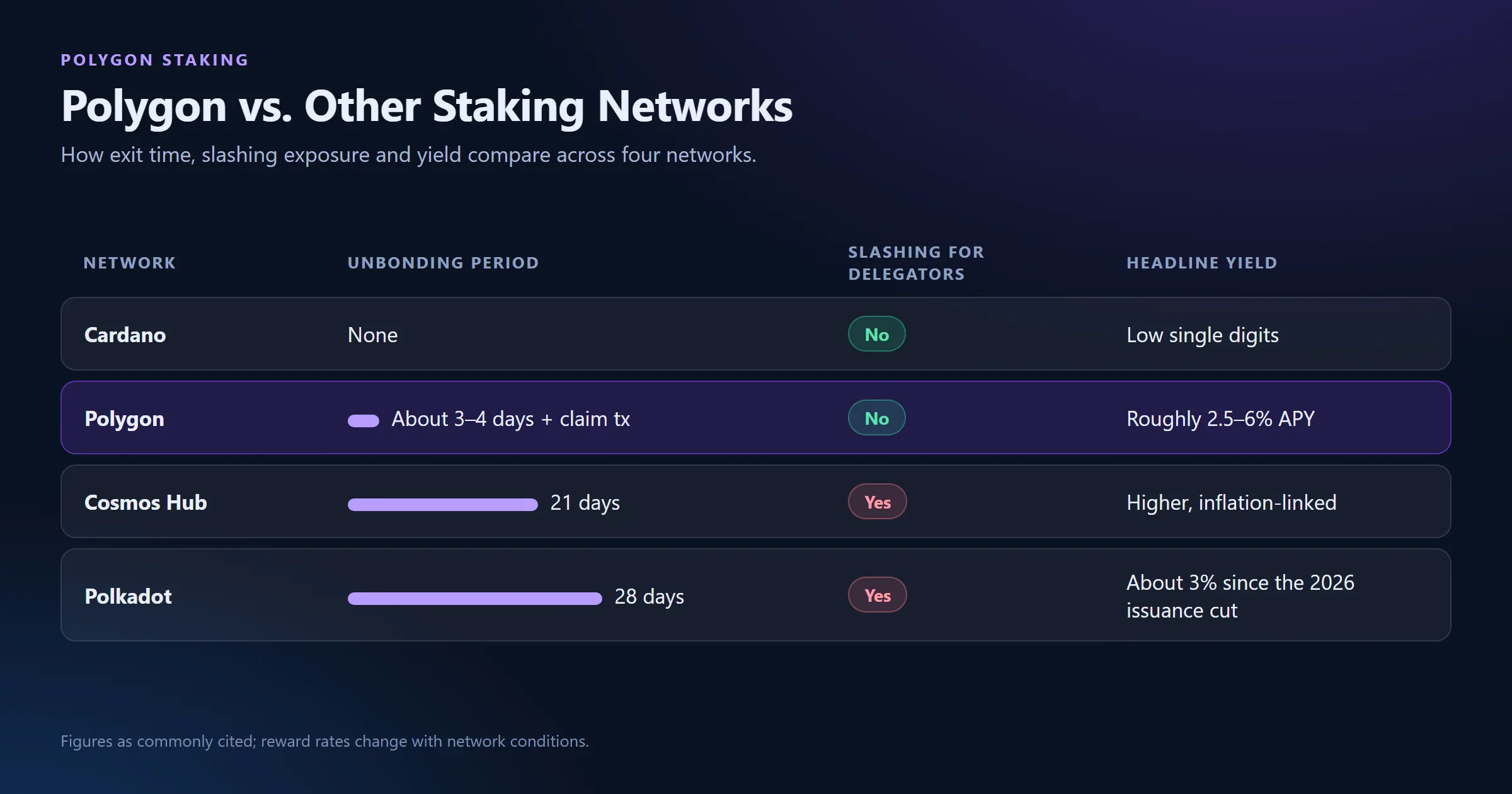
Placed alongside other major proof-of-stake networks, Polygon's staking design sits toward the lower-risk, lower-yield end of the spectrum.
-
Cardano has no unbonding period and no slashing risk for delegators, with a yield in a similarly low single-digit range to Polygon.
-
Cosmos and Polkadot both combine longer unbonding periods, 21 and 28 days respectively, with real slashing risk for delegators and nominators. Cosmos pairs this with a notably higher, inflation-linked headline yield, while Polkadot's reward rate has dropped to roughly 3 percent APY since its March 2026 issuance cut.
-
Polygon's unbonding period, at roughly 3 to 4 days, is far shorter than either Cosmos or Polkadot, and its lack of delegator-level slashing places it closer to Cardano's lower-risk model, despite still requiring a short wait to fully exit a position.
This pattern reinforces a broader theme across proof-of-stake networks: yield, unbonding length, and slashing exposure tend to move together, and a network offering a smaller headline reward is often compensating with less risk in one or more of these other dimensions.
Risks and Practical Considerations
A few practices will be helpful for managing the specific risks of the Polygon staking design.
-
Always consider both steps of unstaking, unbond and claim transactions, rather than counting on the automatic return of funds after the unbonding period ends.
-
Choose a validator with strong uptime and consistent checkpoint signing, since unreliable validators produce less consistent rewards even without a direct slashing penalty against delegators.
-
Remember that staking and unstaking transactions require Ethereum gas fees, which can add a meaningful cost on top of the POL amount being staked or withdrawn.
-
Keep wallet recovery information secure, since staking positions and accumulated rewards are tied directly to the wallet address used to delegate.
Related guides


 Scroll to top