


Polkadot Staking: DOT Rewards, Pools, and Unbonding


Table of contents
- How to Stake DOT
- What Is Polkadot Staking?
- Direct Nomination and Nomination Pools
- How Polkadot Staking Rewards Are Distributed
- The 28-Day Unbonding Period
- Slashing and the Appeal Window
- Shared Security: Staking DOT for Polkadot and Parachains
- Liquid Staking as An Alternative
- How to Check Polkadot Staking Rewards
- How Polkadot Staking Differs from Cosmos and Cardano
- Polkadot Staking and OpenGov Participation
- Risks and Practical Considerations
- Related guides

Staking DOT means nominating validators, either directly or through a nomination pool, to help secure Polkadot's network in exchange for rewards that currently sit a little under 3 percent APY, well below the 8 to 15 percent range that was commonly cited before the March 2026 issuance cut. Direct nomination alone requires far more DOT than most individual holders have on hand, which is exactly why nomination pools exist, letting anyone stake with as little as 1 DOT instead.
Polkadot also combines a mandatory 28-day unbonding period with real slashing risk, both of which apply whether staking directly or through a pool, and both are worth understanding clearly before committing any amount.
How to Stake DOT
-
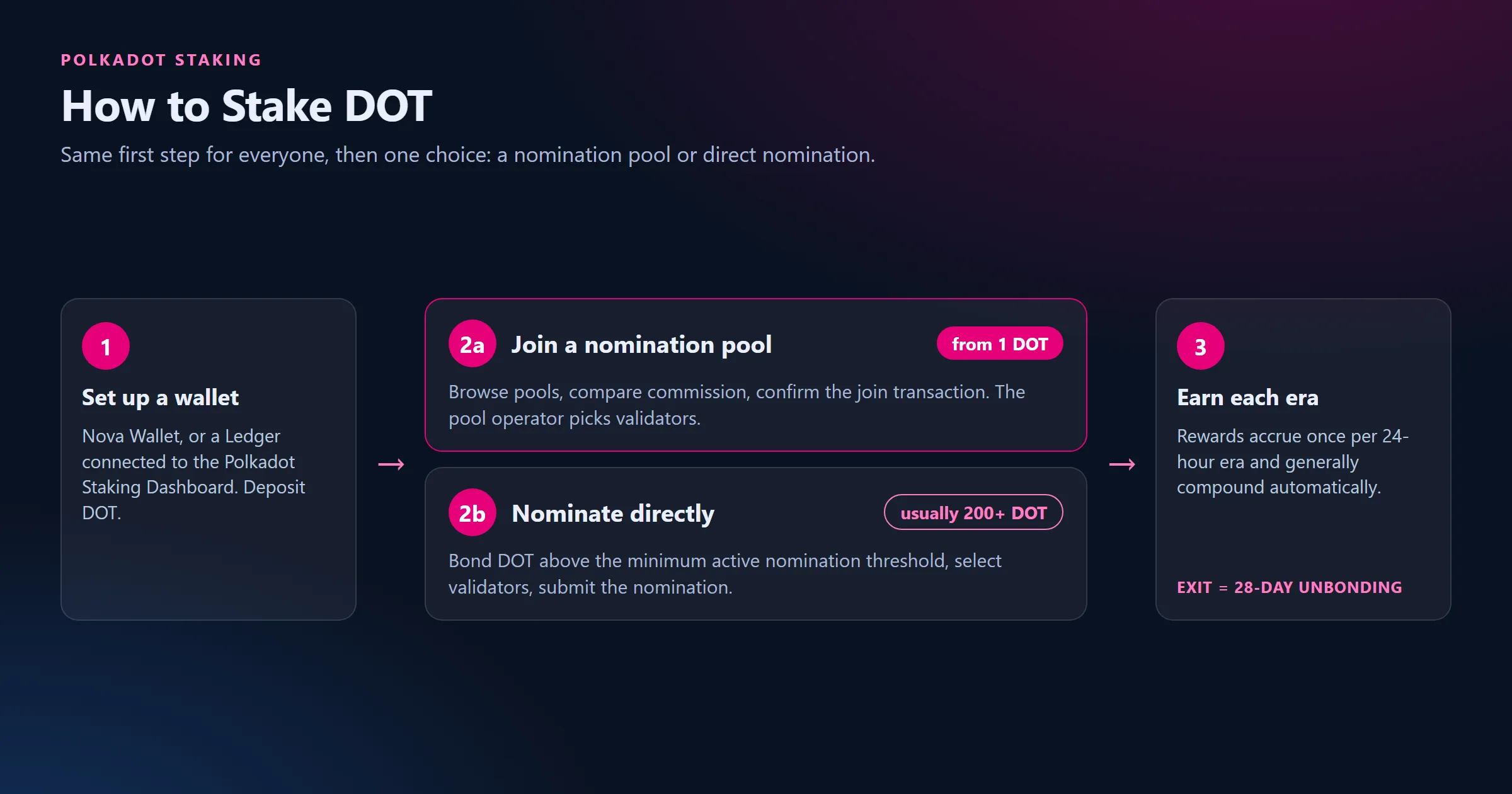
Set up a Polkadot-compatible wallet (Nova Wallet, for instance), or use a hardware wallet (Ledger) via the official Polkadot Staking Dashboard and deposit DOT in it.
-
Make a choice between nominating validators directly, which requires meeting the minimum threshold of bonded DOT that changes with network conditions, and joining nomination pools, which only needs 1 DOT.
-
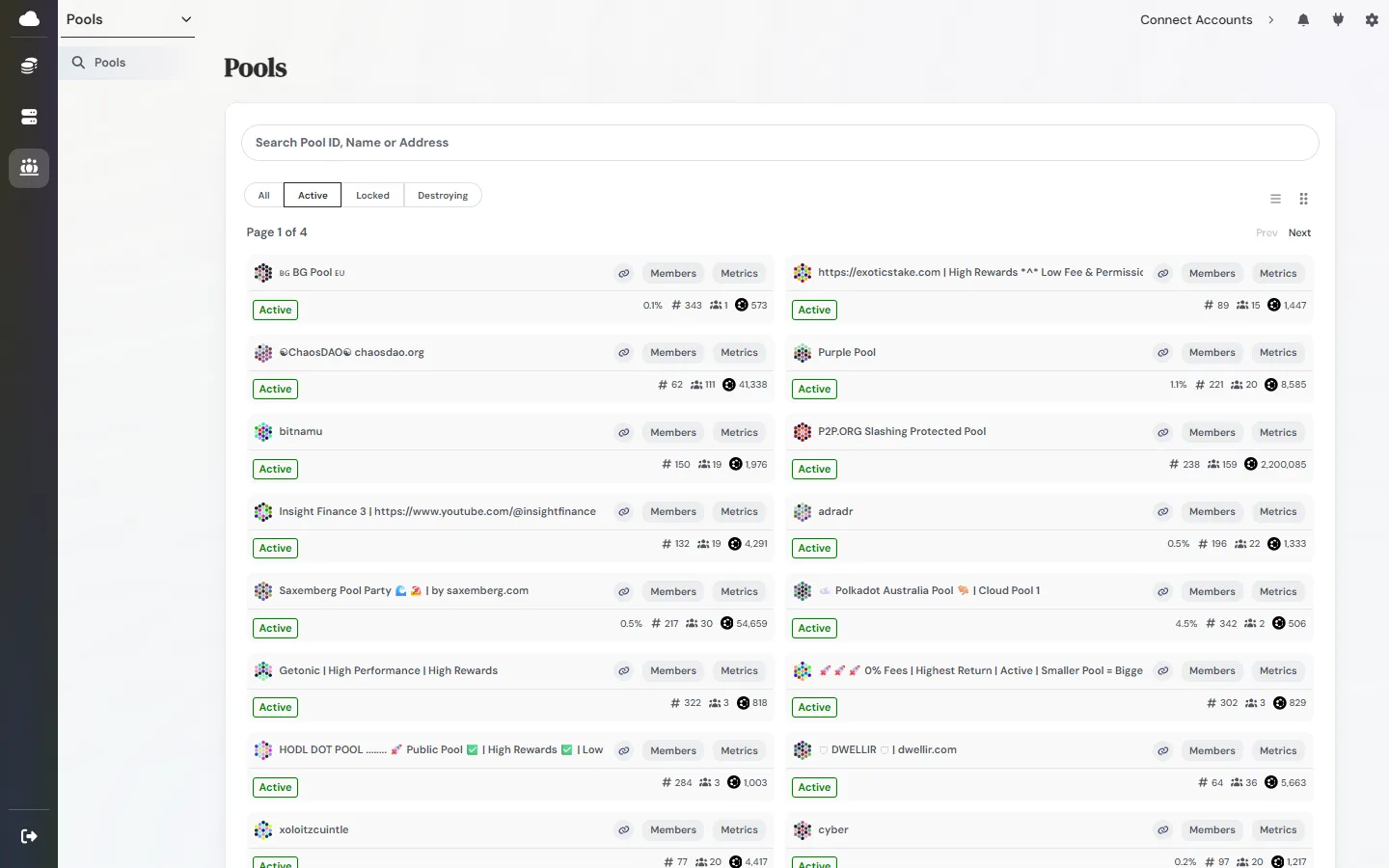
If joining a pool, browse the list of available pools and their commission rates, then confirm the transaction to join.
-
If nominating directly, select up to a set number of validators to back with your bonded DOT, then submit the nomination transaction.
-
Rewards are accrued automatically once per era and generally compounded automatically as well, although some minor differences might exist between the two methods of staking.
Bonded DOT continues earning rewards until an unbonding request is submitted, at which point the 28-day unbonding period begins for that portion of the stake.
What Is Polkadot Staking?
Polkadot secures its network using a system called Nominated Proof-of-Stake, commonly shortened to NPoS, where DOT holders nominate a set of validators they trust to produce blocks and confirm transactions on their behalf. Validator selection uses an algorithm called Phragmén, designed to distribute nominated stake across the active validator set in a way that keeps individual validators from becoming overly concentrated with backing compared with their peers.
Block production and finality on Polkadot run through two separate mechanisms working together: BABE handles the actual production of new blocks, while GRANDPA handles finalizing those blocks so that reversing a confirmed transaction becomes computationally impractical. This split allows Polkadot to combine fast block production with strong, deterministic settlement guarantees.
Direct Nomination and Nomination Pools
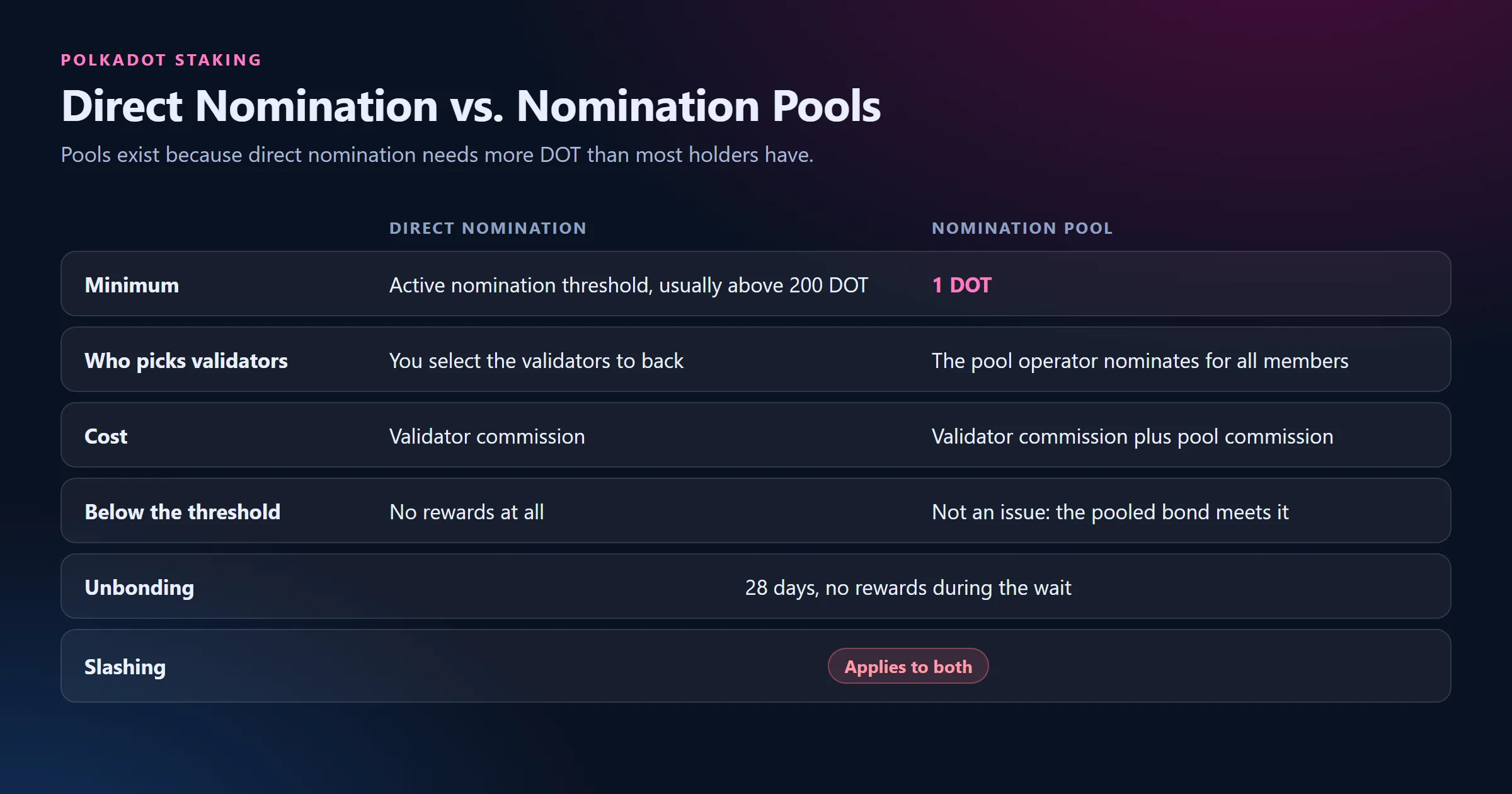
Direct nomination requires bonding a certain amount of DOT above a minimum active nomination threshold, which constantly changes depending on the network conditions. This figure usually stays somewhere above 200 DOT, which is quite a big amount for many individuals. Falling below this threshold when nominating directly generally means receiving no rewards at all, since only nominators contributing to actively backed validators earn anything under the direct model.
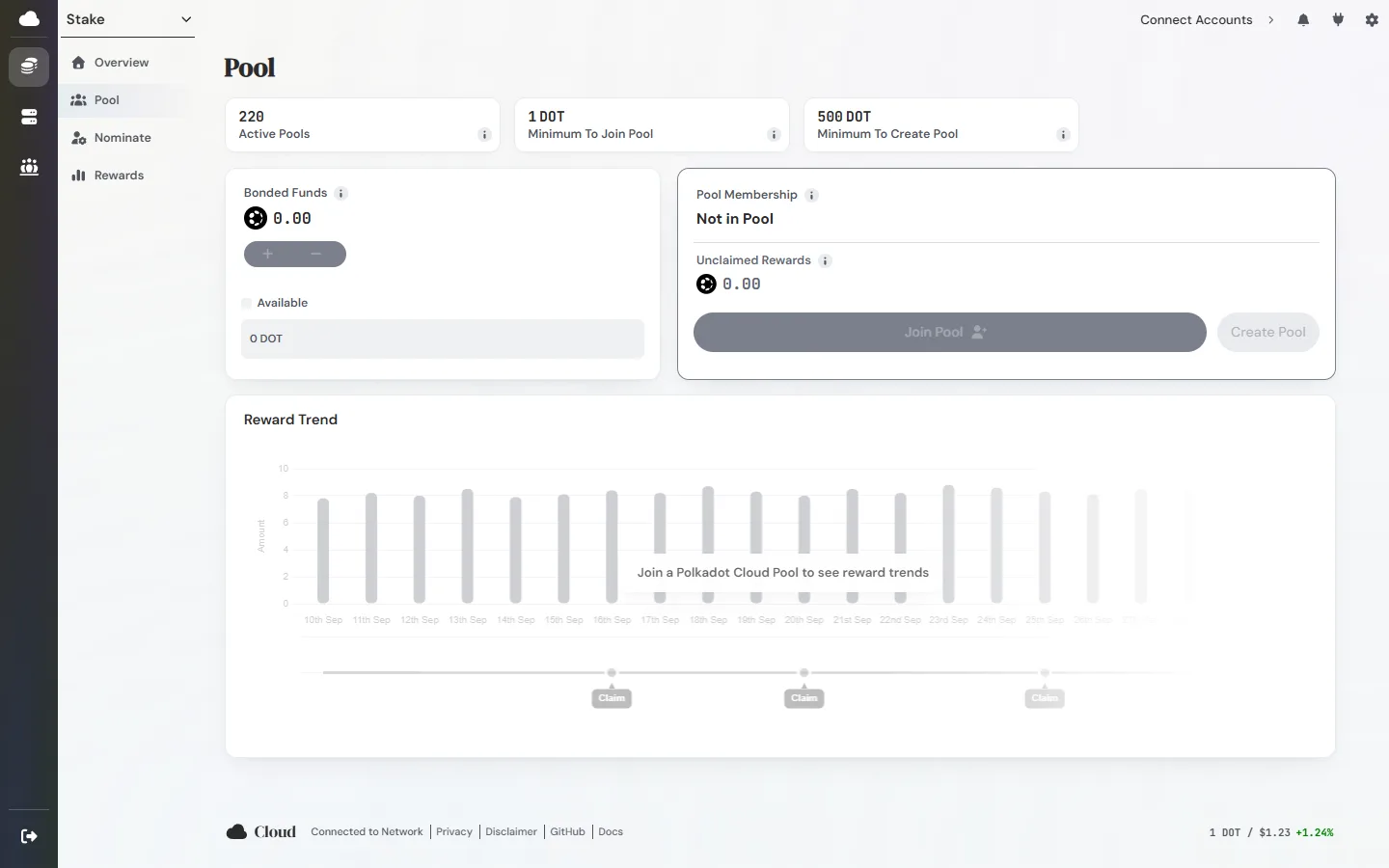
Nomination pools solve this problem by combining many smaller contributions into a single pooled bond that collectively meets the nomination requirements, letting individual members participate with as little as 1 DOT. A pool operator manages the actual validator nominations on behalf of every member, taking a commission from the pool's rewards in exchange for that service, which makes pools the practical entry point for the large majority of individual DOT holders.
How Polkadot Staking Rewards Are Distributed
Rewards on Polkadot are calculated and distributed once per era, a fixed period of 24 hours, drawn from a combination of network inflation and a portion of transaction fees. Polkadot's inflation rate ran at approximately 10 percent annually until March 2026, when annual issuance was cut by roughly half and a 2.1 billion DOT supply cap was introduced, bringing inflation down to roughly 3 percent. The staking reward rate available to nominators tracks that issuance closely, which is why it fell from double digits to under 3 percent APY, similar in structure to how several other proof-of-stake networks tie their headline yield to an inflation-driven issuance schedule.
Both direct nominators and nomination pool members generally see their rewards compound automatically without needing to manually claim and rebond each time, which helps the effective annual return grow slightly faster than the simple headline rate might otherwise suggest.
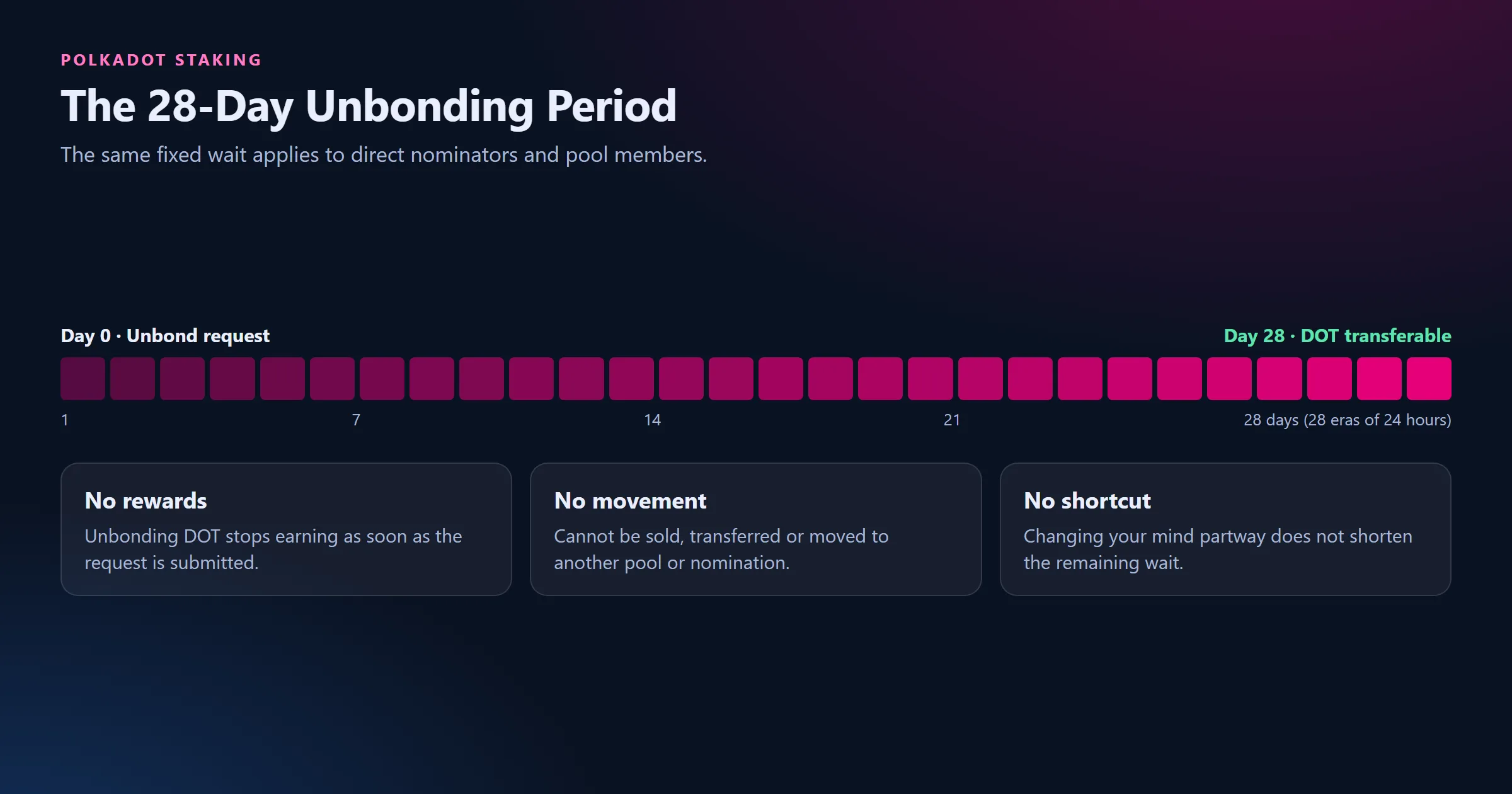
The 28-Day Unbonding Period
Unbonding DOT, whether from direct nomination or a nomination pool, triggers a fixed 28-day waiting period before the tokens become transferable again. During this window, the unbonding DOT no longer earns staking rewards and cannot be sold, transferred, or moved into a different pool or nomination.
This unbonding period applies uniformly regardless of how the DOT was originally staked, and changing a mind partway through the wait does not shorten it, since canceling an unbond and rebonding immediately still requires waiting through any portion of the period that has not yet elapsed. Planning around this delay matters most during periods of high price volatility, when the inability to exit quickly can have a real practical impact.
Slashing and the Appeal Window
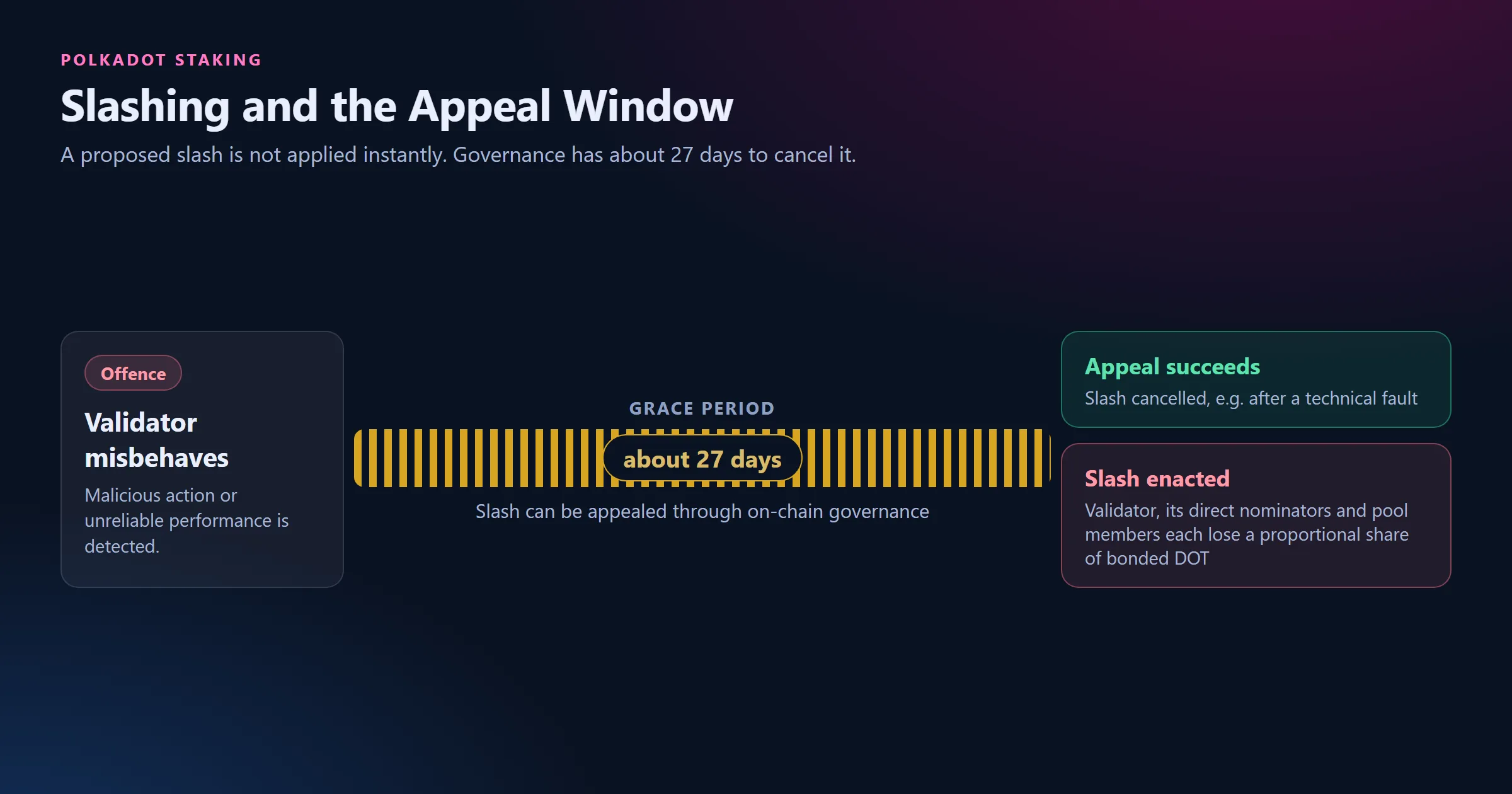
Polkadot applies real slashing penalties when a validator is found to have acted maliciously or performed unreliably, and nominators backing that validator lose a proportional share of their own bonded stake as a result, not just the validator itself. This applies to both direct nominators and nomination pool members, since the underlying validator misbehavior affects everyone who contributed stake toward that validator's backing.
A distinctive feature of Polkadot's slashing system is a grace period, commonly cited around 27 days, during which a proposed slash can be formally appealed through the network's governance process before it is actually enacted. This gives affected nominators and the broader community a structured opportunity to contest a slashing decision that may have resulted from a technical fault rather than genuine malicious behavior, rather than having the penalty applied immediately and irreversibly.
Shared Security: Staking DOT for Polkadot and Parachains
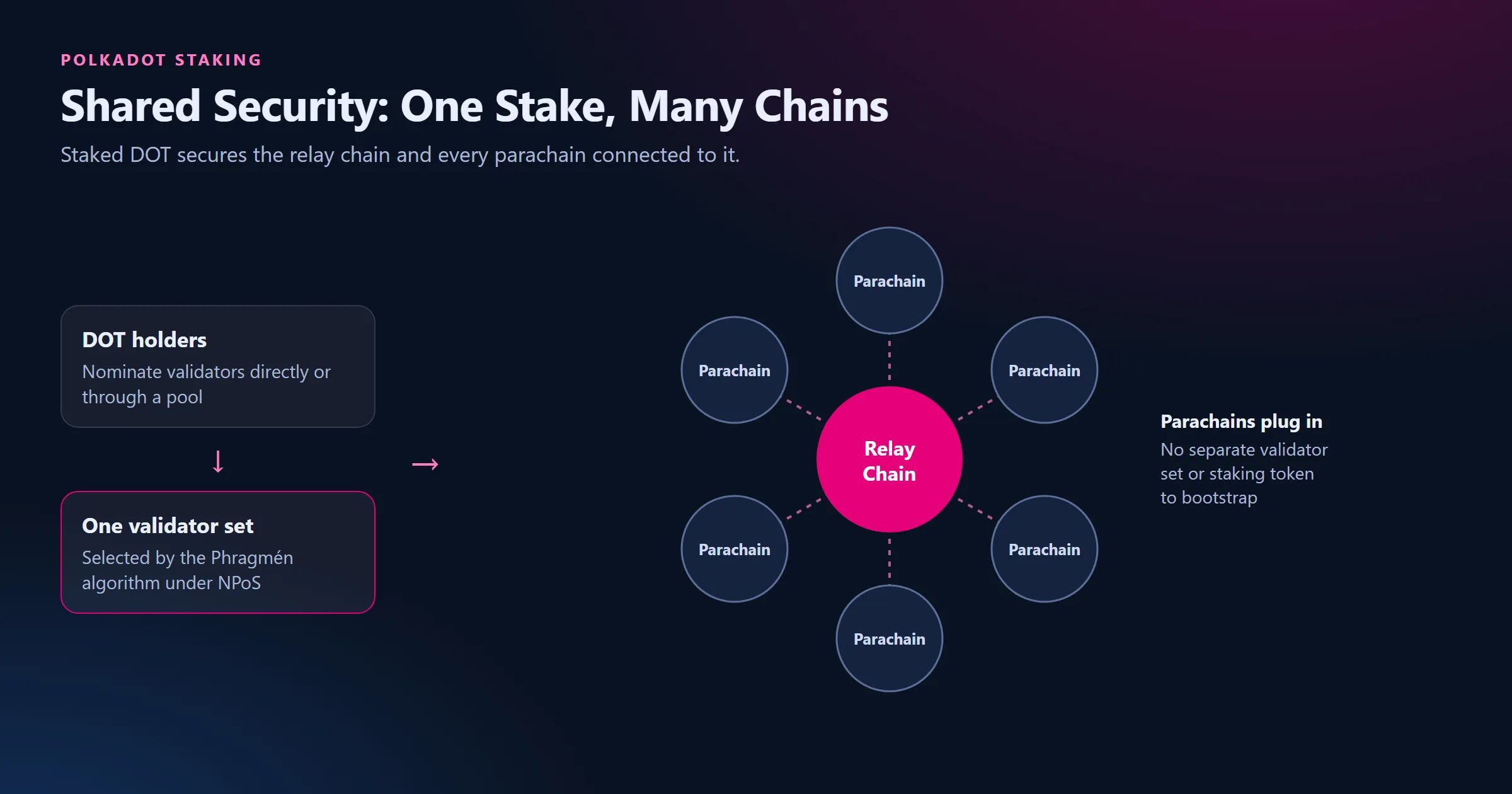
A distinctive feature of Polkadot's design is that staked DOT does not only secure Polkadot's own relay chain. It also extends security to connected parachains, independent, specialized blockchains that plug into Polkadot's shared validator set rather than needing to bootstrap and maintain their own separate security from scratch.
This shared security model differs meaningfully from ecosystems where each connected chain runs its own completely independent validator set and staking token, since a single act of nominating validators on Polkadot contributes to securing the entire connected network of parachains simultaneously, rather than just one isolated chain.
Liquid Staking as An Alternative
While staking native DOT on Polkadot locks the tokens into the 28-day unbonding period, liquid staking systems provide an alternative way to stake DOT. Platforms such as Bifrost issue a liquid staking token, commonly referred to as vDOT, representing a staked DOT position that continues earning rewards while remaining usable and tradable elsewhere in decentralized finance.
This approach removes the unbonding wait entirely for anyone needing to exit a position, since the liquid staking token itself can simply be sold or swapped on a decentralized exchange. in exchange for a protocol fee and additional smart contract risk that native staking through a pool or direct nomination does not carry.
How to Check Polkadot Staking Rewards
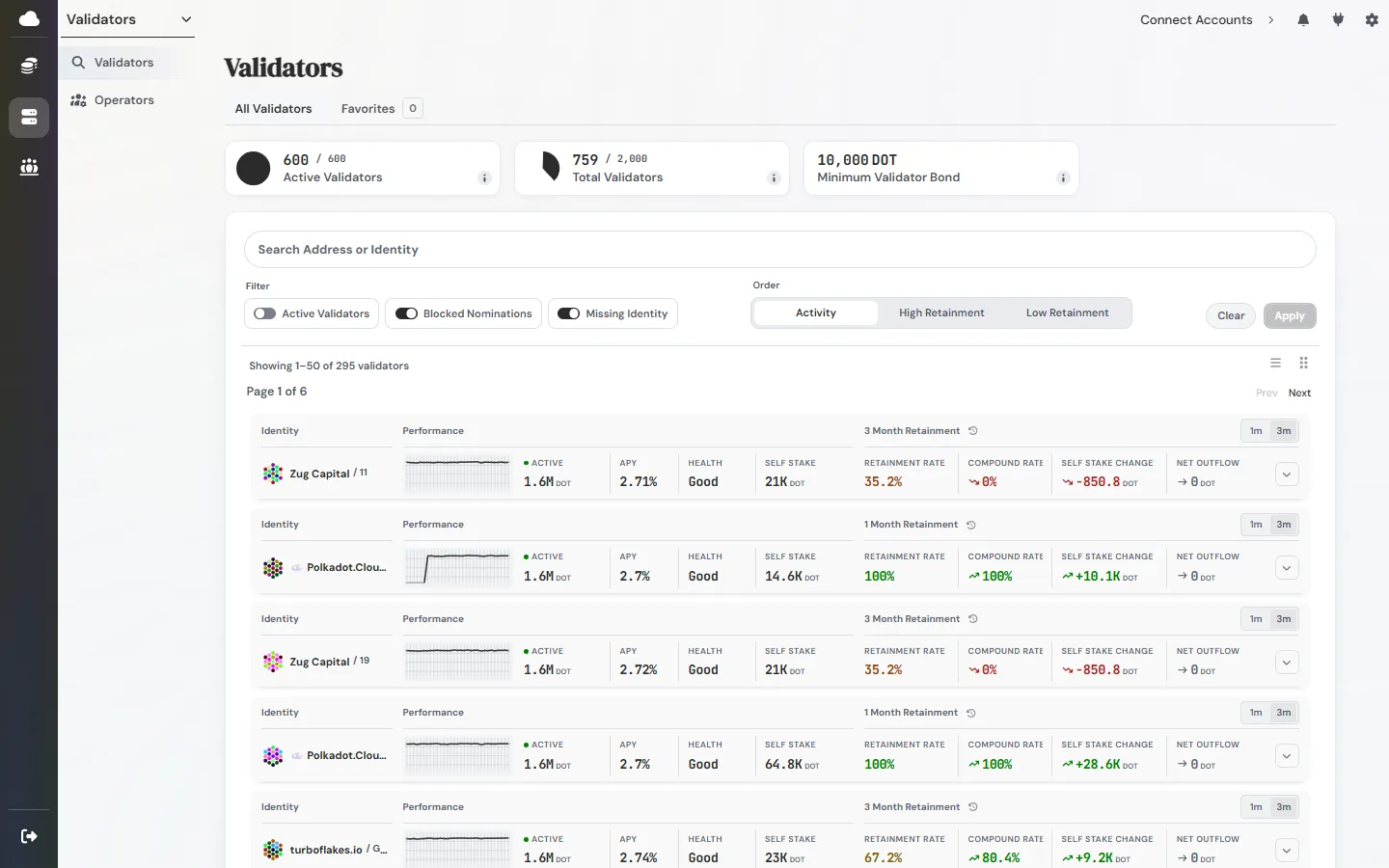
The official Polkadot Staking Dashboard displays current nomination status, accumulated rewards, and unbonding progress directly, and it supports connecting through browser extension wallets as well as hardware wallets including Ledger devices for added key security.
Nova Wallet offers a similar experience with a more mobile-focused interface, supporting both direct nomination and pool participation from within the same app.
Independent block explorers built for Polkadot also allow looking up a specific staking account to review its full nomination history and reward record, which is useful for confirming rewards are arriving as expected and for comparing a chosen pool's or validator's actual performance against its advertised commission and reliability.
How Polkadot Staking Differs from Cosmos and Cardano
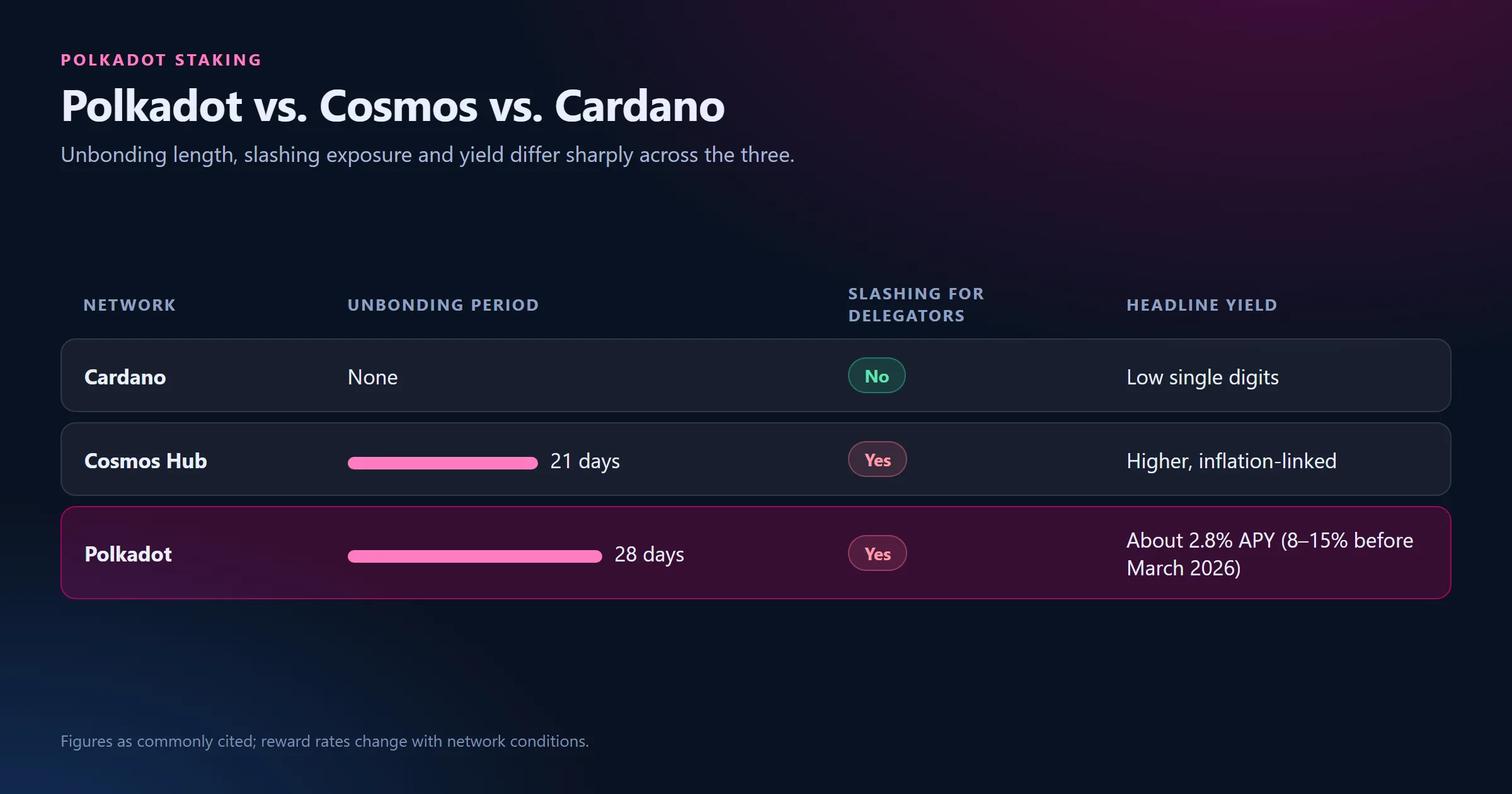
Comparison of the Polkadot's staking system with other major proof-of-stake networks shows its position in the risk-reward space.
-
Cardano imposes no unbonding period and no slashing risk for delegators, and its yield sits in the low single digits, a range Polkadot's own reward rate has also moved into since the 2026 issuance cut.
-
Cosmos Hub combines a 21-day unbonding period with real slashing risk and a headline yield generally higher than Polkadot's current rate, driven by an inflation-linked reward model.
-
Polkadot combines the longest unbonding period among the three, at 28 days, with real slashing risk and a formal appeal window, alongside a shared security model that extends the value of staking beyond a single chain.
This comparison reinforces a broader pattern across proof-of-stake networks: a higher headline yield tends to come paired with more inflation, more liquidity risk, more slashing exposure, or some combination of the three, rather than representing a straightforwardly better deal.
Polkadot Staking and OpenGov Participation
Polkadot's on-chain governance system, known as OpenGov, allows DOT holders to vote directly on network proposals ranging from technical upgrades to treasury spending, with voting power generally weighted by the amount of DOT a holder controls and how long they are willing to lock it for a given vote. Holding DOT in a nomination pool or through direct nomination does not automatically prevent participation in this governance process, though the practical mechanics of voting while staked can differ depending on the specific wallet and staking method used.
This governance layer operates independently of the staking reward system itself, meaning participation in OpenGov proposals has no direct effect on the staking rewards a nominator or pool member earns, similar to how governance participation functions as an additional, separate feature on several other major proof-of-stake networks.
Risks and Practical Considerations
Several habits may help to manage the particular risks of the Polkadot's staking.
-
Avoid staking DOT that might be needed on short notice, given how the 28-day unbonding period removes the option to exit quickly during a sudden price move.
-
Choose a nomination pool or set of validators with a strong operational track record, since slashing events affect nominators and pool members along with the validator itself.
-
Understand that the headline APY figure reflects network inflation, so consider what the reward rate looks like relative to that inflation when evaluating actual returns.
-
Keep the wallet's recovery phrase secure, since staking rewards accumulate within the same account holding the underlying DOT, and losing wallet access means losing access to both.
Related guides


 Scroll to top