


Solana Staking Validators: Criteria, Metrics, and Rewards


Table of contents

There is no single best Solana validator, and the Solana documentation says the Solana Foundation does not recommend any particular one. What can be checked are measurable criteria: commission, skip rate, vote success, uptime, delinquency history, MEV sharing, and how concentrated the network's stake is. A delegator's reward is the validator's reward minus its commission, so a validator that misses blocks or goes delinquent lowers what you receive.
This guide explains how validators earn rewards, which metrics matter and where to read them, what the Solana Foundation's own delegation criteria look like, how to spread stake across validators, and what to look for in a delegated staking API. It does not rank validators or providers. Figures that change are marked as snapshots.
What a Validator Earns and What You Receive
Solana's staking documentation states that validators chosen more often to write transactions earn more rewards, and their delegators share in them. Validators charge a commission, which is a percentage of the rewards earned, and may compete by offering lower commissions. Staking Rewards adds that MEV tips can add yield, but only for validators that run Jito and share the tips, and it suggests modelling an extra 0.3% to 1.0% for those that verifiably do.
Rewards are computed once per epoch and paid into the stake account, according to the Solana economic documentation. Your share is proportional to your active stake, and the commission is taken out first. This means the same amount of SOL can earn different rewards at two validators for reasons unrelated to the network rate.
Metrics to Check
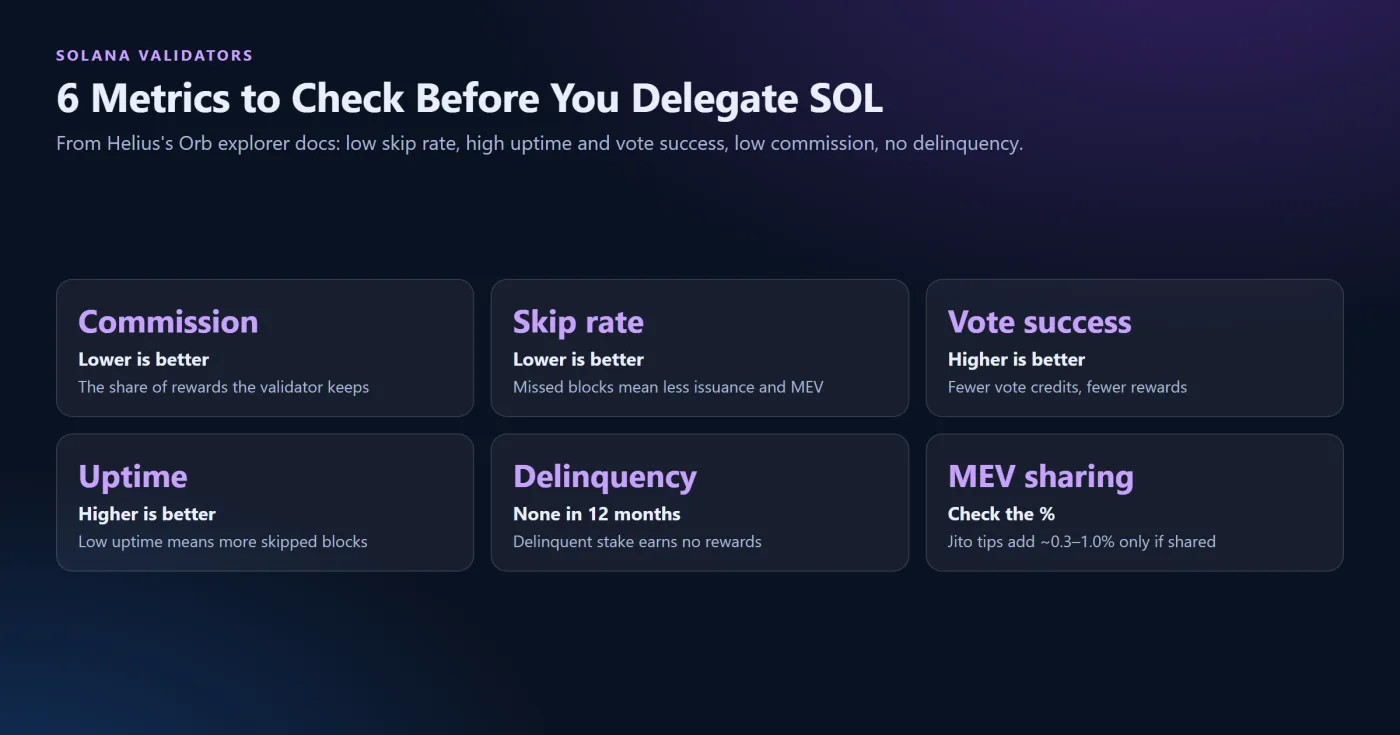
The Helius documentation for its Orb explorer explains the main validator metrics. It recommends a validator with low skip rates, high uptime, high vote success rates, low commission, and no delinquency history.
-
Commission. The share of rewards the validator keeps, which directly affects yield.
-
Skip rate. The percentage of scheduled blocks the validator missed. Skipped blocks mean less issuance and MEV rewards.
-
Vote success rate and vote credits. A lower vote success rate means fewer credits and fewer rewards.
-
Uptime. Low uptime means more skipped blocks and fewer rewards.
-
Delinquency. The time the validator fell behind the cluster over the last 12 months. Delinquent stake earns no rewards, which lowers delegators' APY.
-
Client version. The software version the validator runs, which the Helius page lists but does not evaluate.
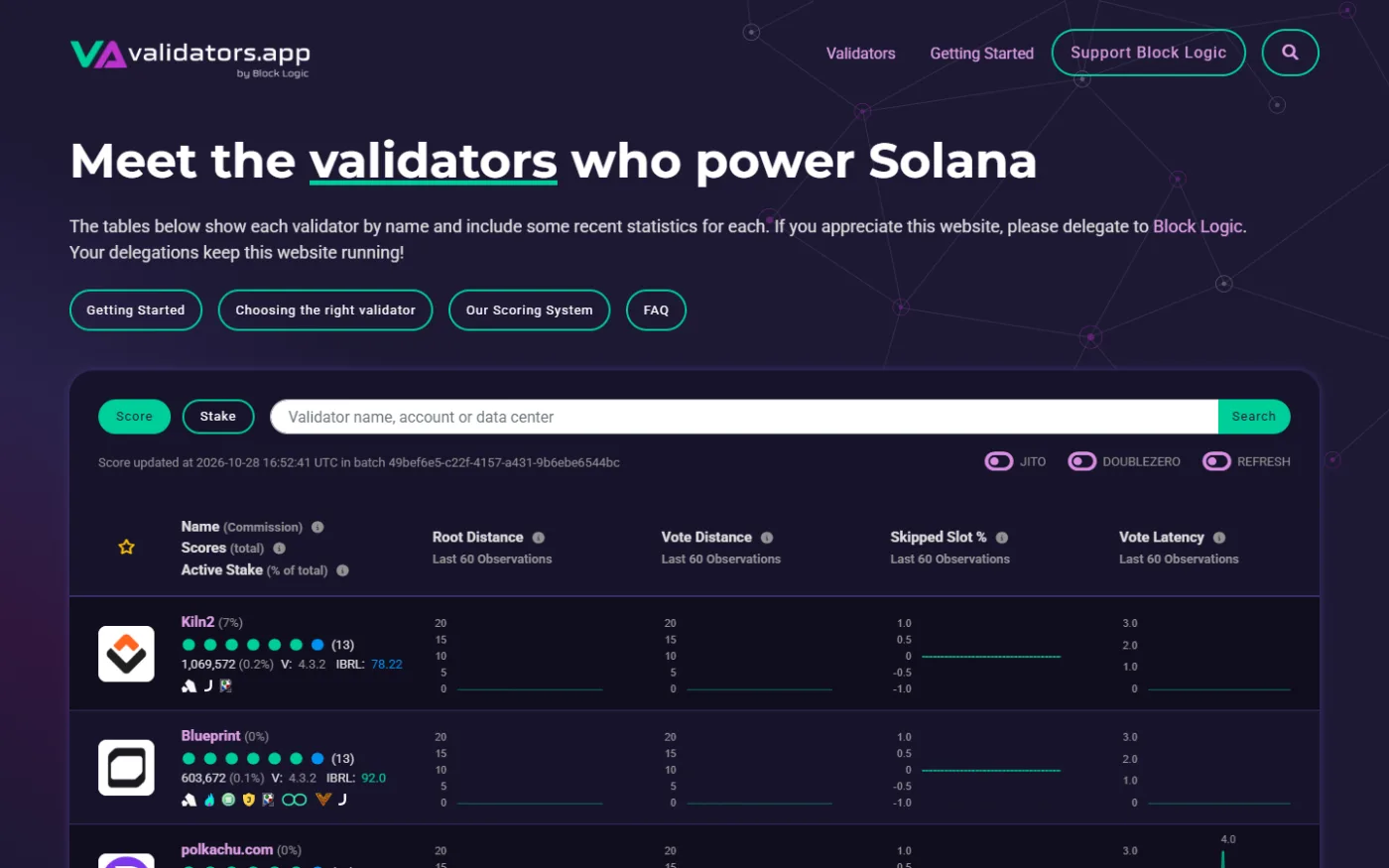
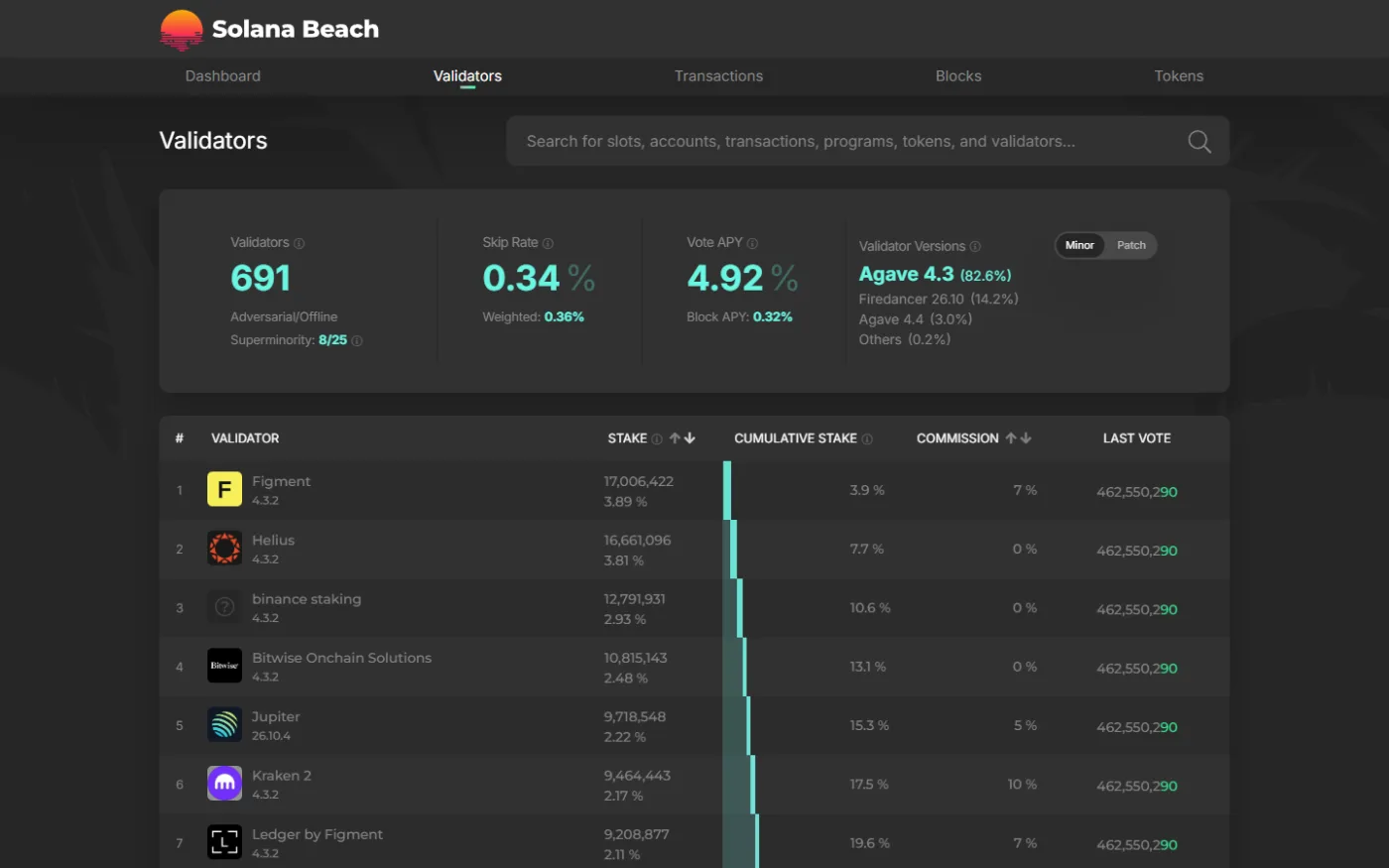
The Solana documentation points to the CLI commands solana validators and solana block-production, and to Solana Beach, for network and validator statistics.
What the Solana Foundation Looks For
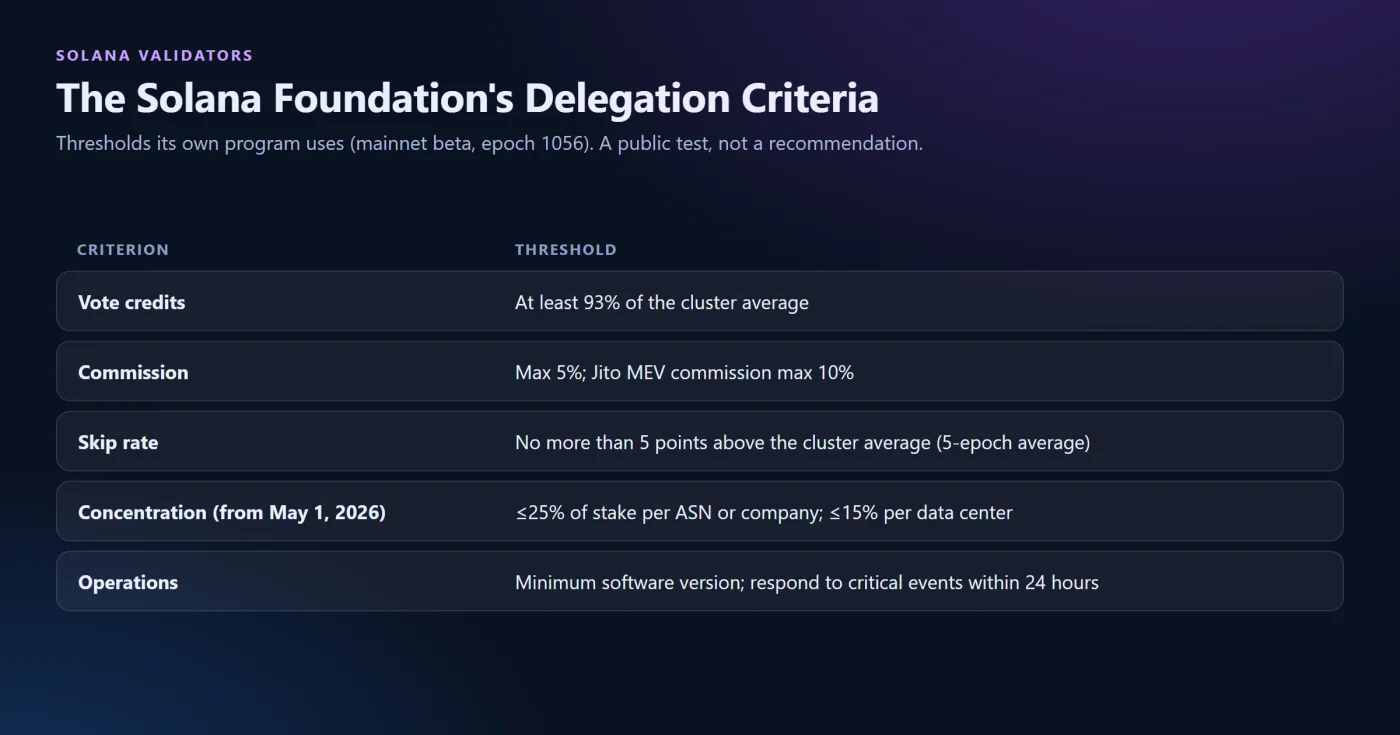
The Solana Foundation publishes criteria for its own delegation program. They are not a recommendation, but they show what thresholds an established program uses. The page read for this article (the mainnet beta table for epoch 1056) lists the following:
-
Vote credits of at least 93% of the cluster average.
-
A commission cap of 5%, and a cap of 10% for Jito MEV commission.
-
Skip rate no more than 5 percentage points above the cluster average (5-epoch average).
-
Concentration limits starting May 1, 2026: 25% or less of network stake for one ASN or company, and 15% or less for one data center.
-
Minimum software versions, a response to critical network events within 24 hours, and no stretches of 10 or more epochs without stake.
The page does not mention a superminority criterion. These rules apply to the program's own delegations, and a validator that does not meet them is not necessarily poor, but a validator that does meet them has passed a public test.
Concentration and Diversifying Your Stake
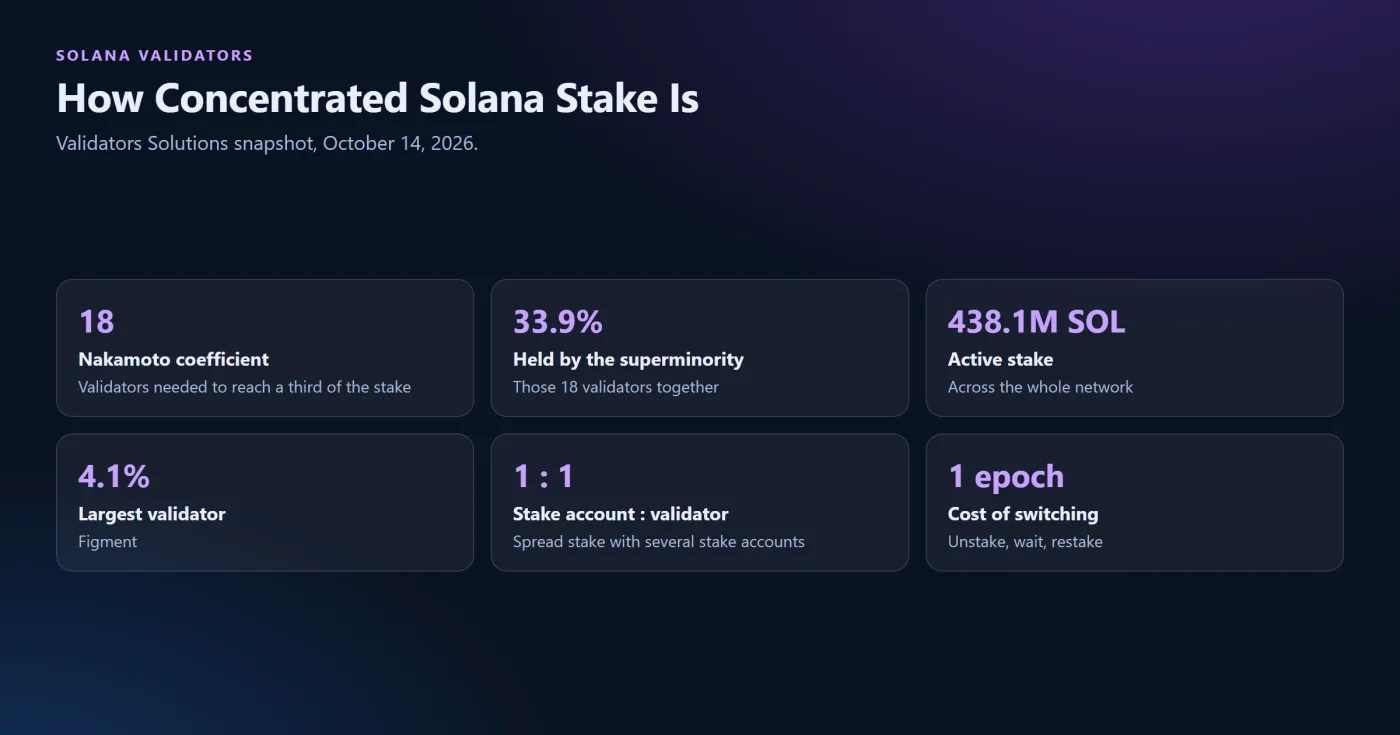
Staking too much with the largest validators concentrates the network. A snapshot from Validators Solutions, updated on October 14, 2026, listed a Nakamoto coefficient of 18, a superminority of 18 validators holding 33.9% of the 438.1 million SOL of active stake, and Figment as the largest validator with 4.1%. These figures describe the network and are not a rating of any validator.
Each Solana stake account can delegate to only one validator, according to the Solana documentation, so spreading SOL over several validators means several stake accounts. Moving stake means unstaking, waiting for the epoch to end, and restaking, as Jupiter's staking page describes. A reader who splits stake should expect more transactions and should check that each account keeps the wallet's minimum.
Liquid Staking and Validator Choice
Choosing a liquid staking token also chooses validators, but indirectly. Sanctum's article notes that Marinade stakes across more than 400 validators and that Jito and Marinade support only their own tokens. That is a company claim and was not verified. Liquid staking adds smart contract and pricing risk, and the validator choice is made by the protocol, not by the holder.
What to Look For in a Delegated Staking API
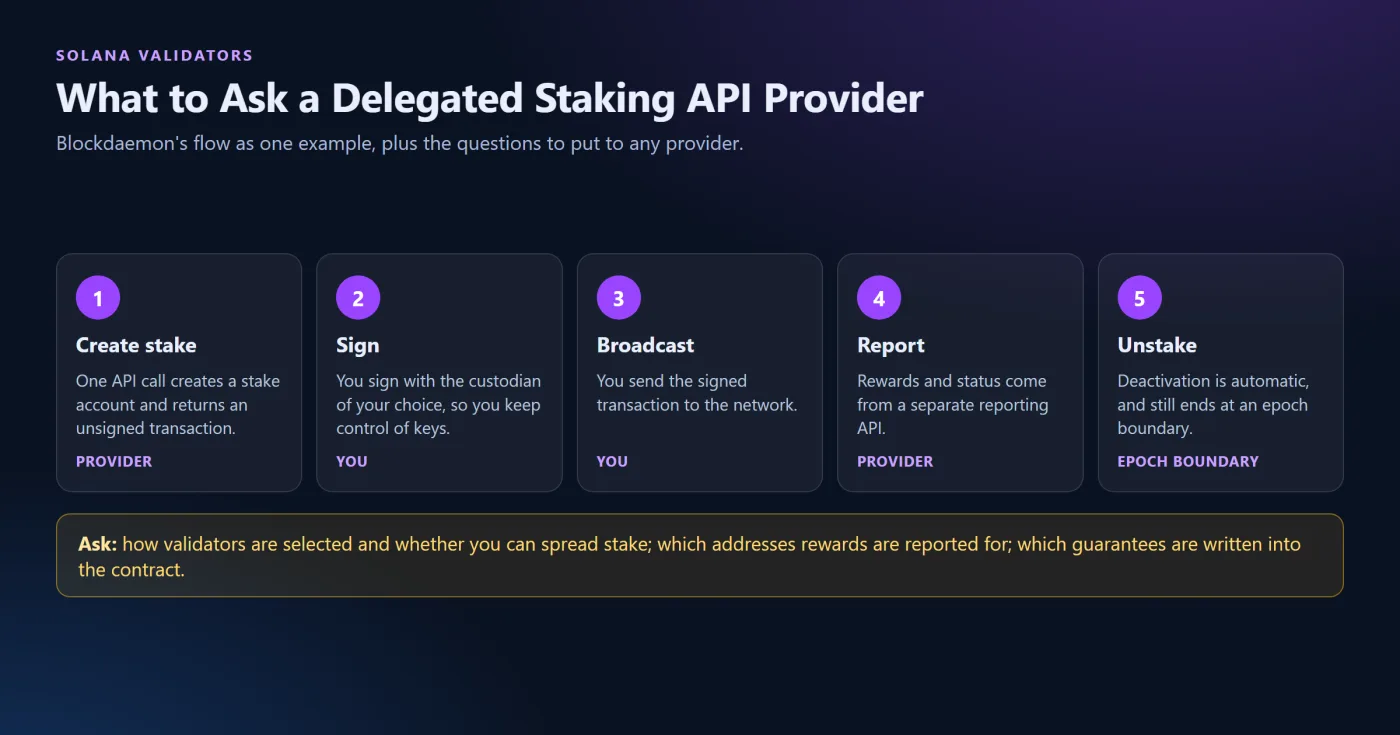
Teams that add Solana staking to a custody service, exchange, or app often ask which API to use. This article does not rank providers, since the pages read did not compare them independently. Blockdaemon's announcement shows what one provider describes: a single call creates a stake account and returns one unsigned transaction, which the customer signs and broadcasts with a custodian of their choice, and unstaking is handled by automatic deactivation of stake accounts. Rewards data comes from a separate reporting API, and the page does not describe how validators are selected. It also makes vendor claims, such as a 100% slashing insurance guarantee, which are not independently verified, and it is undated.
Useful questions for any provider:
-
Does the API return an unsigned transaction so the customer controls signing?
-
How are validators selected, and can the integrator choose or spread stake across several?
-
How are rewards and stake status reported, and for which addresses?
-
What happens at unstaking, given that Solana deactivates at epoch boundaries?
-
What guarantees does the provider make, and are they documented in a contract?
Risks
Solana's slashing is not currently enforced, according to the documentation and Staking Rewards, so the main practical risks are an underperforming or delinquent validator, a commission change, concentration, and the one-epoch cooldown during which SOL earns nothing. Network outages and the single-client architecture, which Staking Rewards lists, apply regardless of the validator chosen.
What to Check Live Before You Delegate
-
The validator's commission, and whether it has changed recently.
-
Skip rate, vote success, uptime, and delinquency history on an explorer.
-
Whether the validator shares MEV tips, and at what percentage.
-
The validator's share of network stake and its data center and operator.
-
The cooldown in your wallet, and the cost of moving stake later.
This article is educational and is not investment advice. Staking involves risk, and each reader should compare the live data with their own situation.
Related guides


 Scroll to top