


Chainlink Staking: Rewards, Pool Cap, and 28-Day Unbonding


Table of contents

Chainlink staking is not like staking on a proof-of-stake chain. LINK holders lock tokens in a smart contract on Ethereum to back the reliability of Chainlink's oracle services, and they earn rewards in LINK in return. The current version is Staking v0.2, with a 45 million LINK cap, a community pool of 40.875 million LINK, a 28-day unbonding period followed by a 7-day claim window, and an effective community rate of about 4.32% at launch. The community pool has been full for long periods, so the first question is whether there is space.
This guide explains how the platform works, what the rates and limits are, how unbonding and the reward ramp-up behave, and what is known about a possible v0.3. Figures that change are marked as such, and the Chainlink pages cited are the project's own descriptions, not independent verification.
How Chainlink Staking Works
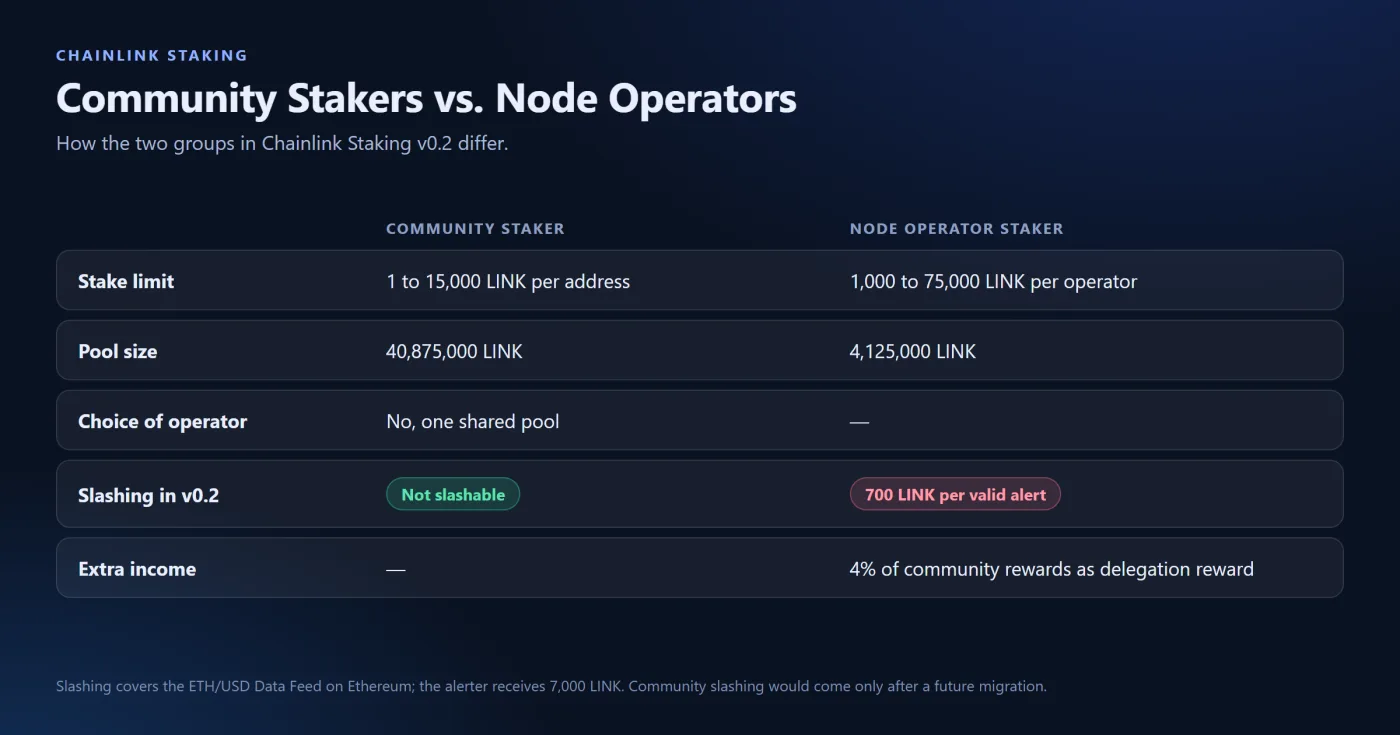
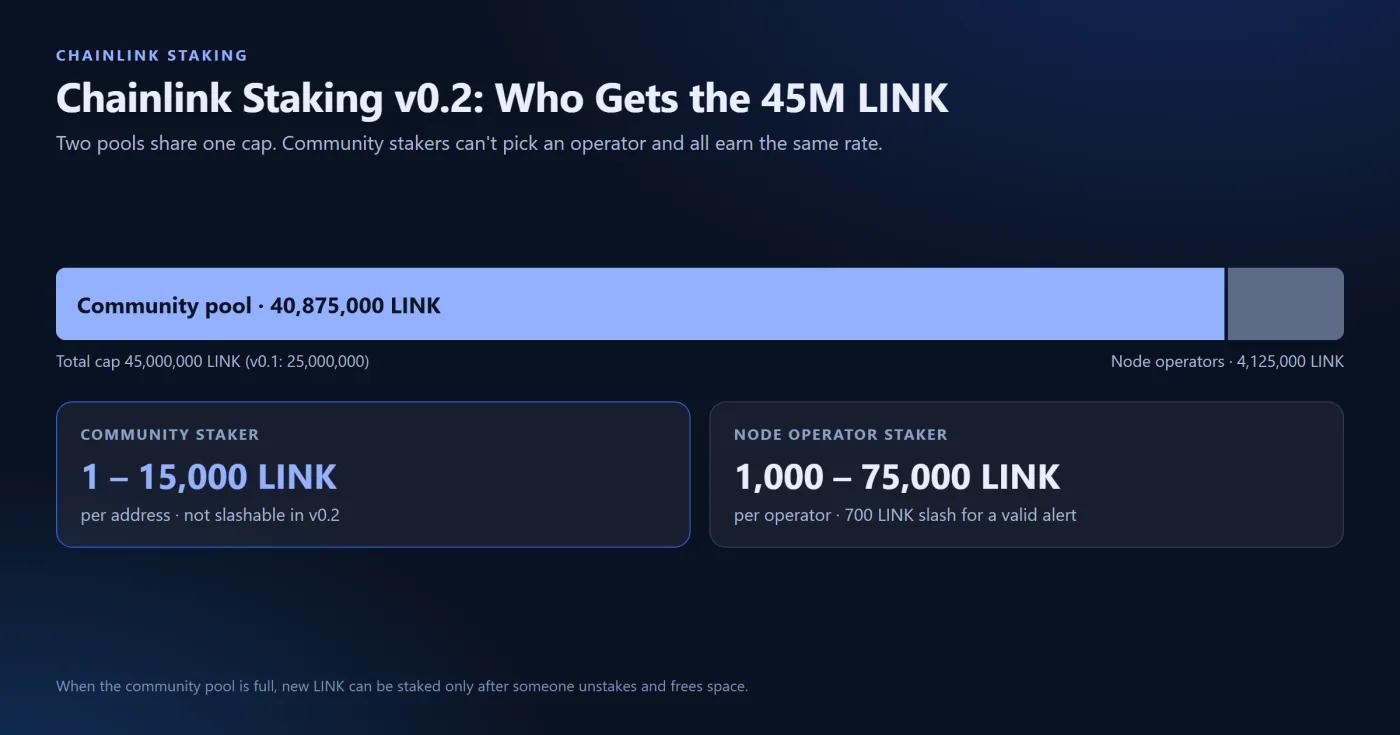
According to the Chainlink v0.2 overview and its staking page, users stake LINK in a non-custodial contract. There are two groups: community stakers, who stake between 1 LINK and 15,000 LINK per address, and node operator stakers, who stake between 1,000 LINK and 75,000 LINK per operator. Community stakers cannot choose an operator, and they share one pool at the same rate.
The purpose of the stake is to back the oracle service. Node operator stakers serving the ETH/USD Data Feed on Ethereum can be slashed 700 LINK for a valid alert, and the alerter receives 7,000 LINK. Everstake's page, which is provider marketing, describes the trigger as more than three hours of downtime since the last valid report. In v0.2, community stakers are not subject to slashing, according to the Chainlink blog.
Community Pool Capacity in v0.2
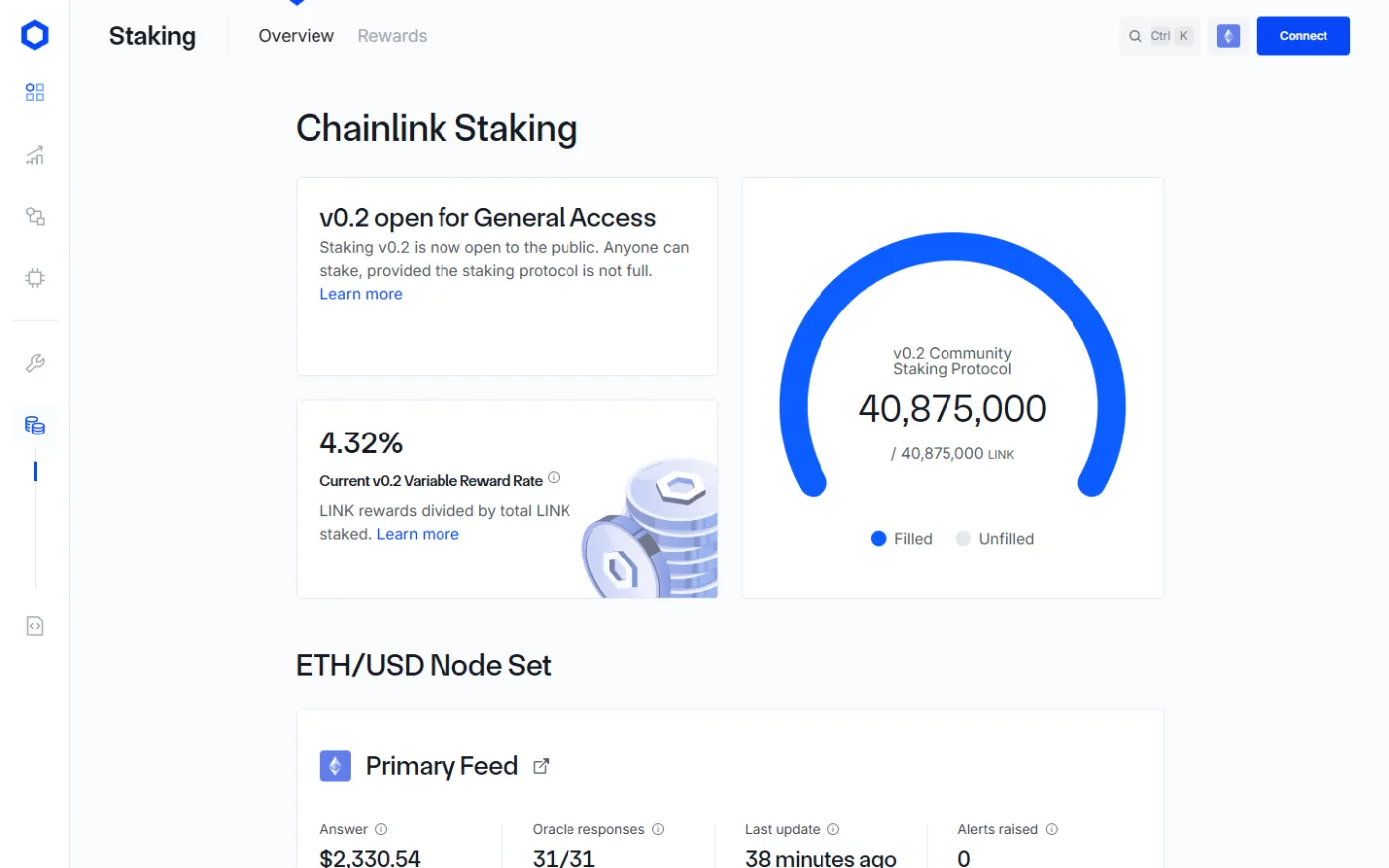
The total cap is 45,000,000 LINK, up from 25,000,000 LINK in v0.1, with 40,875,000 LINK allotted to community stakers and 4,125,000 LINK to node operators. Chainlink's staking page says that when the community pool is full, new LINK can be staked only after an existing staker unstakes and frees space. It does not state the current fill level.
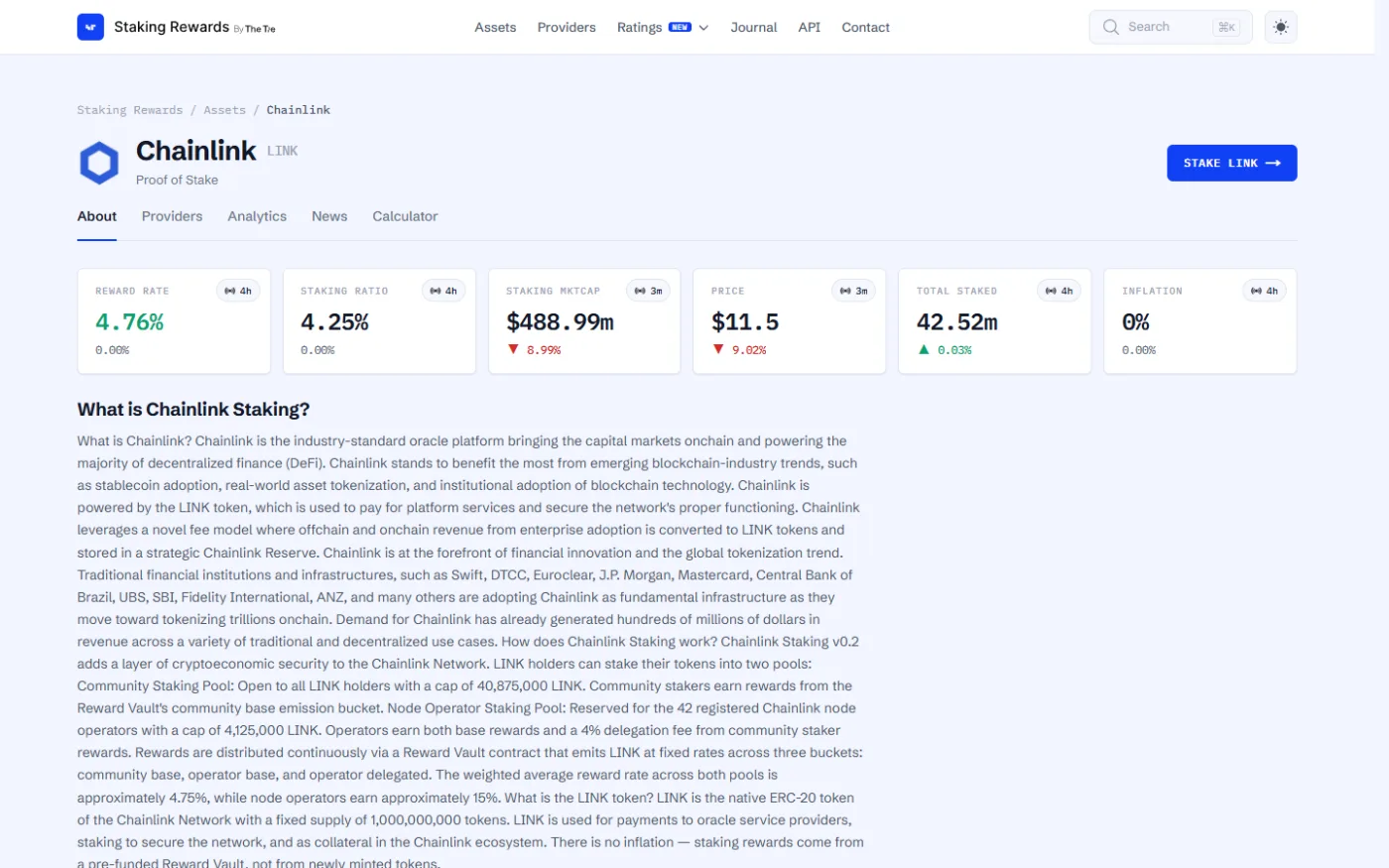
Everstake's page, updated in September 2026, says the community pool is currently full and that the steps for staking cannot be completed until space opens. Staking Rewards showed a total of about 42.52 million LINK staked and a staking ratio of 4.25%, and also says the community pool is full. These are third-party statements, so the live status should be checked on the official staking page before a transfer is planned.
Rewards and the Current Rate
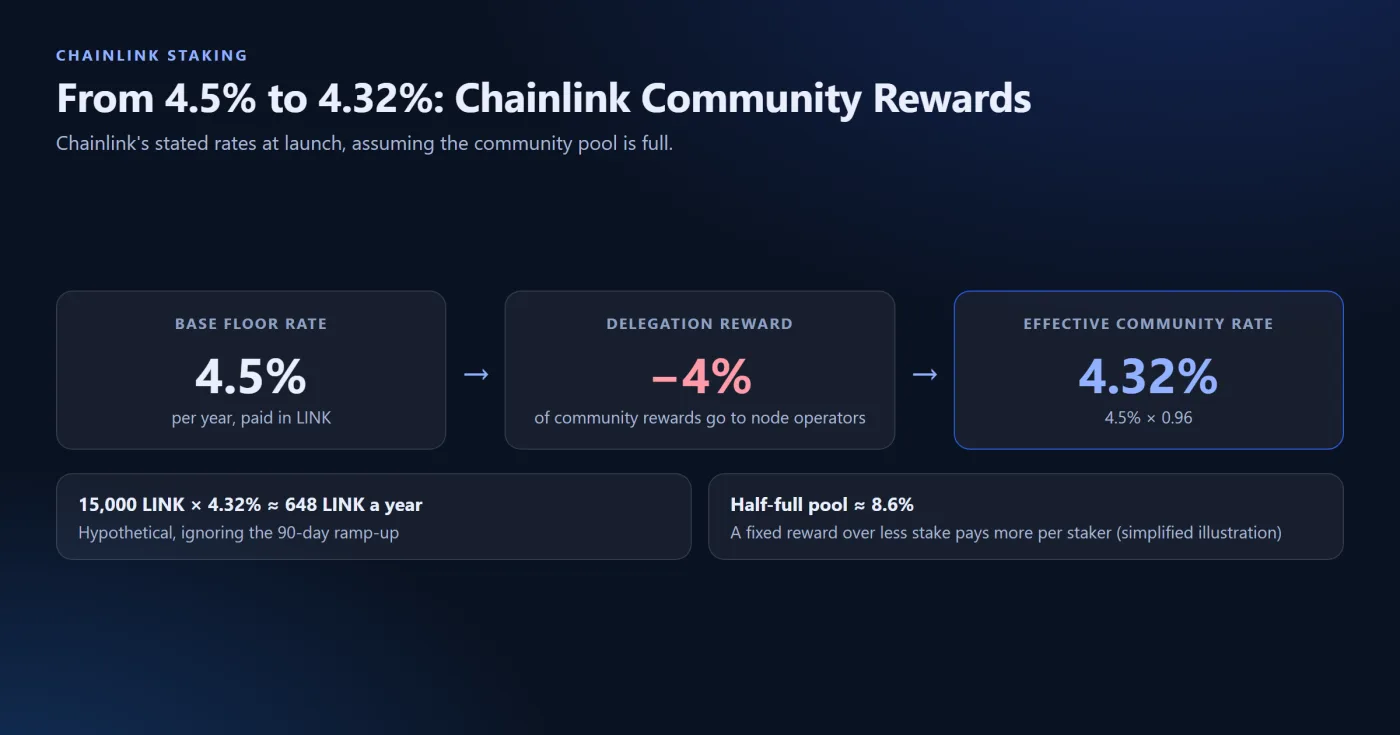
Chainlink states a base floor reward rate of 4.5% per year in LINK, assuming the community pool is full. Four percent of community rewards go to node operators as delegation rewards, which leaves an effective 4.32% for community stakers at launch. The blog says that a fixed total reward amount is spread across stakers, so a pool that is less full pays a higher rate per staker.
Staking Rewards showed a headline rate of 4.76%, about 4.32% for the community pool and about 15% for the node operator pool, but its own figures were inconsistent with each other and with the stated cap. For a calculation, the official reward page and the live pool status are the best inputs.
A Hypothetical Example
These numbers are illustrations, not forecasts. A community staker with the 15,000 LINK maximum at an effective 4.32% would earn about 648 LINK in one year, ignoring the ramp-up described below. If a fixed reward amount were spread over a pool that is half full, the simple proportional reading of the blog would give about twice the rate, near 8.6%. That second figure is a simplified illustration and not a statement about any actual pool.
Reward Sources and Ramp-Up
Rewards are emissions-based at present, and the Chainlink blog expects them to shift toward external sources such as user fees and Chainlink Build rewards over time. It does not give a date. Everstake's page lists emissions, Chainlink Build allocations, and possibly oracle user fees later.
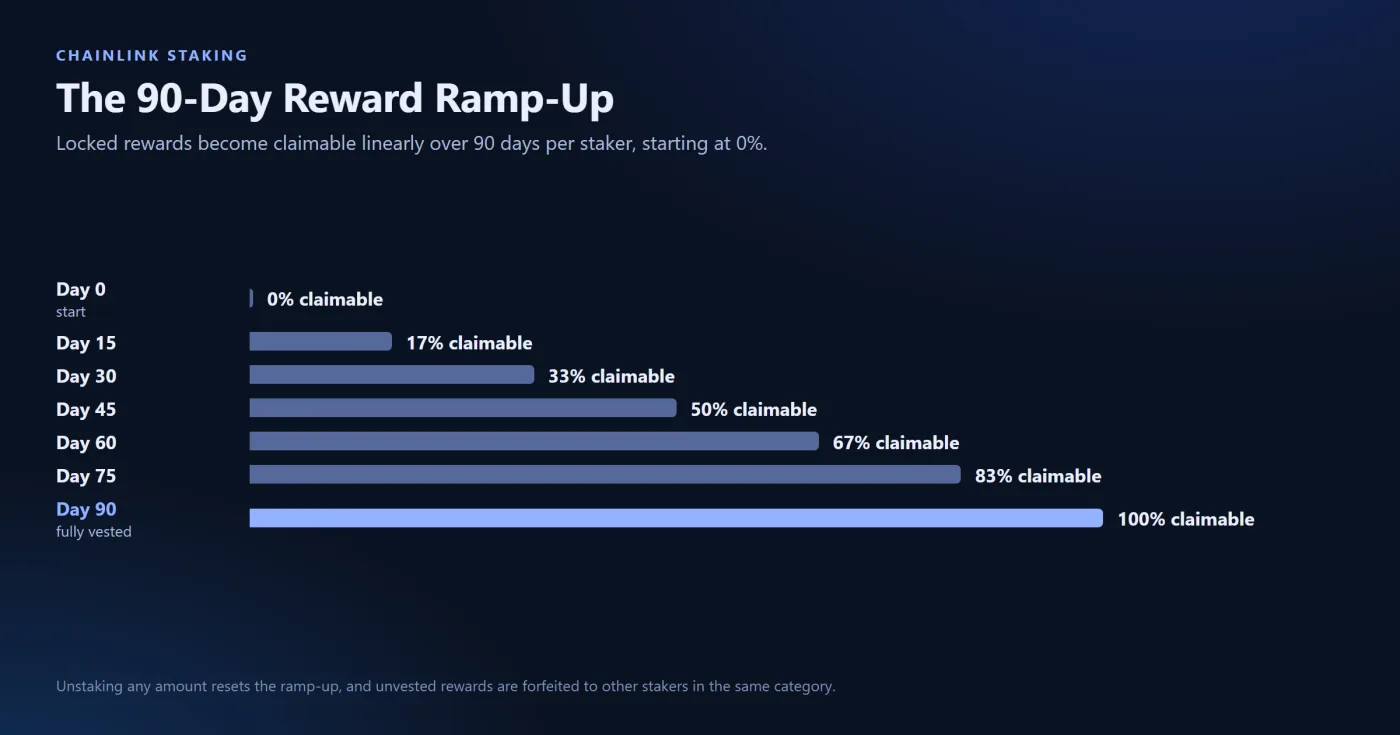
Rewards ramp up over 90 days per staker. Locked rewards become claimable linearly, starting at 0%. Unstaking any amount resets the ramp-up, and locked rewards that have not vested are forfeited to others in the same staker category, according to the Chainlink blog. Claimable rewards can be withdrawn at any time without penalty, according to the Chainlink staking page. A staker who plans to move in and out frequently should therefore expect a lower reward than the headline rate.
Unstaking, the 28-Day Cooldown, and the Claim Window
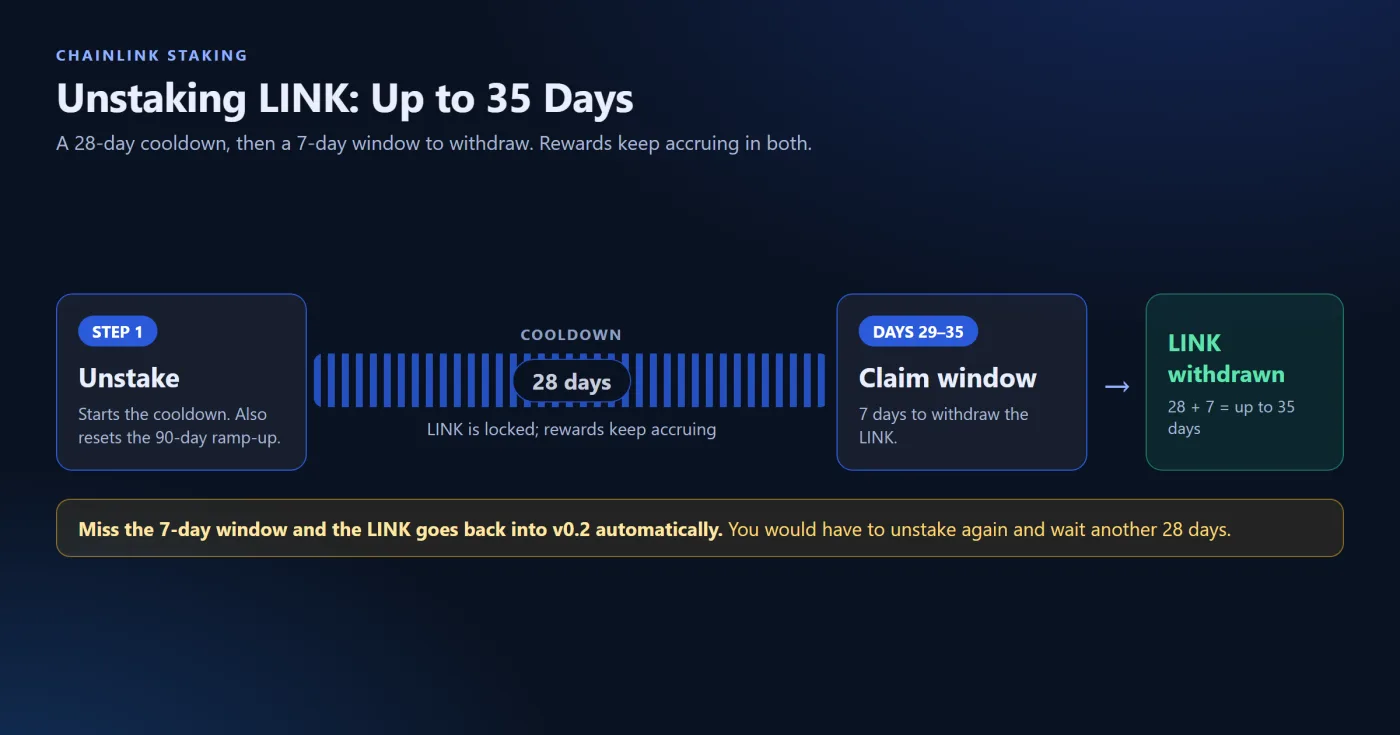
Unstaking starts a cooldown of 28 days, followed by a claim window of 7 days. LINK that is not withdrawn during the claim window automatically re-enters v0.2, according to the Chainlink staking page, which also says rewards keep accruing during both periods. Combined, a full exit can take up to 35 days, a figure that is the sum of the two periods and is not stated as one number in the Chainlink pages read.
Staking Rewards says that unstaking is allowed at any time but does not give a lock-up length, which conflicts with Chainlink's 28-day cooldown, so the official figure was used here.
What About v0.3?
Chainlink's own staking pages and its v0.2 overview describe only v0.2, and the pages read for this article do not mention a v0.3. The v0.2 overview says the size cap is expected to increase over time, that additional oracle services such as CCIP may be added through new alerting modules, and that expanded slashing conditions are planned. It also says that future migrations to a new staking version would require manual action by stakers, and that community stakers would face slashing only after such a migration.
An AMBCrypto article dated November 4, 2025 discusses what v0.3 could bring, including a higher cap, coverage of services such as CCIP, fee-based income, and automatic delegation based on operator performance. The article itself states that these are expectations and not an official specification, and it does not give a release date or a new cap. Details about v0.3 should be treated as unconfirmed until Chainlink publishes them.
Risks of Chainlink Staking
-
Capacity. A full pool means no new community stakers until someone unstakes.
-
Smart contract risk. The contracts were audited, including a Code4rena contest, but Staking Rewards notes that smart contract risk remains on Ethereum.
-
Illiquidity. The 28-day cooldown and claim window make staked LINK unavailable for weeks.
-
Changing rules. The blog says the cap, rewards, and slashing conditions may change in later versions.
-
Price. The reward is paid in LINK and does not protect against a fall in the LINK price.
What to Check Live Before You Stake
-
Whether the community pool has space, on the official staking page.
-
The current reward rate and how it is calculated.
-
The unbonding and claim window lengths.
-
Whether v0.3 or another upgrade has been officially announced.
-
The address and website, by typing the official address yourself and never entering a recovery phrase.
This article is educational and is not investment advice. Staking involves risk, and each reader should compare the live data with their own situation.
Related guides


 Scroll to top