


Ethereum Staking: Yield, Exit Queue, and How to Start


Table of contents

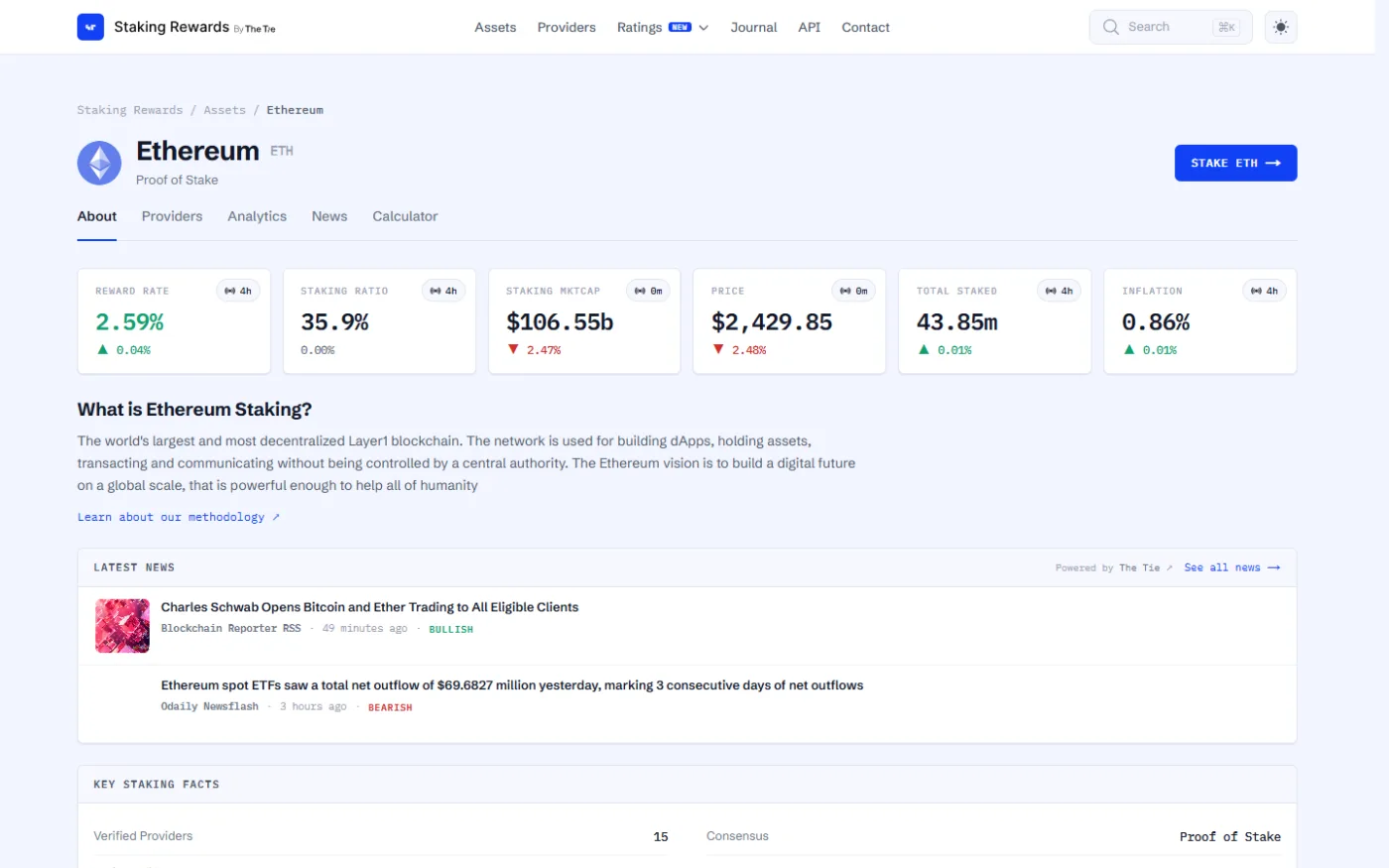
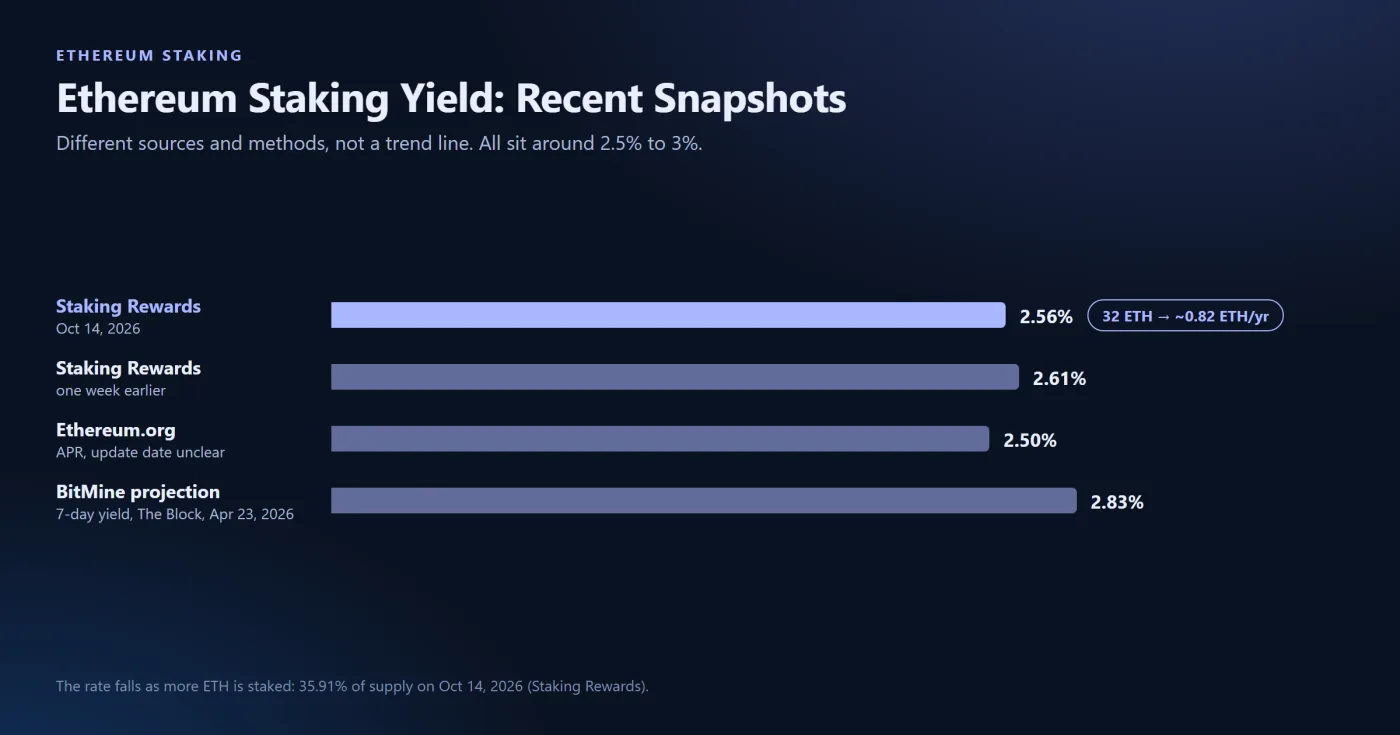
Ethereum staking currently pays about 2.5% to 2.6% per year. Staking Rewards showed 2.56% on October 14, 2026, with 35.91% of ETH supply staked, and Ethereum.org lists a similar figure. A 32 ETH validator at 2.56% would earn about 0.82 ETH per year before fees, and the rate falls as more ETH is staked. Joining the validator set takes time: a queue snapshot read for this article showed about 21 days to enter and about 17 days to exit.
This guide covers the current yield and why it moves, the ways to stake, the queues, the main risks, and what large holders such as BitMine are doing. Numbers marked as snapshots change quickly, so each section says what to check live.
Current Ethereum Staking Yield
Several sources give slightly different numbers, because they measure different things and at different times. Staking Rewards showed a reward rate of 2.56% on October 14, 2026, and 2.61% when read a week earlier. Ethereum.org lists an APR of 2.5% on a page that is inconsistent about its own update date. In an article dated April 23, 2026, The Block cites a 2.83% seven-day yield used in BitMine's own projections.
These values are not a trend line. They come from different sites and different methods, and this article did not find a single source with a dated history that could support a chart of the 2024, 2025, or early 2026 rates. The safe reading is that the rate has been in the range of roughly 2.5% to 3% in the snapshots found, and that the current number should be read from a live source with a date.
APR and APY
APR is the simple yearly rate, while APY includes compounding. Compounding on Ethereum depends on the setup. According to Ethereum.org, validators with compounding (0x02) credentials can hold up to 2,048 ETH since Pectra and add rewards to the stake automatically, while Staking Rewards notes that rewards above the effective balance are swept out every few days. Lido describes stETH as auto-compounding. So the same headline number can mean different results, depending on the method.
Why the Rate Moves
The Ethereum documentation gives the base reward as proportional to the validator's balance and inversely proportional to the square root of the total staked ETH. More stake means a lower reward per validator. A hypothetical illustration: if total staked ETH grew by 21%, each validator's base reward would fall to about 91% of its earlier level. Execution rewards (priority fees and MEV) are added on top, but Staking Rewards warns that MEV is variable and should not be modelled as stable yield.
Ways to Stake ETH
-
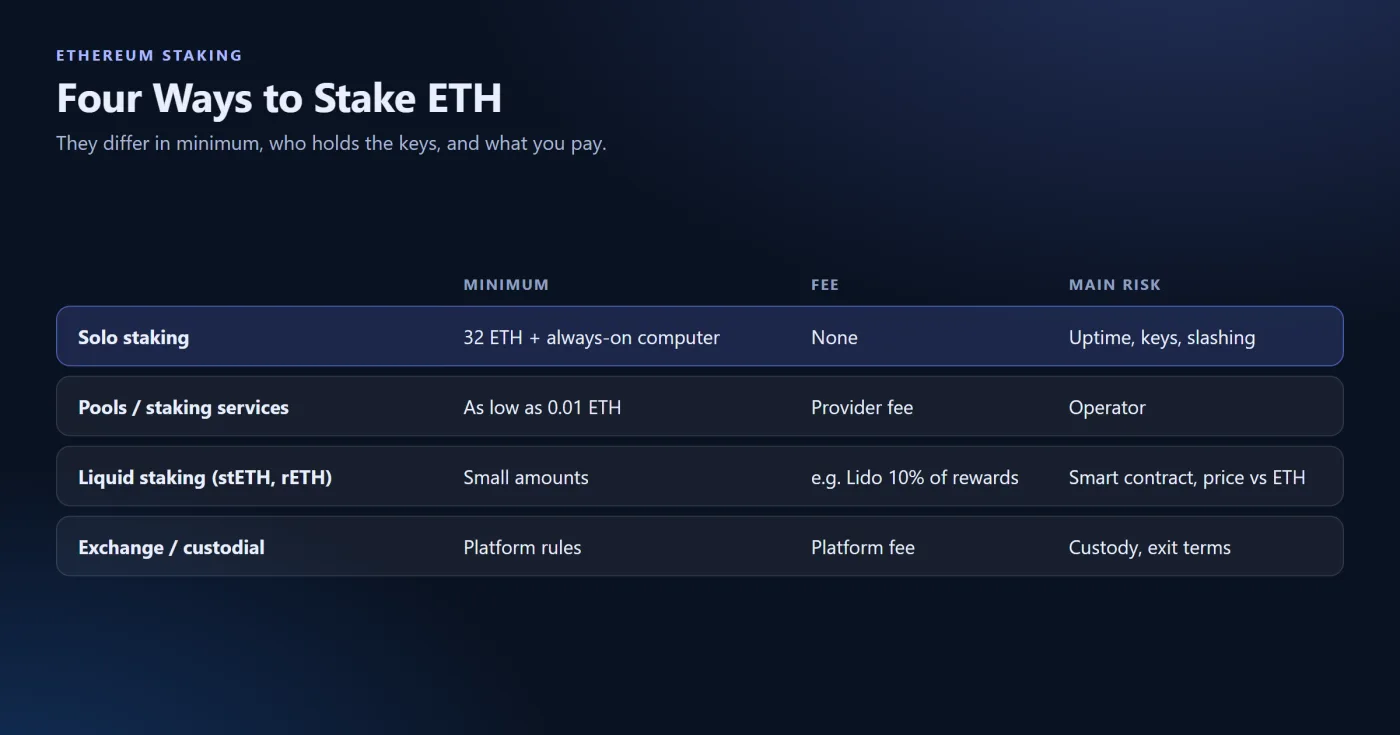
Solo staking. Ethereum.org states that this requires 32 ETH and a computer that is online nearly all the time. There is no provider fee, and the staker is responsible for uptime and keys.
-
Staking pools and staking services. Ethereum.org says pools accept very small amounts, with some as low as 0.01 ETH, and rewards go to the pool's validators. Fees apply.
-
Liquid staking. The staker receives a token that represents the staked ETH and rewards, which can be used in DeFi, with added smart contract, counterparty, and pricing risk.
-
Exchange or custodial staking. The provider holds the ETH and sets its own terms, fees, and exit rules.
Lido and Rocket Pool
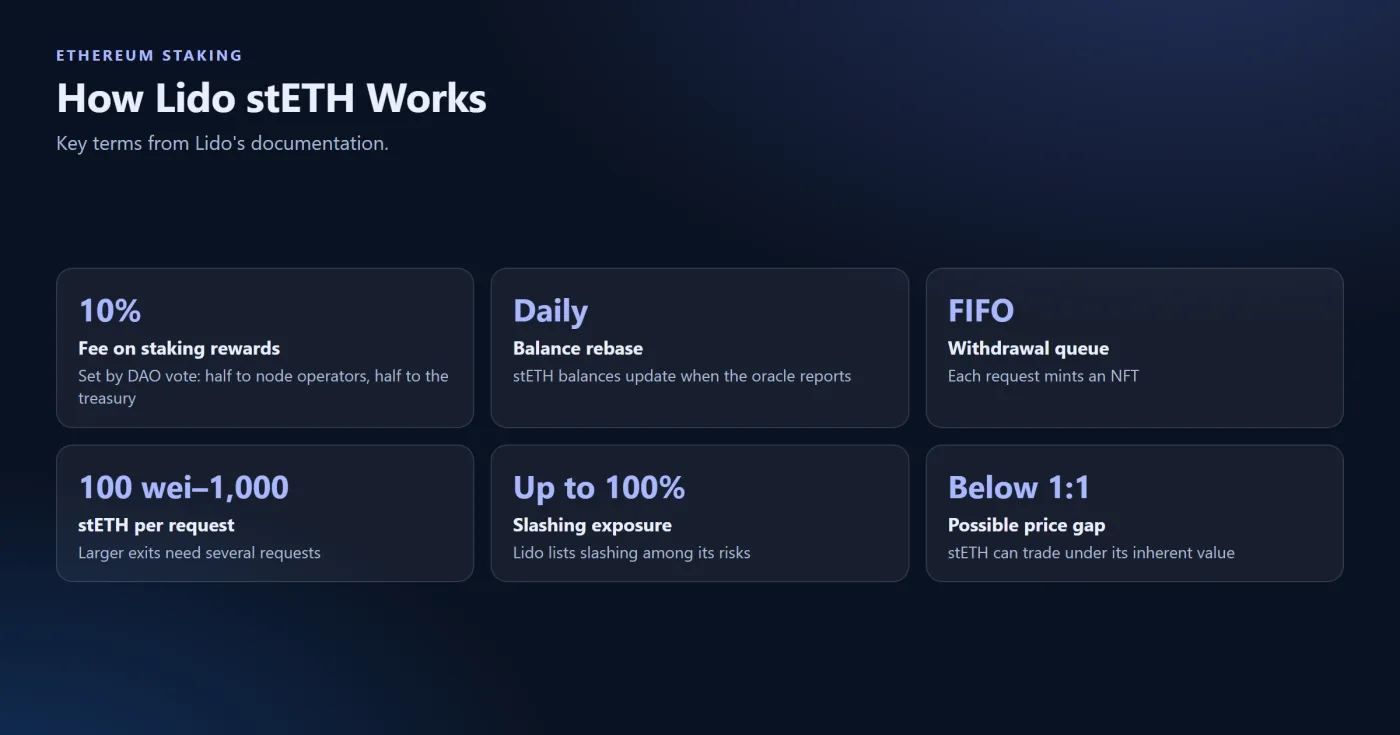
Lido's documentation describes stETH as a rebasable ERC-20 token that represents ether staked with Lido. Balances are recalculated daily, when the oracle reports the consensus layer balance. Lido takes 10% of staking rewards, set by DAO vote, with half going to node operators and half to the treasury. Withdrawals are handled through a first-in, first-out queue where each request mints an NFT, and requests can range from 100 wei to 1,000 stETH. Lido lists smart contract risk, slashing risk (with up to 100% of staked funds at risk), and price risk, since stETH may trade below its inherent value because withdrawal restrictions limit arbitrage.
Rocket Pool describes itself as a decentralised Ethereum liquid staking protocol. The pages read for this article did not give its token mechanics, minimums, or node operator fees, so those details are not covered here and should be taken from its own documentation.
The Entry and Exit Queue
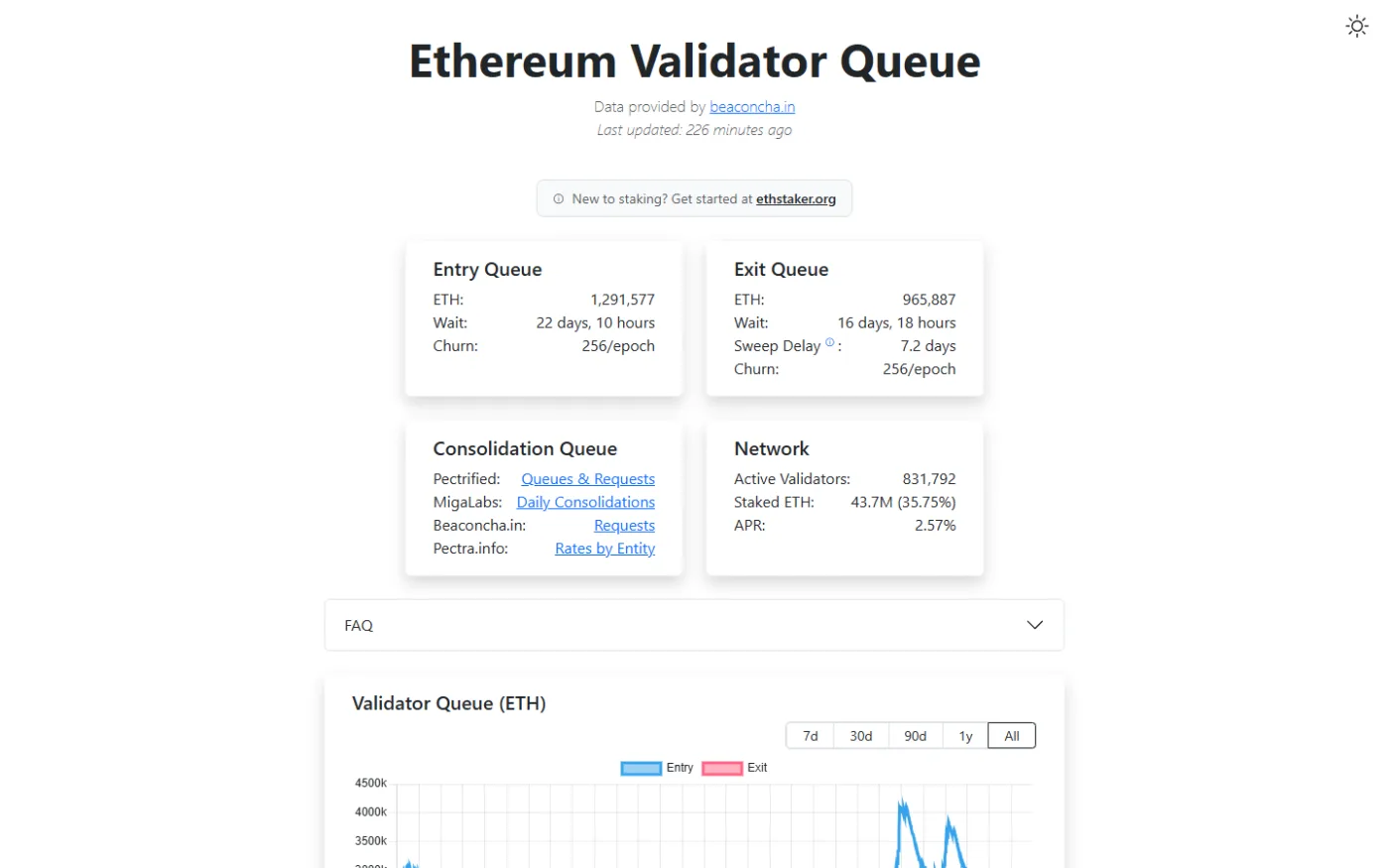
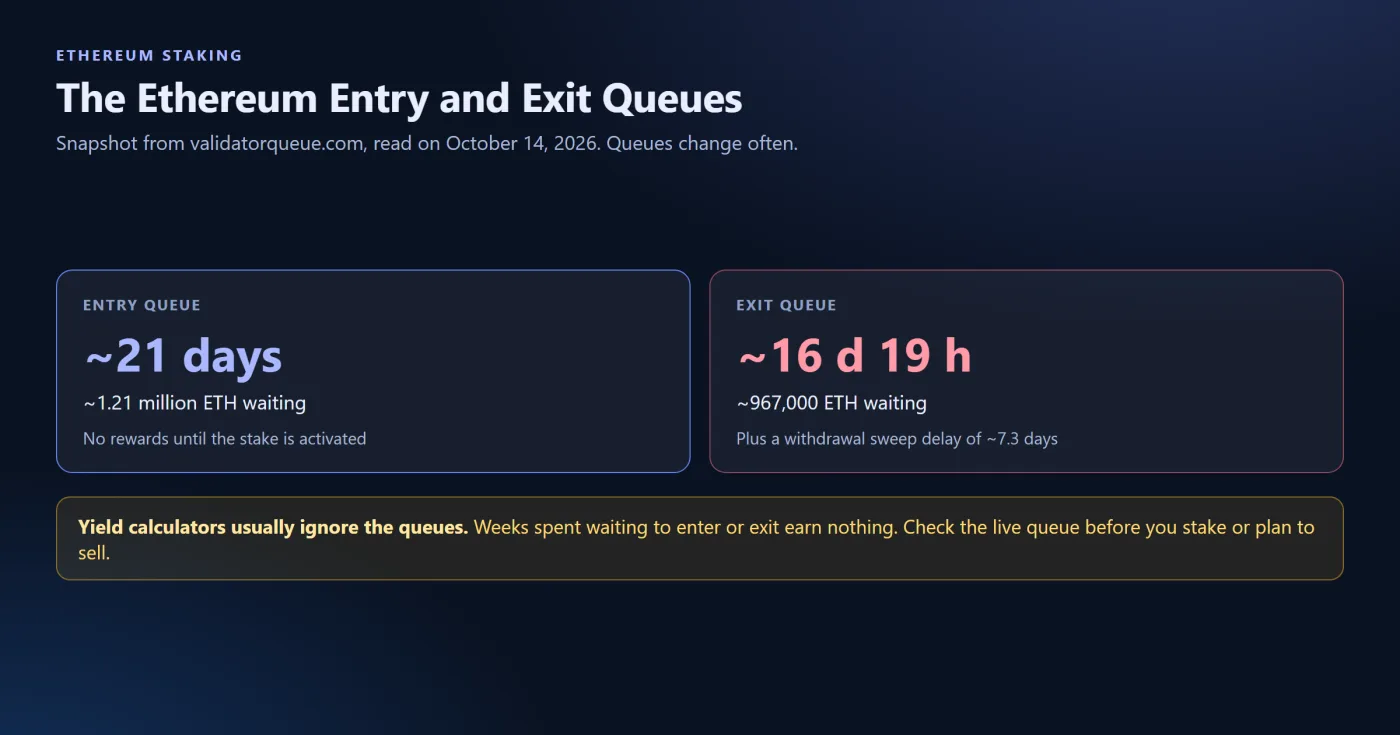
Entering and exiting the validator set is limited by a churn limit. A snapshot of validatorqueue.com, read for this article on October 14, 2026 (the page shows no timestamp), listed about 1.21 million ETH waiting to enter, with a wait of about 21 days, and about 967,000 ETH waiting to exit, with a wait of about 16 days and 19 hours, plus a sweep delay of about 7.3 days.
Staking Rewards says that exits enter a queue and that waits can range from hours to weeks in periods of high demand. These queue sizes change often, and a staker who needs to exit should check the live value first. A stake in the entry queue does not earn rewards until it is activated, which is a cost that yield calculators often ignore.
Share of Supply and Large Holders
Staking Rewards showed 35.91% of the ETH supply staked on October 14, 2026, and Ethereum.org gave 35% on a page with a questionable date. For BitMine, The Block reported on April 23, 2026, that about 3.5 million ETH was staked, which Lookonchain described as 70.1% of its holdings, and that the company controlled more than 4.1% of ETH supply against a target of 5%. The same article says BitMine launched its in-house MAVAN staking platform in March 2026 and plans to migrate its ETH there, but that recent allocations still went through Coinbase Prime. It also reports that BitMine projects annual staking rewards of nearly $300 million once fully migrated, based on a 2.83% seven-day yield. Those are the company's projections as reported, and the holdings were not confirmed by BitMine in that article.
Large holders matter because they raise the share of staked supply, which in turn lowers the reward per validator.
Is Staking Ethereum Worth It?
The answer depends on the individual. The sources describe the following trade-offs, without recommending any of them:
-
Reward. About 2.5% to 2.6% per year in the snapshots found, paid in ETH. It does not protect against a fall in the ETH price.
-
Liquidity. Exits and entries can take weeks, and liquid tokens trade that for added risk.
-
Penalties. Missed votes reduce rewards, and slashing burns part of the stake for provable misbehaviour, with a 36-day removal period, according to Staking Rewards and Ethereum.org.
-
Effort and fees. Solo staking needs hardware and uptime, while pools and providers take a fee, such as the 5% fee Staking Rewards lists for P2P.org.
-
Taxes. Staking Rewards advises consulting legal counsel on tax and regulatory treatment, which varies by jurisdiction.
What to Check Live Before You Stake
-
The current reward rate, its date, and whether it is APR or APY, and net of fees.
-
The entry and exit queue lengths.
-
The provider's fee, withdrawal rules, and the token's price against ETH if it is liquid staking.
-
The minimum amount and the type of withdrawal credentials, if you stake alone.
-
The staking ratio, since it moves the rate.
Never enter a recovery phrase on a website to start staking. A staking transaction is approved inside the wallet, and no provider needs the recovery phrase.
This article is educational and is not investment advice. Staking involves risk, and each reader should compare the live data with their own situation.
Related guides


 Scroll to top