


Polygon Staking Calculator: POL Rewards and Gas Costs


Table of contents

A Polygon staking calculator needs the amount of POL, the annual reward rate, the validator's commission, how often you claim and restake, and the time. Polygon adds two practical details that a basic calculator misses: rewards are not compounded automatically, so each claim or restake is a separate transaction that costs ETH gas, and unstaked POL is locked for an unbonding period that sources put at between about 1.5 and 4 days. MATIC is the former name of the token, and the current staking token is POL.
This guide explains the formula, the inputs that change the result, and the rules that affect real returns. It does not include a built-in calculator. All numeric examples are hypothetical and were computed for this article.
The Formula Behind a POL Staking Calculator
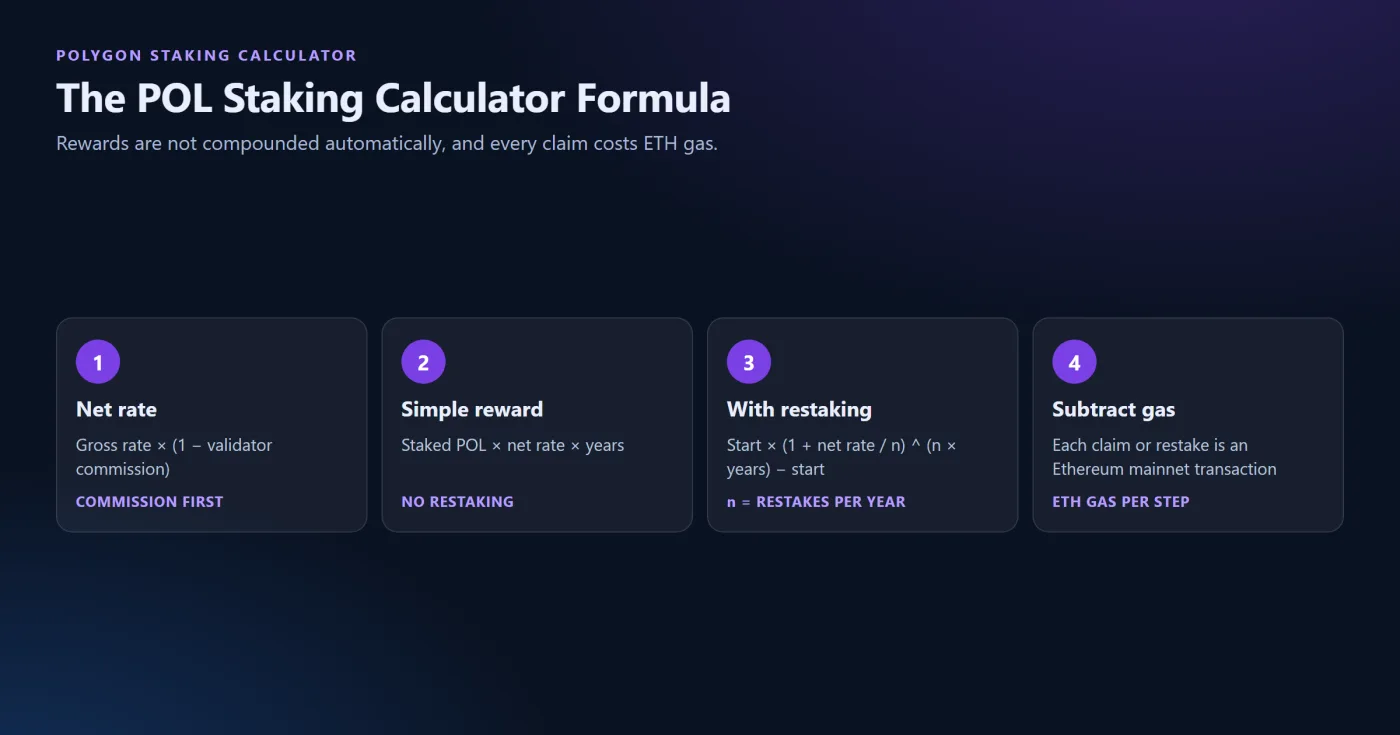
Blockdaemon's documentation says that rewards are issued at each checkpoint and accumulate in the contract, and that a delegator must claim them with an on-chain transaction. A calculator that models this works in three steps:
-
Net rate = gross rate x (1 - validator commission).
-
Yearly reward without compounding = staked POL x net rate x years.
-
Reward with compounding = starting POL x (1 + net rate / n) ^ (n x years) - starting POL, where n is the number of times per year you claim and restake.
Because staking happens on the Ethereum mainnet contract, according to Staking Rewards, each claim or restake costs ETH gas. The calculator should treat gas as a cost per transaction and subtract it for every compounding step, which most online calculators do not do.
Which Rate to Enter
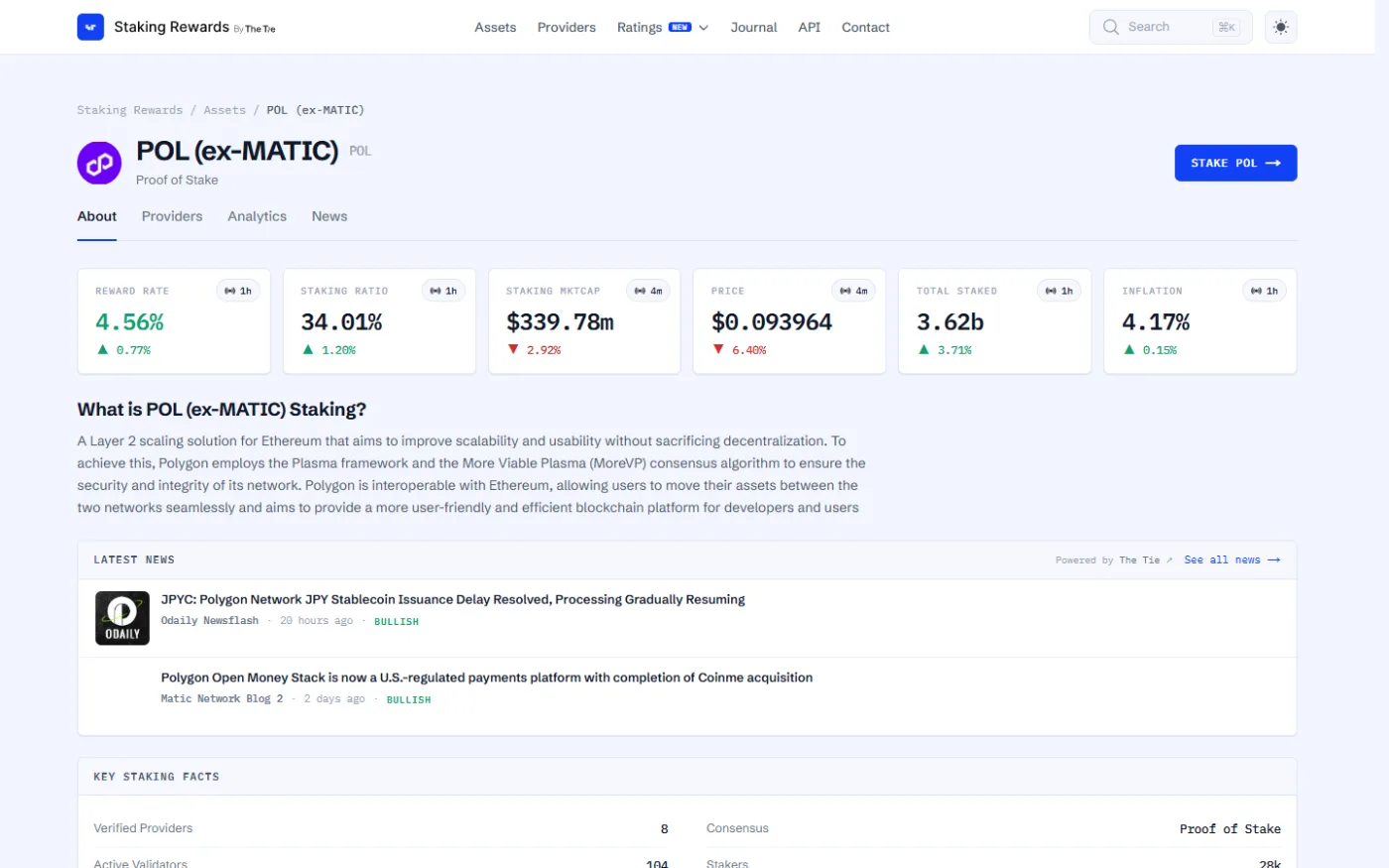
Staking Rewards showed a reward rate of 3.69% APY on October 14, 2026, with inflation at 3.61%, a staking ratio of 33.1%, and 3.52 billion POL staked. Other sources give different numbers. Blockdaemon's documentation says inflation is about 5% currently and expected to fall as the supply approaches the 10 billion POL cap, and Ledger's page mentions up to 5% to 6% APR, or about 3% adjusted, referring to Staking Rewards. The sources differ in date and method, so the rate should be taken from a live source and its date noted.
Whether a rate is APR or APY, and whether it is before or after commission, changes the calculation. Staking Rewards lists a benchmark commission of 4.35% and top providers at 0% to 1% fees, which suggests that commission is a smaller factor on Polygon than the rate itself.
Commission
Validators charge a commission on the rewards of their delegators. The Blockdaemon page read for this article does not mention commission rates, so the figure must be taken from the validator's page in the wallet or on the staking dashboard. A calculator should treat commission as a separate input, and it is worth running the calculation with a higher value to see how much it matters.
Worked Examples (Hypothetical)
These are illustrations, not forecasts or observed results. They assume a constant 3.69% rate, treated as the rate you receive after commission, and no change in the POL price or gas costs.
-
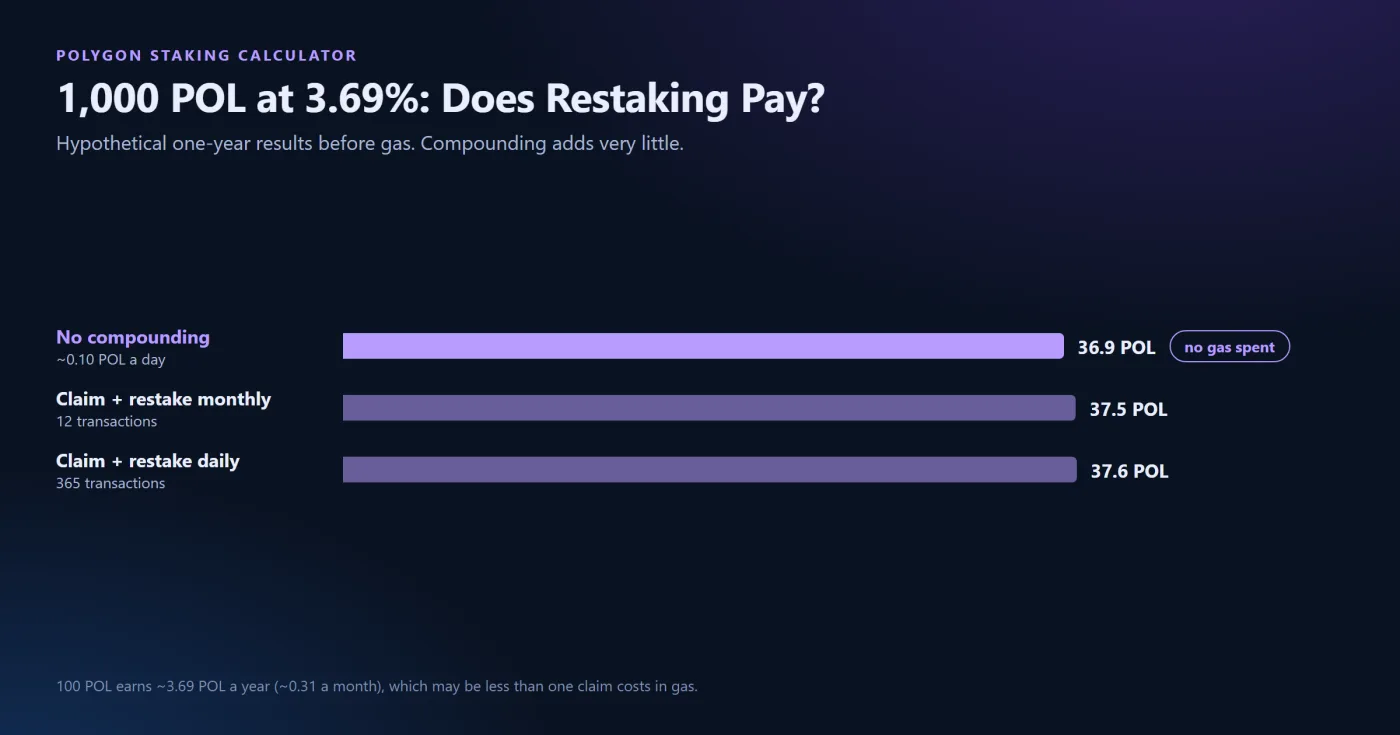
1,000 POL for one year without compounding: 36.9 POL, or about 0.10 POL per day.
-
The same stake if the reward is claimed and restaked monthly: about 37.5 POL, before gas.
-
With daily compounding: about 37.6 POL. The extra is small, and each restake costs gas.
-
100 POL for one year without compounding: 3.69 POL, or about 0.31 POL per month. A small stake may earn less than a single claim costs in gas, so compare the reward with your own gas quote before claiming.
Restake Minimums
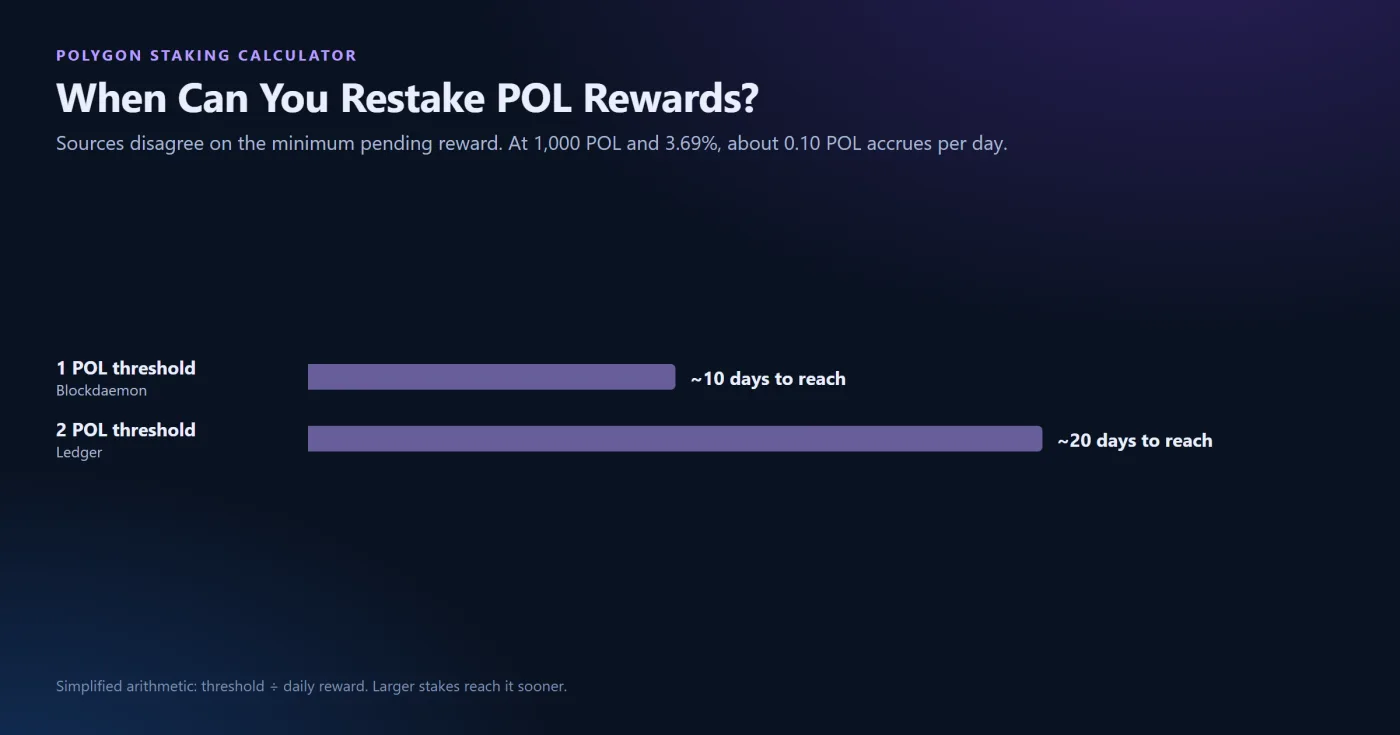
Sources disagree on how large the reward must be before it can be restaked. Blockdaemon says you can restake only when pending rewards reach at least 1 POL, while Ledger's page says withdrawing or restaking requires at least 2 POL. For 1,000 POL at 3.69%, about 0.10 POL accrues per day, so a 1 POL threshold would be reached in about 10 days and a 2 POL threshold in about 20 days, according to this simplified arithmetic.
Unbonding and Timing
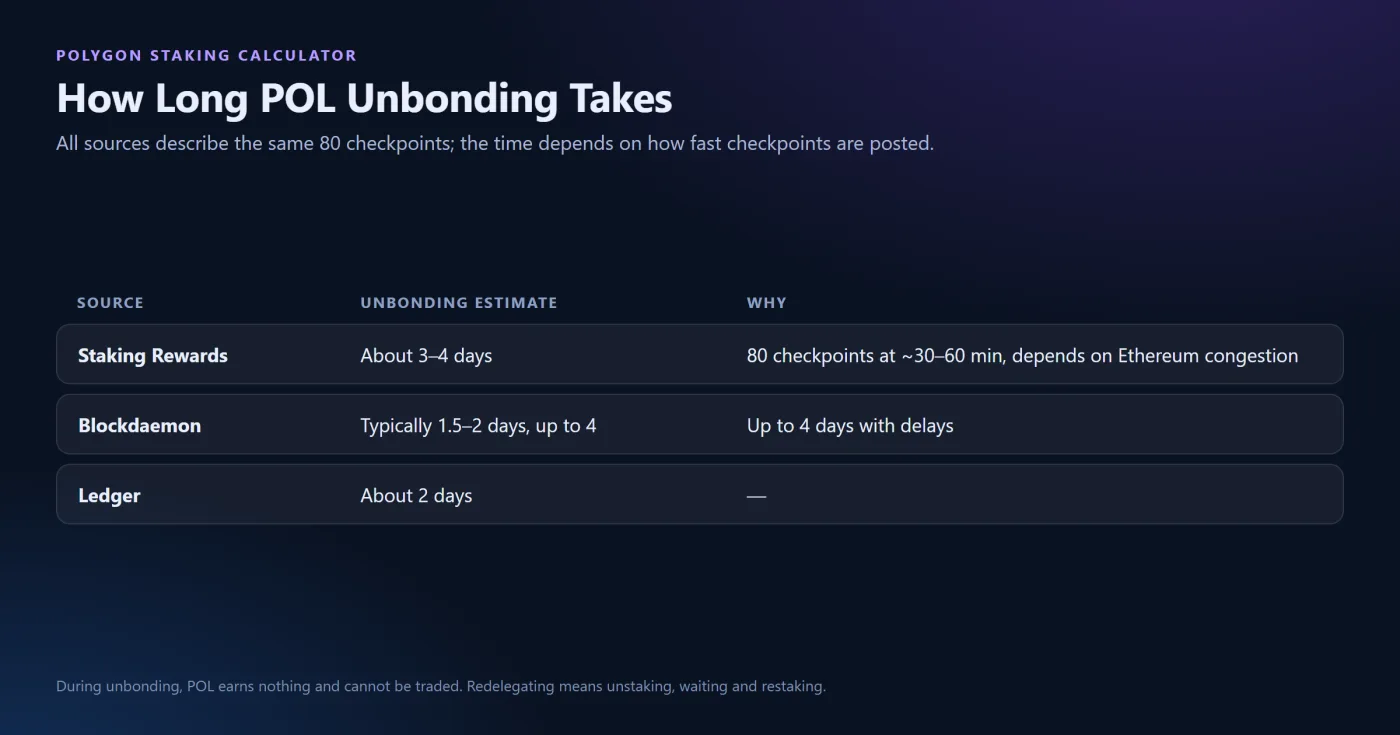
Sources give different unbonding periods for undelegating POL. Staking Rewards says about 3 to 4 days, based on 80 checkpoints with each checkpoint taking roughly 30 to 60 minutes depending on Ethereum congestion. Blockdaemon says typically 1.5 to 2 days and up to 4 days with delays, and Ledger says about 2 days. All describe the same 80-checkpoint mechanism, so the actual time depends on how fast checkpoints are posted. During unbonding, tokens earn no rewards and cannot be traded, according to Staking Rewards.
Blockdaemon states that there is no fixed bonding time when delegating, and Ledger says rewards accrue from the upcoming checkpoints. For a calculator, the delay at the start is small, but the unbonding days at the end are not earning time.
Minimum Stake and the Validator Set
Blockdaemon lists a minimum stake of 1 POL, while Staking Rewards does not state a minimum. Ledger says up to 100 validators secure the network, and Staking Rewards says the active set is the top 100 by stake. Its key facts list 104 active validators, and the page does not explain the difference. A validator that drops out of the active set stops earning rewards for its delegators.
Staking Rewards also notes that redelegating means unstaking, waiting for the unbonding period, and restaking, and that delegating gives your governance voting rights to your validator.
Slashing and Risks
Staking Rewards says slashing is not currently active, though future governance could enable it, and that validators can be jailed for poor performance, which pauses rewards for their delegators. Blockdaemon says that an underperforming validator reduces its rewards and yours, and can be ejected from the network if violations persist. Gas costs, a falling reward rate, and the POL price are the other factors that a calculator does not control. Staking Rewards adds that each reward claim may be a taxable event in many jurisdictions, which a reader should check locally.
MATIC and POL
The token was migrated from MATIC to POL at a 1:1 ratio, a process that Staking Rewards says was completed on September 4, 2024 and is 99% done. The page says the migration contract still converts remaining MATIC 1:1. A calculator for "MATIC staking" should therefore use POL amounts, and anyone holding old MATIC should confirm the migration steps with an official source before staking.
What to Check Live Before You Calculate
-
The current reward rate, its date, and whether it is net of commission.
-
The validator's commission, rank, and whether it is in the active set.
-
The unbonding period stated in the wallet or dashboard.
-
The minimum for claiming and restaking, and the current ETH gas cost of each.
-
Whether any MATIC you hold has been migrated to POL.
Never enter a recovery phrase on a website to start staking. Delegating is approved inside the wallet, and no validator or calculator needs the recovery phrase.
This article is educational and is not investment advice. Staking involves risk, and each reader should compare the live data with their own situation.
Related guides


 Scroll to top