


Solana Staking: Current APY, Platforms, and How to Stake


Table of contents

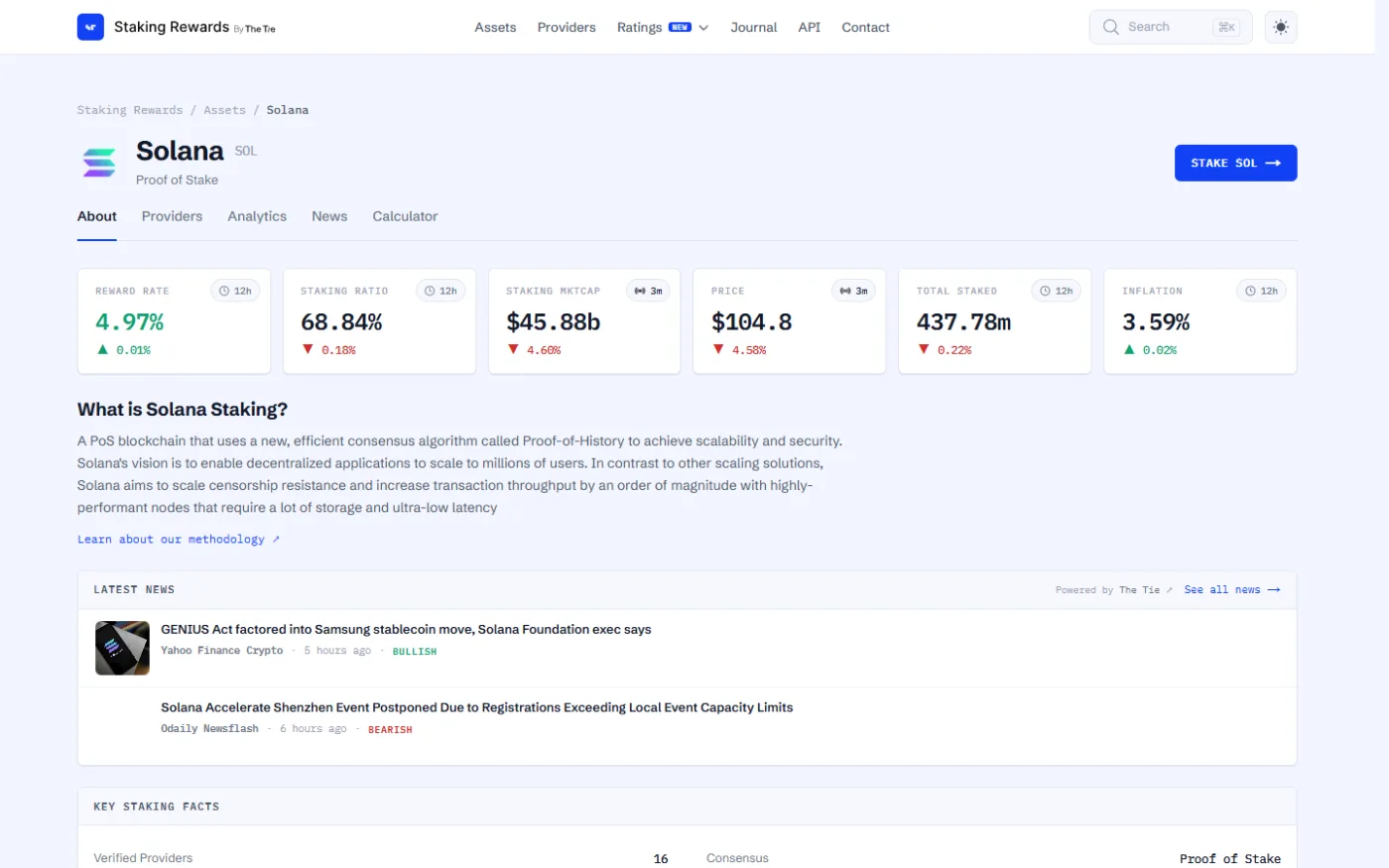
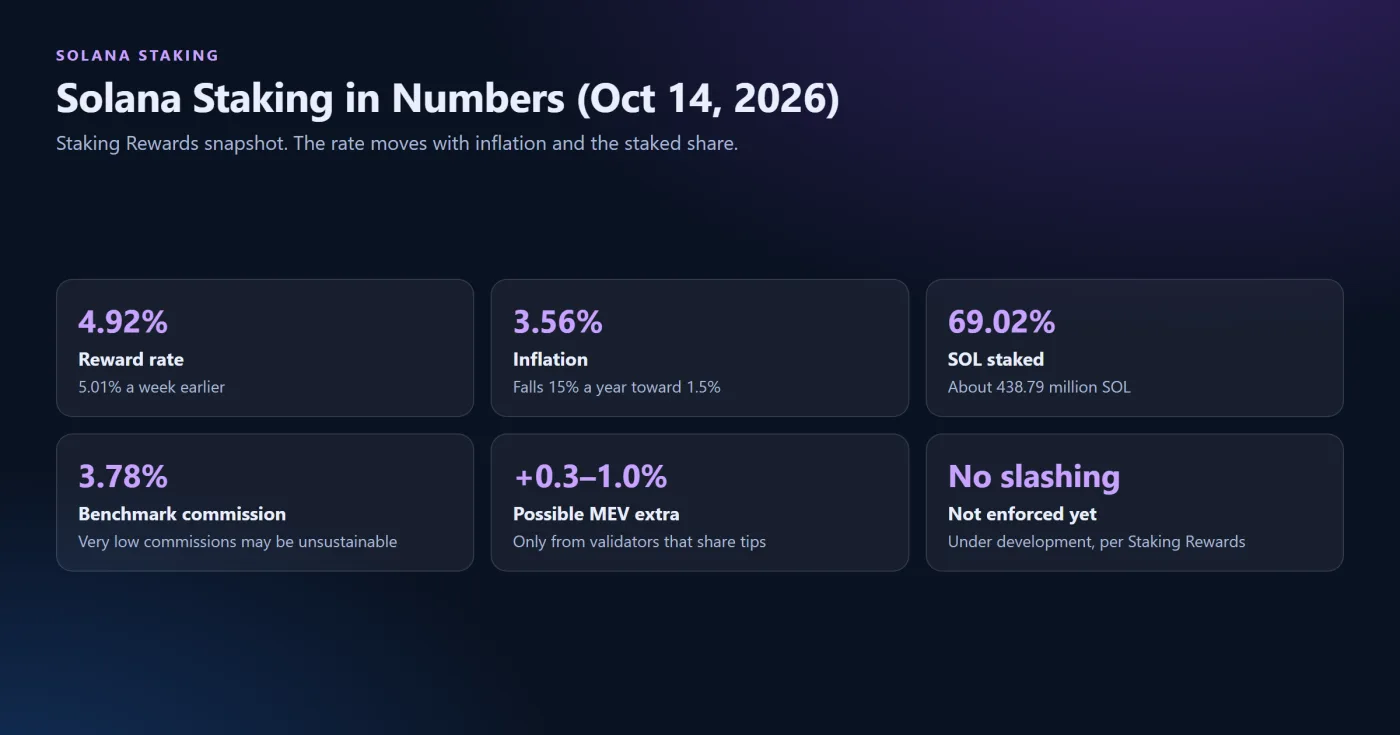
Solana staking currently pays about 5% per year. Staking Rewards showed a reward rate of 4.92% on October 14, 2026, with 69.02% of SOL staked, down from 5.01% when read a week earlier. The rate is not locked in: it moves with inflation and with the share of SOL that is staked. Native staking compounds automatically each epoch (about two days) and has no lockup, but unstaking takes one epoch, during which SOL earns nothing.
This guide covers the current rate and why it changes, how to stake in a wallet such as Phantom, the main ways to stake including liquid staking, the risks, and what a JitoSOL exchange-traded product is. Numbers marked as snapshots change quickly, so each section says what to check live.
Current Solana Staking APY
Staking Rewards listed the following for Solana on October 14, 2026: a reward rate of 4.92%, inflation of 3.56%, a staking ratio of 69.02%, and about 438.79 million SOL staked, with a benchmark commission of 3.78%. These figures are third-party snapshots, and the same page showed 5.01% a week earlier, so a small drift is normal.
A different source, a January 13, 2026 article from Sanctum, gives 5.96% over the last 10 epochs for jitoSOL and 6.66% for mSOL, and a range of 5% to 8% for native staking. Those figures are undated, come from a company that promotes its own product, and are not comparable with the Staking Rewards snapshot. This article did not find a dated, independent history of the Solana rate for early 2025 or 2026, so it does not give month-by-month values. The practical rule is to read the current number from a live source with a date, and to check whether it is before or after commission.
Is the Solana Staking Rate Locked In?
No. The Solana documentation describes an inflation schedule that starts at 8% and falls by 15% each year until it reaches a long-term rate of 1.5%, with all issuance going to stakers and validators. A proposal to lower inflation faster, SIMD-0228, failed in March 2025 with 61.39% approval against the 66.67% needed, according to Traders Union. Besides inflation, the reward per staked SOL falls as the staking ratio rises, as Staking Rewards notes.
What Adds to the Base Rate
MEV tips can add yield, but Staking Rewards says they are highly variable and reach delegators only if the validator shares them. It suggests modelling an extra 0.3% to 1.0% for validators that verifiably share tips, and that figure is not part of the 4.92% headline rate.
How to Stake SOL in Phantom
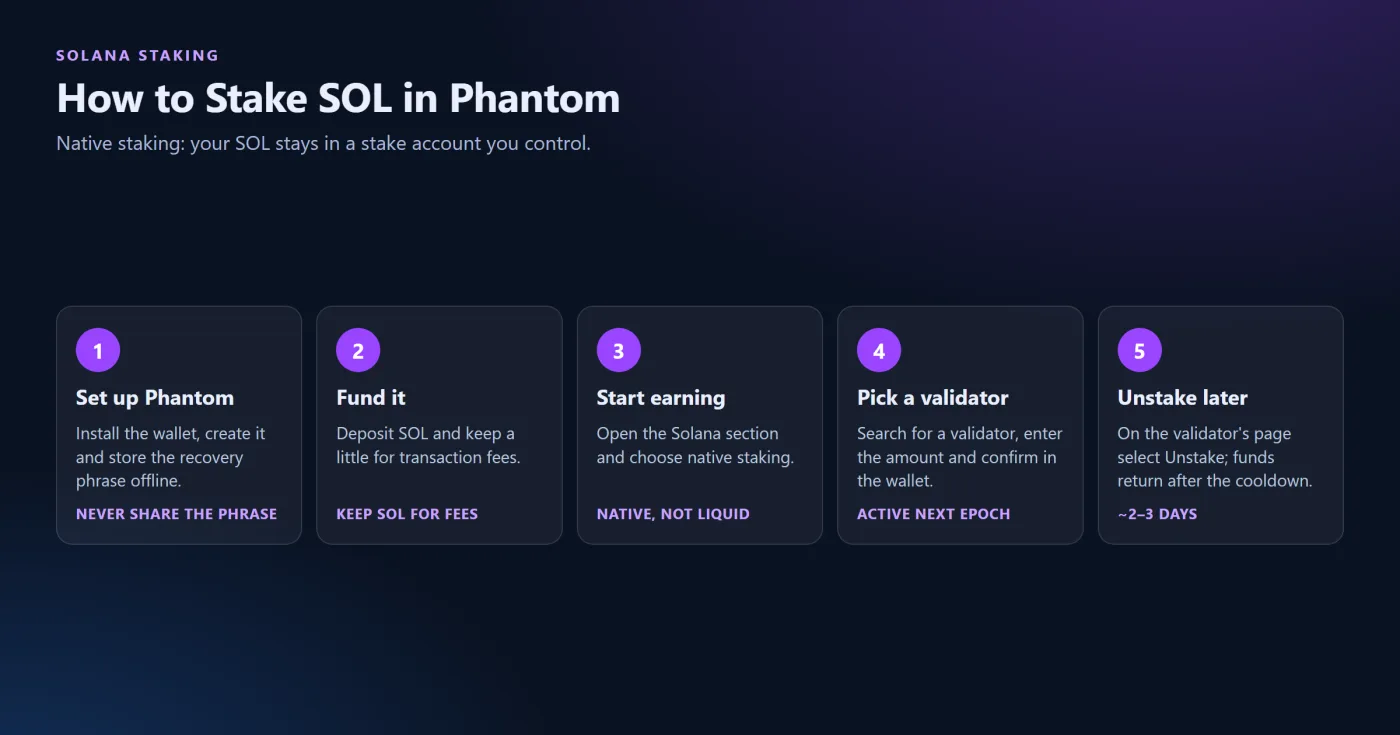
A guide from Stakin, published in 2021 and last modified in October 2024, describes the steps for native staking in Phantom. The interfaces were not tested for this article, and the screenshots in that guide are from 2024, so the labels may have changed.
-
Install the wallet, create it, and store the recovery phrase offline.
-
Fund the wallet by depositing SOL, and keep a small amount for transaction fees.
-
Open the Solana section, choose the option to start earning, and select native staking.
-
Search for a validator, enter the amount to delegate, and confirm.
-
To unstake, open the validator's page and select Unstake. Stake that is still activating cannot be unstaked, and the funds return to the wallet after the cooldown.
Never enter a recovery phrase on a website to "activate" staking. Delegating is approved inside the wallet. The same process works in other wallets such as Solflare, according to ParaFi Tech's guide, though labels vary.
How Native Solana Staking Works
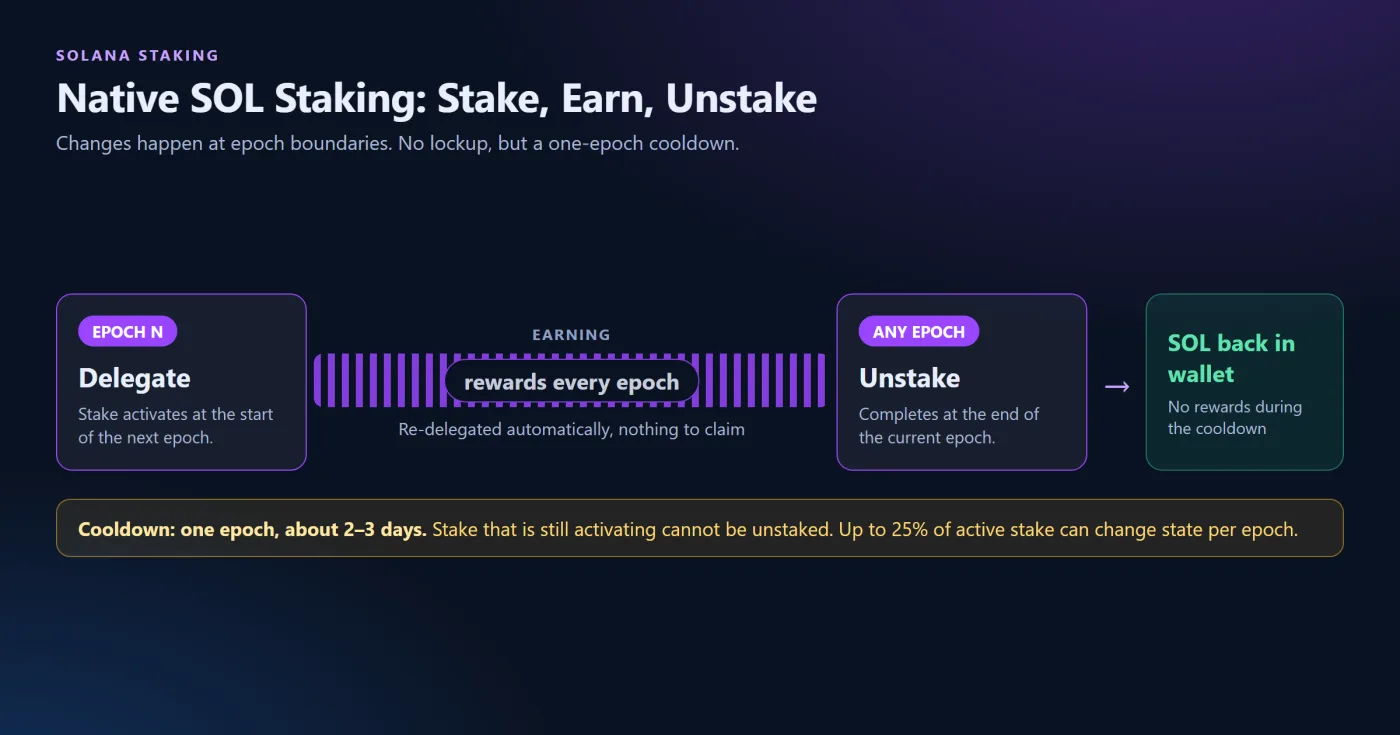
SOL stays in a stake account that you control, and each stake account can delegate to only one validator, according to the Solana documentation. Changes take effect at epoch boundaries, so stake activates at the start of the next epoch, and unstaking completes at the end of the current one. Staking Rewards puts the cooldown at one epoch, about two to three days, with a network limit of 25% of active stake changing state per epoch.
Rewards are computed once per epoch and automatically re-delegated into the stake account, according to the Solana economic documentation, so no manual claim is needed.
Choosing a Validator
-
Commission. Staking Rewards shows a benchmark of 3.78%. Commissions far below the norm may signal unsustainable economics, the page notes.
-
Performance. Downtime or poor performance reduces rewards, which is the main practical risk today.
-
MEV sharing. Only validators that share tips pass that extra to delegators.
-
Concentration. Staking Rewards lists Solana's single-client architecture and past outages as network-level risks.
-
Moving later. Moving stake to another validator requires unstaking, waiting out the epoch, and restaking, as Jupiter's staking page describes.
Liquid Staking on Solana
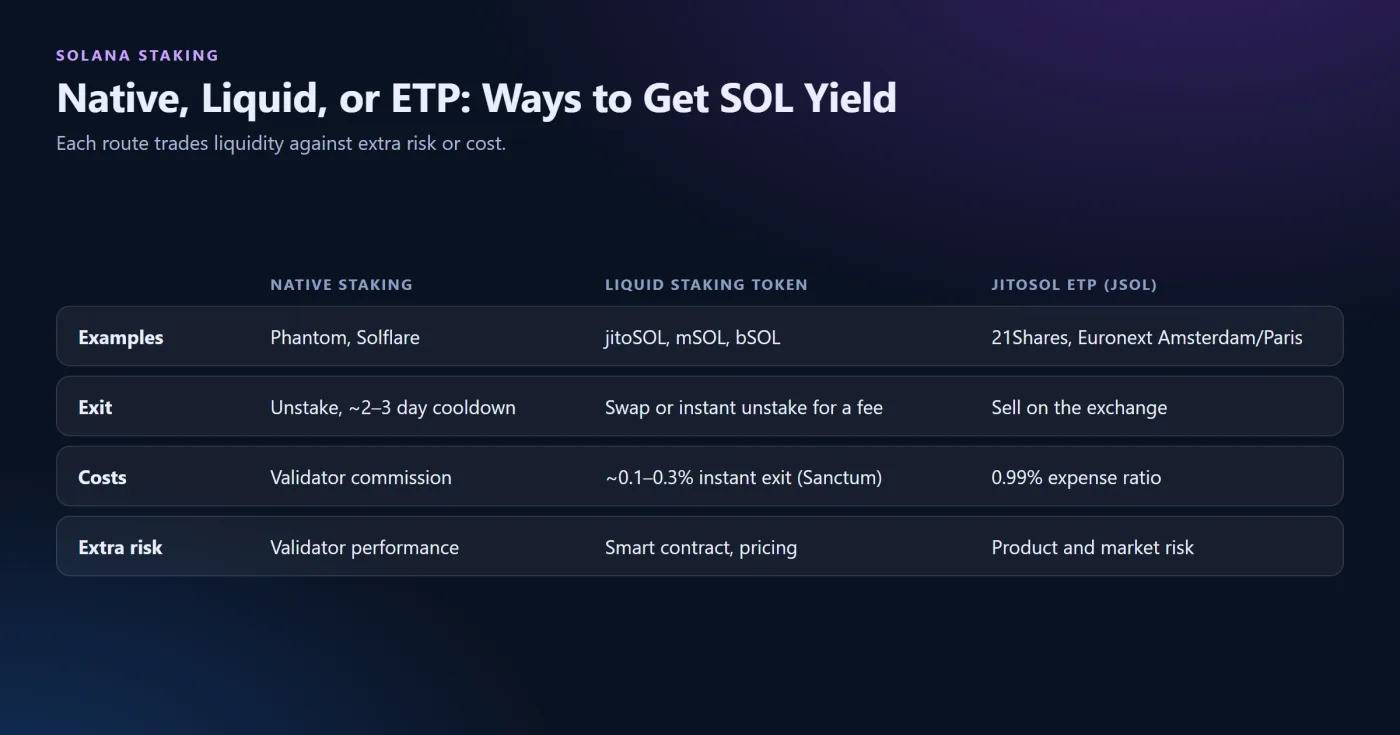
Liquid staking tokens (LSTs) such as jitoSOL, mSOL, and bSOL avoid the unbonding delay and can be used in DeFi, according to Staking Rewards, but they add smart contract risk. The page says the jitoSOL pool distributes 100% of MEV tips to holders. Sanctum's article lists platforms including Sanctum, Jupiter, Phantom, Jito, and Marinade, and notes that fees vary: Sanctum states a 0.1% to 0.3% fee for instant unstaking through its pool, while Jupiter's swap route typically costs about 0.3%. The article is published by Sanctum, so its fee and performance claims are not independently verified.
The same source lists trade-offs worth knowing: single-token liquidity pools can give unpredictable prices in volatile markets, and Jito and Marinade support only their own tokens. Native staking has no such pricing risk.
The JitoSOL ETP (JSOL)
The Block reported that 21Shares announced the Jito Staked SOL ETP on January 29, 2026, with the ticker JSOL, listed on Euronext Amsterdam and Euronext Paris in US dollars and euros. It gives exposure to JitoSOL, so the holder has SOL price exposure and earns staking rewards plus a share of Jito's infrastructure revenue, with a total expense ratio of 0.99%. It is a European exchange-traded product, not a stock, and this article did not verify any listing outside Euronext.
Risks and Costs
Staking Rewards states that Solana's slashing mechanism is under development and has not been actively enforced. The risks that exist today are underperforming validators, opportunity cost during the cooldown, smart contract risk in liquid staking, and the SOL price, which can fall by more than the rewards earn. Solana has had multiple outages, as Staking Rewards also notes.
Is Staking Solana Worth It?
The sources do not answer that question, since it depends on the holder's goals and on liquidity needs. They show what is being weighed: a reward of about 5% per year in the current snapshot, paid in SOL and not protected from price moves, against a two-to-three-day cooldown, validator quality, and, for liquid staking, extra contract and pricing risk. Holders who do not stake are diluted by inflation, since new issuance goes to stakers.
What to Check Live Before You Stake
-
The current reward rate, its date, and whether it includes commission and MEV.
-
The validator's commission, performance, and MEV policy.
-
The cooldown shown in the wallet and any fees for liquid staking exits.
-
Whether the wallet labels the option as native or liquid staking.
-
The staking ratio and inflation, since both move the rate.
This article is educational and is not investment advice. Staking involves risk, and each reader should compare the live data with their own situation.
Related guides


 Scroll to top