


Solana Unstaking Period: Cooldown, Epochs, and Instant Exit


Table of contents

Unstaking native SOL takes until the end of the current epoch, which Jupiter's staking page describes as up to about two days, and Staking Rewards describes as one epoch of about two to three days. The exact wait depends on when in the epoch you start: a request made early in an epoch waits close to the full epoch, and one made near the end waits much less. Solana does not have a fixed unbonding timer like some other networks, and the SOL is not available until the stake account is fully deactivated.
This guide explains how deactivation works, how to estimate the wait, what happens to rewards in the meantime, and how instant-unstake options on liquid staking tokens differ from native unstaking. It does not rank tokens. Fees and rates marked as snapshots change quickly.
How Long Unstaking Takes
Jupiter's staking page states that unstaking follows Solana's epoch schedule and finishes at the end of the current epoch, which can take up to about two days depending on when you unstake. Staking Rewards gives one epoch, roughly two to three days, and notes that unstaking requires a full epoch cooldown. The Solana economic documentation describes an epoch as approximately two days. The sources differ slightly because epoch length varies a little, so the figures are best read as a range of about one to three days.
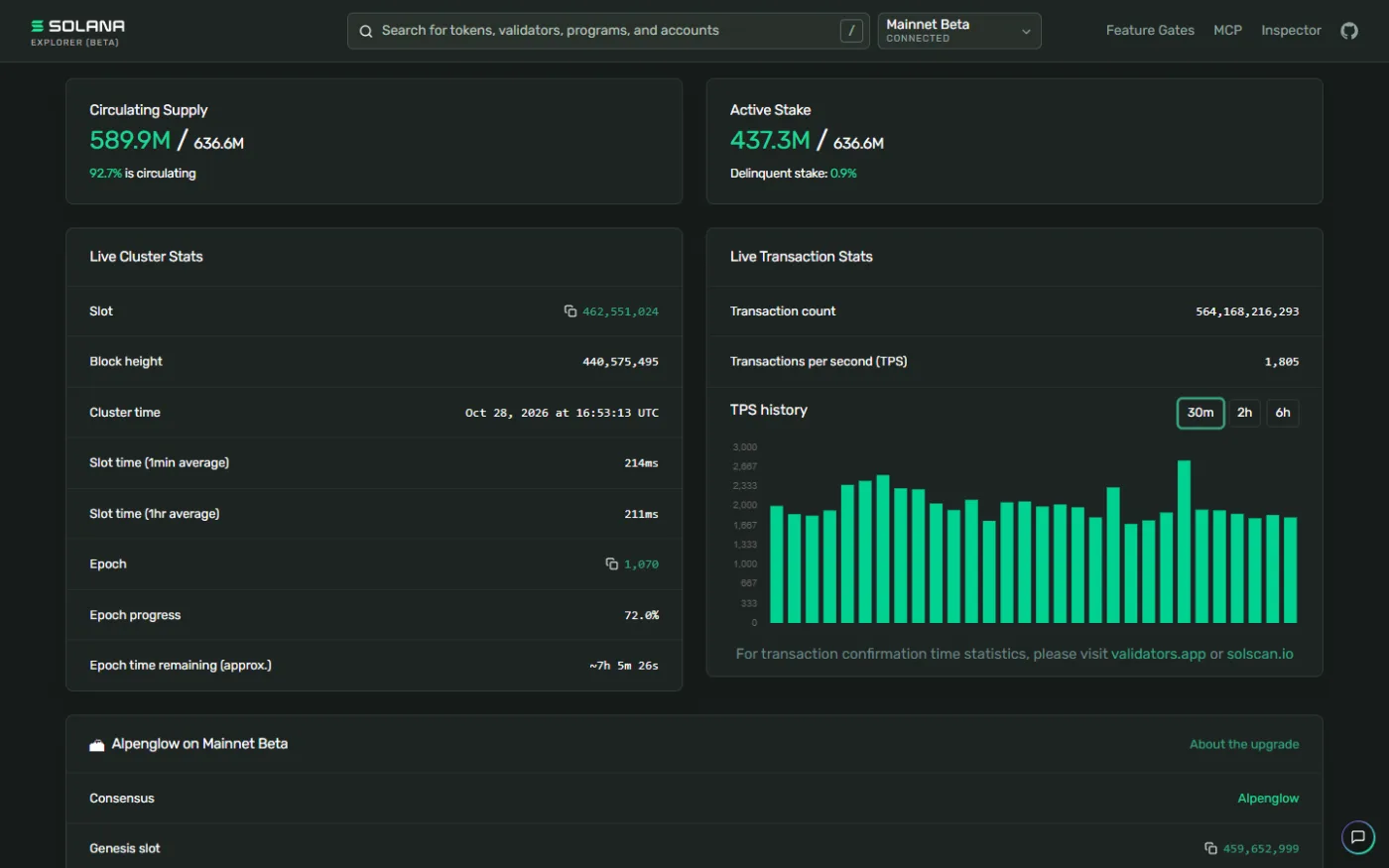
The Solana terminology page defines an epoch by the number of slots for which a leader schedule is valid and gives no fixed duration. A plan that depends on the exact hour of withdrawal should check the epoch progress in an explorer.
A Hypothetical Timeline
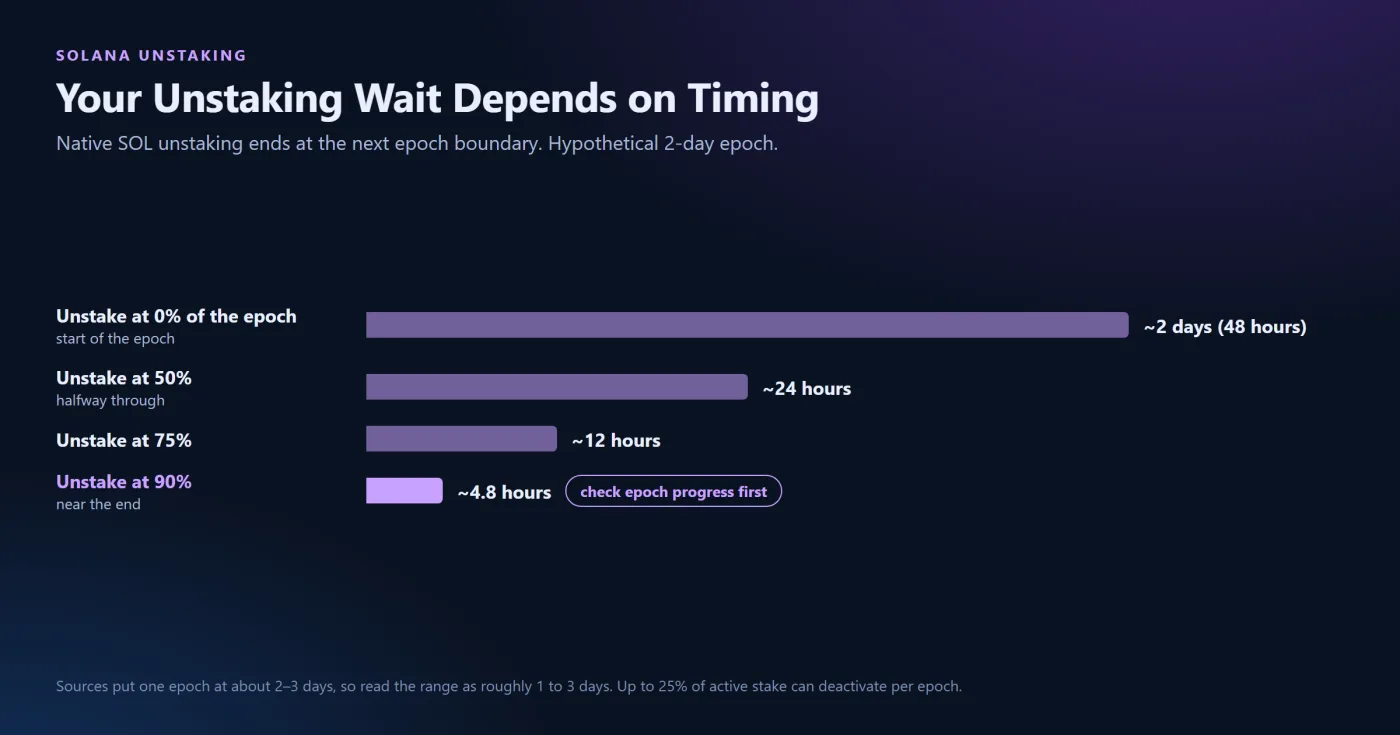
This is an illustration, not an observed result. Suppose an epoch lasts two days and you deactivate a stake account at the start of it. The funds would become withdrawable at the end of that epoch, roughly two days later. If you deactivate when 90% of the epoch has passed, the wait would be about five hours. The same account activating a new stake after a withdrawal would also wait for an epoch boundary before earning.
How Deactivation Works
The Anza documentation describes the process. The staker signs a Deactivate instruction, the stake ramps down, and its lamports become available for withdrawal after the cooldown. Changes take effect at epoch boundaries, and the network limits how much stake can change state in each epoch. The documentation gives a warmup rate of 25% per epoch and says that cooldown works the same way, and Staking Rewards also lists a limit of 25% of active stake per epoch.
In practice a small unstake is processed in the first boundary, but a very large unstake across the network at the same time could take more than one epoch. The page read for this article does not give an example of how often that happens.
Do Rewards Continue During the Cooldown?
Sources disagree. The Anza documentation says that deactivating stake keeps earning rewards and stays exposed to slashing until it fully cools down. Jupiter's page says the SOL does not earn rewards during the unlock period, and Staking Rewards says the same about the cooldown. The disagreement may come from how each source treats the final epoch, and this article could not settle it. The safe assumption for planning is that rewards for the cooldown epoch should not be counted on.
Partial Unstaking and Withdrawal Steps
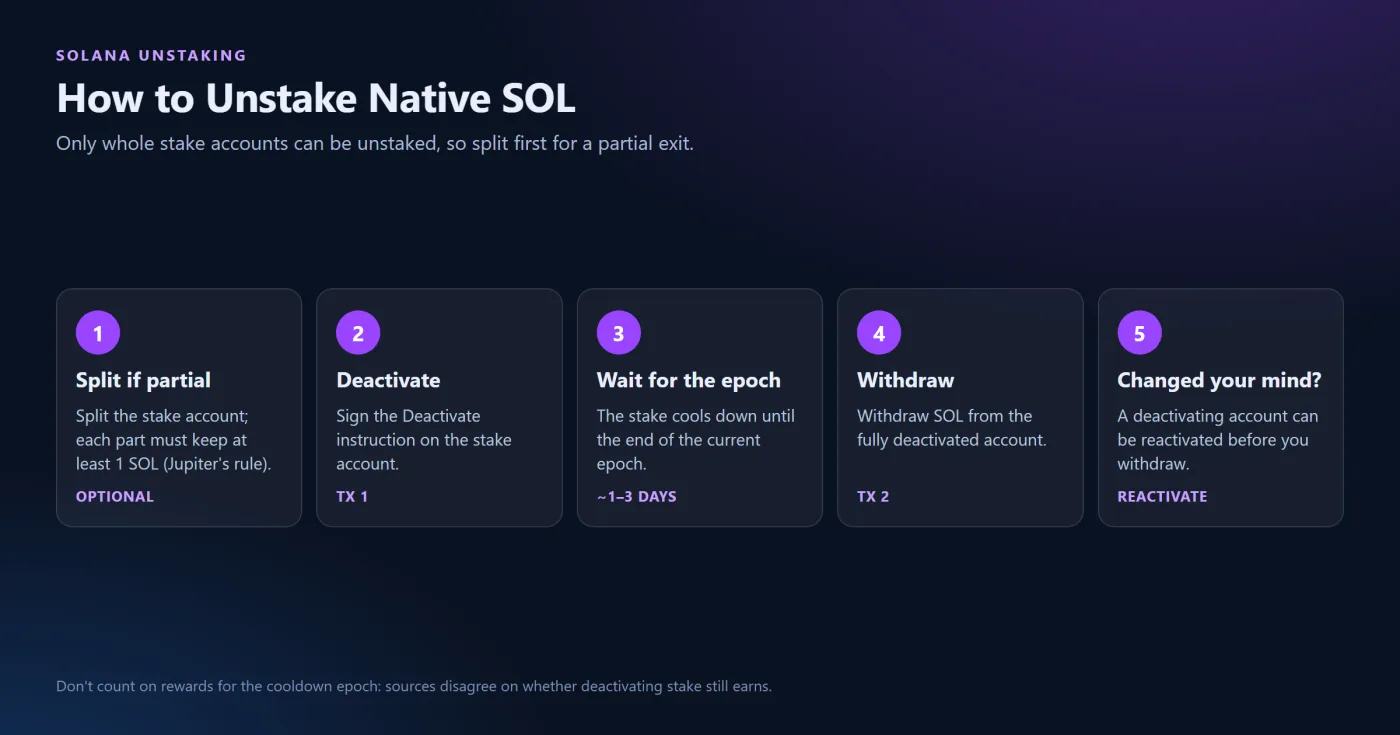
Jupiter's page states that only whole stake accounts can be unstaked, so a partial unstake requires splitting the account first. It also states that every stake account must keep at least 1 SOL, so both resulting accounts must stay above that minimum. This is the wallet's or provider's rule, and the protocol minimum was not covered by the sources read.
-
Start unstaking (deactivation) on the stake account.
-
Wait until deactivation completes at the end of the epoch.
-
Withdraw the SOL from the fully deactivated account.
-
If you change your mind before withdrawing, a deactivating account can be reactivated, according to Jupiter.
Instant Unstaking With Liquid Staking Tokens
Liquid staking tokens (LSTs) let a holder exit without waiting for the epoch, because the exit is a swap or a liquidity-pool withdrawal and not a deactivation. Sanctum's guide, published on January 14, 2026, describes two methods. Instant unstaking pays SOL within seconds from a reserve pool, for a variable fee that is typically around 0.1% and can rise when many users unstake. Delayed unstaking converts the LST to a stake account that deactivates at the end of the epoch, for a fixed fee of 0.1%, with a wait of about two to three days.
The guide notes that obscure LSTs can have high slippage when liquidity is thin. Sanctum is a seller of these services, so its descriptions are promotional and its fee claims are unverified.
How Common LSTs Compare
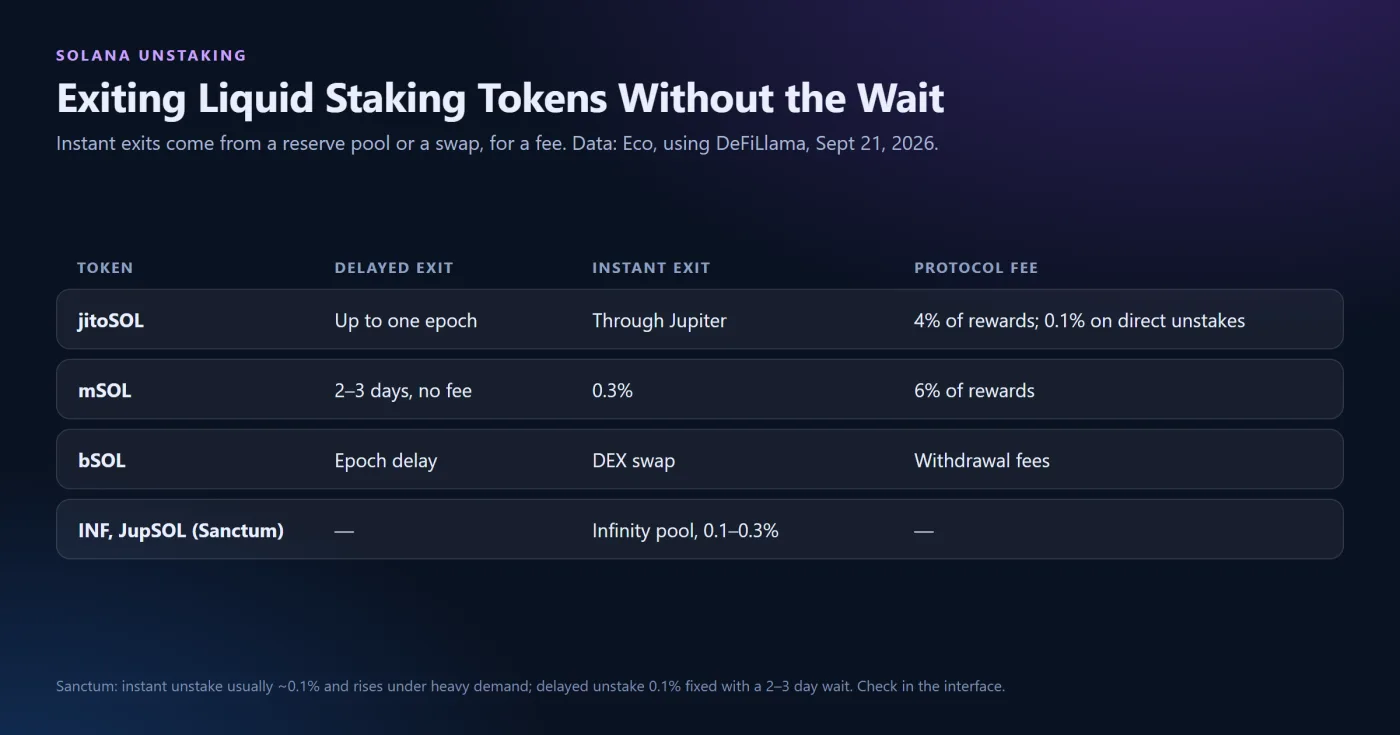
An article from Eco, using data from DeFiLlama as of September 21, 2026, lists the following. It is a vendor article that sells other services, and its figures come from third-party trackers on one date.
-
jitoSOL. Delayed unstaking of up to one epoch, or instant through Jupiter; a protocol fee of 4% of rewards and 0.1% on direct-website unstakes.
-
mSOL. Delayed unstaking of two to three days without a fee, or instant at 0.3%; a protocol fee of 6% of rewards.
-
bSOL. An epoch delay or a DEX swap, with withdrawal fees.
-
INF and JupSOL (Sanctum). Near-instant exit through the Infinity pool, with an instant-unstake fee of 0.1% to 0.3%.
The same article contradicts itself on jitoSOL: its table says near-instant, while its text describes an epoch delay as the default. Because of this, the speed of any exit should be checked in the interface before committing funds. The article does not support its claims about which token has the thinnest or deepest liquidity with figures.
What Instant Exit Costs, Hypothetically
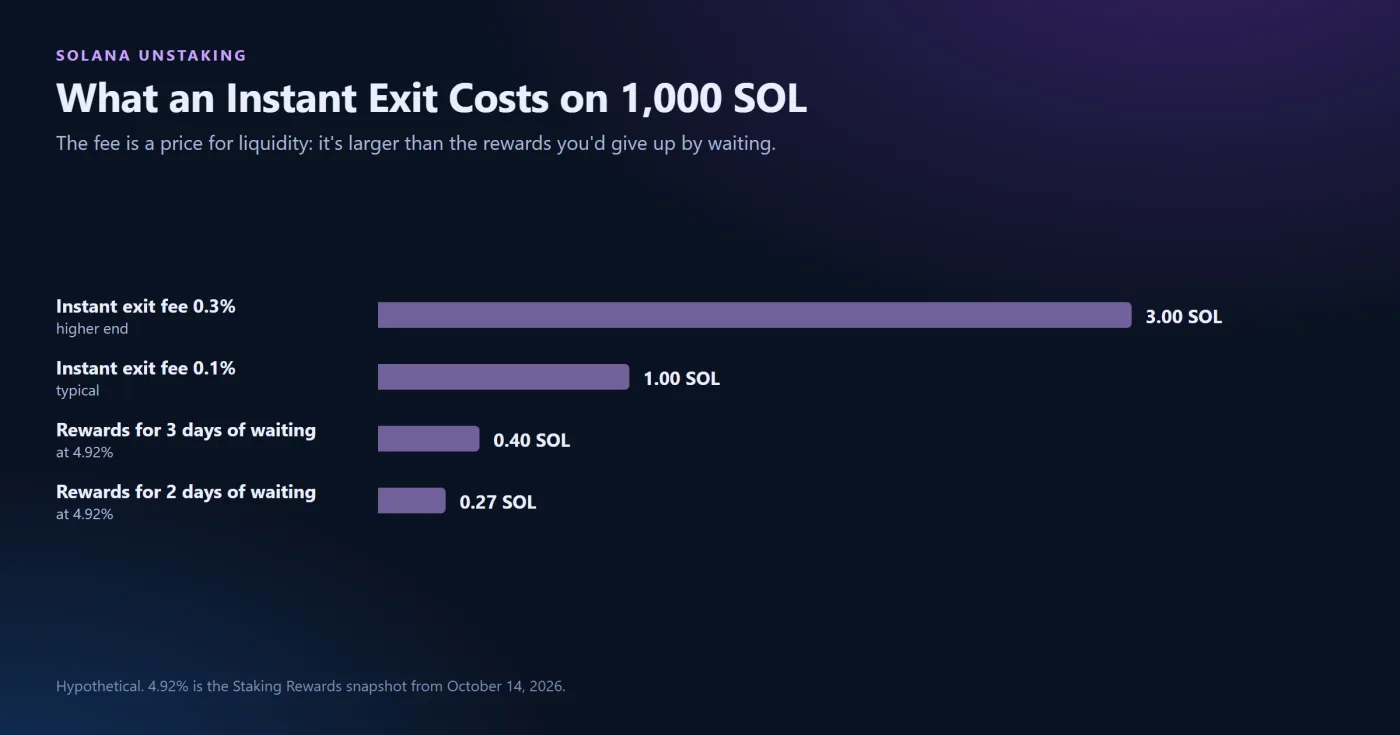
For a 1,000 SOL position, a 0.1% fee is 1 SOL and a 0.3% fee is 3 SOL. At the Staking Rewards rate of 4.92% (a snapshot from October 14, 2026), two days of rewards on 1,000 SOL come to about 0.27 SOL, and three days to about 0.40 SOL. This is a hypothetical calculation, but it shows that the fee for an instant exit is mainly a price for liquidity, not something recovered through rewards.
Risks and Limits
Liquidity depth can change quickly, and fees can rise during heavy unstaking. Smart contract risk applies to LSTs, and an LST may trade away from its underlying value during stress. Native unstaking has no such pricing risk, but SOL is illiquid during the cooldown and the SOL price can move meanwhile.
What to Check Live Before You Unstake
-
The epoch progress, to estimate the wait.
-
Whether the wallet shows a delay or an instant option, and the fee for each.
-
The token's price against SOL if you exit a liquid staking token.
-
Whether a partial unstake needs the account to be split first.
-
The 1 SOL minimum per account if your wallet applies it.
This article is educational and is not investment advice. Staking involves risk, and each reader should compare the live data with their own situation.
Related guides


 Scroll to top