


How to Choose a Validator for Ethereum Staking


Table of contents

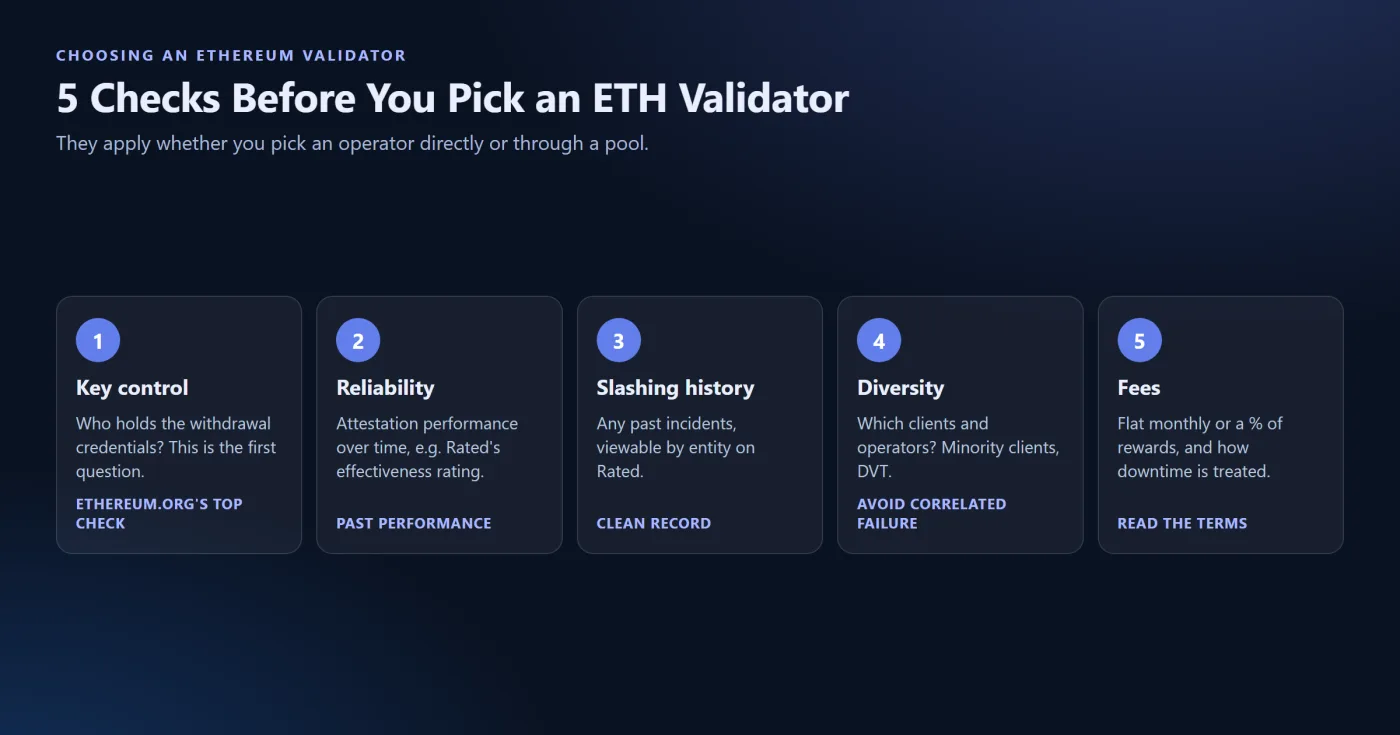
Choosing a validator for Ethereum staking comes down to five checks: who controls the withdrawal credentials, what is the operator's reliability in performing its role, whether it has had any slashing incidents in the past, how diverse is the software and operators behind the operation, and what fees it charges. Key control is listed as the first question by ethereum.org's advice on staking services, because it decides whether an unresponsive or failing operator can trap the stake. The checks below apply whether the validator is picked directly (delegated staking with 32 ETH) or indirectly through a pool.
This guide explains to what a validator operator controls and which performance metrics and red flags to watch. It does not name a best operator. Figures marked as snapshots change, so live data should be checked before any decision.
What a Validator Operator Controls
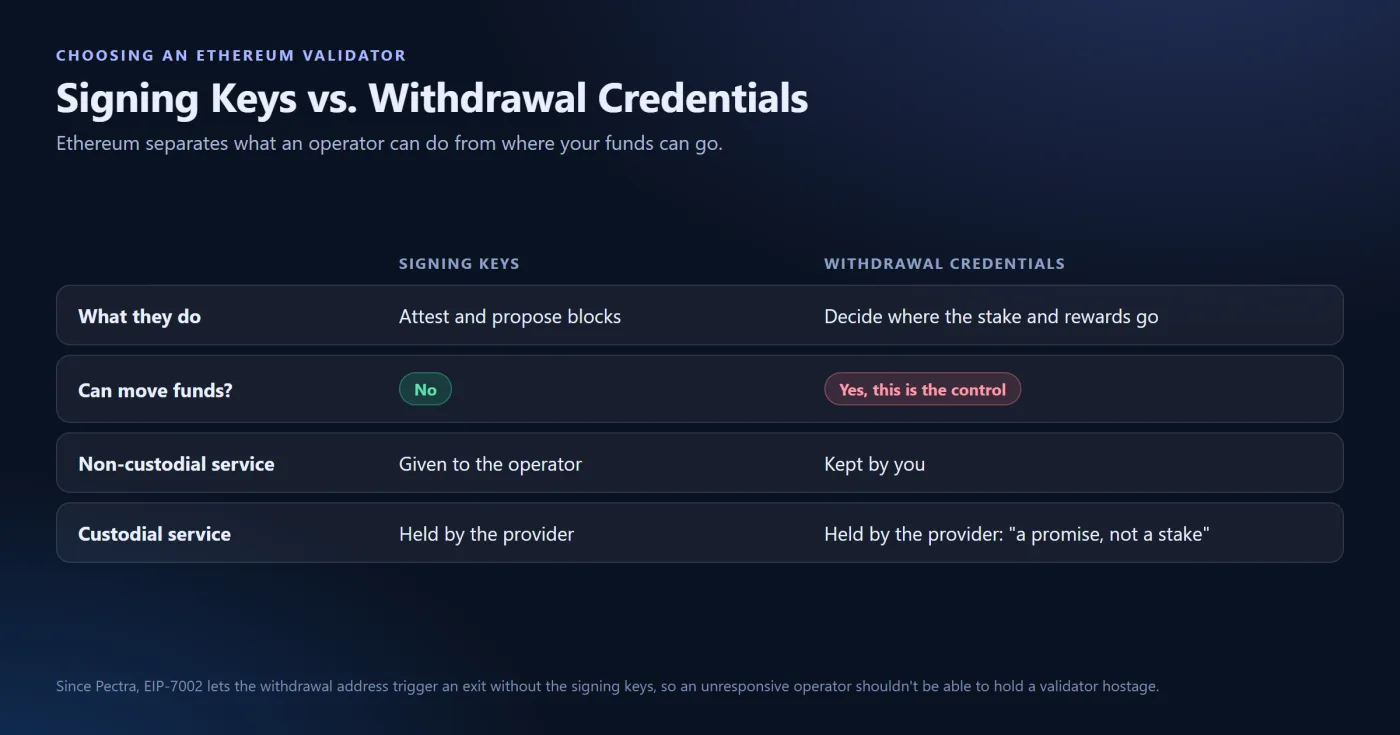
Ethereum distinguishes between two types of keys. According to ethereum.org, signing keys allow the operator to perform attestations and make proposals. They cannot be used to withdraw, transfer or spend any funds. Withdrawal credentials determine where the stake and the rewards go. In a non-custodial staking model, the staker creates the keys, makes the 32 ETH deposit, transfers the signing keys to the operator and retains control over the withdrawal credentials.
In a custodial staking service, typically a cryptocurrency exchange, the service provider holds both. According to ethereum.org, in that case it is a question of trusting the service provider with your funds, and when the provider controls the credentials the service "is a promise, not a stake."
Ethereum.org also adds that since the Pectra upgrade, EIP-7002 lets the withdrawal address trigger an exit without the signing keys, if the credentials belong to the staker. This means an unresponsive operator should not be able to hold a validator hostage.
Direct Operator or Pool?
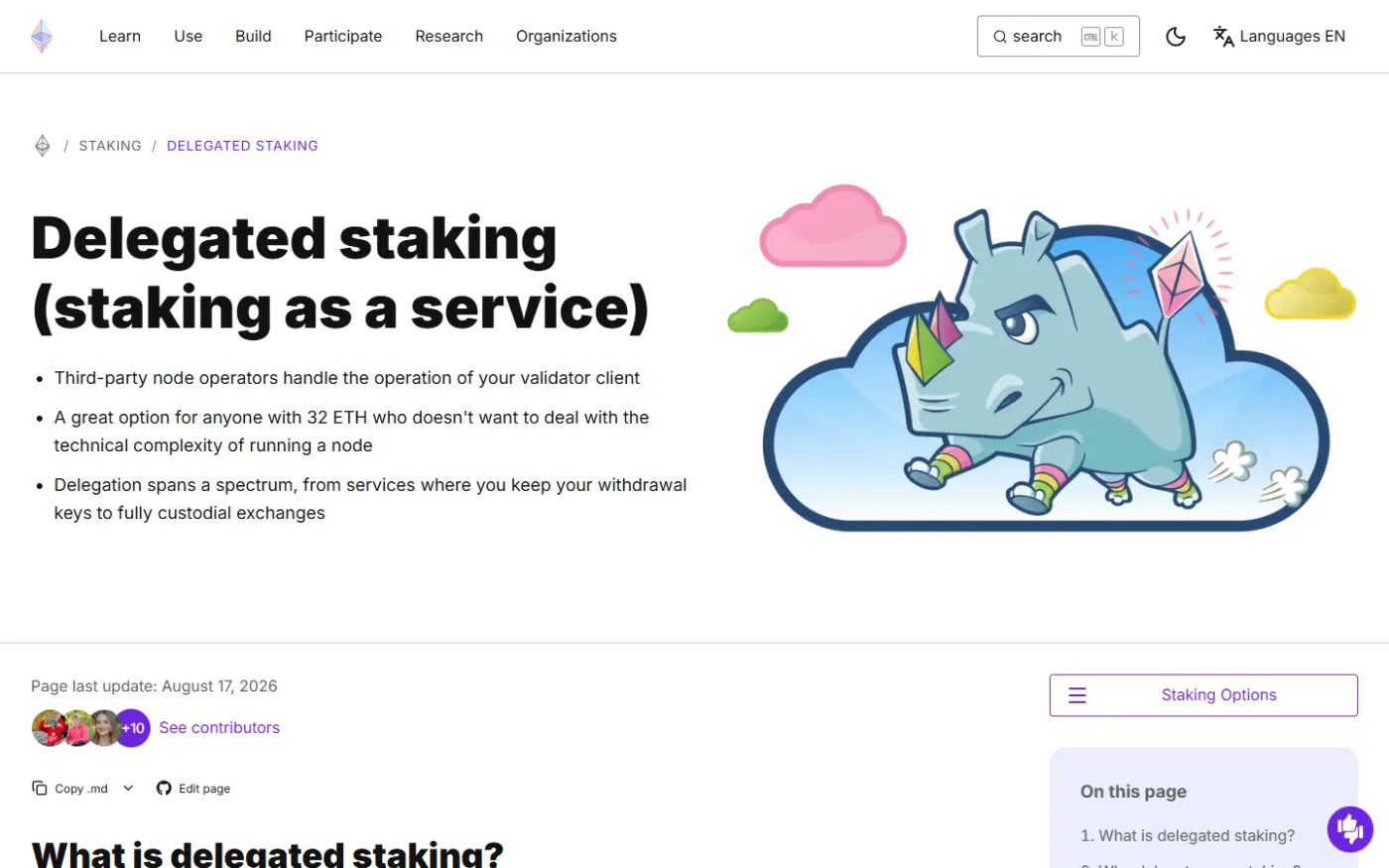
Delegated staking requires 32 ETH per validator and an operator of choice. Pooled staking accepts lower stakes and shares the workload among operators in the pool, thus a selection of the validator becomes a selection of the pool. Ethereum.org advises to favor pools that feature permissionless and distributed operator set, use open-source and audited code, and publish a list of operators.
It also warns that liquid staking tokens add trust in the pool's contracts, governance, and operators, that secondary market prices may differ from the backing ETH (depegging), and that slashing losses are shared among all token holders.
Performance Metrics to Read
Missing duties costs rewards. According to ethereum.org, missing a timely source or target vote carries a penalty equal to the reward that would be earned, that a missed head vote carries no penalty, and that a failed proposal carries no penalty. Hence, operator's reliability comes down to attesting over time.
Rated Network publishes an effectiveness rating (RAVER). It is described in the service's documentation as a metric that represents how well a validator performed its deterministic duties, measured in percentage job completion rate. It can be filtered by operator. According to Rated's page, the score correlates strongly with the performance of operator's infrastructure. The exact formula components are not mentioned on the page, and the rating is based on past performance only.
Slashing History and Risk
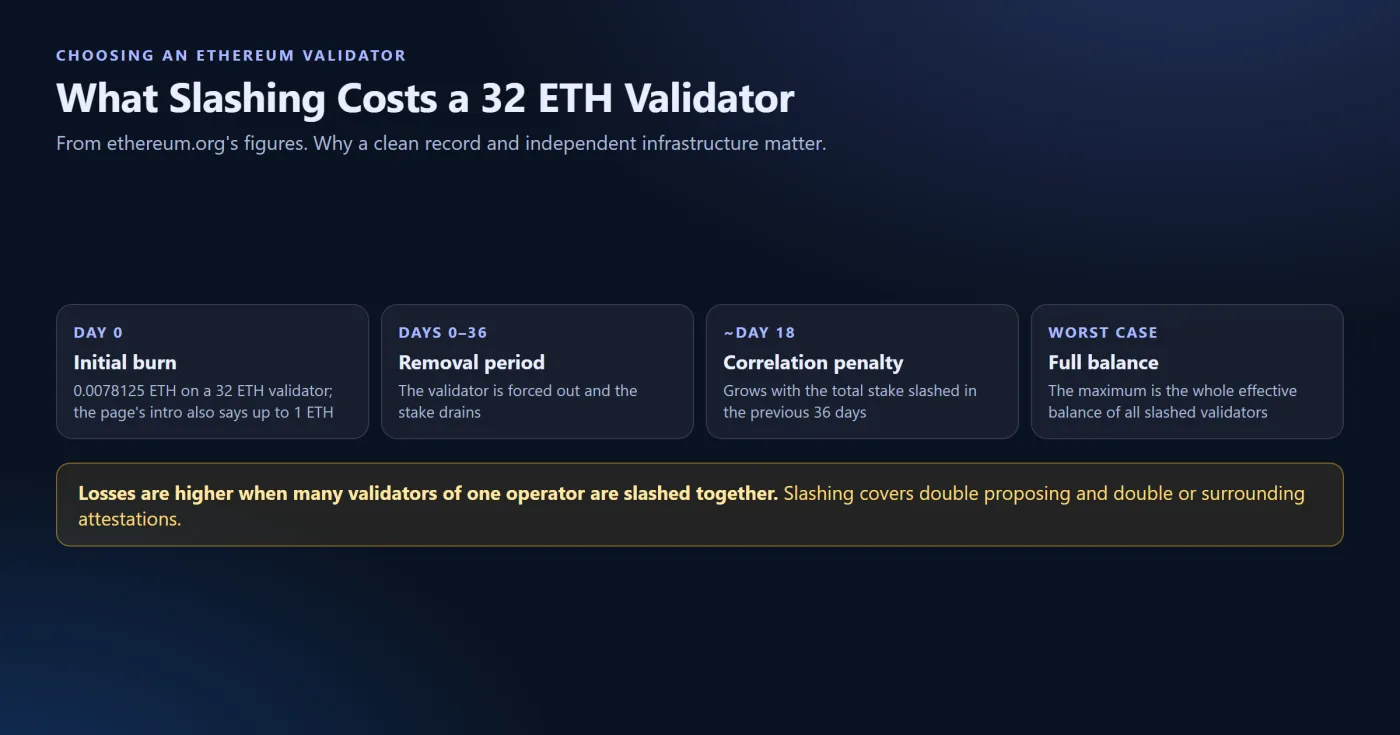
Slashing is a punitive removal of a validator for double proposing, attestations of surrounding blocks or double voting. For a 32 ETH validator, ethereum.org lists an initial burn of 0.0078125 ETH, a 36-day removal period, during which the stake is draining, and a correlation penalty at around the day 18, growing depending on the total slashed stake within the previous 36 days. According to the page, the maximum possible slash is the whole effective balance of all slashed validators. The introduction of the page mentions "up to 1 ETH" burned, which is inconsistent with 0.0078125 ETH figure, hence the initial burn value should be verified against the current documentation.
The correlation penalty is the reason why clean slashing history and independent infrastructure matters. When many validators of the same operator are slashed together, the losses are higher compared to the case when the incident is isolated. Rated publishes slashing statistics that can be viewed by the entity.
Client Diversity and Distributed Validators
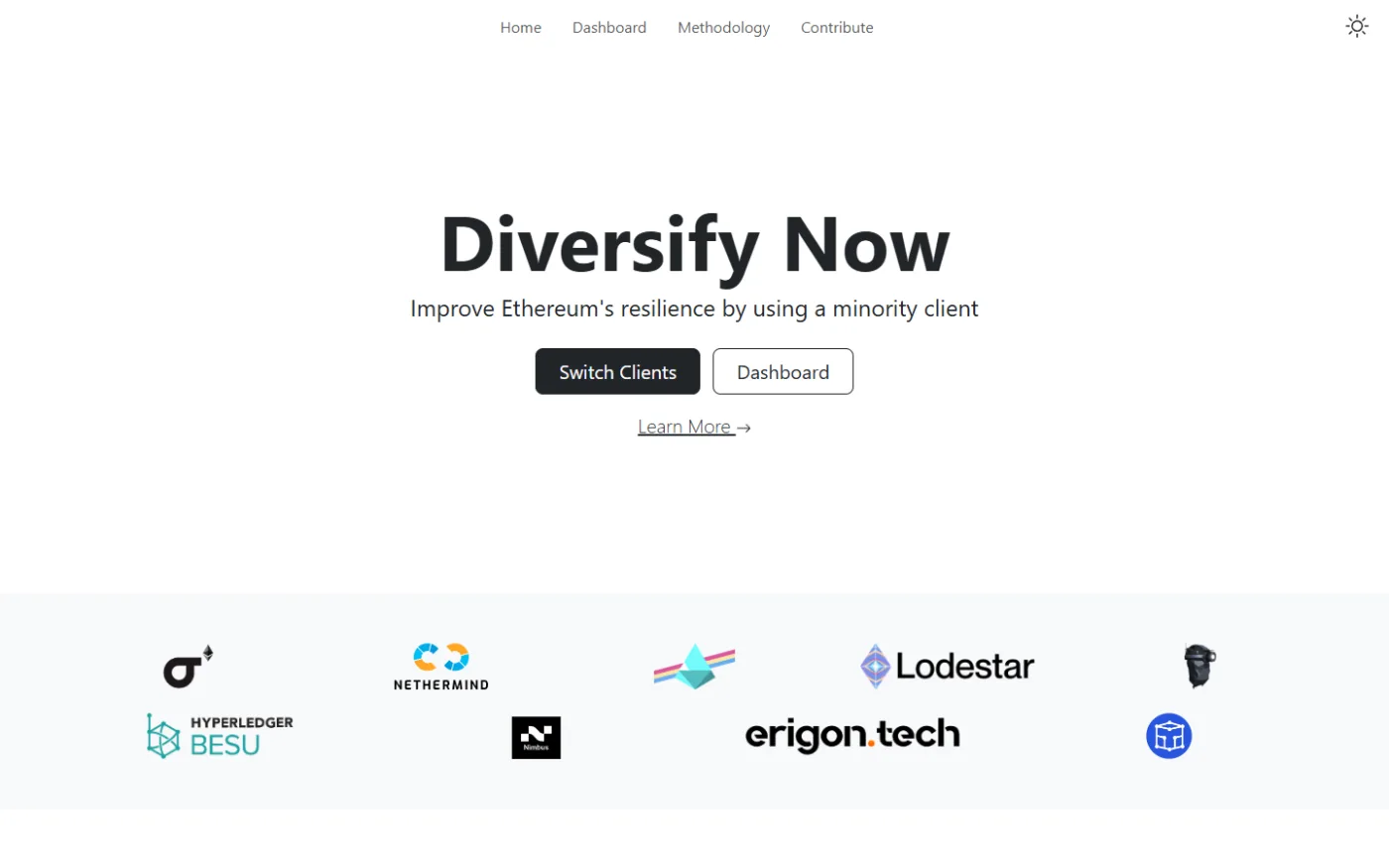
According to ethereum.org, one should check which execution and consensus clients an operator runs, since majority clients create correlated failure risk, and minority clients are preferable. It also points out distributed validator technology (DVT), where a validator key is split among several nodes so a crash of one node wouldn't bring the whole validator down.
According to Lido's Q3 2025 metrics report, as of October 1, 2025, an example of operator-side data that can be published is: the number of DVT setups, such as Obol, SafeStake or SSV Network – 547,968 ETH across 17,124 validators, and the biggest consensus client in Curated Module is Lighthouse with 26.70% against 48.57% on Ethereum. This is one provider's own report and a dated snapshot.
Fees and Terms
According to ethereum.org, services charge either flat monthly fee or a percentage of rewards, and one should check how the fees work in conjunction with downtime and penalties, how the underperformance is charged, and what guarantees or insurance is offered.
A Hypothetical Fee Comparison
That is a hypothetical comparison and assumes a gross reward of 3% per year, not a current rate. From the 32 ETH stake, 3% is 0.96 ETH per year. 10% fee on rewards equals to 0.096 ETH, leaving 0.864 ETH. Flat fee has a different structure: it doesn't decrease with lower rewards, hence the comparison depends on the actual reward rate.
Red Flags
-
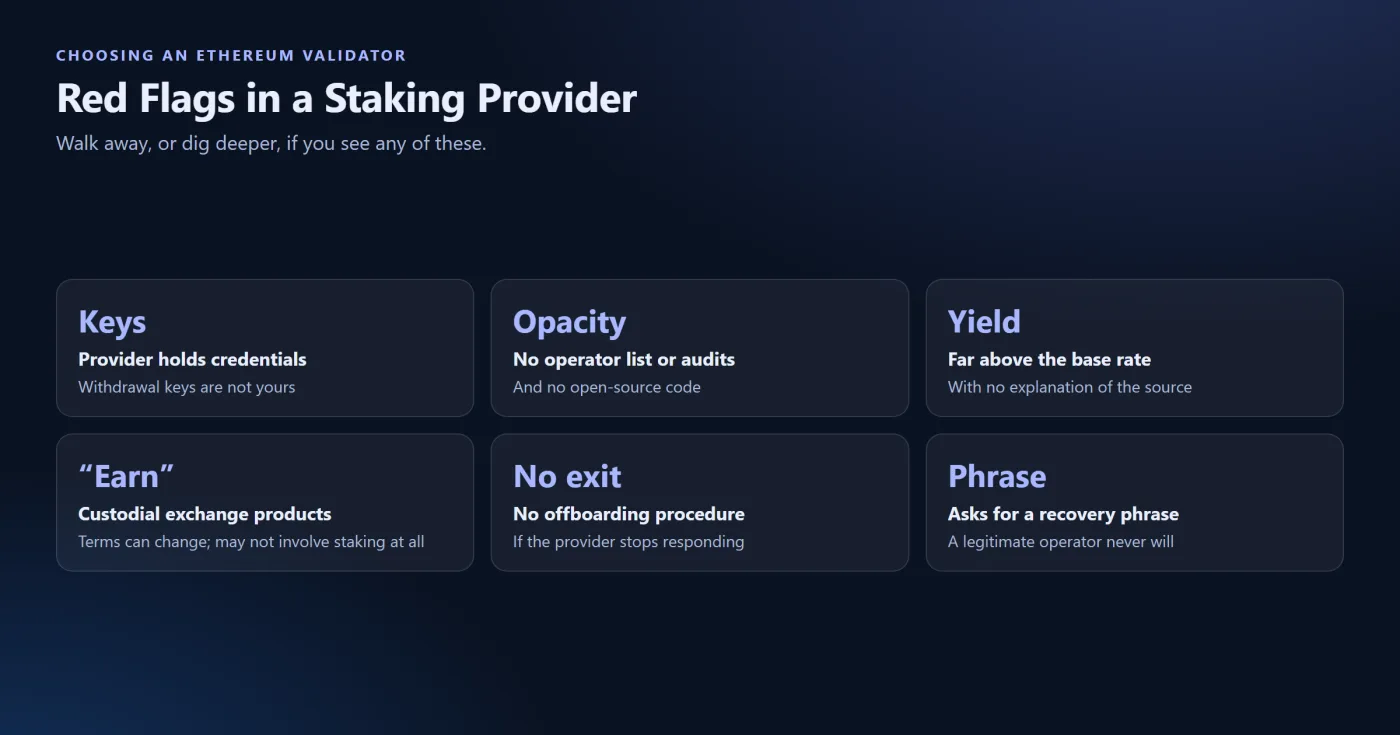
Withdrawal credentials or keys are held by the provider.
-
Lack of published operator list, audits and open-source code.
-
Yields that are substantially higher than the staking base rate without an explanation of the source of additional returns. Ethereum.org warns that restaking is a separate risk category.
-
Exchange "earn" products that are custodial and can change the terms anytime, according to ethereum.org they may not involve staking at all.
-
Lack of offboarding procedure if the provider stops operations or ceases to respond.
-
Requests to input recovery phrase on a website or to transfer it to support. A legitimate operator will never ask you for it.
What to Check Live Before Choosing
-
Whose withdrawal credentials will control your stake after setup.
-
Latest effectiveness and slashing data on Rated or other explorer.
-
Operator's client diversity and usage of DVT.
-
Fee structure and penalty terms.
-
Process of exiting and withdrawing stake, including current exit queue status.
-
Whether the wallet or dashboard contains the same data. Provider interfaces were not tested for this article.
This article is educational and not investment advice. Staking involves risks of penalties, slashing and losses. Each reader should verify live data.
Related guides


 Scroll to top