


Solana Staking Calculator: Formula and Worked Examples


Table of contents

A Solana staking calculator needs only four inputs: the amount of SOL, the annual reward rate, the validator's commission, and the time. Rewards are paid once per epoch (about two days) and are added to the stake account automatically, so the result is compound growth. The most common mistake is using a rate that is out of date, because the Solana reward rate falls as more SOL is staked and as inflation decreases.
This guide gives the rules a calculator relies on, a formula you can use in any spreadsheet, and worked examples that are clearly hypothetical. It does not offer a built-in calculator, since none was built or tested for this article.
The Formula Behind a Solana Staking Calculator
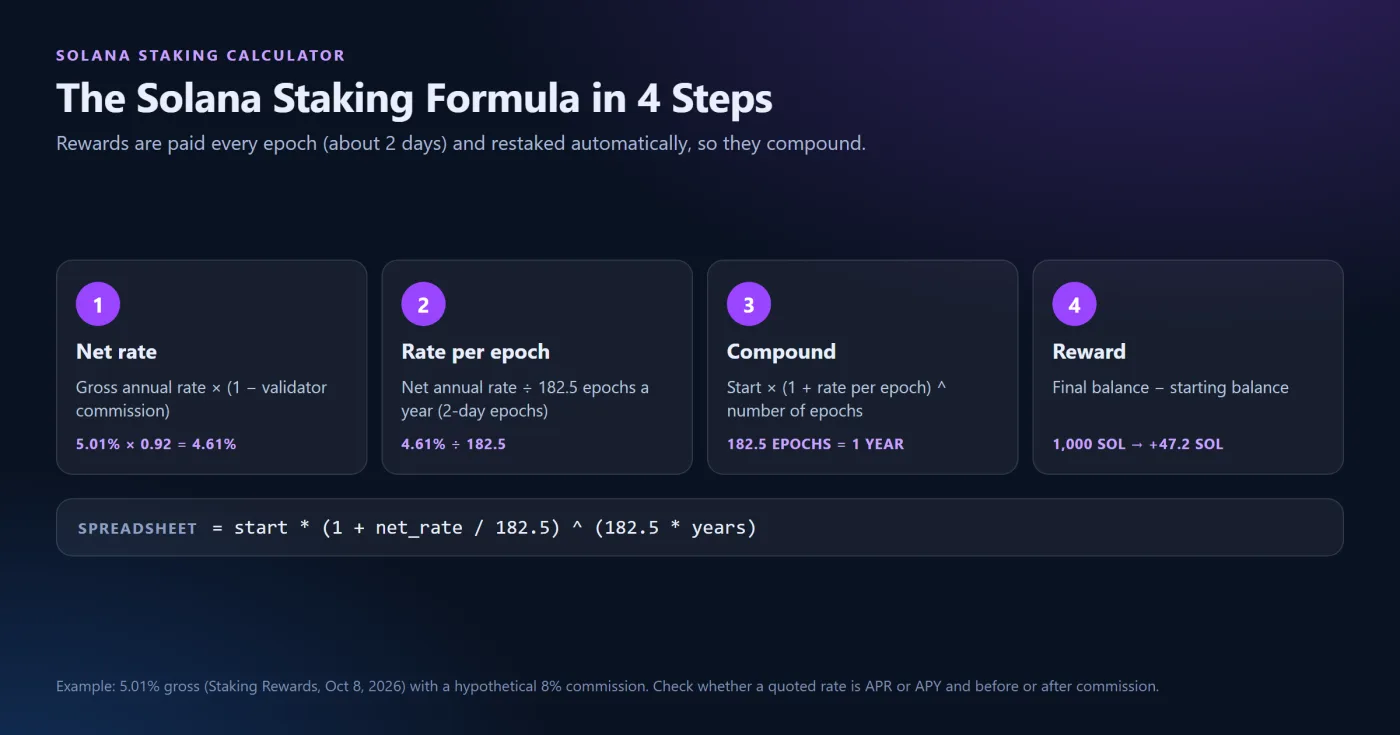
Solana's economic documentation says that rewards are computed and issued once per epoch, in the first block of the following epoch, and are deposited into the stake account that earned them, where they are automatically delegated again. An epoch lasts about two days, so a year has roughly 182 epochs. Staking Rewards describes the epoch as 2 to 3 days, so the exact count varies a little.
A simple calculator therefore works like this:
-
Net annual rate = gross annual rate x (1 - validator commission).
-
Rate per epoch = net annual rate / 182.5 (using a 2-day epoch).
-
Final balance = starting balance x (1 + rate per epoch) raised to the power of the number of epochs.
-
Reward = final balance - starting balance.
In a spreadsheet, the last step is one formula: starting balance x (1 + net rate / 182.5) ^ (182.5 x years). Whether a published rate is quoted before or after commission, and whether it is APR or APY, should be checked on the source page, because the formula above depends on the answer.
Which Rate to Enter
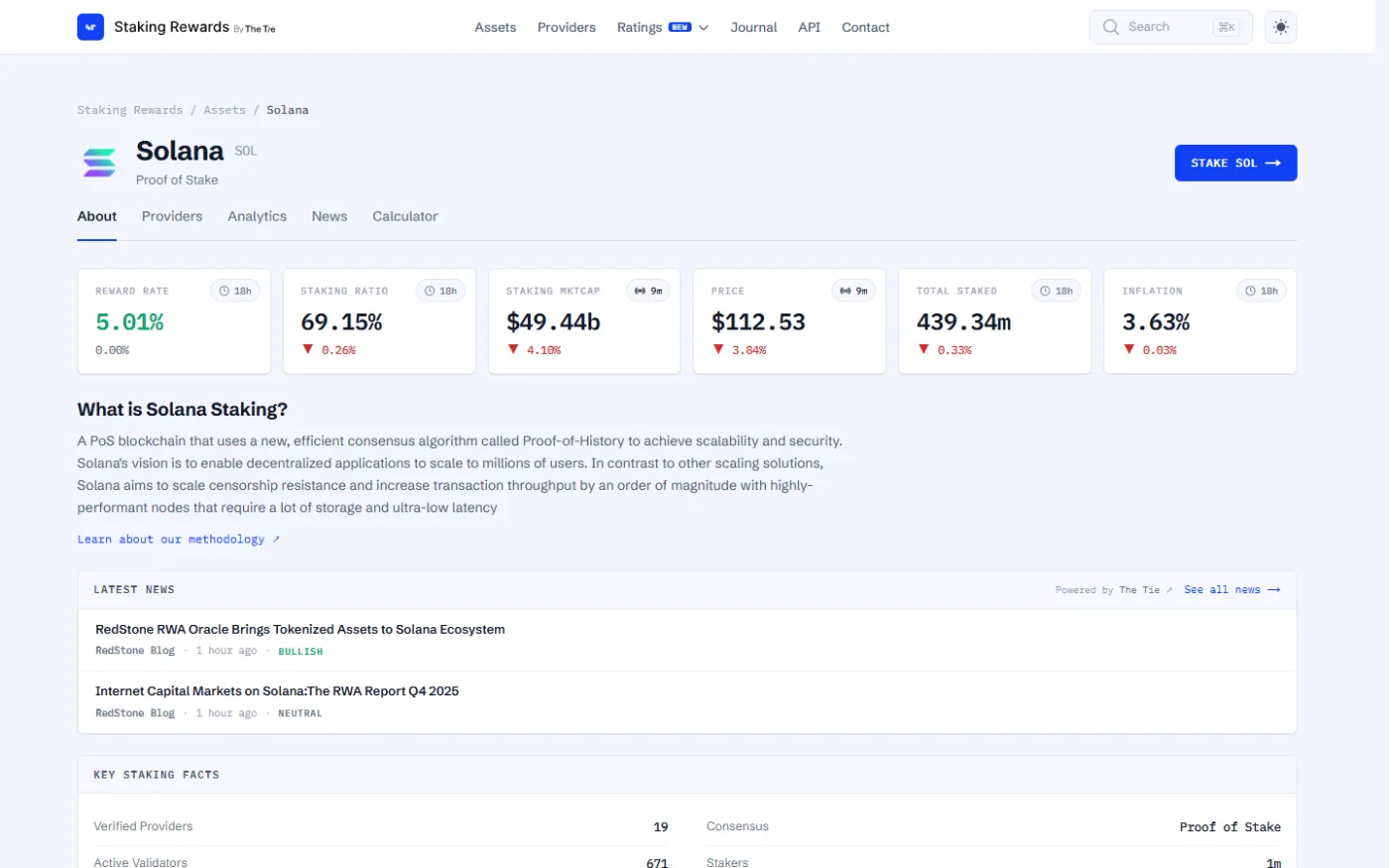
This is the input that changes most. Staking Rewards showed a reward rate of 5.01% when read on October 8, 2026, with inflation at 3.63% and a staking ratio of 69.15%. The same page says the figure is a point-in-time value and that the reward per token falls as the staking ratio rises. It also describes MEV tips as an extra of roughly 0.3% to 1.0%, not included in the headline rate, and only for validators that run Jito and share the tips.
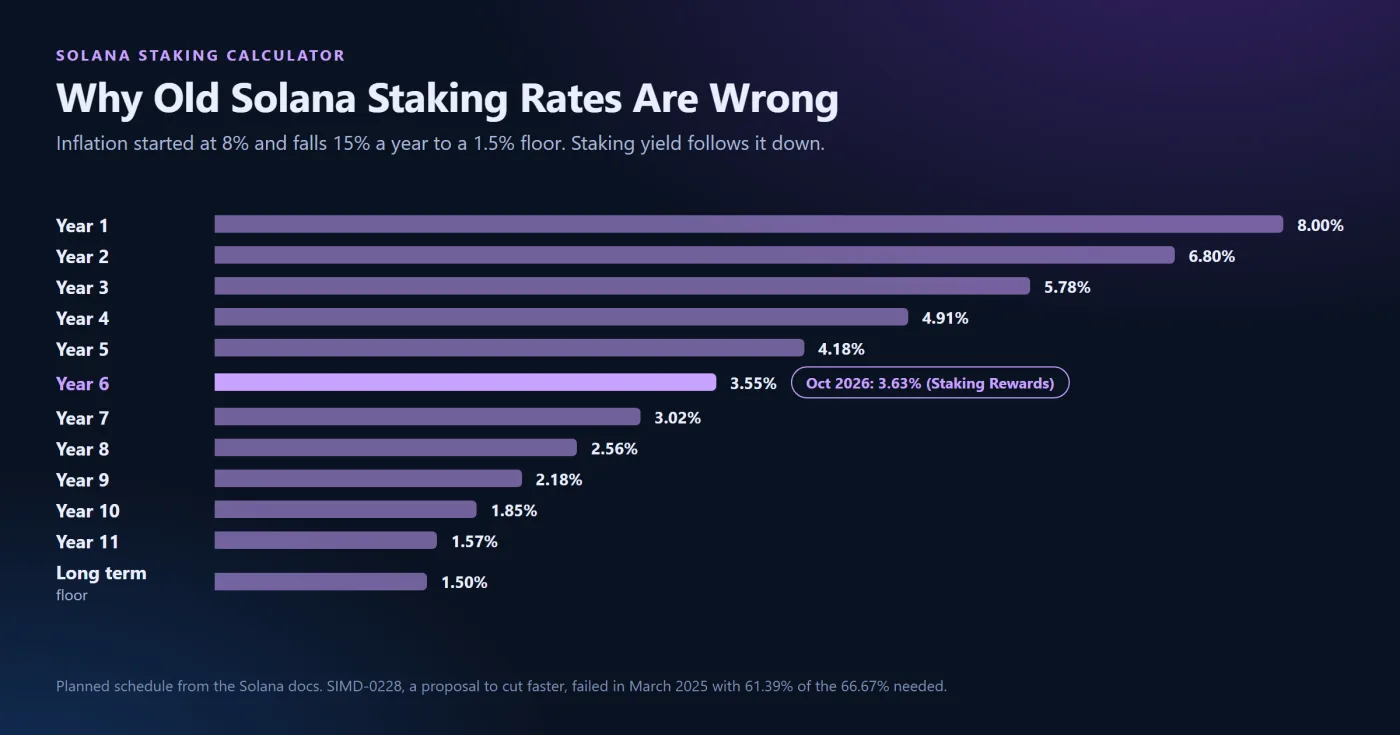
The Solana documentation describes the planned inflation schedule: an initial rate of 8%, falling by 15% each year until it reaches a long-term rate of 1.5%. Because stakers receive the new issuance, the yield follows this schedule, which is why a rate from an old article is likely wrong. A proposal to speed up the reduction, SIMD-0228, failed in March 2025 with 61.39% approval against the 66.67% needed, according to a report by Traders Union, so the schedule was left unchanged at that time.
Commission and MEV
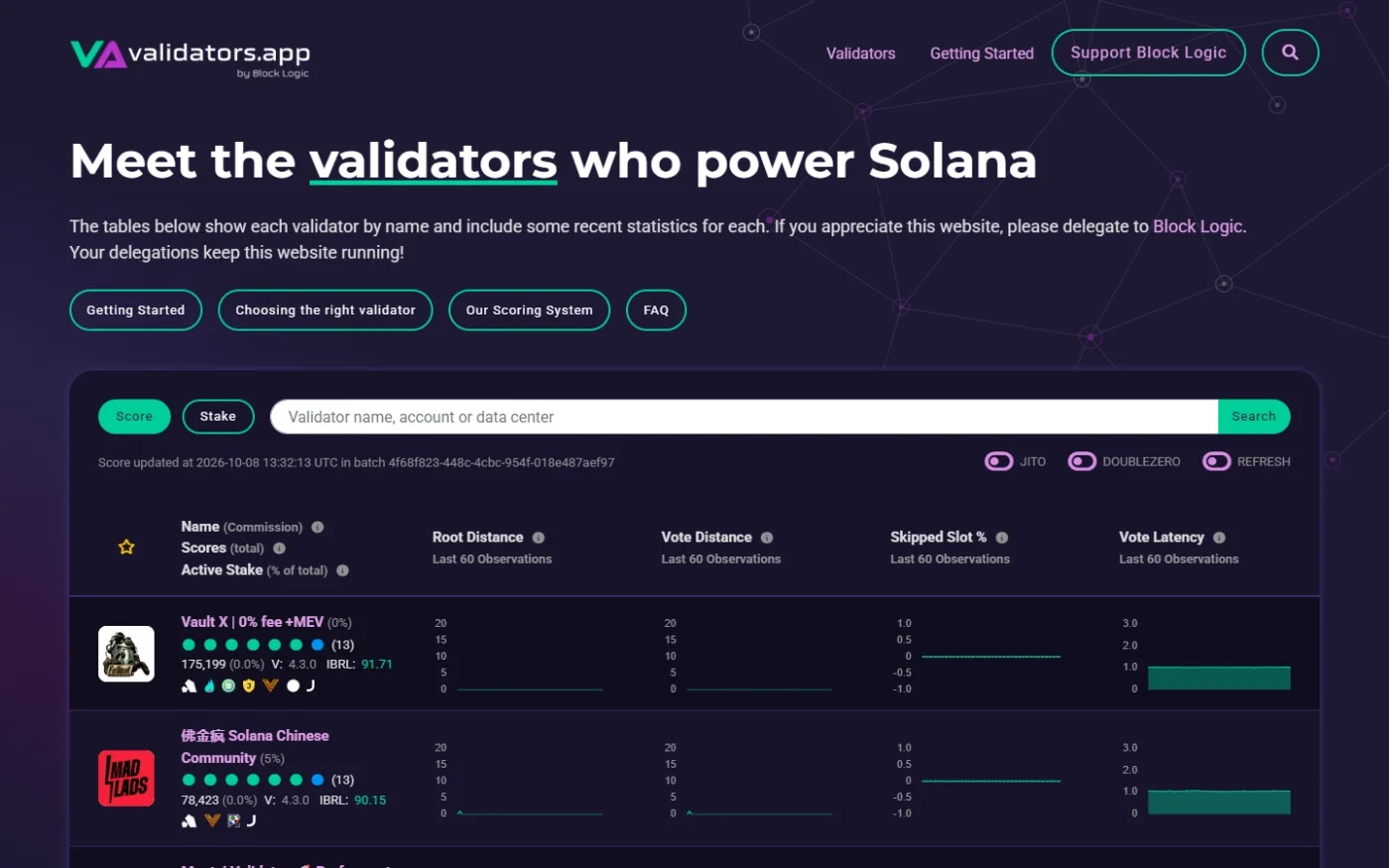
Validators charge a commission on inflation rewards, and the commission is deducted before delegators receive their share. Staking Rewards gives a benchmark commission of 3.78% and says that commissions typically range from 0% to 10%. Jupiter's native staking page, as one example, states 5% on inflation rewards and 0% on MEV rewards, with 100% of MEV rewards passed to stakers.
For a calculator, this means two inputs rather than one: commission on inflation rewards, and an optional extra for MEV. Treat the MEV figure as an estimate and keep it separate from the base result.
Worked Examples (Hypothetical)
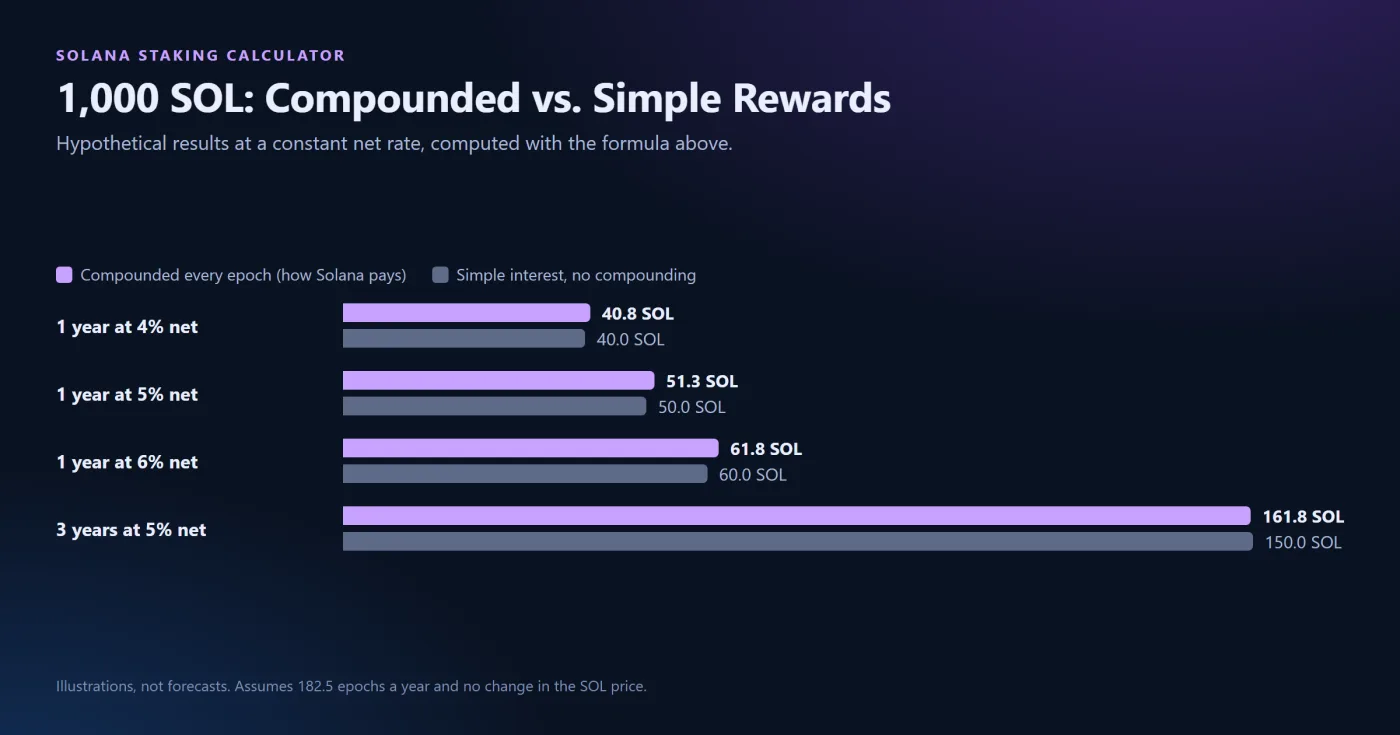
The numbers below are illustrations, not forecasts or observed results. They assume a constant rate, 182.5 epochs per year, and no change in the SOL price. They were computed for this article with the formula above.
-
1,000 SOL for one year at a net 4%: about 40.8 SOL, compared with 40 SOL if rewards were not compounded.
-
1,000 SOL for one year at a net 5%: about 51.3 SOL, compared with 50 SOL without compounding.
-
1,000 SOL for one year at a net 6%: about 61.8 SOL, compared with 60 SOL without compounding.
-
1,000 SOL for three years at a net 5%: about 161.8 SOL, compared with 150 SOL without compounding.
Applying Commission
Suppose the gross rate is 5.01% and the validator takes a hypothetical 8% commission. The net rate would be 5.01% x 0.92 = about 4.61%, and 1,000 SOL would grow by about 47.2 SOL in one year. If a source quotes a rate that is already net of commission, the commission must not be subtracted again.
Why the Result Is an Estimate
Real outcomes differ because the rate changes over time, the validator's performance varies, and the SOL price is independent of the reward. A calculator can show how many SOL you may receive, but it says nothing about what those SOL will be worth.
Rules That Affect the Timing of Rewards
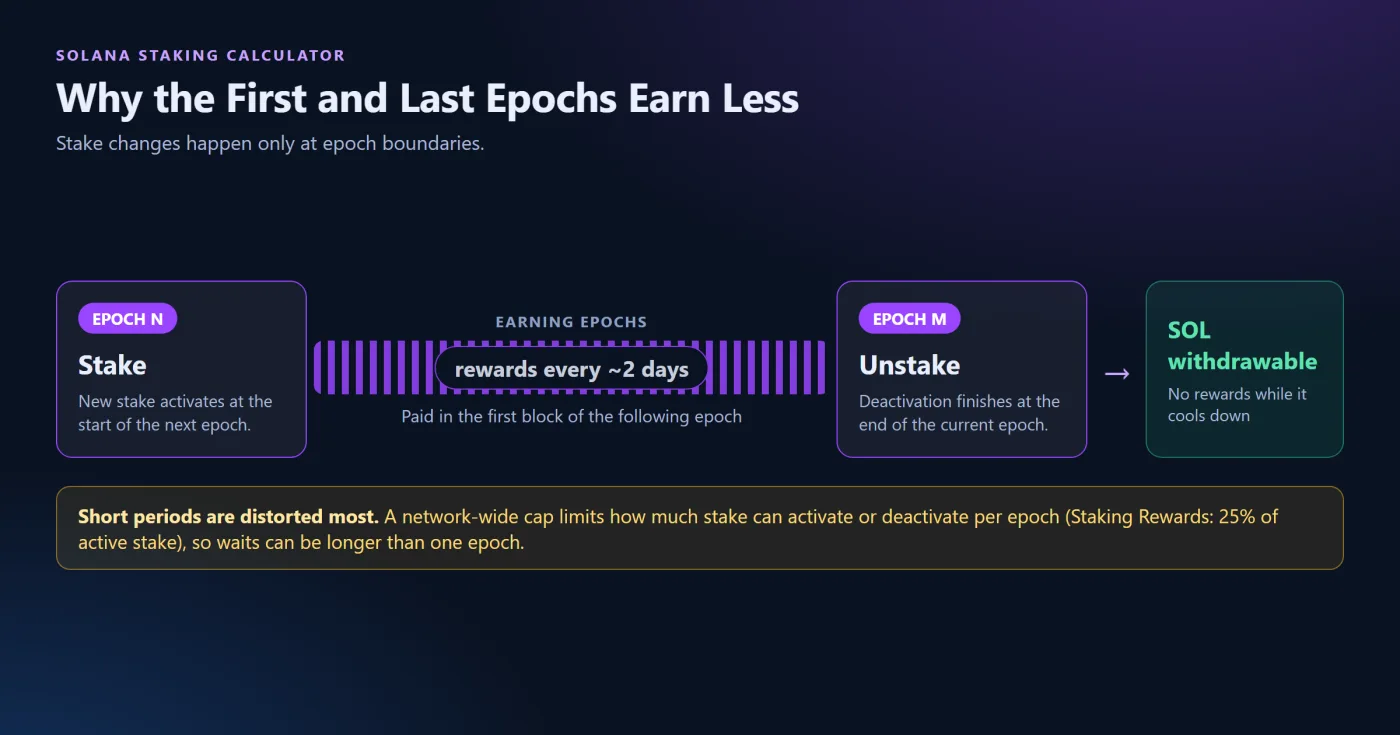
Changes in Solana staking happen at epoch boundaries. The Solana documentation says that delegating and deactivating take effect gradually at each epoch boundary, and that a network-wide limit caps how much stake can change state in one epoch. Staking Rewards puts the limit at 25% of active stake per epoch. Jupiter's page states that new stake activates at the start of the next epoch, and that unstaking finishes at the end of the current epoch, with no rewards earned during this period.
For a calculator, the practical point is that the first and last epochs are not fully rewarded. For small amounts and long periods the effect is minor, but for short periods it can be a large share of the result.
Account Rules to Remember
Each Solana stake account can delegate to only one validator at a time, according to the Solana documentation, so splitting a position across validators needs several accounts. Jupiter's page states a 1 SOL minimum for its staking form and says each account must keep at least 1 SOL, and that moving to another validator requires unstaking and restaking. These are provider rules, and the protocol's own minimum and rent-exempt reserve were not covered by the sources read for this article.
Liquid Staking and the Calculator
Liquid staking tokens such as jitoSOL, mSOL, and bSOL, which Staking Rewards mentions, avoid the epoch wait and capture MEV, but they add smart contract risk. Their value grows against SOL over time instead of being paid as new SOL, so a calculator for them should model the exchange rate between the token and SOL, which this article does not cover.
Risks and Limits of Any Calculator
Staking Rewards states that Solana's slashing mechanism is under development and not actively enforced, and Jupiter's page says the risk is currently negligible but possible under the protocol. Validators with poor performance still reduce rewards. Solana's history of network outages and its single-client architecture are risks that Staking Rewards also lists. A calculator ignores all of these.
What to Check Live Before You Calculate
-
The current reward rate, and whether it is APR or APY, before or after commission.
-
The validator's commission and whether it shares MEV rewards.
-
The epoch length and any activation or deactivation limits.
-
The minimum amount and fees in the wallet or provider you use.
-
The current inflation rate and staking ratio, since both change the rate.
This article is educational and is not investment advice. Staking involves risk, and each reader should compare the live data with their own situation.
Related guides


 Scroll to top