


BNB Staking: Rewards, 7-Day Unbonding, and Validators


Table of contents

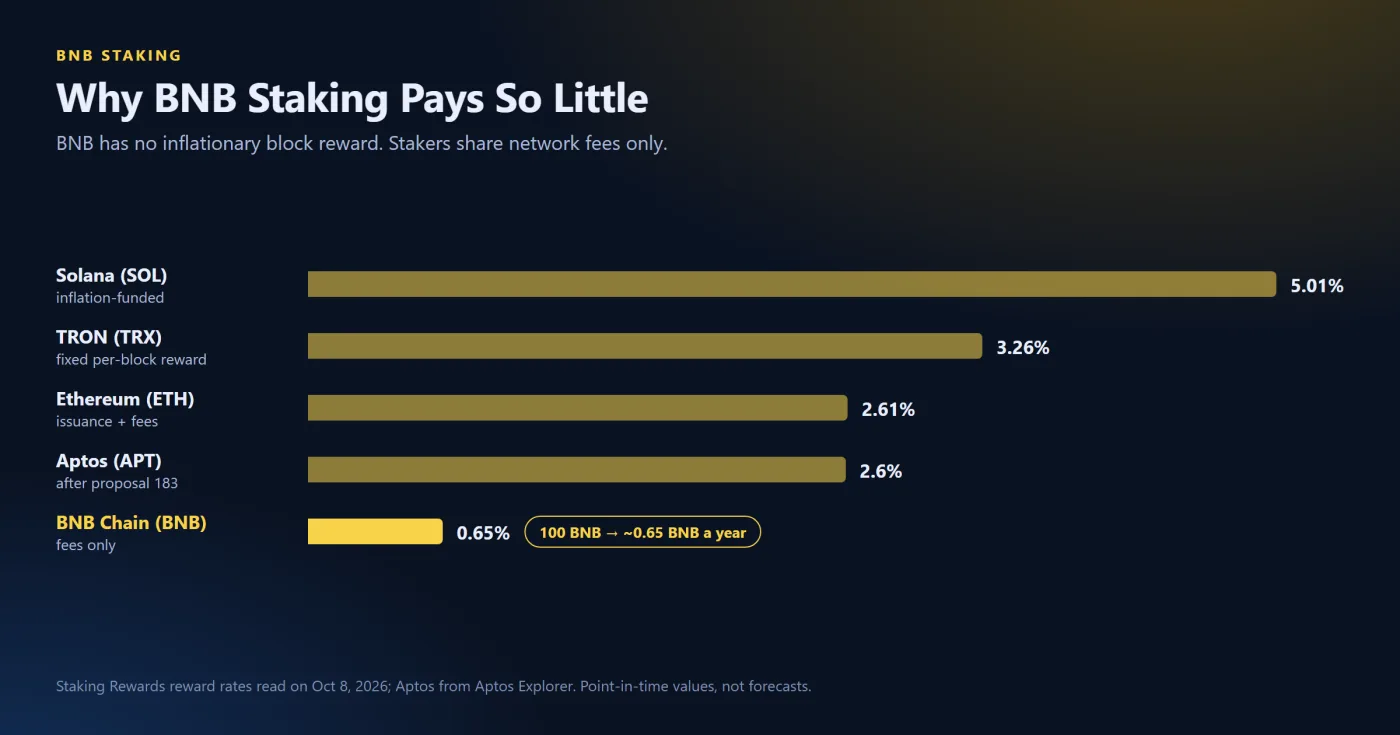
BNB staking on BNB Smart Chain means delegating BNB to a validator through the BNB Staking dApp or a compatible wallet. The BNB stays in your account, undelegated BNB returns after a 7-day unbonding period, and the reward is small: Staking Rewards showed 0.65% per year when this article was researched, which is lower than on many other networks.
The reason is how the network pays stakers. According to Staking Rewards, BNB has no inflationary block rewards, so yield comes from network fees and depends on activity. That is the central point for anyone comparing BNB with other proof-of-stake coins.
How to Stake BNB Step by Step
The interfaces described here were not tested for this article. The steps follow the BNB Chain staking user guide.
-
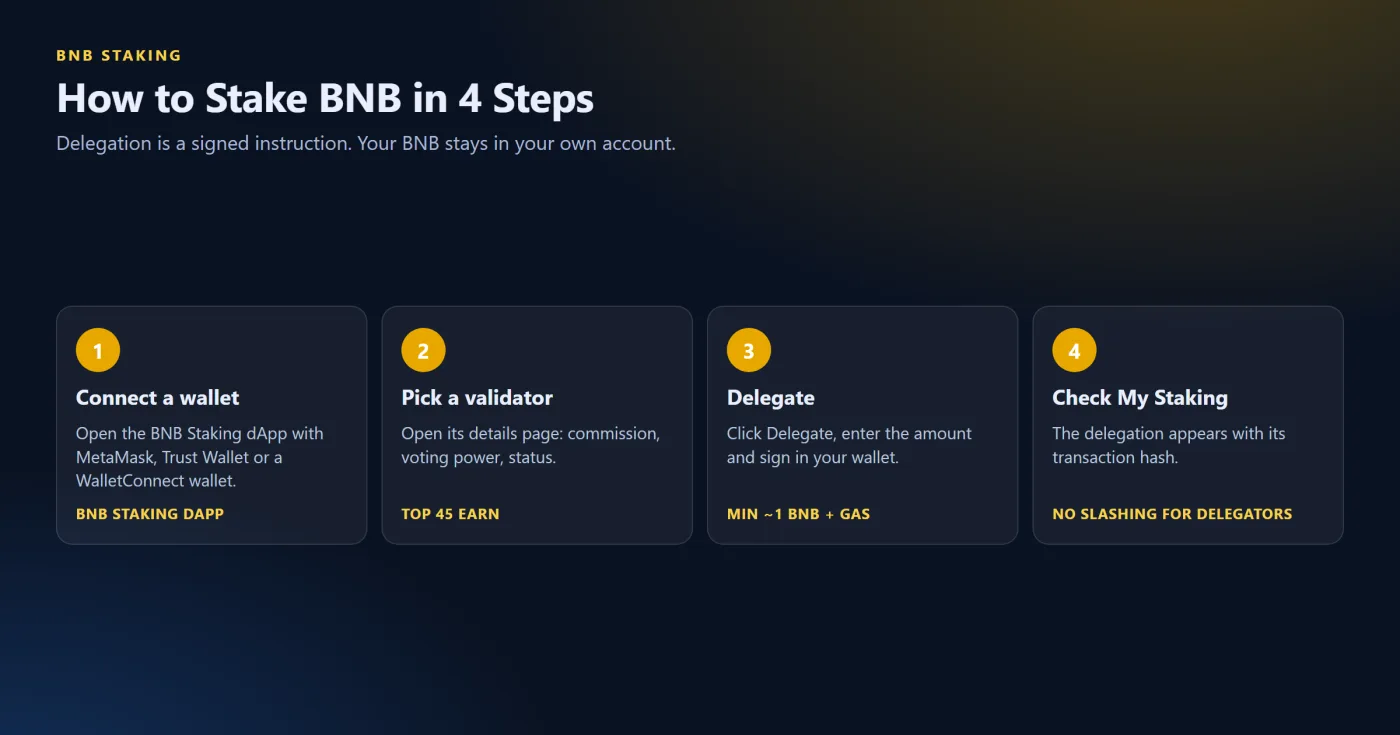
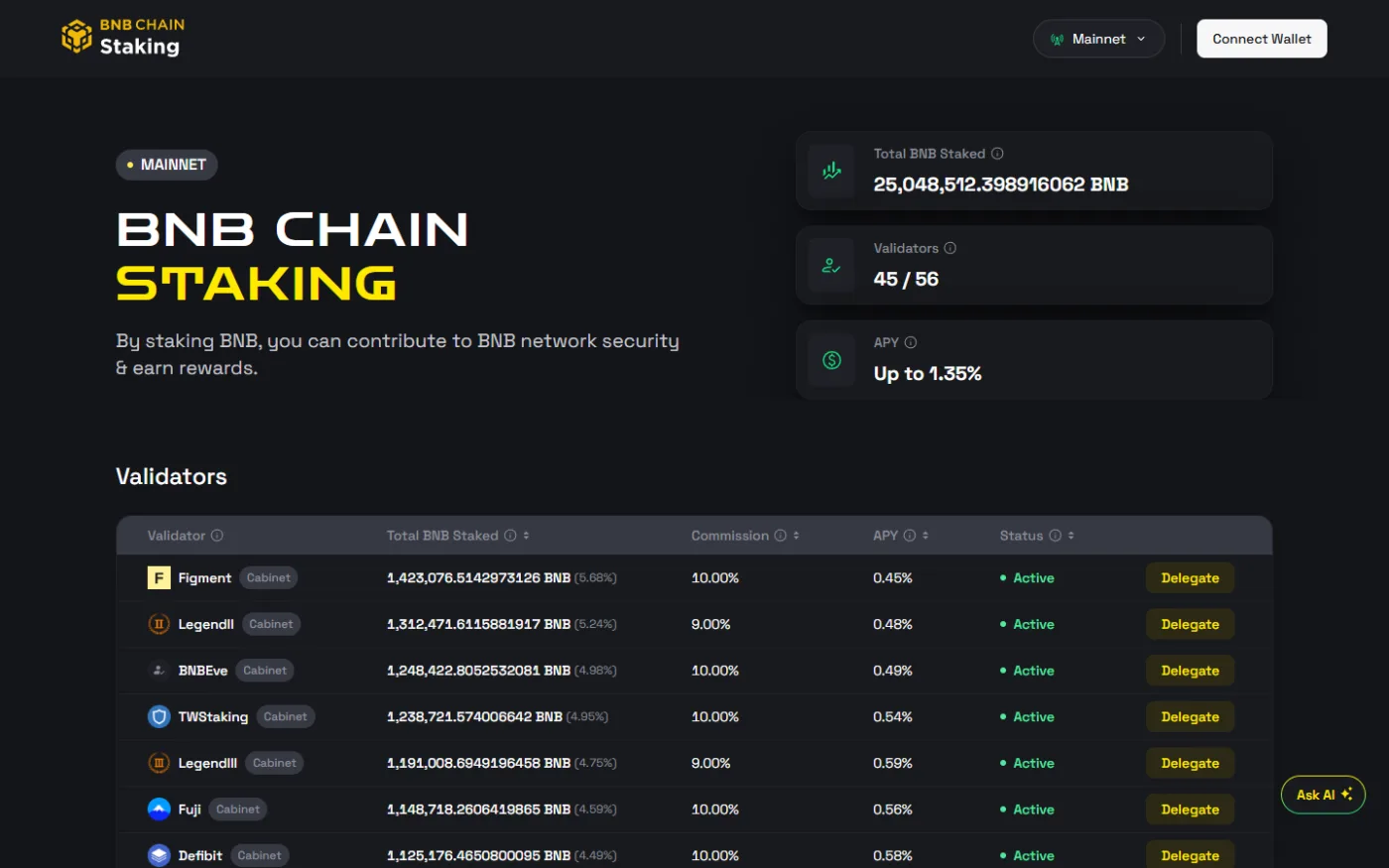
Connect a wallet to the BNB Staking dApp. The guide lists MetaMask and Trust Wallet (mainnet only), and any WalletConnect-compatible wallet.
-
Choose a validator and read its details page. Compare commission, voting power, and status before continuing.
-
Click Delegate, enter the amount of BNB, and sign the transaction in the wallet.
-
Check the My Staking page, where the delegation appears with its transaction hash.
Staking Rewards lists 1 BNB as the minimum to delegate, while the BNB Chain guide does not state a minimum. The wallet will show the actual limit. Keep some extra BNB for gas, because every delegation, claim, and redelegation is a transaction.
Do not enter a recovery phrase on any staking website. Delegating requires only a signature inside the wallet, and no legitimate service needs the recovery phrase.
How to Unstake BNB and the 7-Day Wait
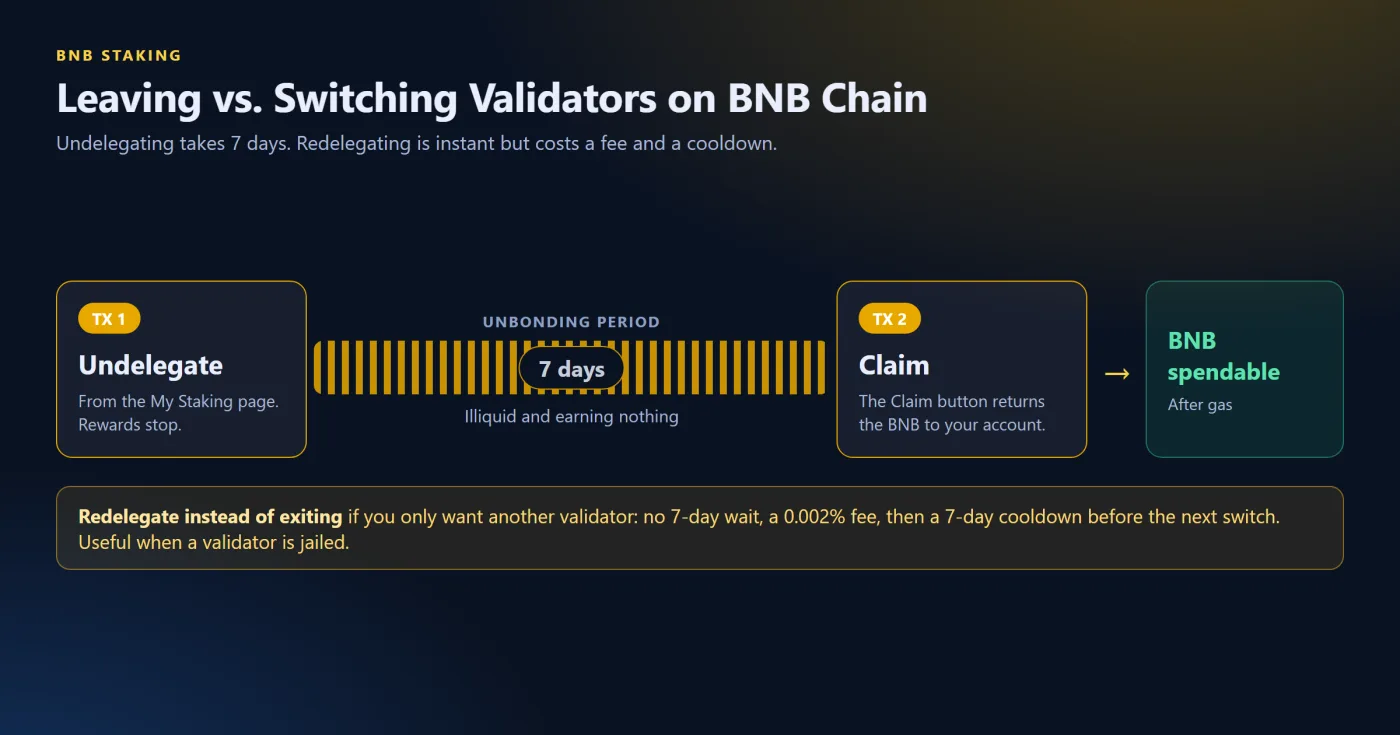
To exit, undelegate from the My Staking page. The BNB Chain guide states that undelegated stake is subject to a 7-day unbonding period, after which a Claim button returns the funds to the account. Staking Rewards adds that during this time the tokens are illiquid and earn nothing.
The guide also says rewards are distributed when you undelegate. Staking Rewards, in contrast, says rewards are not auto-compounded and must be claimed and restaked, with gas on each restake. The two sources describe the same system from different angles, and this article could not test which flow the dApp currently uses. Before staking a large amount, read the dApp's own text on claiming.
Redelegating to Another Validator
A holder can move stake from one validator to another without waiting for the unbonding period. The BNB Chain guide describes a redelegation fee of 0.002%, meant to discourage frequent switching. Staking Rewards notes a 7-day cooldown before the next redelegation.
Redelegating is useful when a validator is jailed or its commission changes. It is not a way to chase small differences in reward, since both the fee and the cooldown reduce the benefit.
What Delegation Means on BNB Smart Chain
BNB Smart Chain is secured by a limited set of validators that produce blocks, and holders who do not run a validator take part by delegating. Delegation is a signed instruction, not a transfer of ownership: the BNB stays in the delegator's account, and the validator's voting power grows by the amount delegated. The validator then earns fees for the blocks it processes and passes a part of them to delegators after taking its commission.
This design explains two practical facts. The validator set is fixed at 45, so delegation matters mostly for ranking. And since rewards come from fees, a quiet network pays stakers less than a busy one, which is why the live rate can move noticeably from week to week.
How BNB Staking Rewards Work
BNB Smart Chain has 45 active validators according to Staking Rewards, up from 21 after the Feynman upgrade in April 2024. Only validators in the top 45 by delegated stake earn rewards, and delegators share in what the validator earns after the validator's commission.
Because there is no inflationary block reward, the yield depends on fee revenue. Staking Rewards describes it as comparatively modest. This is also why providers show very different rates: the same page lists examples from 0.20% to 0.64%, with provider fees from 10% to 12% and a benchmark commission of 9.37%.
A Hypothetical Example
The following is an illustration, not a forecast. Assume 100 BNB is delegated for one year at a flat 0.65%, the live figure that Staking Rewards showed. The reward would be 0.65 BNB. Whether a published rate is quoted before or after the validator's commission should be confirmed with the provider, since a 10% commission on 0.65 BNB would be 0.065 BNB. If the holder restakes the reward, each restake costs gas. At such a small reward, fees and the price of BNB can matter more than the staking income.
Choosing a Validator
-
Rank. Only the top 45 validators earn rewards, so a validator near the edge of the set carries more risk of losing its place.
-
Commission. Compare the percentage, and check how often the validator has changed it.
-
Jailing record. Delegators are not slashed, but according to Staking Rewards they lose rewards while a validator is jailed.
-
Operator. Look at who runs the node and how it communicates incidents.
-
Concentration. Staking Rewards notes that the 45-validator set is more concentrated than many other permissionless networks.
Liquid Staking and Other Ways to Stake BNB
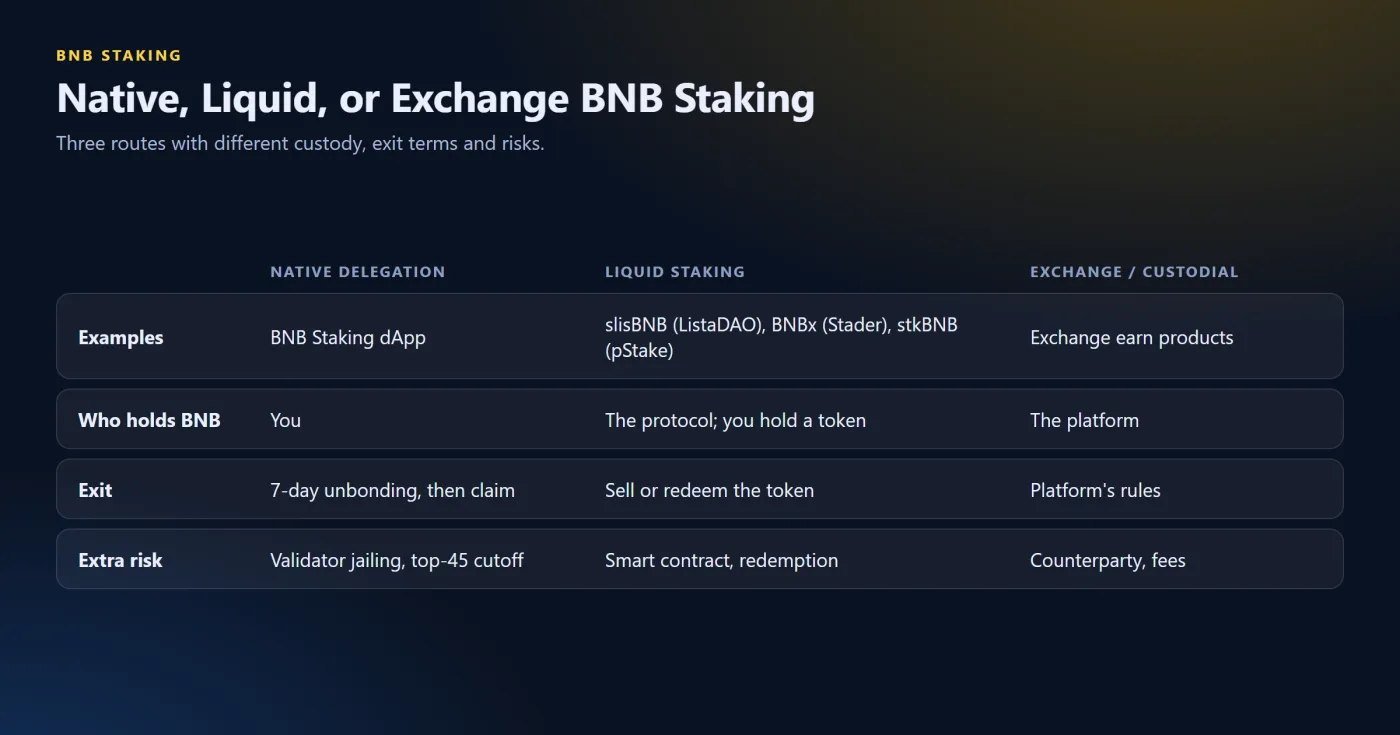
The BNB Chain website lists three liquid staking providers: ListaDAO (slisBNB), Stader (BNBx), and pStake (stkBNB). Each issues a token that the page says is redeemable for the BNB staked, and the tokens can be used in other DeFi applications. The page shows no APR, no unbonding terms, and no risk statement, and its own figures for total BNB staked are inconsistent with the text. These tokens add smart contract and redemption risk on top of staking risk, and they were not evaluated for this article.
Exchanges and custodial platforms also offer BNB staking or savings products. Their terms, lock-up rules, and fees are set by the platform and were not reviewed here.
Risks of BNB Staking
Staking Rewards states that delegators are not slashed and that principal stays intact. The remaining risks are practical. Rewards stop while a validator is jailed or if it falls out of the top 45. The 7-day unbonding period delays access to funds. Gas fees can take a large share of a small reward. The value of BNB is closely tied to Binance, so regulatory or business events affecting Binance can affect the price, and Staking Rewards also points to the October 2022 cross-chain bridge exploit as a past security incident.
What to Check Live Before You Stake
-
The current reward rate in the dApp and on a staking data page, and whether it is quoted as APR or APY.
-
The unbonding period and the current rules for claiming and redelegating.
-
The validator's rank, commission, and jailing status.
-
The minimum delegation shown in the wallet.
-
The gas cost of each transaction compared with the expected reward.
This article is educational and is not investment advice. Staking involves risk, and each reader should compare the live data with their own situation.
Related guides


 Scroll to top