


TRON Staking: Rewards, Votes, and the 14-Day Unstake


Table of contents

TRON staking means freezing TRX in your own account to receive TRON Power, then using that power to vote for a Super Representative or SR Partner. The stake does not move to the representative, and the voting rewards are paid to your account, where you must claim them manually. Unstaked TRX is returned only after a waiting period, which wallets and data providers describe as 14 days.
Staking on TRON also produces network resources (Bandwidth and Energy), so the reward is split between two different things: a variable voting reward in TRX and a reduction in transaction costs. This guide explains both, and marks which numbers come from TRON's documentation and which come from third-party providers.
How to Stake TRX Step by Step
The exact screens depend on the wallet, and none of the interfaces were tested for this article. The sequence below follows the TRON developer documentation and a hardware-wallet guide from Trezor.
-
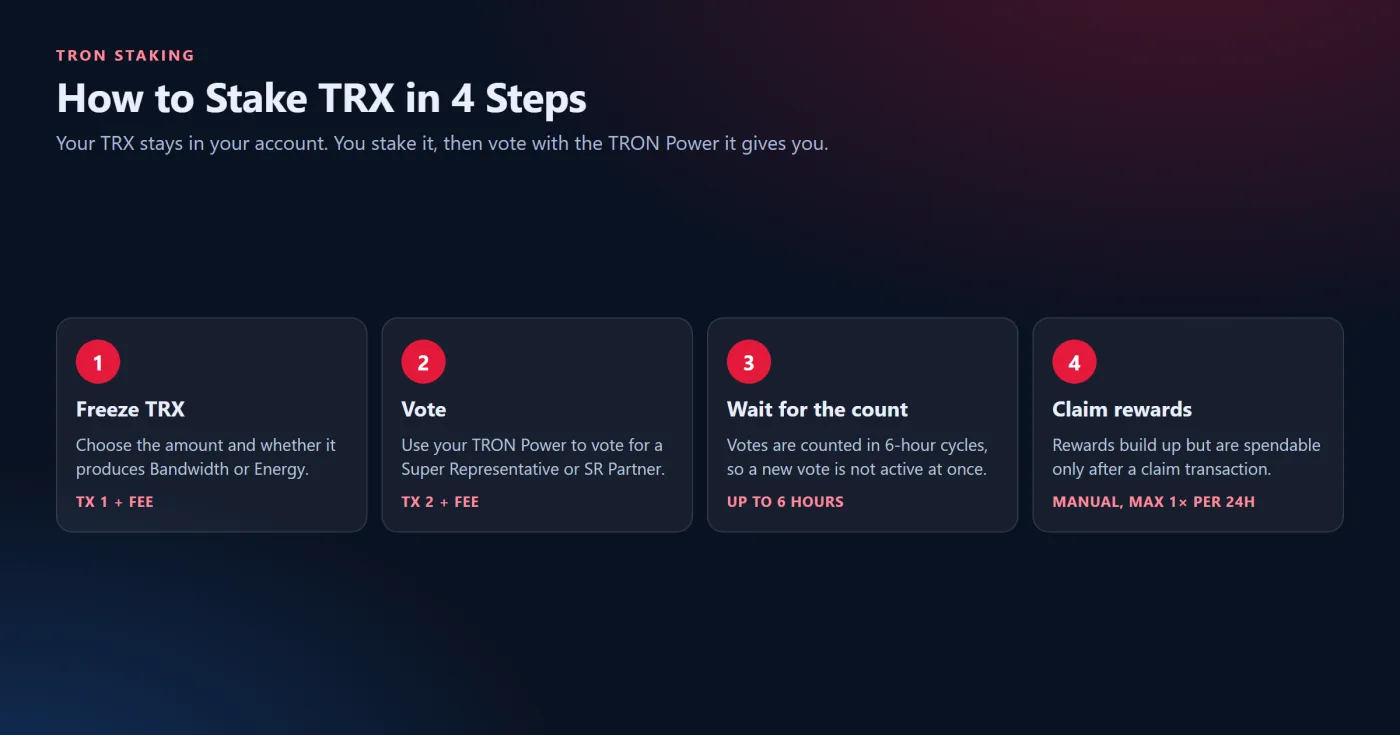
Freeze TRX. In the wallet, specify the amount and choose whether you want the stake to generate Bandwidth or Energy. It is a network transaction and incurs a fee.
-
Vote. The frozen TRX gives TRON Power, and the vote is a second transaction. Choose a Super Representative or an SR Partner and confirm.
-
Wait for the vote to count. According to the TRON documentation, votes are counted in cycles of six hours, so a new or changed vote does not take effect at once.
-
Claim rewards. Rewards build up in the account but become spendable only after a claim transaction.
Trezor's guide states that the staked TRX never leaves your account or goes to the representative. Even so, never enter a recovery phrase on a website or in a chat that promises to "activate" staking. Approving a transaction inside the wallet is enough, and no legitimate service needs the recovery phrase.
How Voting Rewards Work
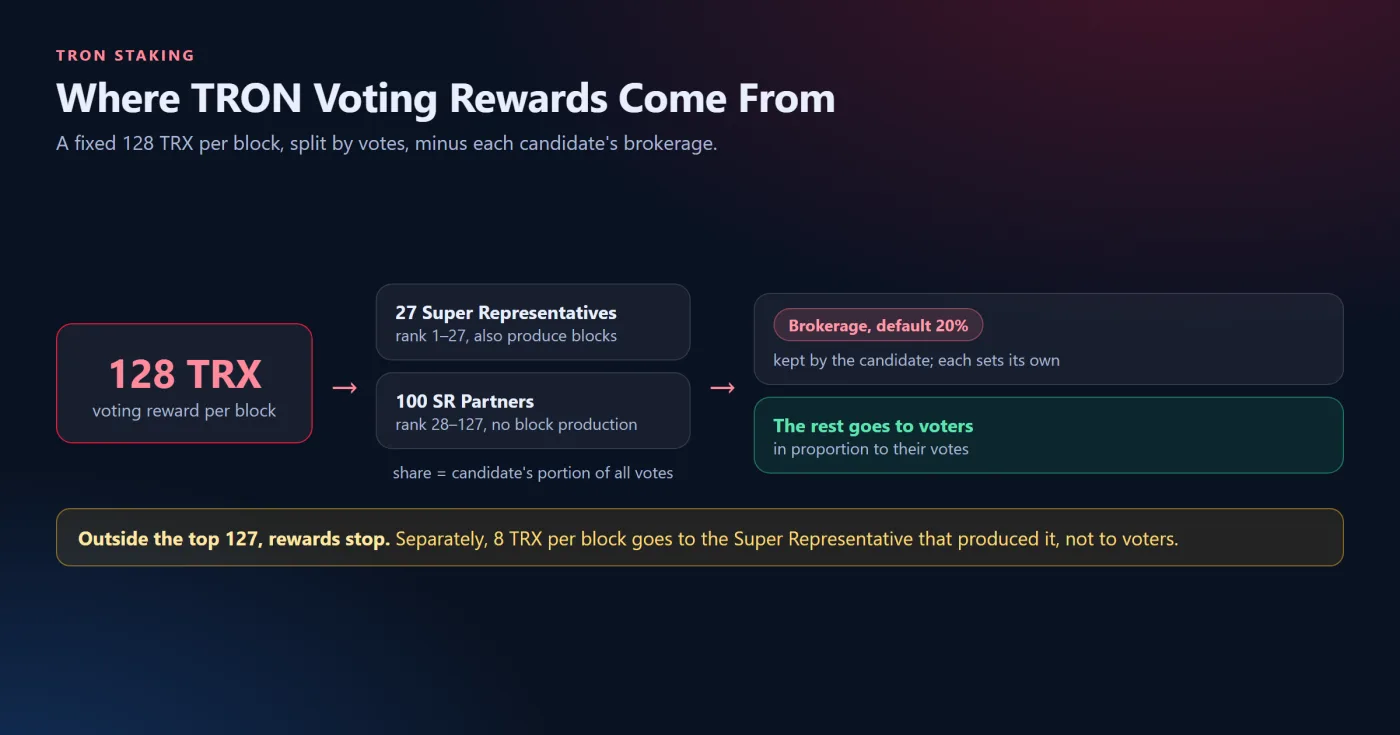
Each TRON block carries a voting reward of 128 TRX, according to the TRON developer documentation. This amount is shared among the 127 top candidates: the 27 Super Representatives, who also produce blocks, and 100 SR Partners ranked 28 to 127, who do not produce blocks. The share of the candidate depends on the number of votes it receives.
Each candidate keeps a part of its share, called the brokerage, and the rest goes to its voters in proportion to their votes. The default brokerage is 20%, but every SR or SR Partner can set its own value. The documentation gives the voter's daily reward as the voter's share of the votes multiplied by what remains after the brokerage. Because of this, two voters with the same amount can earn different rewards if they choose candidates with different brokerage rates.
Block production adds a separate reward of 8 TRX per block. That reward goes to the Super Representatives who produce the blocks and is not part of what voters earn directly.
Bandwidth and Energy: The Other Part of Staking
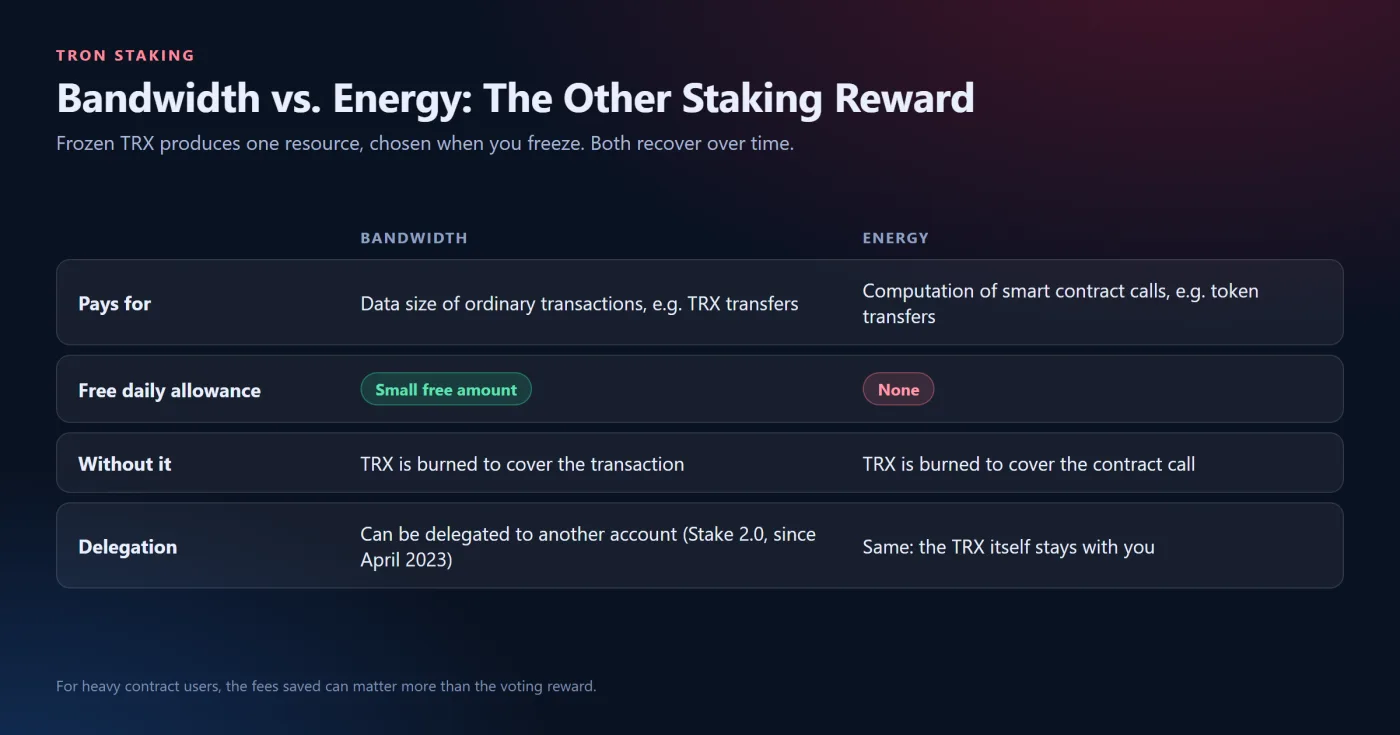
When TRX is frozen, the owner chooses which resource it produces. Bandwidth covers the data size of ordinary transactions, such as a transfer. Energy covers the computation of smart contract calls, for example when a token is moved through a contract. Neither resource is a permanent balance, because both recover over time. Trezor notes that Bandwidth has a small free daily allowance and Energy does not.
Stake 2.0, the current version of the system, separates staking from delegation. It has been active since April 7, 2023, under proposal 84. A holder can therefore delegate the resources to another account without handing over the TRX. For someone who makes many contract transactions, the saved fees can matter more than the voting reward, but this depends on the person's own activity and cannot be generalized.
How Much Does TRON Staking Pay?
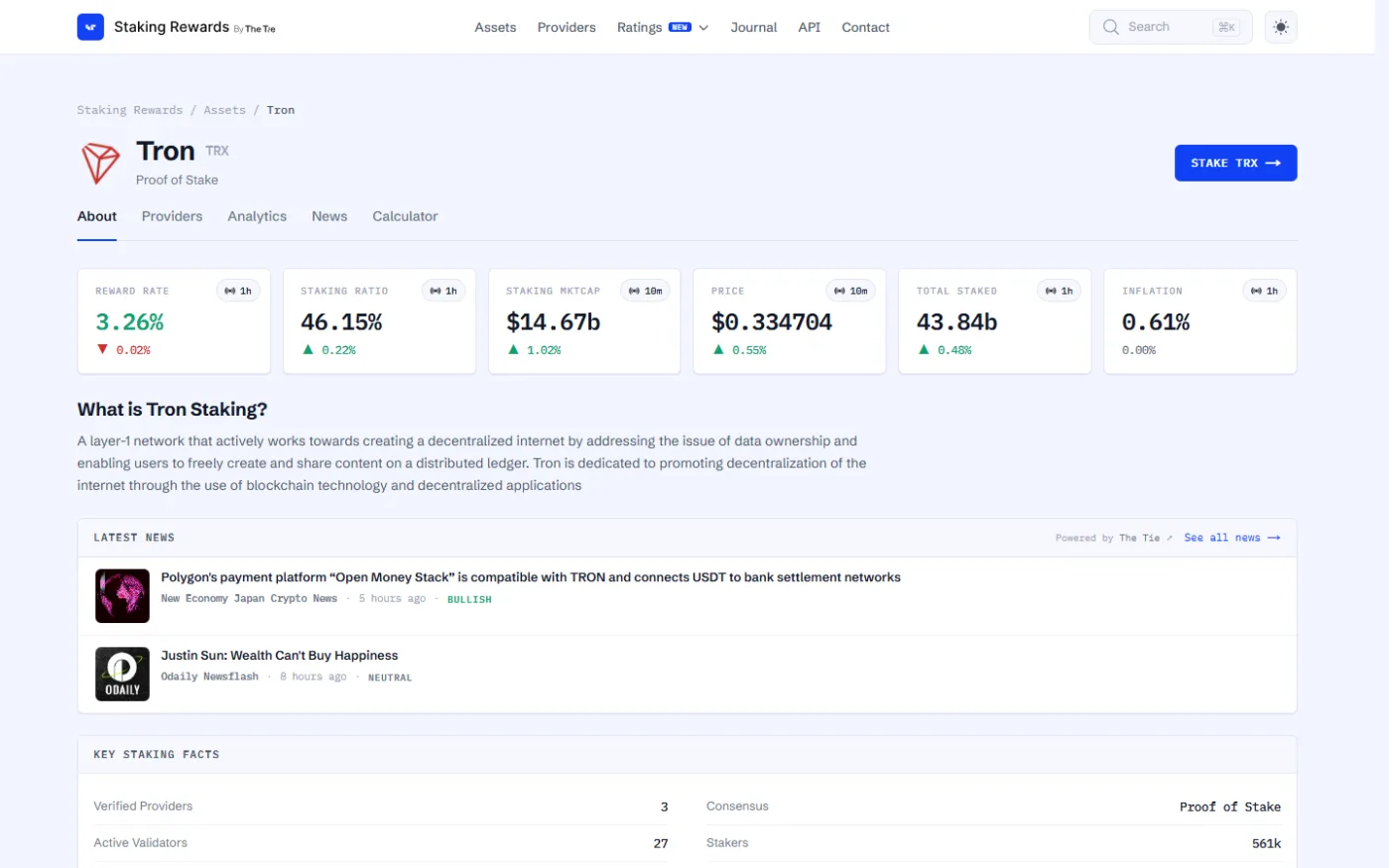
TRON's own documentation gives the reward rules but no yield figure, and Trezor describes the rate as dynamic. A live figure on Staking Rewards was 3.26% when the page was read on October 8, 2026, with listed providers between 3.26% and 3.30% and provider fees of 4% to 5%. Trezor's screenshots show 3.26% APR as an example. These numbers come from third parties and will have changed by the time you read this.
The rate moves because the 128 TRX per block is fixed in the documentation, while the number of votes and the brokerage of each candidate change. More votes spread over the same reward means a lower return per vote.
A Hypothetical Example
The following is an illustration, not a forecast. Assume 10,000 TRX is staked for one year at a flat 3%. The reward would be 300 TRX, which is not compounded because TRON rewards are claimed and restaked by hand. If the holder claims and restakes every month, the result would be slightly higher, but each claim and restake costs a network fee. The price of TRX can move by more than the reward in either direction.
Unstaking and the 14-Day Wait
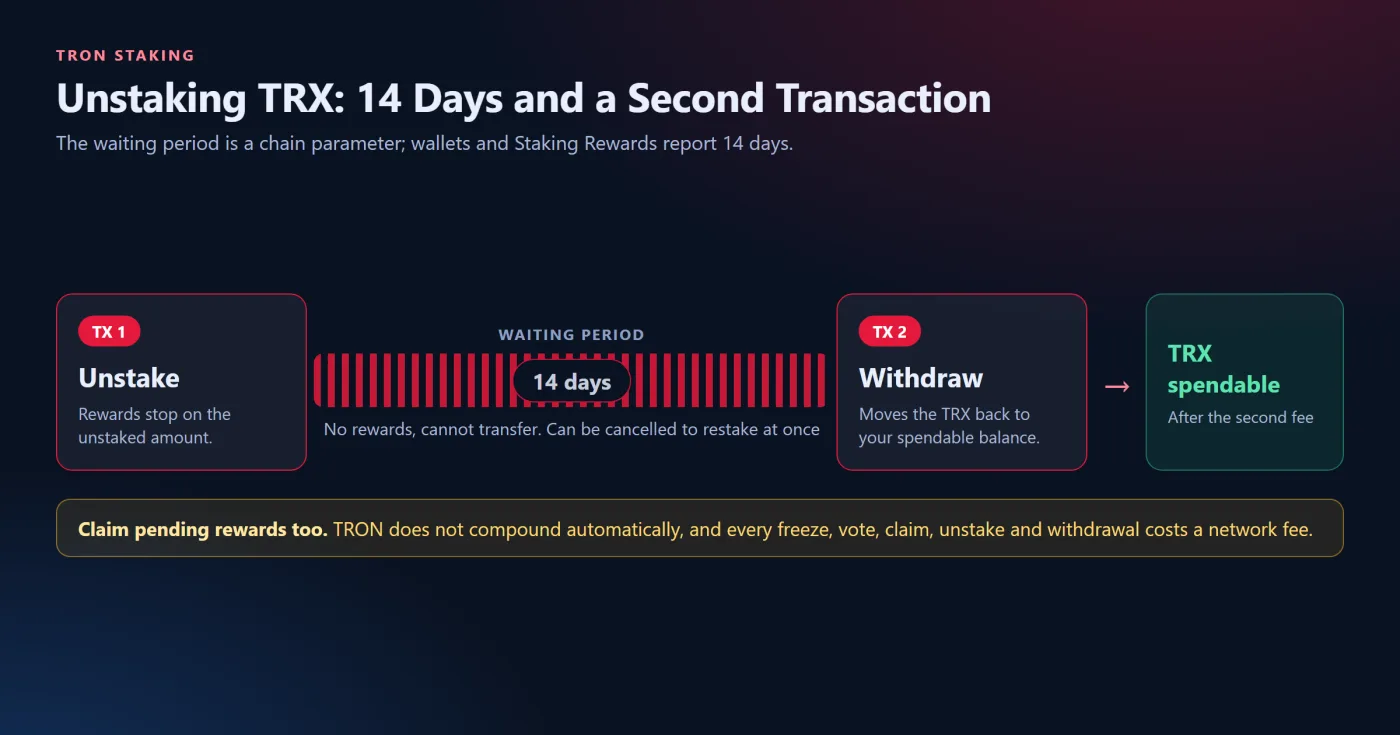
The TRON documentation says that unstaked TRX is held for a waiting period set by a chain parameter, and does not state the number on the page that was read. Trezor and Staking Rewards both describe it as 14 days, so this article uses 14 days as the figure reported by providers and recommends checking it in the wallet before unfreezing.
According to Staking Rewards, TRX that is being unstaked earns no rewards and cannot be transferred during the wait. However, the pending request can be cancelled to stake again straight away. After the wait, a second transaction (a withdrawal) returns the TRX to the spendable balance.
Choosing a Super Representative or SR Partner
Since the reward depends on the candidate, the choice is more than a click. Points worth comparing:
-
Brokerage. A lower brokerage leaves more of the share to the voters, though it may come with fewer services.
-
Rank. Only the top 127 candidates receive voting rewards. According to Staking Rewards, if your candidate is no longer among the top 127, you stop earning.
-
Reliability. Staking Rewards notes that a representative can be voted out by the community.
-
Terms. Wallets such as Trezor Suite ask the voter to accept the representative's terms before voting, so they are worth reading.
-
Concentration. Staking Rewards notes that the top 27 are concentrated and that the TRON Foundation and related entities strongly influence governance.
Risks of TRON Staking
Staking Rewards states that the TRON network does not slash delegator stake, so a voter does not lose principal when a candidate is voted out. The remaining risks are different. Rewards stop if the candidate leaves the top 127. The 14-day wait limits access to funds in a fast market. Each freeze, vote, claim, unstake, and withdrawal costs a fee. TRX has no fixed maximum supply, which makes supply modelling less predictable, and ordinary smart contract and protocol risks apply. Custodial platforms that offer TRX staking add their own fees and counterparty risk, and their rules differ from the on-chain process described here.
What to Check Live Before You Stake
-
The current unstaking period in the wallet or on a TRON explorer.
-
The candidate's rank, brokerage, and whether it is inside the top 127.
-
The live reward rate from the wallet or provider, and whether it is APR or APY.
-
The fees for freezing, voting, claiming, and withdrawing.
-
Whether the wallet supports staking on mobile or only on desktop. Trezor's guide says staking actions are desktop-only.
This article is educational and is not investment advice. Staking involves risk, and each reader should compare the live data with their own situation.
Related guides


 Scroll to top