


ETH Staking Calculator: Formula, Rewards, and Examples


Table of contents

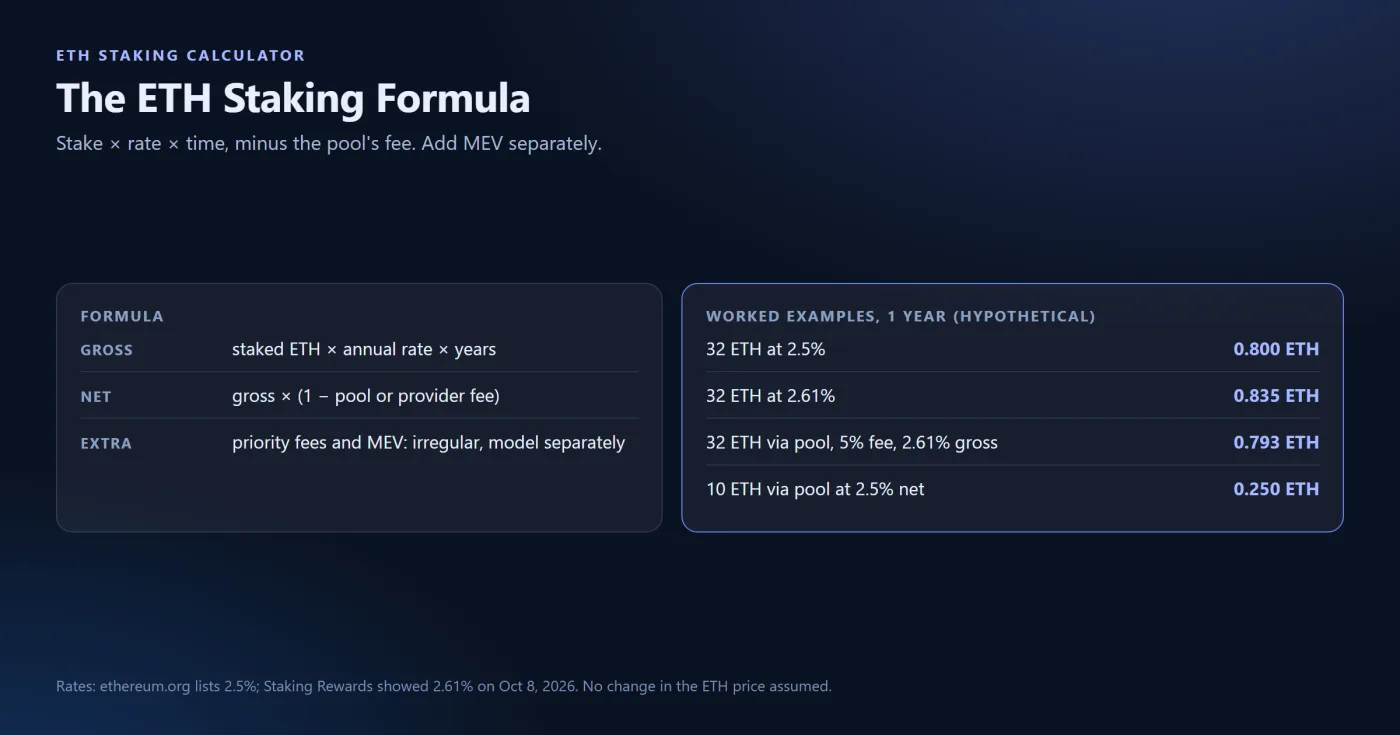
An ETH staking calculator multiplies the amount of staked ETH by the annual reward rate, subtracts any fee charged by a pool or provider, and scales the result by time. For a 32 ETH validator at a 2.5% rate, that is 0.8 ETH per year before fees. The hard part is the rate, because Ethereum's reward rate is not set by anyone: it falls as more ETH is staked, and it also moves with MEV and network activity.
This guide explains what goes into an Ethereum staking rewards calculator, which inputs to check, and how to read the result. It does not include a built-in calculator. The examples are hypothetical and were computed for this article.
The Formula Behind an ETH Staking Calculator
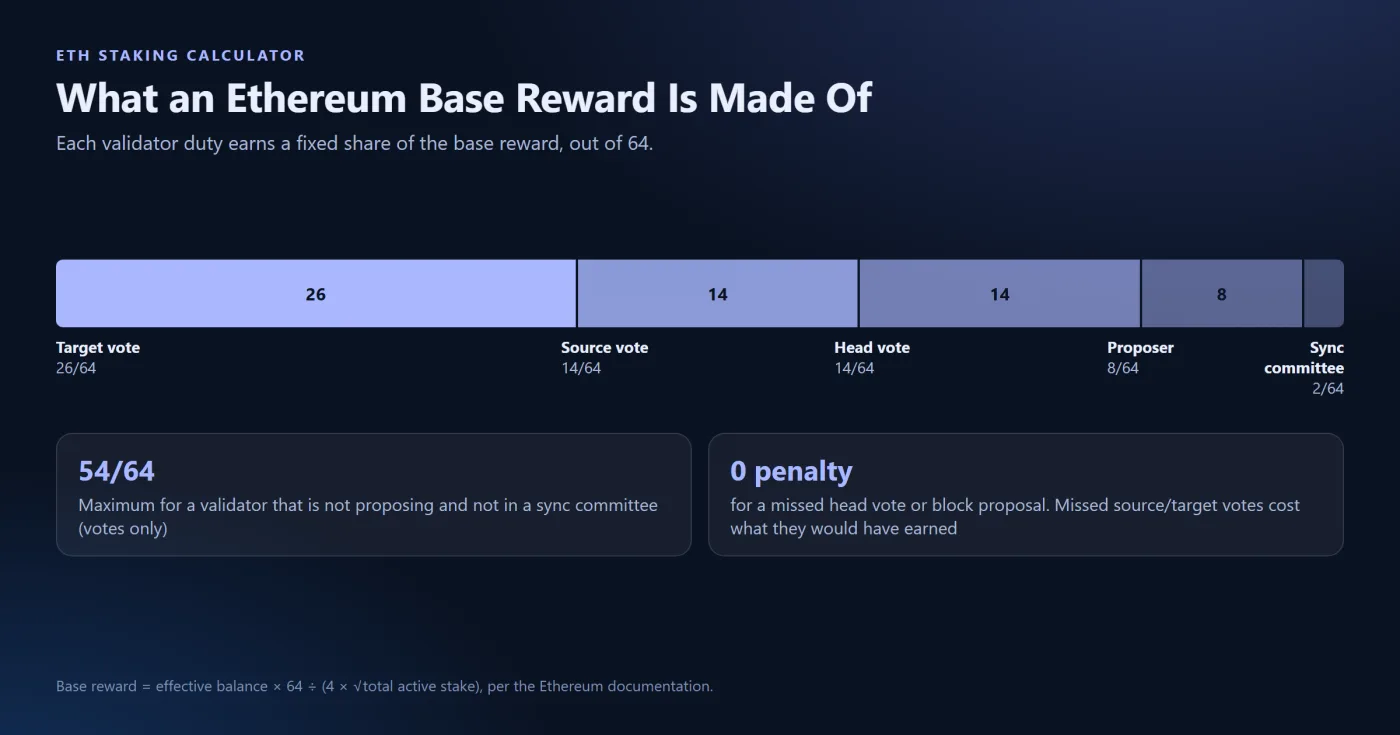
Ethereum's consensus rewards come from several duties: voting on the chain (attestations), taking part in sync committees, and proposing blocks. The Ethereum documentation gives the base reward as the validator's effective balance multiplied by a base reward factor (64), divided by the product of 4 and the square root of the total active staked ETH. In plain terms, the reward is proportional to your stake and falls as the total stake grows.
-
Gross reward = staked ETH x annual rate x years.
-
Net reward = gross reward x (1 - fee), when a pool or provider takes a percentage.
-
Add execution rewards (priority fees and MEV) separately, because they are irregular.
The same documentation lists the weights that make up the reward out of 64: source vote 14, target vote 26, head vote 14, sync committee 2, and proposer 8. A validator that is not a proposer and not in a sync committee can earn up to 54/64 of the base reward. A calculator based on a single average rate hides this structure, but it is accurate enough for planning if the rate is current.
Which Rate to Enter
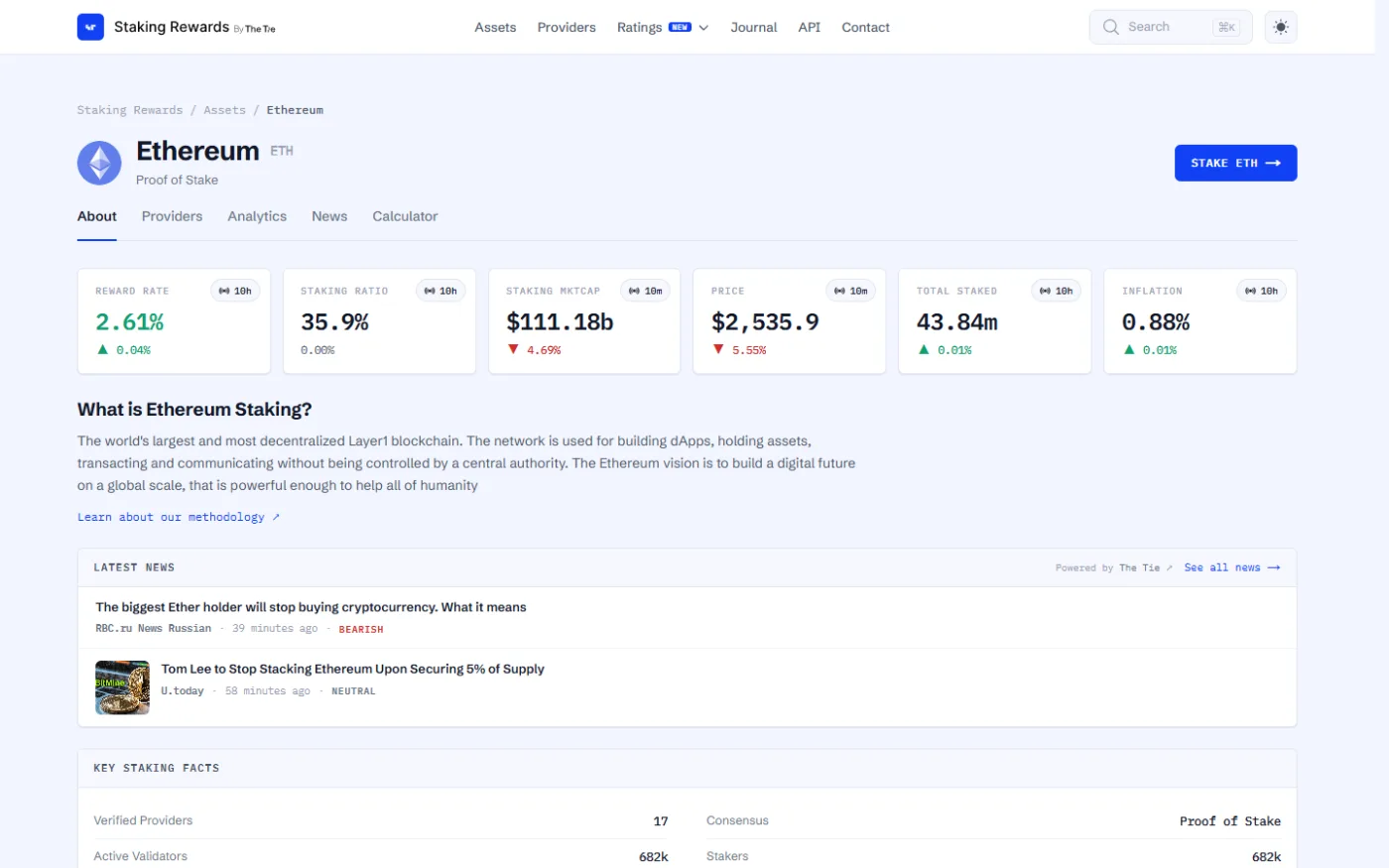
Ethereum.org lists the current staking APR as 2.5% with about 43.95 million ETH staked (35% of supply), while Staking Rewards showed a reward rate of 2.61% on October 8, 2026, with a staking ratio of 35.9%. The two figures are close, but the Ethereum.org page is inconsistent about its own update date, so its numbers may be older. Both are point-in-time snapshots.
Staking Rewards also lists P2P.org at 2.58% with a 5% fee and notes that MEV can be 10% to 30% of validator revenue but is highly variable. For a calculator, it is safer to model MEV as an optional extra than to build it into the base rate.
Why the Rate Falls as Staking Grows
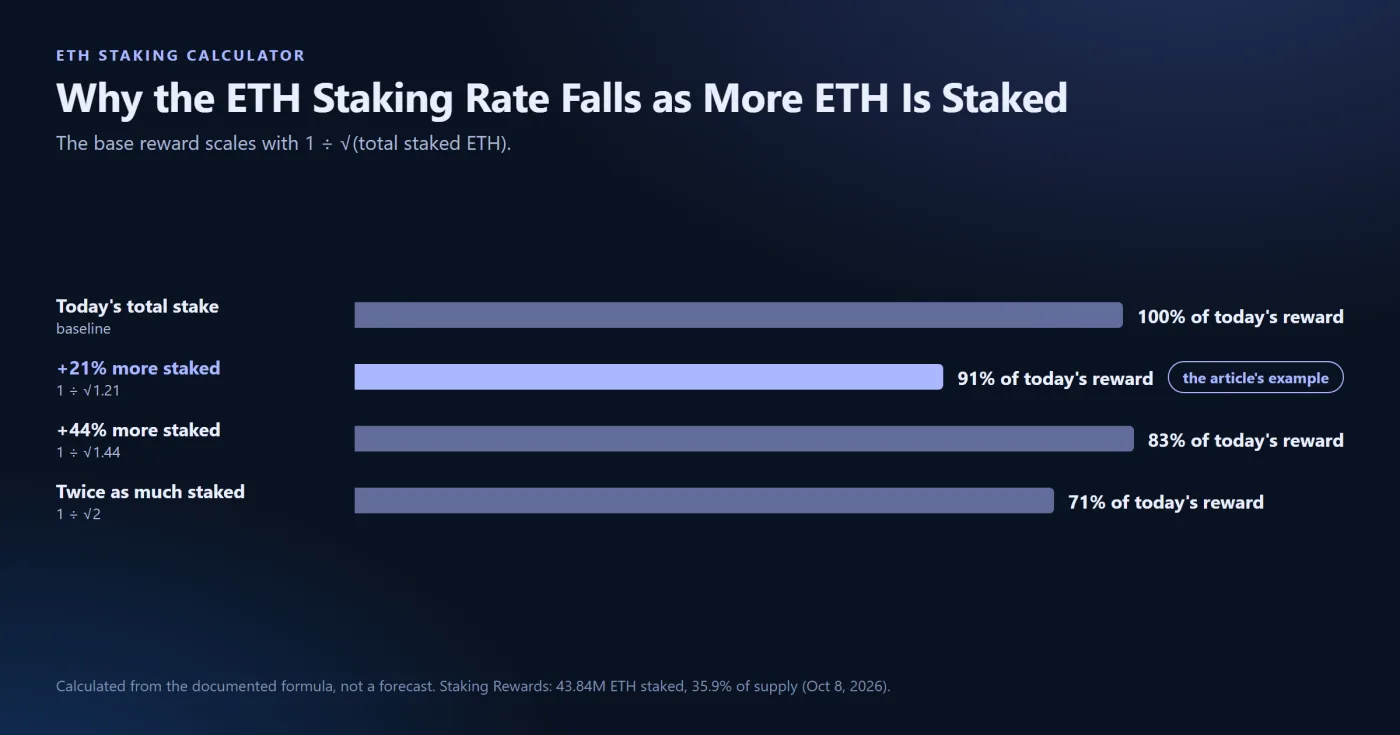
Because the base reward depends on 1 divided by the square root of the total stake, more staked ETH means a lower reward per validator. This is the explanation for the rate declining over time and not a sign that something is broken. A hypothetical illustration: if total staked ETH grew by 21%, each validator's base reward would fall to 1 / sqrt(1.21) = 1 / 1.1, about 91% of its earlier level, which is roughly 9% lower. This is a calculation from the documented formula and not a forecast.
Worked Examples (Hypothetical)
The examples assume a constant rate and no change in the ETH price. They are illustrations, not observed results.
-
32 ETH for one year at 2.5%: 0.8 ETH.
-
32 ETH for one year at 2.61%: about 0.835 ETH.
-
The same 32 ETH through a pool with a 5% fee at 2.61% gross: about 0.793 ETH.
-
10 ETH through a pool for one year at a net 2.5%: 0.25 ETH.
For the 5% fee case, the net rate is 2.61% x 0.95, or about 2.48%.
Compounding and Withdrawals
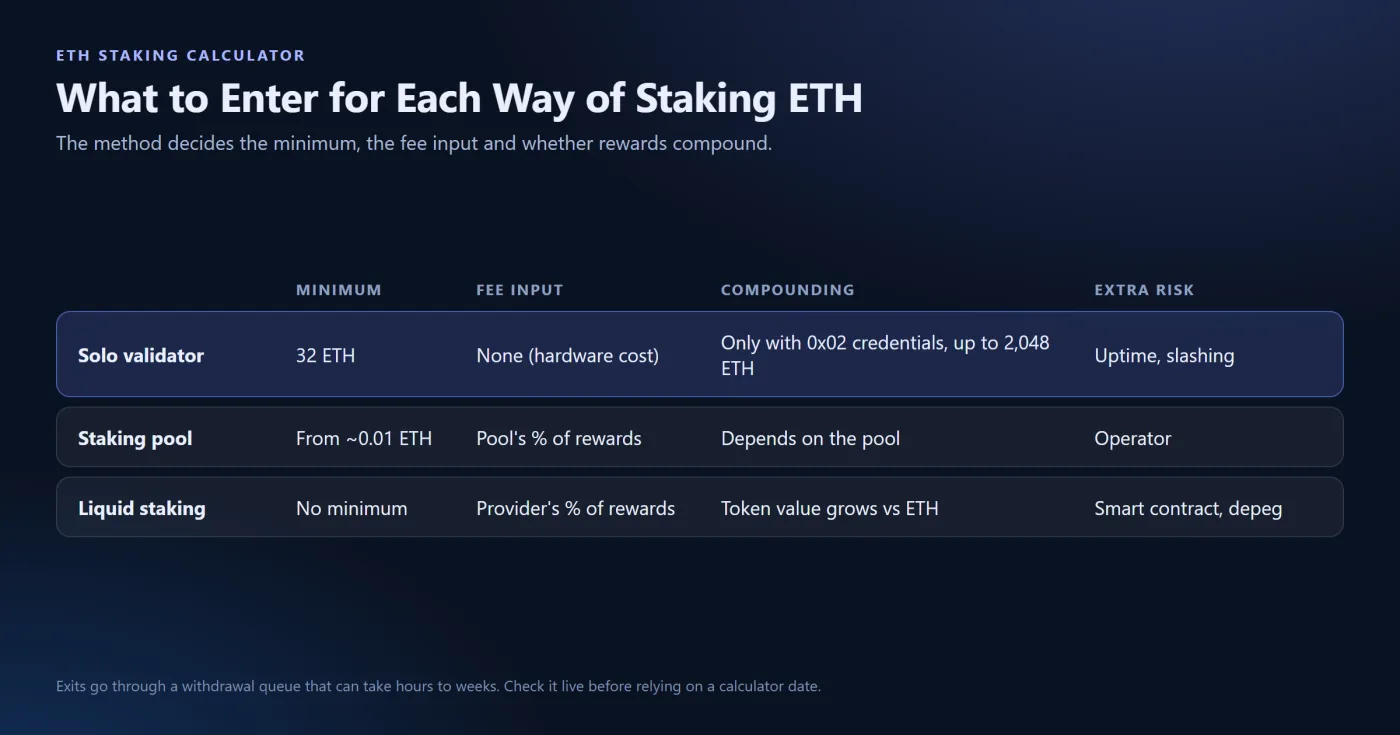
Calculators often assume compounding, but on Ethereum it depends on the type of validator. According to Ethereum.org, a validator can hold up to 2,048 ETH since the Pectra upgrade, and validators with compounding (0x02) withdrawal credentials automatically add rewards to the stake. Staking Rewards notes that rewards above the effective balance are swept out automatically every few days. This suggests that a standard 32 ETH validator does not compound unless the sweeping rules and credentials are changed, so a simple, non-compounded result is the safer default for solo staking.
Pools and liquid staking tokens handle this differently, and their results depend on the provider's design, so the provider's own documentation should be checked.
Minimum Amounts and Ways to Stake
Ethereum.org states that a solo validator needs at least 32 ETH and a computer that is online nearly all the time. Staking pools can accept much smaller amounts, with some as low as 0.01 ETH, and their rewards go to the pool's validators, not directly to you. Liquid staking returns a token that represents the staked ETH plus rewards and can be used in DeFi, which adds smart contract and counterparty risk. Staking Rewards notes that liquid staking has no minimum deposit.
The method changes what should go into the calculator: solo staking has no fee but needs hardware, while pools and providers charge a percentage.
Entry and Exit Timing
A calculator based on yearly rates ignores the time spent waiting. Staking Rewards says that full exits enter a withdrawal queue, and that waits can range from hours to weeks during high demand. Ethereum.org states that stakers can withdraw rewards or principal, and that since Pectra exits and partial withdrawals can be triggered from the withdrawal address without the validator's signing keys. The length of the entry and exit queues changes often, so it should be checked live.
Penalties and Slashing
A calculator should not suggest that staking has no downside. According to the Ethereum documentation, missing a timely source or target vote costs the amount that would have been earned, while missing a head vote or a block proposal carries no penalty. Slashing applies to provable misbehaviour, such as double-proposing or conflicting attestations, and leads to removal after a 36-day period, with an extra correlation penalty that grows when many validators are slashed together.
Sources disagree on the size of the first burn: the Ethereum documentation states 0.0078125 ETH for a 32 ETH validator and mentions a maximum of up to 1 ETH, while Staking Rewards describes about 1/32 of the stake. Staking Rewards also says slashing has been rare and mostly caused by misconfiguration. An inactivity leak drains stake from validators that are offline when the chain cannot finalize for a long period.
What to Check Live Before You Calculate
-
The current reward rate, its date, and whether it includes MEV and fees.
-
The staking ratio and the amount of ETH staked, since both move the rate.
-
The pool or provider's fee and how rewards are paid out.
-
The minimum amount, the withdrawal rules, and the current exit queue.
-
The type of validator credentials, if you stake alone.
This article is educational and is not investment advice. Staking involves risk, and each reader should compare the live data with their own situation.
Related guides


 Scroll to top