


Cardano Staking Calculator: Formula, Fees, and Examples


Table of contents

A Cardano staking calculator needs the amount of ADA, the network reward rate, the pool's fixed fee and margin, and the time. Cardano pays rewards once per epoch (five days), two epochs after they are earned, and the ADA never leaves your wallet. The calculation is simple, but two inputs change the answer a lot: the pool you choose and the rate you enter.
This guide explains what a Cardano staking rewards calculator does, the formula you can use in a spreadsheet, and why a small pool can return much less than the headline rate. It does not include a built-in calculator. All numeric examples are hypothetical and were computed for this article.
The Formula Behind an ADA Staking Calculator
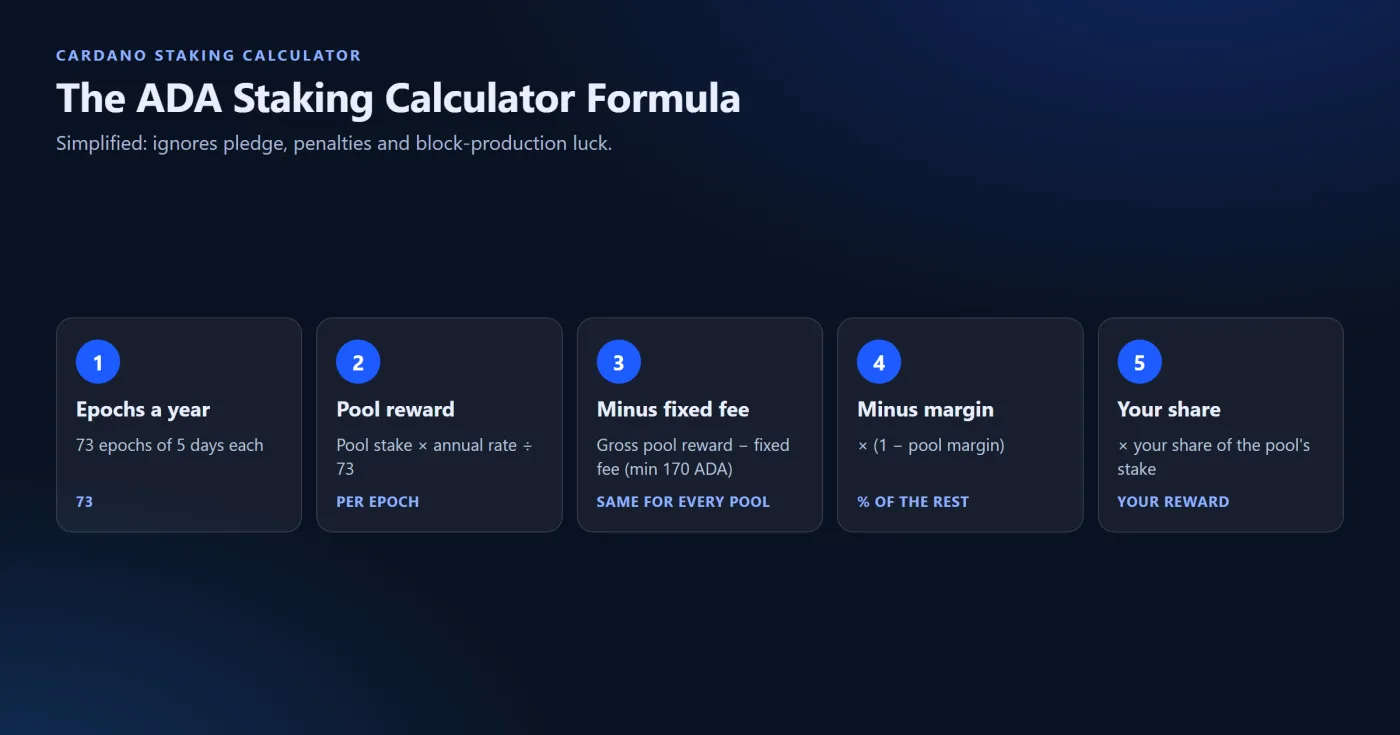
According to the Cardano glossary, rewards are calculated each epoch from the stake snapshot and the producing pool's performance, and a delegator's share depends on the pool's performance and on the delegator's share of that pool's stake. The protocol takes the rewards of a pool through several steps, which the Coinbase explainer on pledge and margin lists: penalties for poor behaviour, adjustment for pledge, the fixed cost, the operator's margin, and finally a split of the remainder in proportion to stake.
A calculator can reproduce this in simplified form:
-
Epochs per year = 73 (five-day epochs, as explained by NBX).
-
Gross reward per epoch for the pool = pool stake x annual rate / 73.
-
After fixed fee = gross reward - fixed fee.
-
After margin = (gross reward - fixed fee) x (1 - margin).
-
Your reward = your share of the pool's stake x the result after margin.
This ignores pledge influence, penalties, and the randomness of block production, which the NBX article says varies around an average and makes rewards estimates and not guarantees. It is a planning tool and not a prediction.
Which Rate to Enter
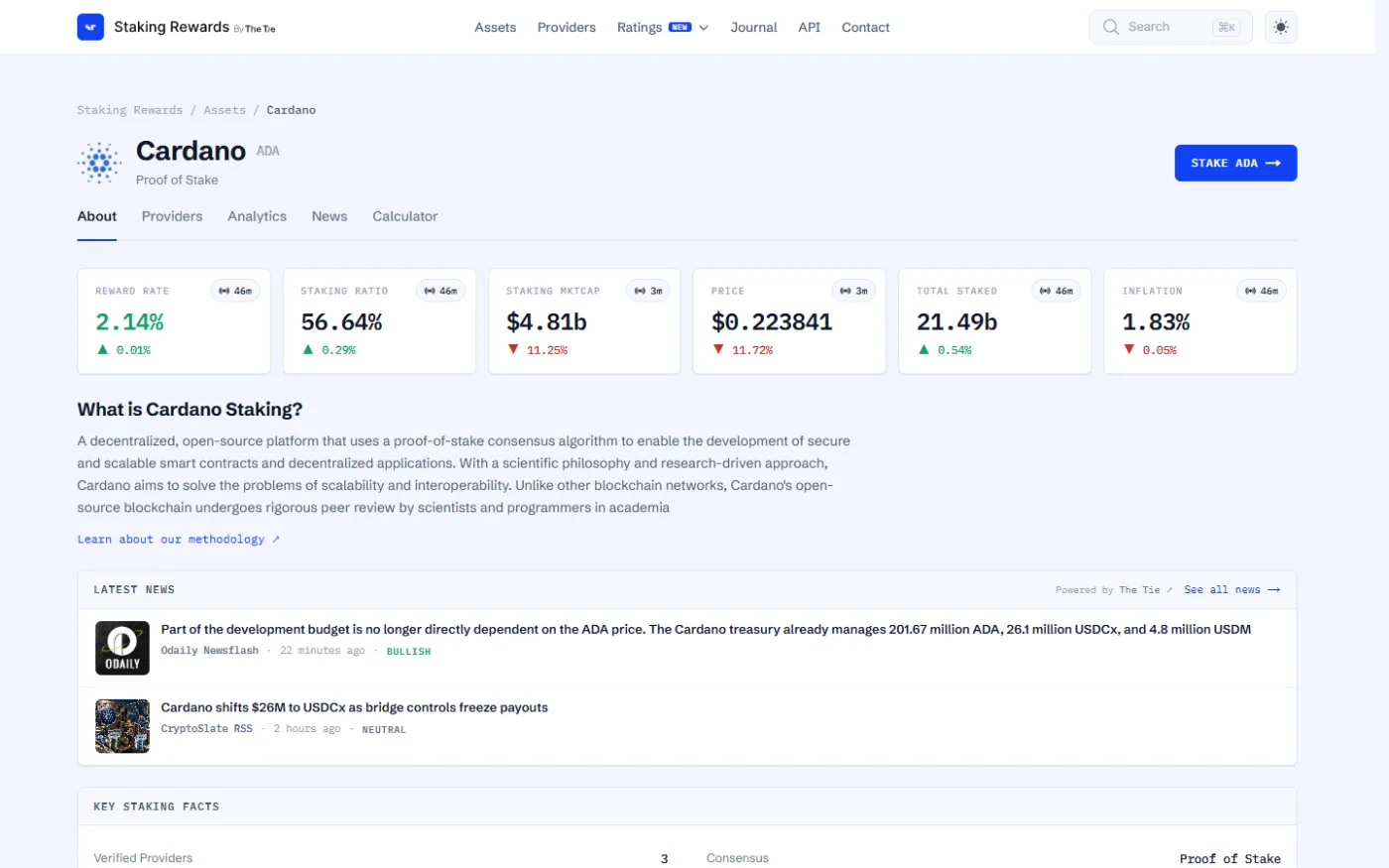
Staking Rewards reported a reward rate of 2.1% at an inflation rate of 1.86% and a staking ratio of 56.54% on October 14, 2026. According to Staking Rewards, per-token yield falls with growing participation and epoch rewards can be highly variable, so it suggests assessing yield over several months. NBX, in an older article, reported about 4% historical return for its own pool and an overall downward trend. They are third-party numbers, and the live rate should be checked before calculation.
The reward pot is also influenced by two protocol parameters specified in the Cardano glossary: the monetary expansion rate determining how much of the remaining ADA reserve is unlocked each epoch and the treasury cut allocating a fraction of each epoch's pot to the on-chain treasury before pools and delegators get paid. According to NBX, the reserve issuance is declining over time.
Pool Fees and Margin
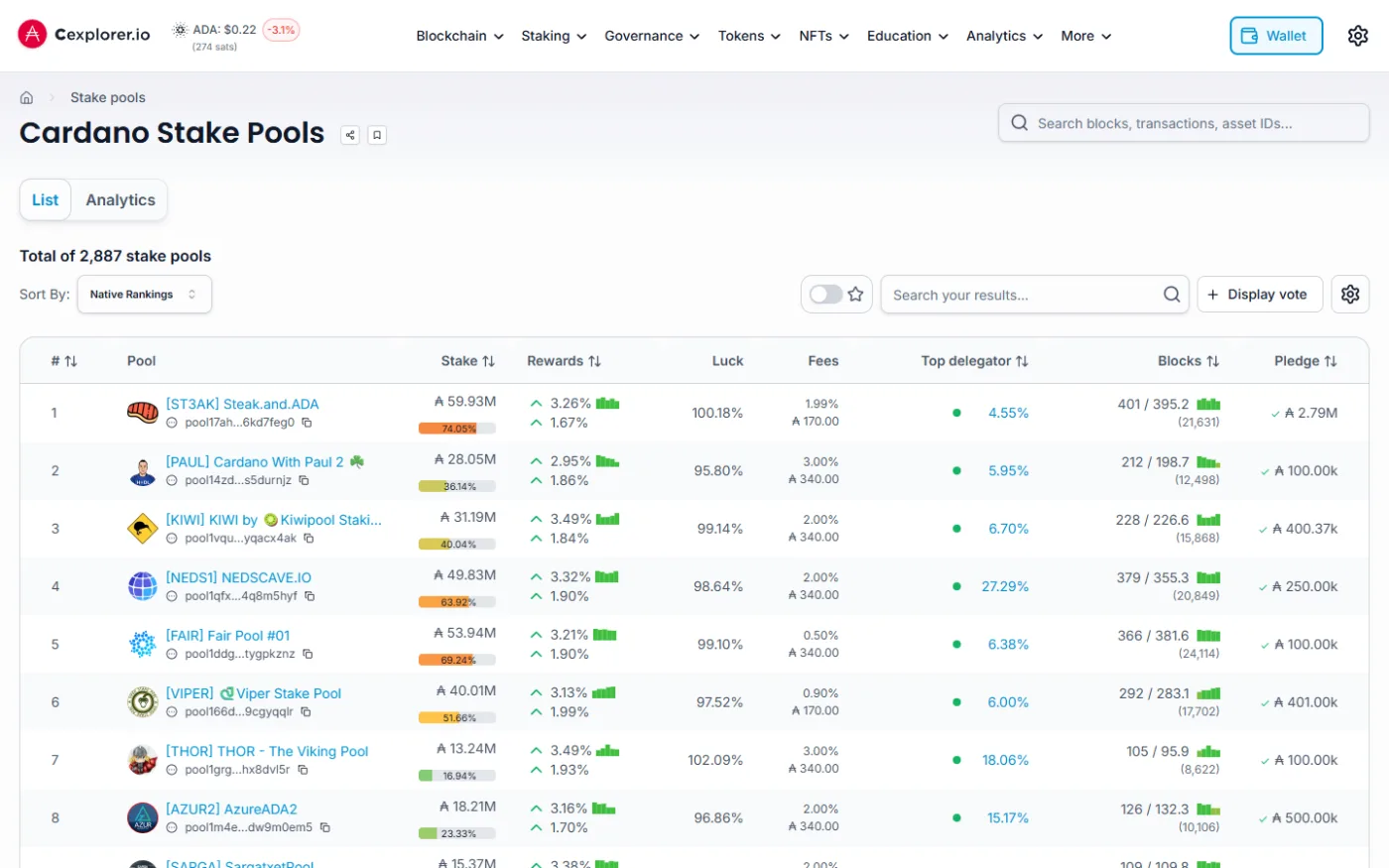
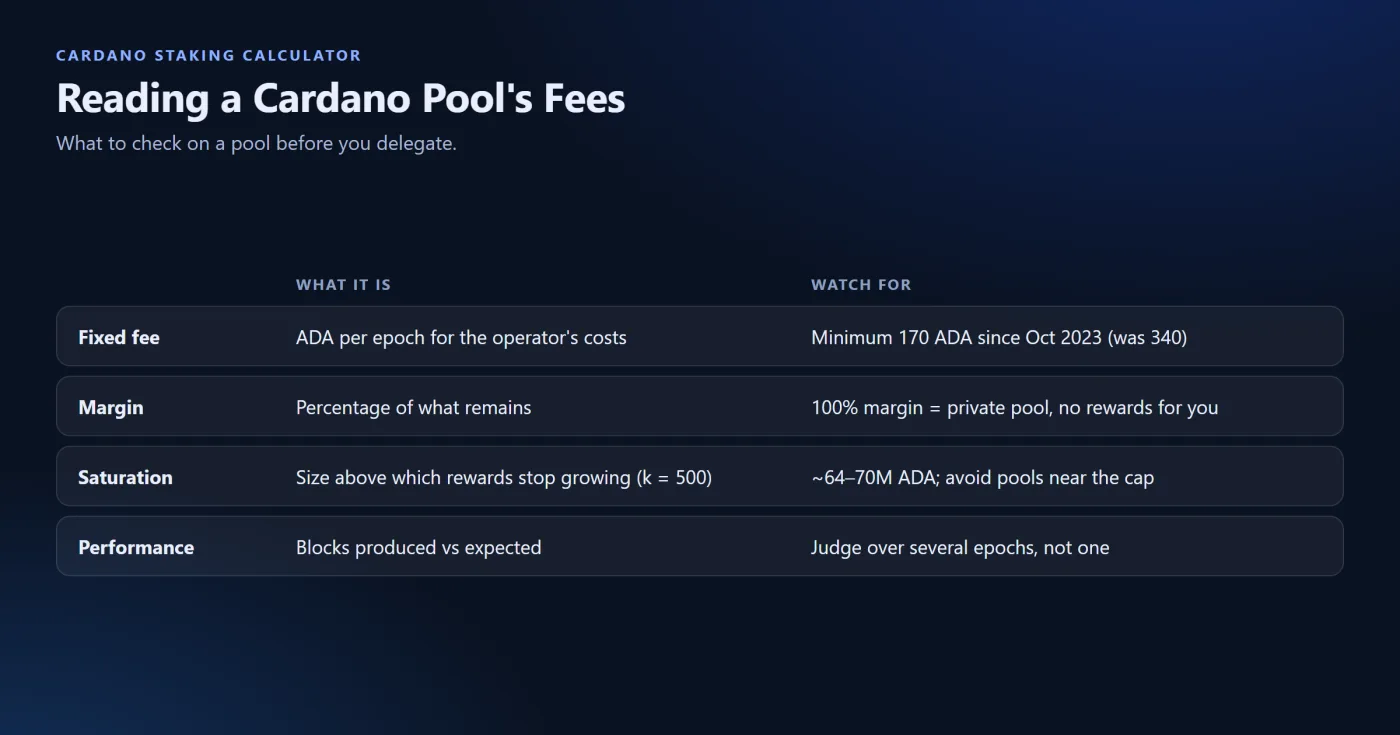
Each pool charges two things before delegators are paid. The fixed fee is a set amount of ADA per epoch that covers the operator's costs, and the margin is a percentage of what remains. Staking Rewards states that the minimum fixed fee is 170 ADA per epoch, reduced from 340 ADA in October 2023. The Coinbase explainer and an NBX article both mention 340 ADA, which appears to be the earlier value, so a figure from an older source may be out of date.
A pool with a 100% margin is private, and delegators get no rewards from it, according to the Coinbase explainer. The Staking Rewards benchmark for commission is 24.22%, which is a provider-side measure that can incorporate various fee structures and should not be confused with the margin of a particular pool.
Why Pool Size Matters for the Calculator
The fixed fee is the same for every pool, so a small pool pays a larger share of its rewards as fixed fee than a large one. The Staking Rewards page notes that the fixed fee affects each delegator less in larger pools, and that oversaturated pools give diminishing returns. The next section shows the effect with numbers.
Worked Examples (Hypothetical)
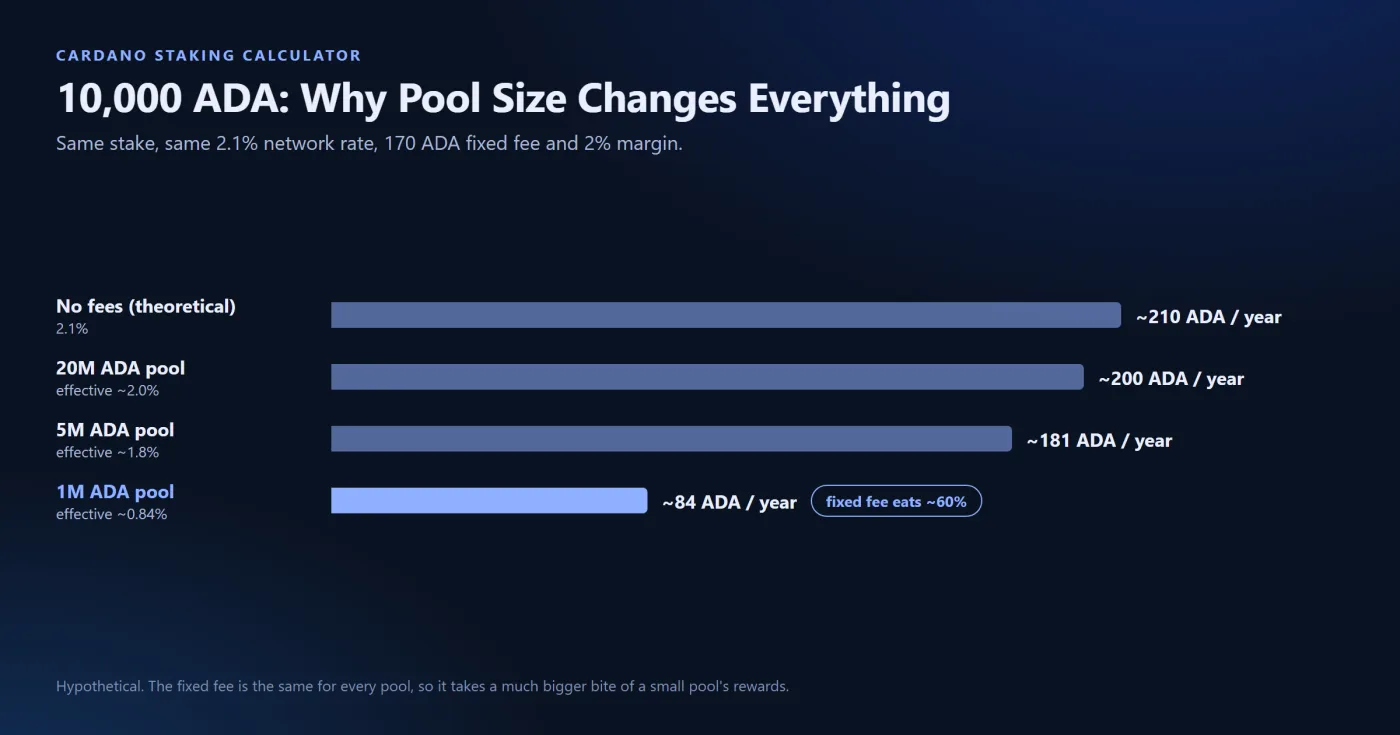
These examples are illustrations, not forecasts or observed results. They assume that the pool earns the 2.1% network rate, a 170 ADA fixed fee, a 2% margin, no pledge effect, and 73 epochs per year.
-
10,000 ADA at 2.1% for one year with no fees: 210 ADA, or about 2.88 ADA per epoch.
-
The same stake in a pool with 20 million ADA: the pool earns about 5,753 ADA per epoch, 170 ADA fixed fee and a 2% margin leave about 95.1%, so the effective rate is about 2.0% and the year's reward is about 200 ADA.
-
In a pool with 5 million ADA, about 86.4% remains, so the effective rate is about 1.8% and the reward is about 181 ADA.
-
In a pool with 1 million ADA, only about 40.1% remains, so the effective rate is about 0.84% and the reward is about 84 ADA.
What the Examples Show
The same ADA earns very different amounts depending on the pool, which is why a calculator that asks only for the network rate is not enough. Real pools also differ in pledge, performance, and luck in block production, so the effective rate for a specific pool can be higher or lower than shown.
Saturation and the k Parameter
A pool has a size beyond which extra delegation does not increase rewards. The Cardano glossary calls this saturation and says it encourages spreading stake across pools. The Coinbase explainer states that the k parameter, set at 500 as of December 2020, puts the cap at about 64 million ADA per pool, while NBX cites about 70 million ADA. The two numbers differ because the cap depends on total stake, so the current value should be read from a pool explorer. For a calculator, the practical rule is to avoid pools close to or above the cap.
Timing, Lockup, and Deposit
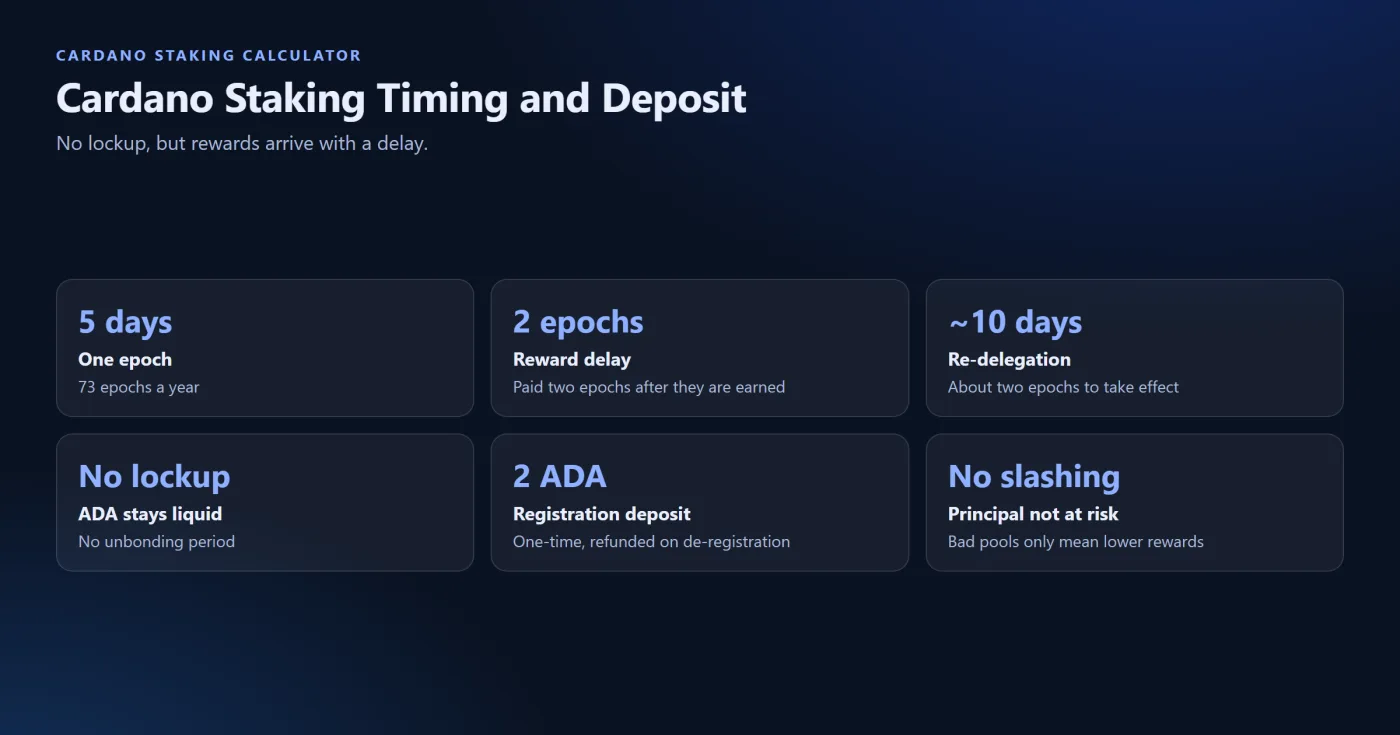
Staking Rewards states that Cardano has no lockup or unbonding period, so staked ADA stays liquid. Rewards are paid two epochs after they are earned, according to the Cardano glossary, and Staking Rewards says re-delegation takes about two epochs, roughly 10 days, to take effect. A one-time 2 ADA deposit is required to register a staking address, refundable on de-registration, according to the same page.
For a calculator this means that the first reward arrives later than the first epoch, and that switching pools has a short gap. For a long period, the delay barely changes the result.
Risks
According to Staking Rewards, Cardano does not implement slashing, so the ADA cannot be lost to a pool's mistake. The remaining risks are low or zero rewards from a poorly performing or oversaturated pool, the falling network rate, the ADA price, and theoretical bugs. The sources read for this article do not describe how rewards are compounded, so the examples above are not compounded.
What to Check Live Before You Calculate
-
The current network reward rate and its date.
-
The pool's fixed fee, margin, pledge, and saturation level.
-
The pool's recent performance for several epochs, not one.
-
The wallet's own estimate and any fee shown before delegating.
-
The deposit and the time before the first reward.
Never enter a recovery phrase on any website to start staking. Delegation is approved inside the wallet, and no pool or calculator needs the recovery phrase.
This article is educational and is not investment advice. Staking involves risk, and each reader should compare the live data with their own situation.
Related guides


 Scroll to top