


Polkadot Staking Calculator: Formula and Claim Rules


Table of contents

A Polkadot staking calculator needs the amount of DOT, the annual reward rate, the validator's commission, and the time. The calculation is simple, but Polkadot adds three details that a basic calculator misses: rewards are not paid out automatically and are not compounded, rewards must be claimed within 84 eras (about 84 days) or they are lost, and unbonded DOT is locked for a period that Staking Rewards puts at 28 days.
This guide explains the formula, the inputs to check, and the Polkadot-specific rules that change the result. It does not include a built-in calculator. All numeric examples are hypothetical and were computed for this article.
The Formula Behind a DOT Staking Calculator
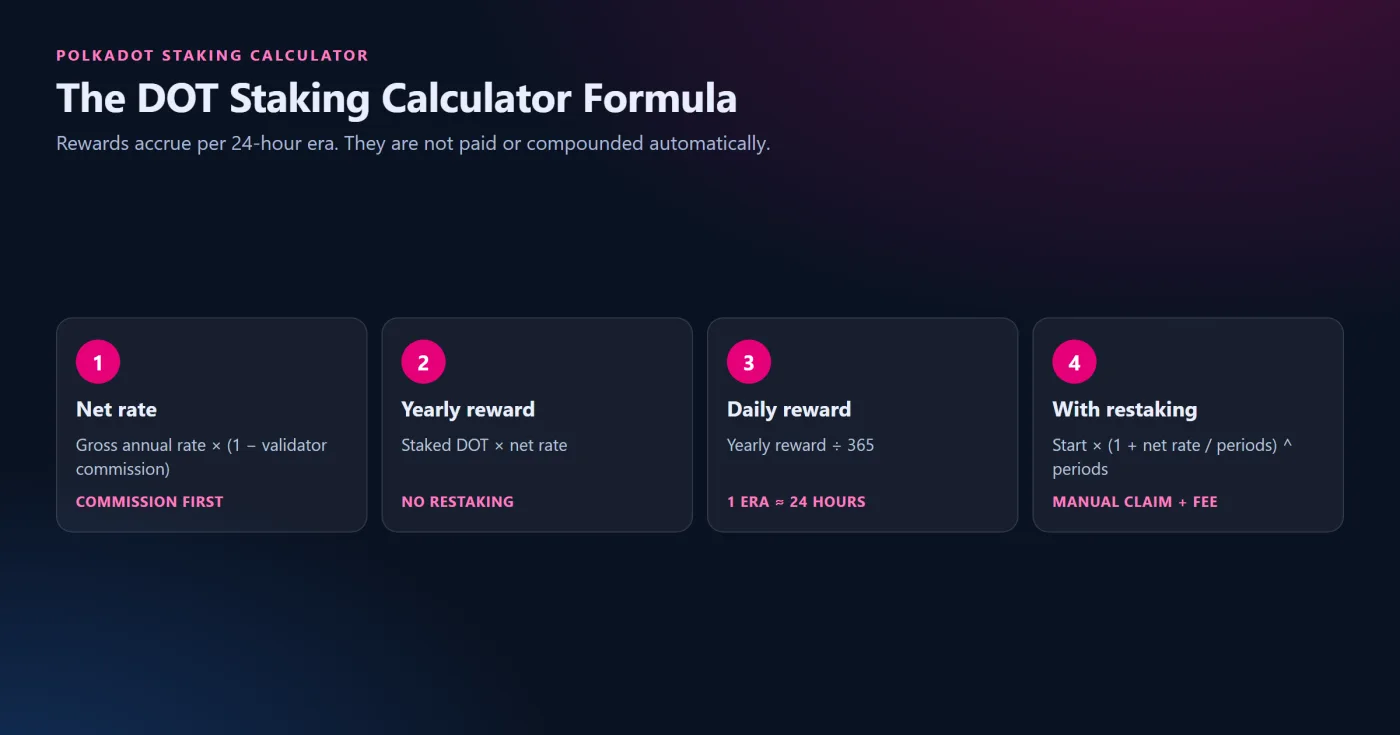
Polkadot calculates rewards per era, and an era lasts 24 hours on Polkadot according to the Polkadot Wiki. The wiki states that rewards are shared pro rata with stakers after the validator's commission, and that validators receive equal rewards regardless of how much stake backs them. A simple calculator therefore needs only a few steps:
-
Net rate = gross annual rate x (1 - validator commission).
-
Yearly reward = staked DOT x net rate.
-
Daily reward = yearly reward / 365, since rewards accrue per era of about 24 hours.
If you want the result with compounding, the calculator must assume that you claim and restake at a chosen interval, because Staking Rewards states that rewards are not auto-compounded. The formula then becomes: starting DOT x (1 + net rate / periods) ^ periods, where periods is the number of times per year you restake. Each claim and restake is a transaction with a fee, and the calculator does not include it.
Which Rate to Enter
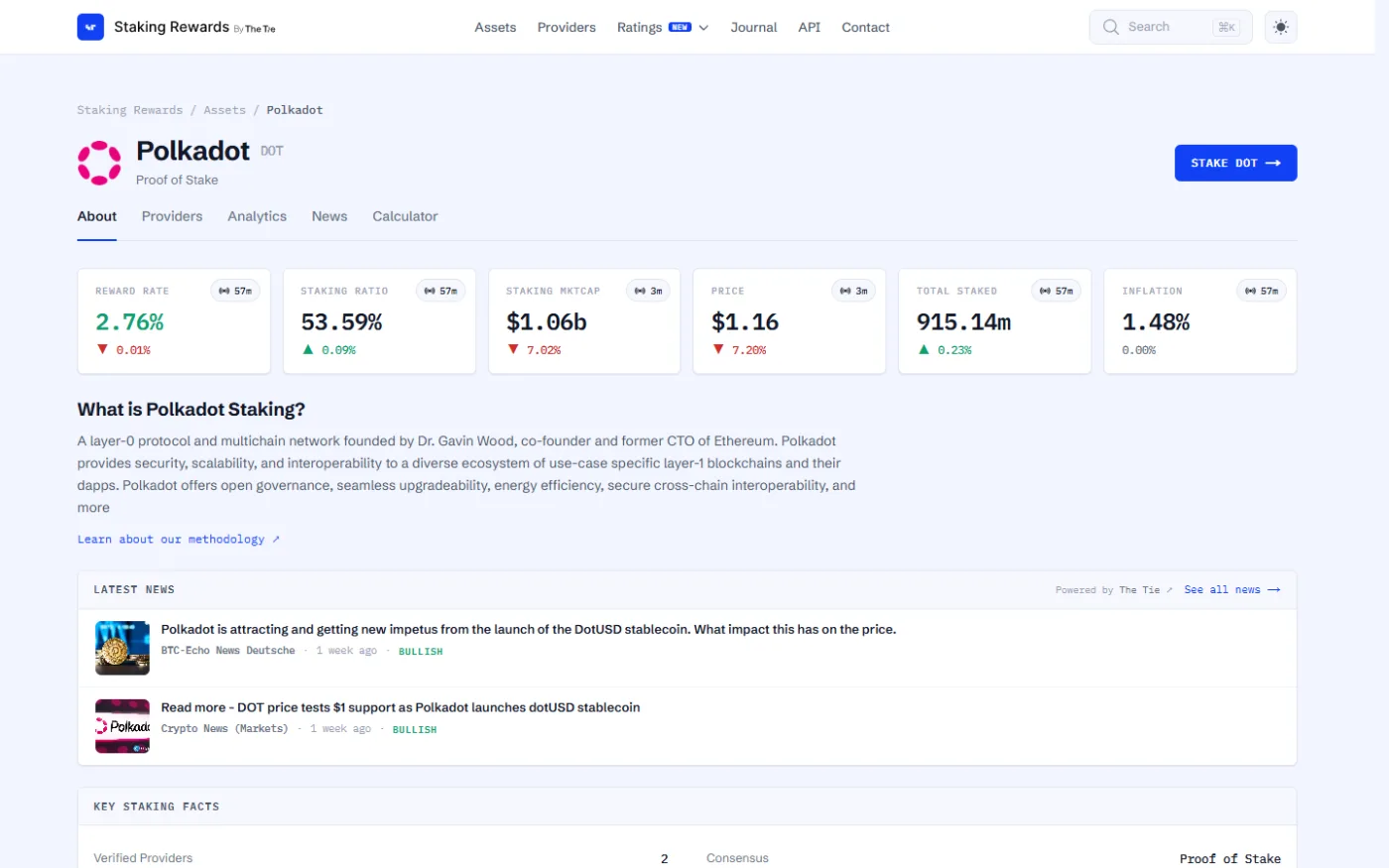
Staking Rewards showed a reward rate of 2.76% APY on October 14, 2026, with inflation at 1.48%, a staking ratio of 53.53%, and about 913.87 million DOT staked. The Polkadot Wiki says about 85% of the yearly token inflation is intended mainly for staking rewards. Because the reward comes from inflation, the rate depends on how much DOT is staked and on how inflation is set.
Staking Rewards also notes that inflation is declining under Referendum 1139 and that a cap of 2.1 billion DOT was set by Referendum 1710, which it expects to reduce nominal yields progressively. These governance details come from a third-party page, and the proposals were not read directly for this article. The rate should be checked live in the wallet or on a data page before using it.
Commission and Provider Fees
Validators set their own commission and can change it at any time, according to the Polkadot Wiki. The wiki suggests looking for a low commission, though not 0%. Staking Rewards calls a commission under 5% fair, shows a benchmark commission of 0%, and lists examples of providers: P2P.org with a 7.90% fee at a 2.51% rate and Staking4All with a 0.00% fee at a 2.63% rate.
For the calculator, commission is a required input. Check whether a published rate is already net of commission, because subtracting it twice would understate the result.
Worked Examples (Hypothetical)
These are illustrations, not forecasts or observed results. They assume a constant rate and no change in the DOT price.
-
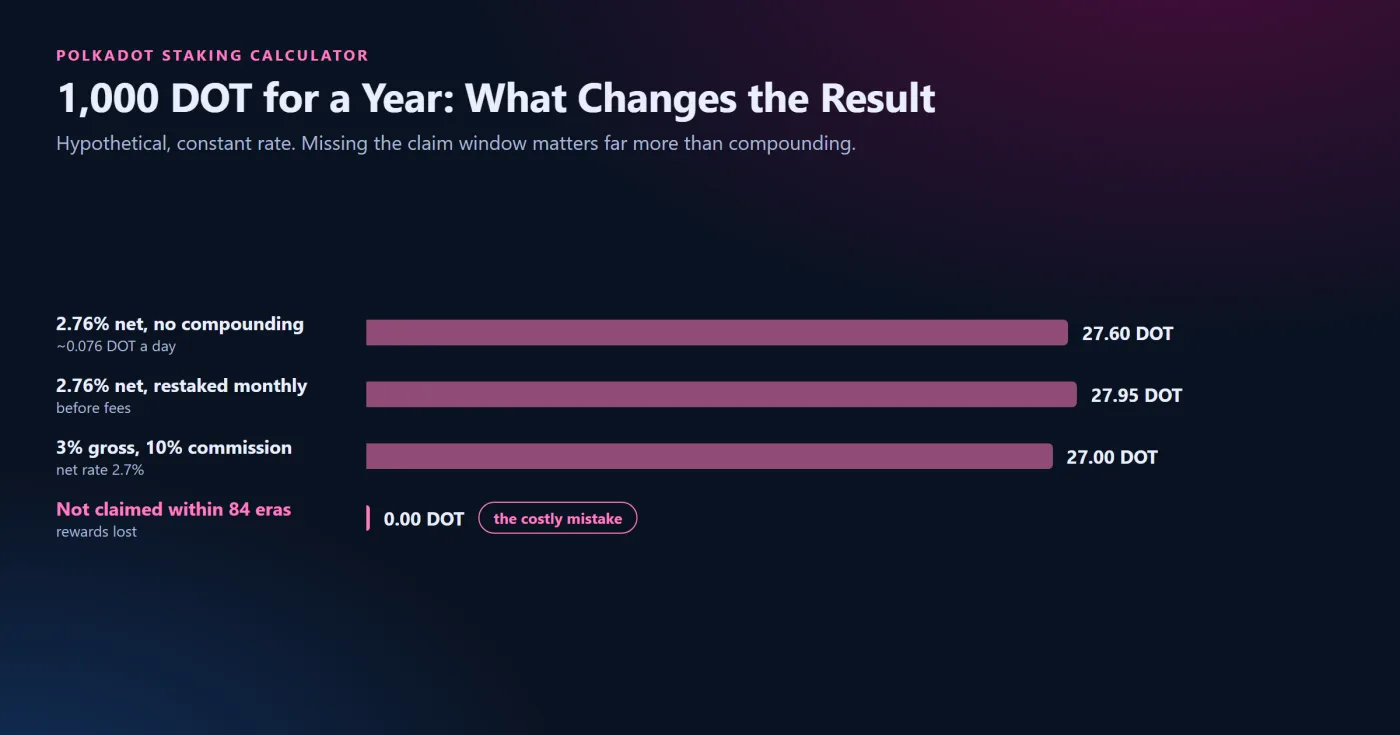
1,000 DOT for one year at a net 2.76%, no compounding: 27.6 DOT, or about 0.076 DOT per day.
-
The same stake if the reward is claimed and restaked once a month: about 27.95 DOT, which is only slightly more, before transaction fees.
-
A gross rate of 3% with a hypothetical 10% commission: net rate 2.7%, so 1,000 DOT earns about 27 DOT in one year.
-
Rewards that are not claimed within 84 eras: lost, so the effective result for that period is 0 DOT.
What the Examples Show
For a rate in this range, the benefit of compounding is small, while a missed claim can cost the whole reward for the period. This is why claiming is a larger risk factor than the choice of compounding interval.
Claiming Rewards and the 84-Era Window
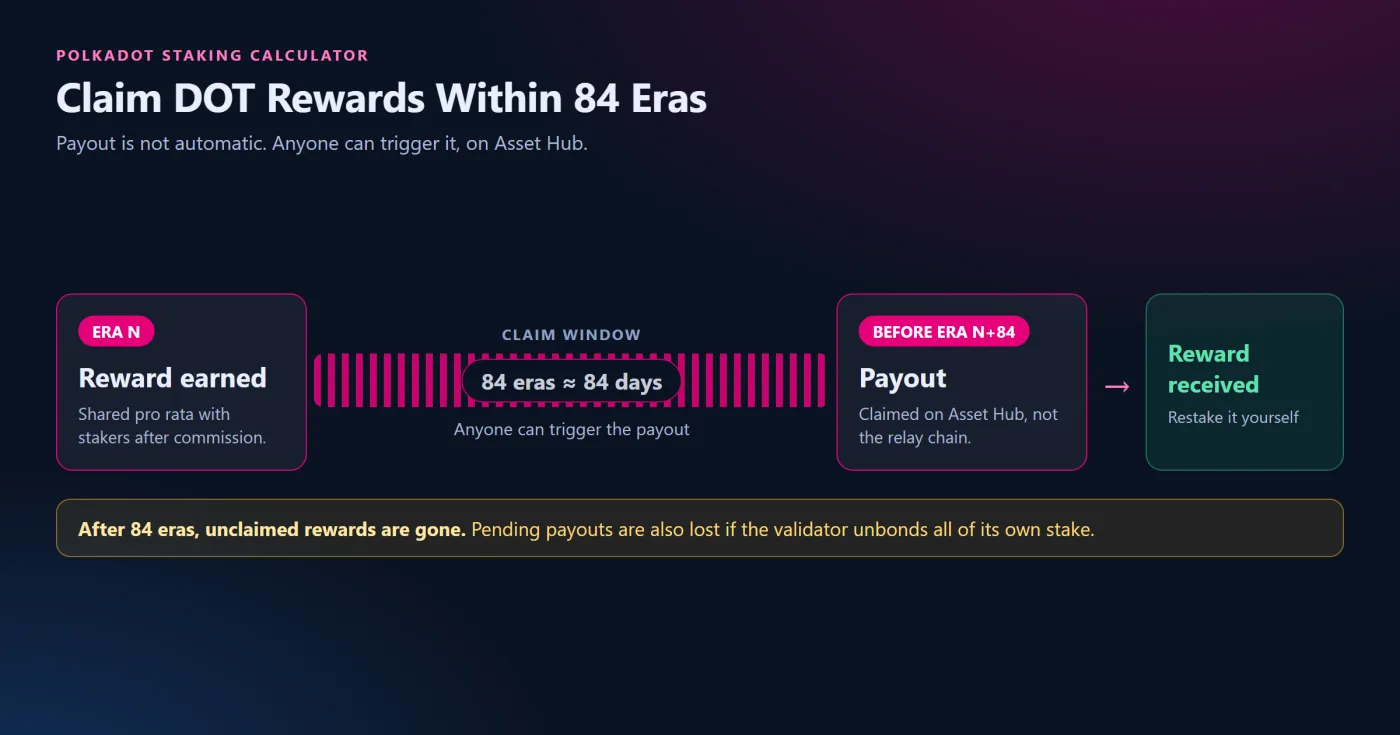
The Polkadot Wiki states that payout is not automatic. Anyone can trigger it, and claims are made on Asset Hub, not the relay chain. If nobody claims a staker's rewards within 84 eras, they cannot be claimed any more. The wiki also says that if a validator unbonds all of its own stake, pending payouts are lost.
For a calculator this means a gap between theoretical and received rewards, depending on whether and when payouts are triggered. Many wallets and nomination pools handle claiming, but the sources read for this article did not describe how each of them does it.
Nomination Pools and Direct Nomination
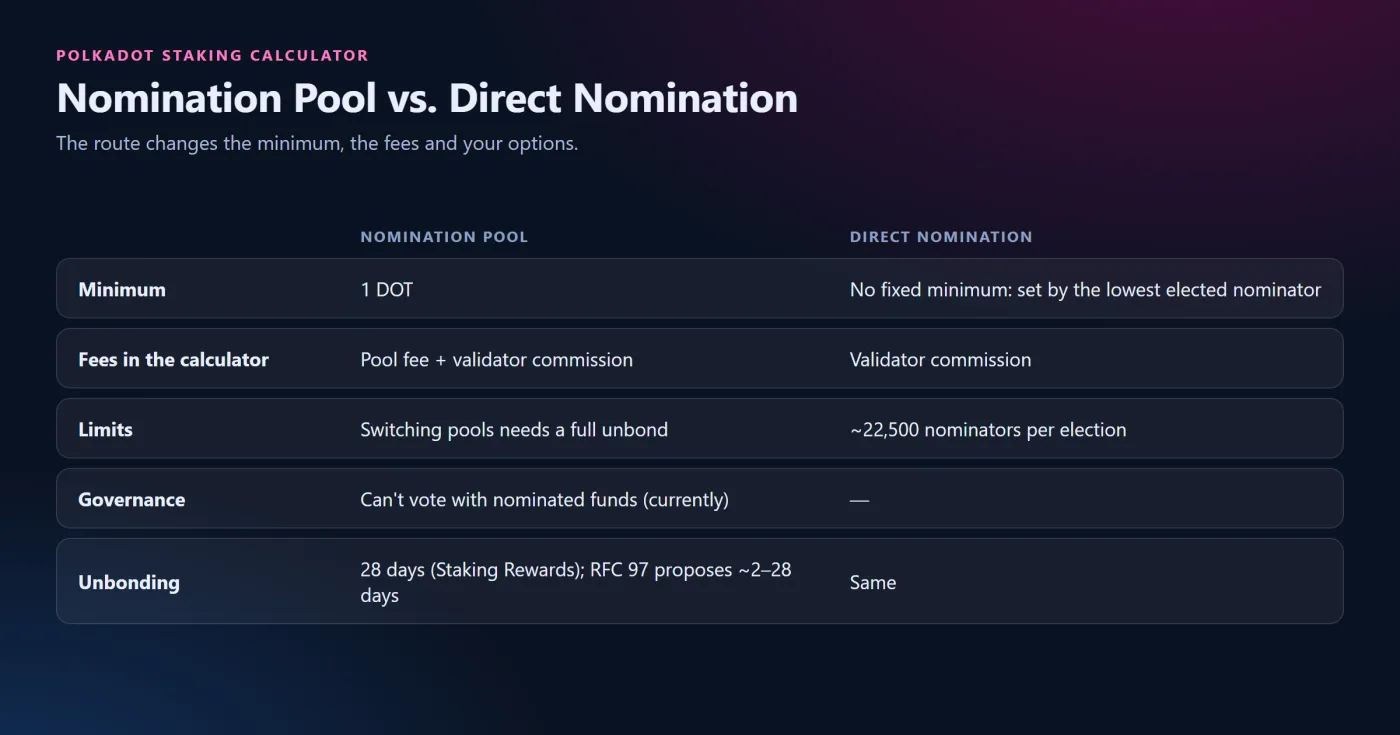
The Polkadot Wiki states that nomination pools let a holder start earning with as little as 1 DOT. For direct nomination, the wiki says there is no fixed minimum: the minimum active bond is set dynamically by the lowest-ranked elected nominator, and the number of nominators in an election is capped at about 22,500.
Staking Rewards also notes that pool members cannot currently vote in governance with their nominated funds and that switching pools requires full unbonding. For the calculator, a pool adds its own fee, and a direct nominator has to meet a minimum that changes. Both should be checked in the wallet at the time of staking.
Unbonding and Locked DOT
Tokens in unbonding stay locked and earn no rewards, according to the Polkadot Wiki, which does not state the length on the page read. Staking Rewards gives 28 days and mentions RFC 97, which proposes a dynamic period of about 2 to 28 days, with uncertain timing. A calculator for a short horizon should subtract the unbonding time from the earning period.
Risks
The Polkadot Wiki states that validators and nominators can both be slashed, with the slashed stake partly or fully confiscated and deposited in the treasury. Staking Rewards says that slashing is partial for equivocation or other violations, gives no percentage, and adds that correlated slashing across validators increases penalties. A validator that is unresponsive for a full session can be chilled, and no rewards accrue while chilled. Inflation also dilutes holders who do not stake. A calculator that shows only the reward does not show any of this.
What to Check Live Before You Calculate
-
The current reward rate, its date, and whether it is net of commission.
-
The validator's or pool's commission, and whether it has changed recently.
-
The unbonding period and the current minimum for your staking method.
-
How rewards are claimed in your wallet or pool, and the claim deadline.
-
The validator's recent status and whether it is in the active set.
Never enter a recovery phrase on a website to start staking. Nominating is approved inside the wallet, and no validator or calculator needs the recovery phrase.
This article is educational and is not investment advice. Staking involves risk, and each reader should compare the live data with their own situation.
Related guides


 Scroll to top