


Cosmos Staking Calculator: ATOM Rewards, Formula, Examples


Table of contents

A Cosmos staking calculator needs the amount of ATOM, the annual reward rate, the validator's commission, how often you compound, and the time. On the Cosmos Hub, rewards are paid every block (about every 7 seconds, according to Kiln) but are not added to your stake automatically unless you use an auto-compounding service, so the compounding frequency is one of the main inputs. The rate itself is much higher than on many networks, and it depends on how much ATOM is bonded.
This guide explains the formula, the inputs that change the result, and the rules that a basic calculator misses. It does not include a built-in calculator. All numeric examples are hypothetical and were computed for this article.
The Formula Behind an ATOM Staking Calculator
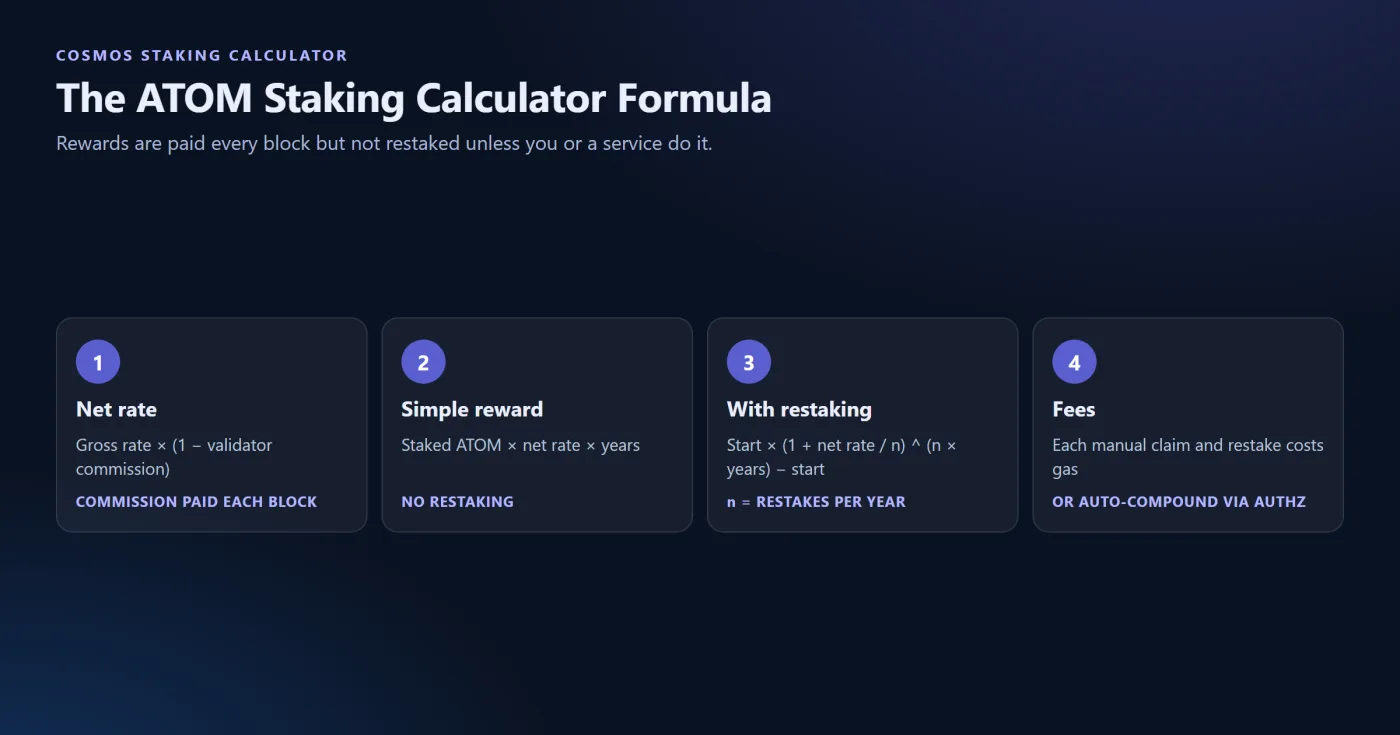
The calculation follows the order in which rewards are paid. A simple version works like this:
-
Net rate = gross rate x (1 - validator commission).
-
Yearly reward without compounding = staked ATOM x net rate x years.
-
Reward with compounding = starting ATOM x (1 + net rate / n) ^ (n x years) - starting ATOM, where n is how many times per year you claim and restake.
Chorus One's staking primer lists what the rewards depend on: the amount staked, the effective inflation rate, block times, fee revenue, validator commission, validator uptime, re-staking behaviour, and the ATOM price. A calculator that asks only for the amount and the rate leaves out most of these. Kiln states that commission is paid to the validator at the same frequency as rewards, so it is already taken out of what you receive.
Which Rate to Enter
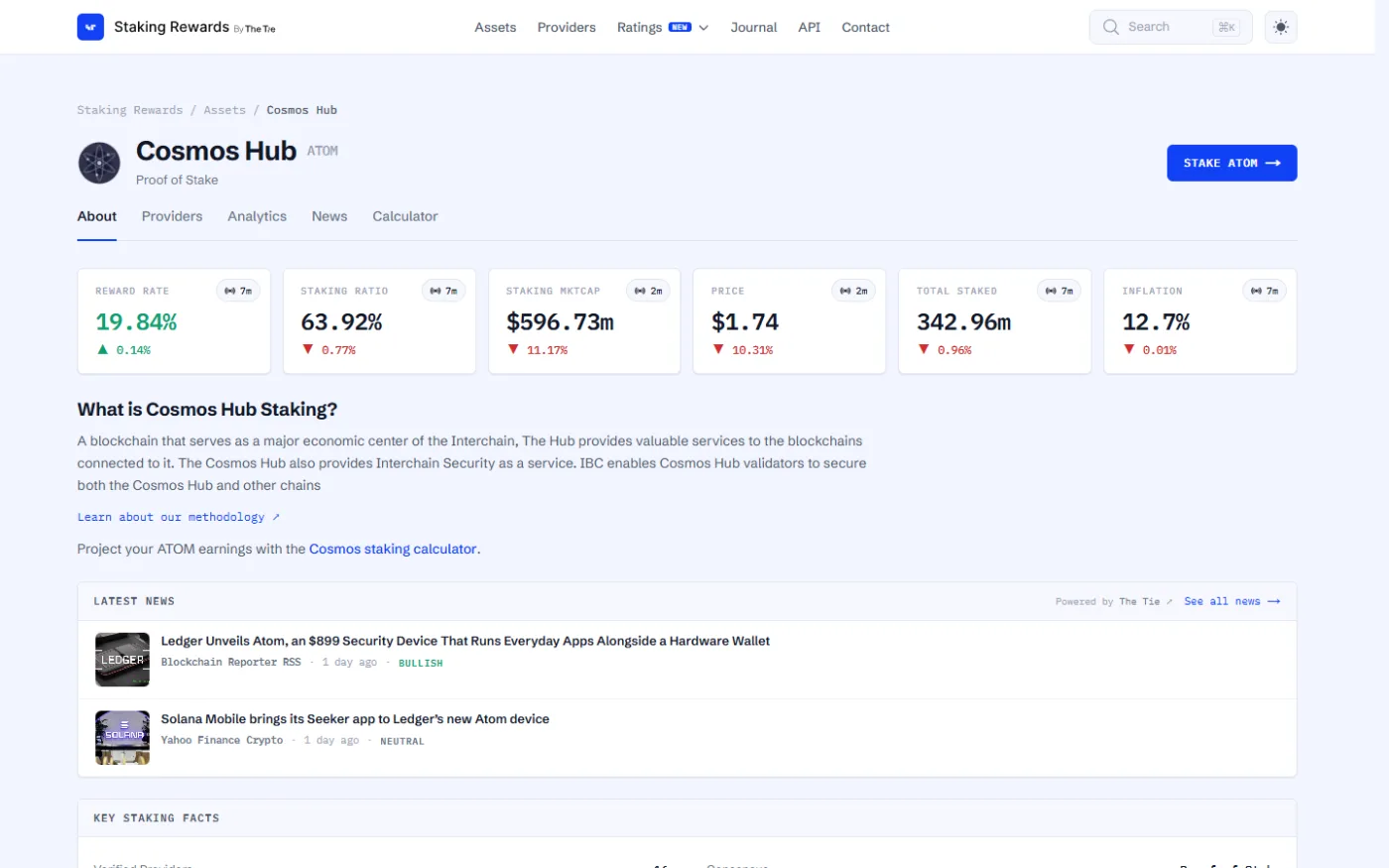
Staking Rewards showed a reward rate of 19.82% on October 14, 2026, with inflation at 12.7% and a staking ratio of 64.5%. The page describes this as a live snapshot. A 2019 article from Chorus One, which describes launch-era parameters, explains how the rate responds to staking: inflation moves toward 7% when more than two-thirds of the supply is bonded and rises toward 20% when less is bonded, and the fewer people stake, the higher the effective reward for those who do. Because it is from 2019, current parameters may differ and should be checked.
Staking Rewards also warns that pending governance proposals could change inflation, and therefore the yield. A rate from an old guide can be far from the current one.
Interchain Security Rewards
Staking Rewards notes that rewards from Interchain Security are distributed alongside standard rewards and must also be claimed. It describes their contribution as variable and early-stage, suggests a 30% to 50% haircut when modelling them, and says they may be paid in consumer-chain tokens. For a calculator, they should be treated as an optional extra and kept separate from the base rate.
Commission and Validator Limits
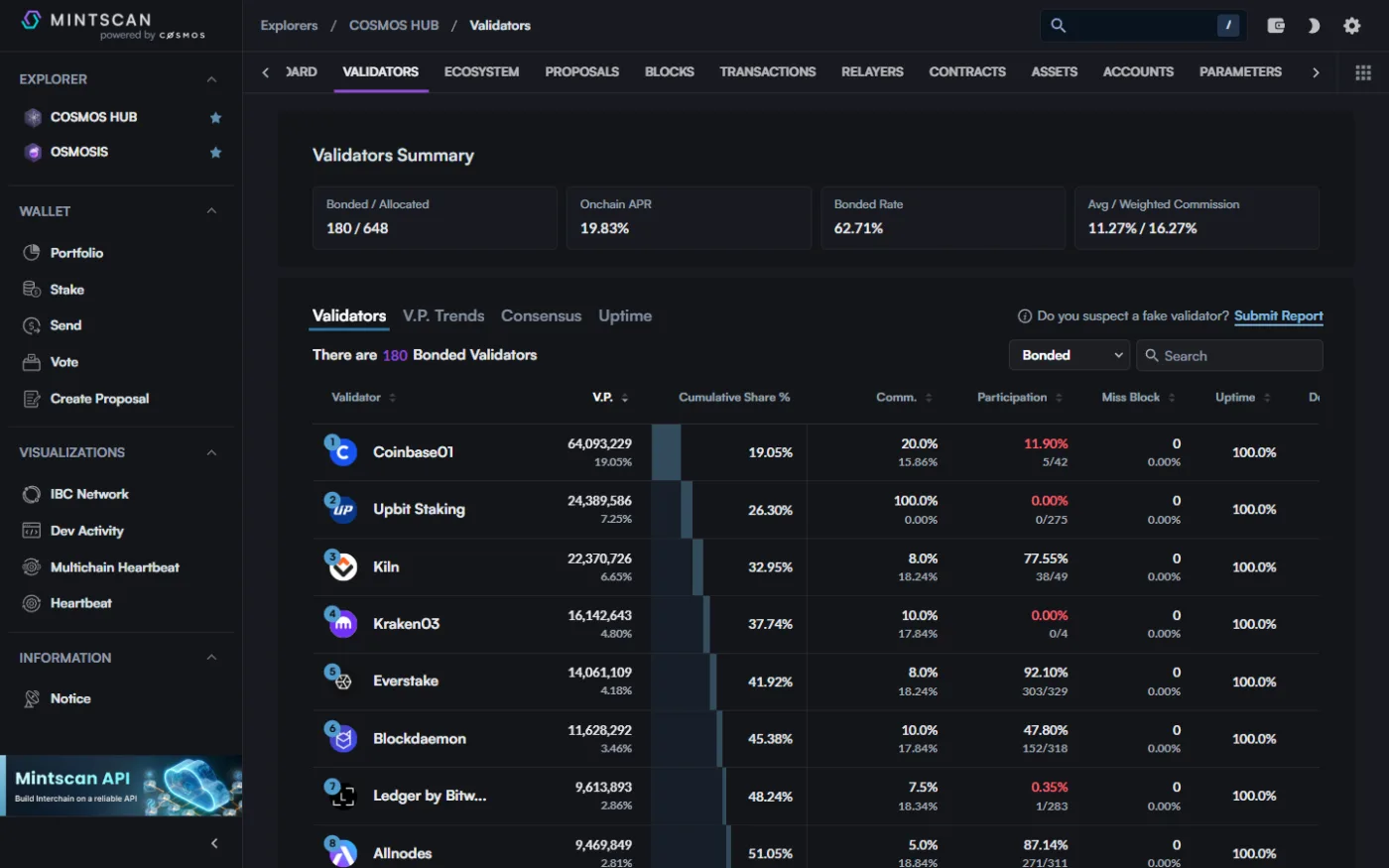
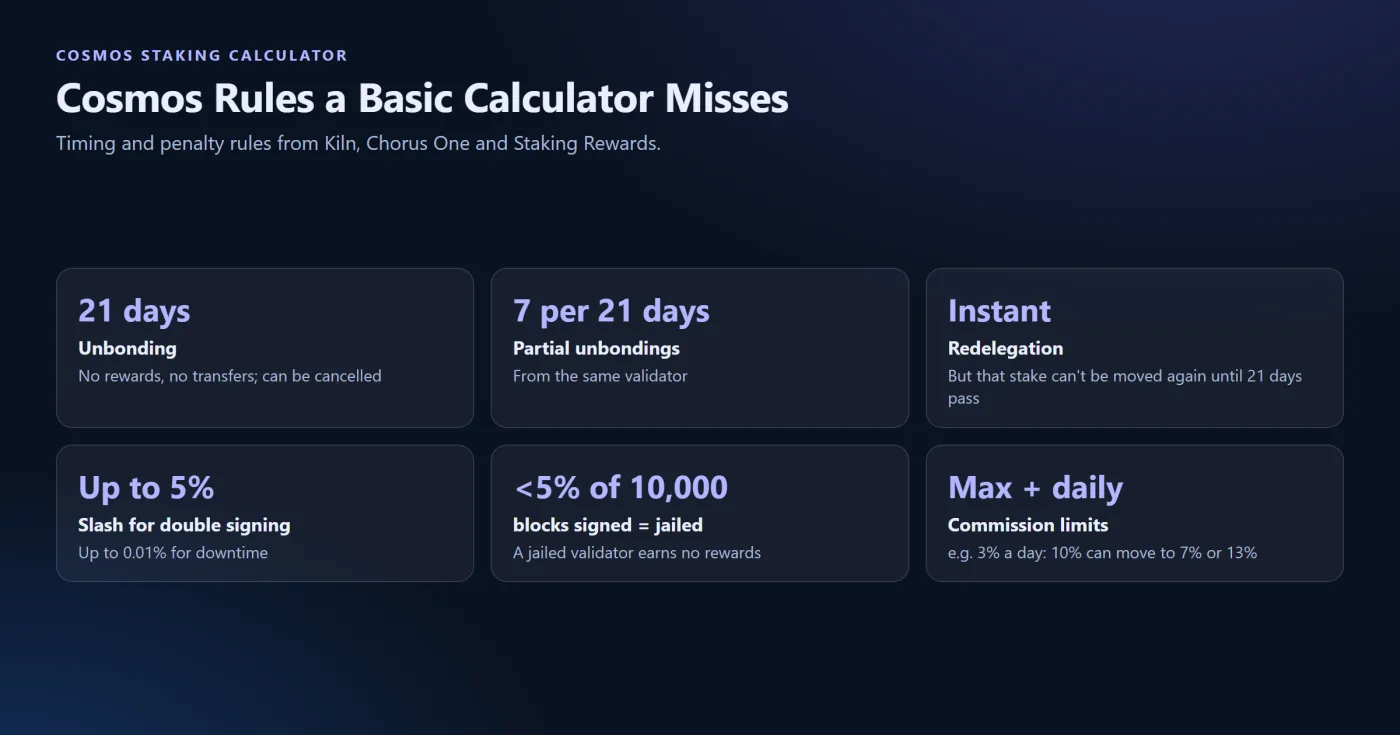
Validators set their own commission and can change it. According to Chorus One, each validator also has a maximum commission that it can never exceed and a maximum daily change. For example, with a 3% daily limit, a validator at 10% could move to 7% or 13% in one day. Staking Rewards shows a benchmark commission of 9.96% and advises watching both limits.
For a calculator, the commission can be entered as a single number, but it is better to run the calculation at a higher value too, to see how the result changes.
Worked Examples (Hypothetical)
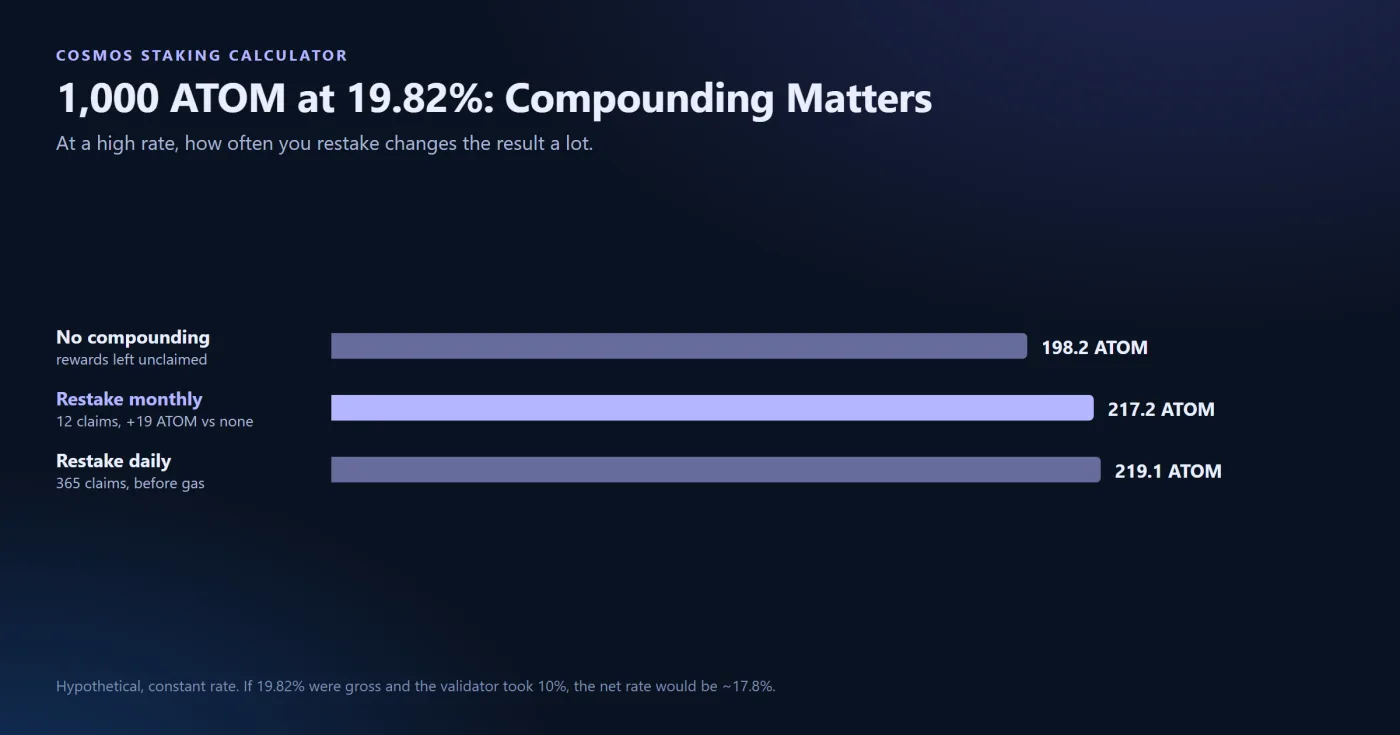
These are illustrations, not forecasts or observed results. They assume a constant 19.82% rate, treated as the rate you receive after commission, and no change in the ATOM price.
-
1,000 ATOM for one year without compounding: 198.2 ATOM.
-
The same stake if rewards are claimed and restaked monthly: about 217.2 ATOM, before gas fees.
-
With daily compounding: about 219.1 ATOM. The extra beyond monthly is small, and each transaction costs a fee.
-
If a published rate of 19.82% were gross and the validator took a 10% commission, the net rate would be about 17.8%.
Staking and Dilution
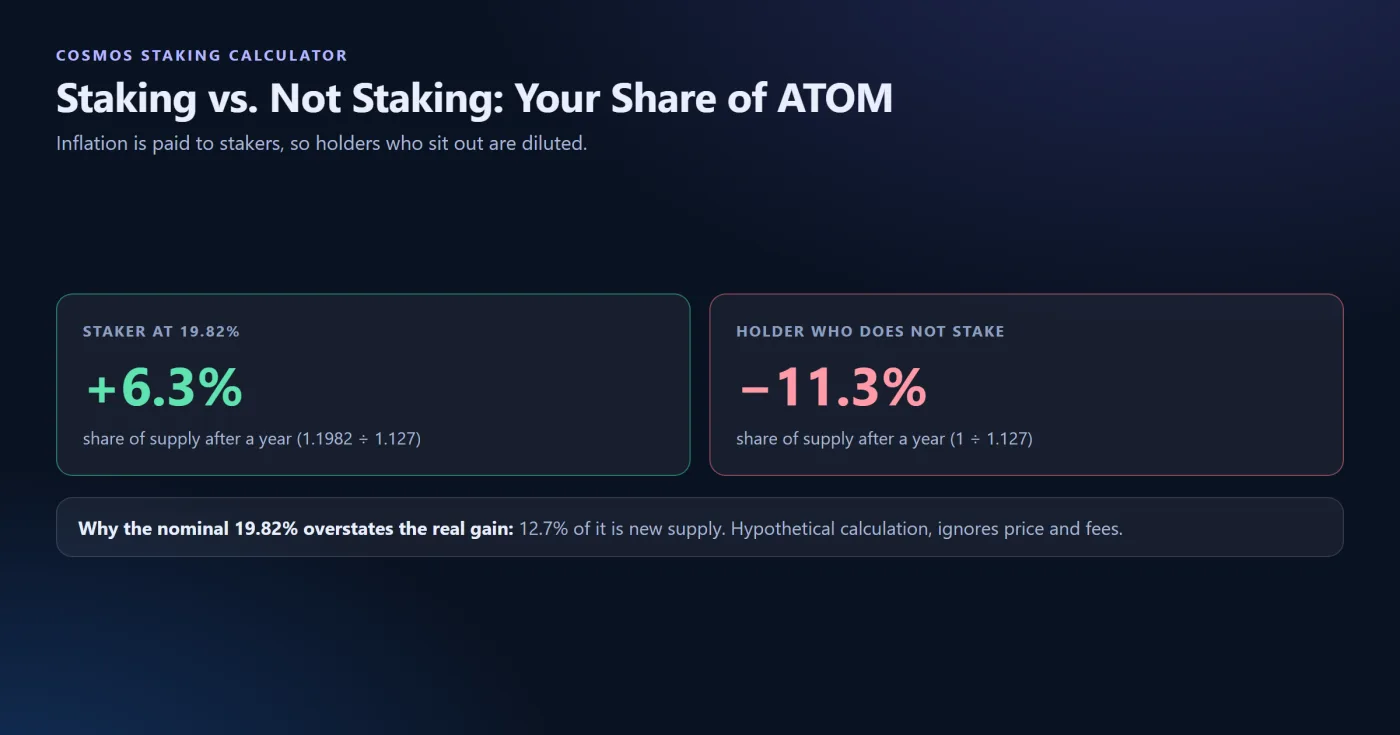
Inflation is paid to stakers, so holders who do not stake lose a share of the supply. Using the 12.7% inflation figure above and treating it as the supply growth for one year, 1 / 1.127 means a non-staker's share of the supply would fall by about 11.3%, while a staker earning 19.82% would see the share rise by about 6.3% (1.1982 / 1.127). This is a hypothetical calculation that ignores price and fees, but it shows why the nominal rate overstates the real gain.
Compounding on Cosmos
Staking Rewards states plainly that ATOM rewards are not auto-compounded. Restaking requires periodic manual claims, and each transaction has a gas fee. It mentions restake.app as an option for auto-compounding through selected validators. Kiln describes auto-compounding on its own validator through the AuthZ module, where a delegator gives permission to claim and restake rewards and can revoke it at any time.
Unbonding, Redelegation, and Timing
Both Staking Rewards and Kiln give an unbonding period of 21 days. Tokens cannot be sold or transferred during this time, and no rewards are earned. Kiln adds that unbonding can be cancelled and that partial unstaking is limited to seven unbondings from the same validator in any 21-day period.
Redelegation is instant according to Kiln, but it creates a cooldown: you cannot redelegate that stake again until the unbonding period ends. For a calculator, the practical point is that the last 21 days of a plan earn nothing if you intend to withdraw.
Slashing and Jailing
Kiln and Chorus One state that up to 5% of staked tokens can be slashed for double signing, and up to 0.01% for downtime. A validator that signs fewer than 5% of blocks in a 10,000-block window is jailed and earns no rewards, according to Kiln, and Staking Rewards notes that only validators in the active set earn rewards. These are low-probability events that a calculator ignores, but they are why validator choice matters.
What to Check Live Before You Calculate
-
The current reward rate, its date, and whether it is net of commission.
-
The validator's commission, maximum commission, and maximum daily change.
-
The unbonding period and the current slashing parameters.
-
Whether your wallet or validator offers auto-compounding, and how it works.
-
Whether Interchain Security rewards are included in the rate you are using.
Never enter a recovery phrase on a website to start staking. Delegating is approved inside the wallet, and no validator or calculator needs the recovery phrase.
This article is educational and is not investment advice. Staking involves risk, and each reader should compare the live data with their own situation.
Related guides


 Scroll to top