


KuCoin Review: Safety, US Status, Fees, and Bots


Table of contents
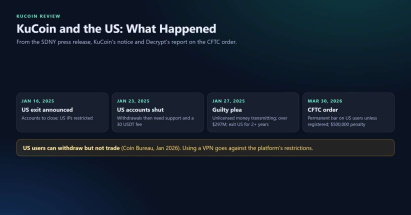
KuCoin is not available to US residents: in January 2025, its owner pleaded guilty to operating an unlicensed money transmitting business, agreed to exit the US market for at least two years, and in March 2026 agreed to a permanent ban on US customers unless registered with the CFTC. Outside the US, KuCoin runs a large custodial exchange with 0.10% base spot fees and trading bots, and a MiCA license for the EU, but its enforcement record in several countries means safety and legitimacy are not settled by any single source.
This review explains the US legal position, what actions were taken in 2025 and 2026, how KuCoin's fees and bots operate according to the sources, and what to check before using the platform. It does not give a verdict or rank KuCoin against other exchanges. Most of the figures in this article are taken from regulatory bodies, KuCoin, or secondary sources and are marked accordingly.
Is KuCoin Available or Legal in the US?
The Criminal Case
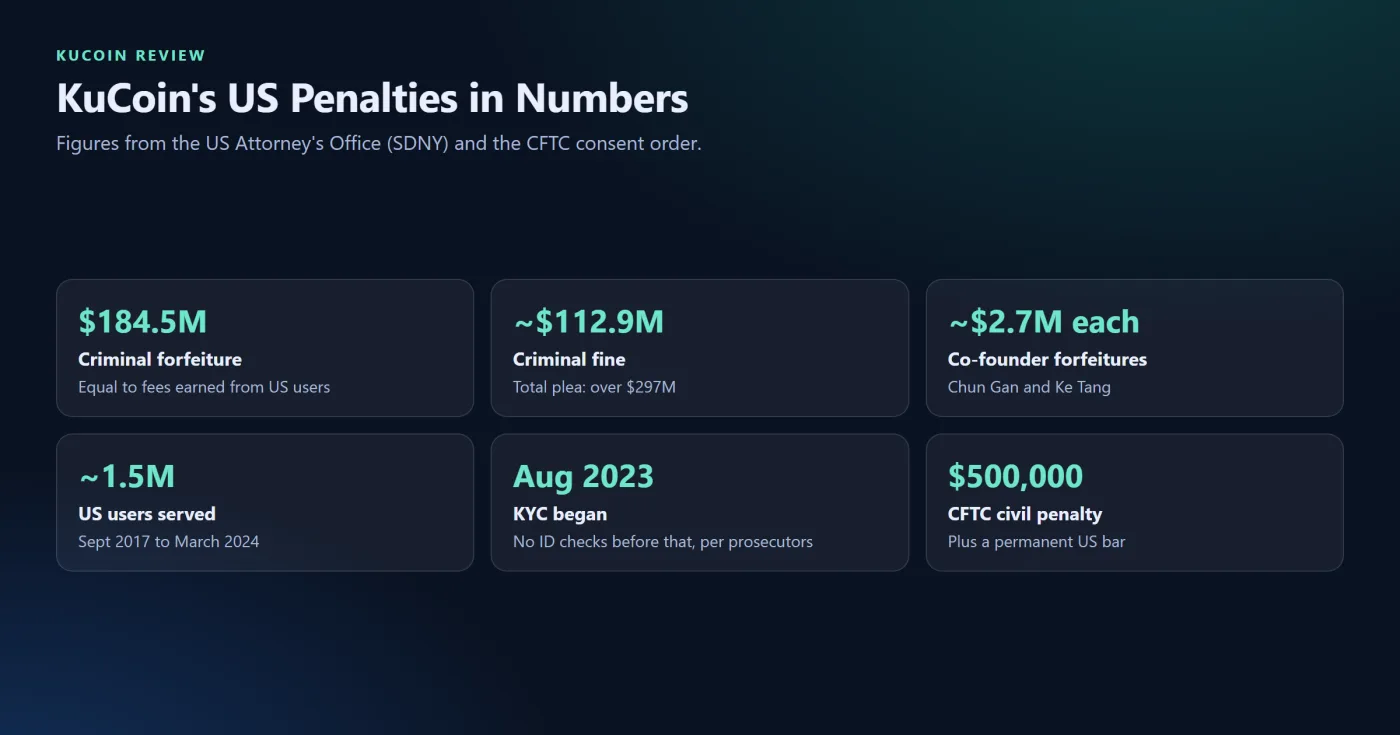
According to the press release No. 25-018 of the US Attorney's Office for the Southern District of New York, issued January 27, 2025, PEKEN GLOBAL LIMITED, a Seychelles-based company that has operated KuCoin since at least September 2019, pleaded guilty to one count of operating an unlicensed money transmitting business. The company agreed to pay over $297 million: criminal forfeiture of $184.5 million and criminal fine of about $112.9 million, and two co-founders Chun Gan and Ke Tang agreed to forfeit about $2.7 million each.
The release says KuCoin served about 1.5 million registered US users from about September 2017 to March 2024 and made at least $184.5 million from them in fees. It says KuCoin did not require any identification verification from users until August 2023, did not register with FinCEN, and did not file suspicious activity reports. These claims come from the prosecutors alongside the plea which is the formal admission of guilt. As part of the plea deal, KuCoin agreed to leave the US market for at least two years, and the two co-founders are to have no role in management, with their prosecution deferred for two years.
The CFTC Order
According to Decrypt, a consent order in the Southern District of New York, dated March 30, 2026, Peken Global paid a civil penalty of $500,000 and agreed to be permanently barred from letting US participants use the platform unless it registers with the CFTC as a foreign board of trade. The 2024 suit by the CFTC accused KuCoin of being an unregistered derivatives exchange, failing to register as a futures commission merchant, and having ineffective customer identification program. In the order, no disgorgement of profits is sought, and claims against other three entities are dismissed with prejudice.
What This Means for US Users
KuCoin announced on January 16, 2025 that it would shut down accounts of US users starting from January 23, 2025 at 9:00 p.m. EST, disable logins of verified US users, and restrict US IP addresses. It said withdrawals after that date would need customer service help and a one-time fee of 30 USDT. According to Coin Bureau's January 2026 review, US users are limited to withdrawals and have no trading access. The sources read did not test what happens to users who use a VPN, but doing so would go against the platform's restrictions, and the legal position of such users was not covered.
Is KuCoin Legit and Safe?
Regulation Outside the US
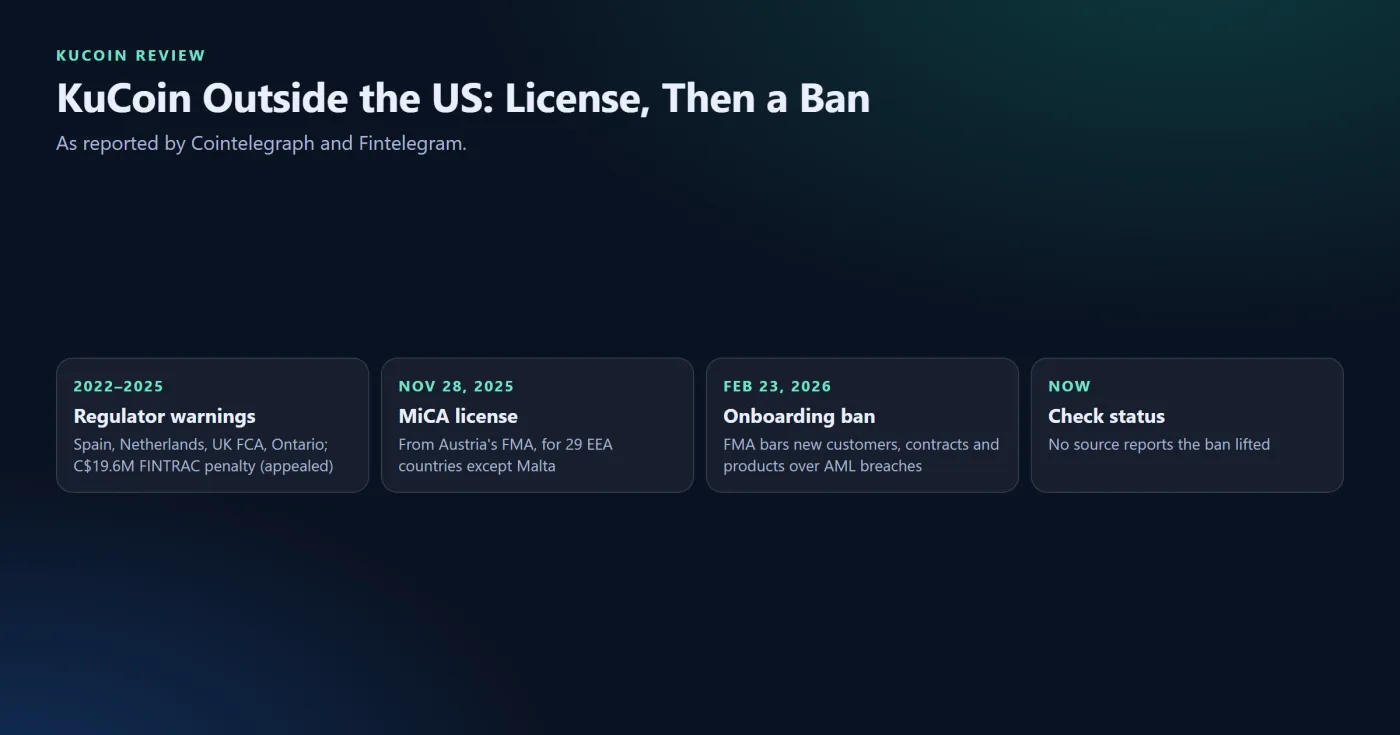
According to Cointelegraph, dated November 28, 2025, KuCoin EU received a MiCA license from Austria's Financial Market Authority (FMA) for 29 EEA countries, except for Malta, without giving a reason. Less than three months later, Cointelegraph reported, dated February 23, 2026, that the FMA banned onboarding of new customers, execution of new contracts, and introducing of new products at KuCoin EU's Vienna entity due to breaches of AML, counter-terrorism financing, and sanctions compliance organization requirements. KuCoin EU's managing director noted that two compliance specialists recently quit, described the matter as contained, and voluntarily paused new onboarding. The sources read do not report that the ban has been lifted.
According to Fintelegram, the Austrian license sits poorly with KuCoin's record: it mentions a Spanish warning (2022), a Dutch AML warning (2022), a UK FCA warning list entry (October 2023), an Ontario regulator warning, and C$19.6 million FINTRAC penalty (September 2025) that KuCoin has reportedly appealed. The article is opinion and analysis, and those details are as reported by it, not checked against the regulators. Coin Bureau also mentions that KuCoin Thailand is licensed with the Thai SEC, and there is Ontario ban from June 2022.
Hacks and Reserves
According to Coin Bureau, attackers stole about $275 million to $281 million in 2020, and about 84% of that was returned by November 2020, and the CEO said the remaining 16% (about $45.6 million) was covered by insurance funds in February 2021. This is not stated by KuCoin itself but from Coin Bureau's review.
Also, according to the same review, KuCoin has proof-of-reserves coverage as of November 30, 2025: 102% for BTC and ETH, 105% for USDT, and 115% for USDC. However, the quick-facts table gives different figures. Proof-of-reserves coverage above 100% on self-reported snapshots does not replace an independent audit, and no independent audit was found in the sources read.
KuCoin Fees
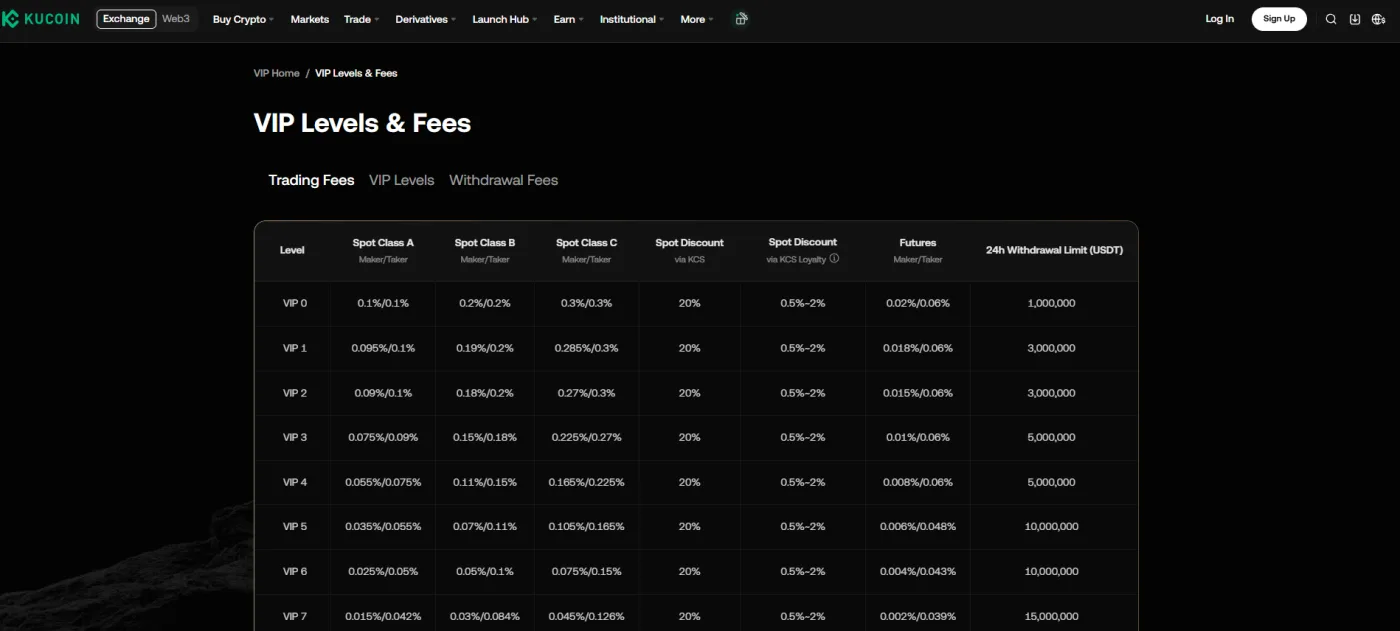
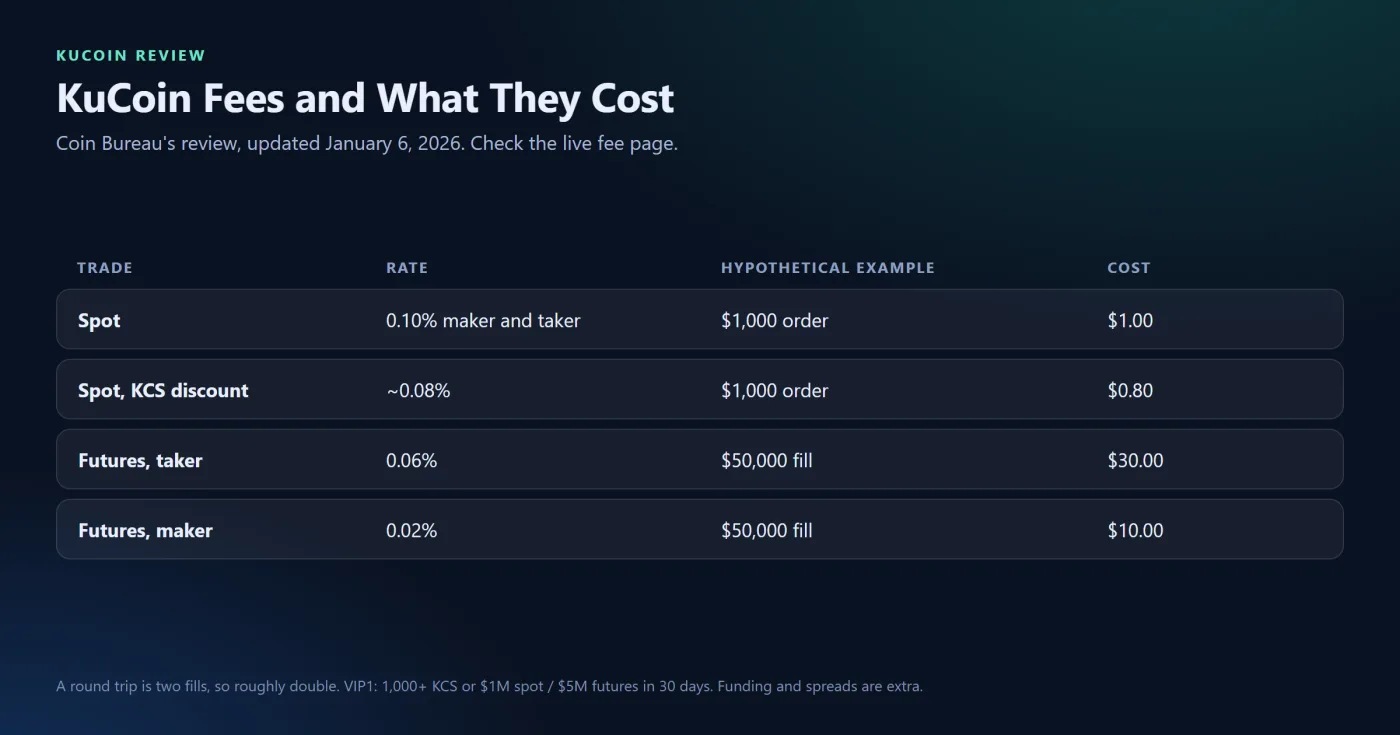
Coin Bureau's review, updated January 6, 2026, lists 0.10% spot maker and taker fees that fall to 0.08% when using KCS, and 0.02% maker / 0.06% taker futures fees. It shows a $50,000 futures fill at 0.06% cost of $30. Reaching VIP1 status requires 1,000 or more KCS tokens or $1 million spot trading / $5 million futures in 30 days. No withdrawal fees are mentioned.
A Hypothetical Fee Calculation
This example is based on the listed fees and is not a prediction. A $1,000 spot order at 0.10% fee would cost $1.00 or $0.80 with KCS discount. A $50,000 futures fill at 0.06% would cost $30.00, which matches the review's figure. Round trips consist of two fills, thus the cost is roughly double, and funding payments and spreads are extra cost that is not covered by this example.
KuCoin Trading Bots
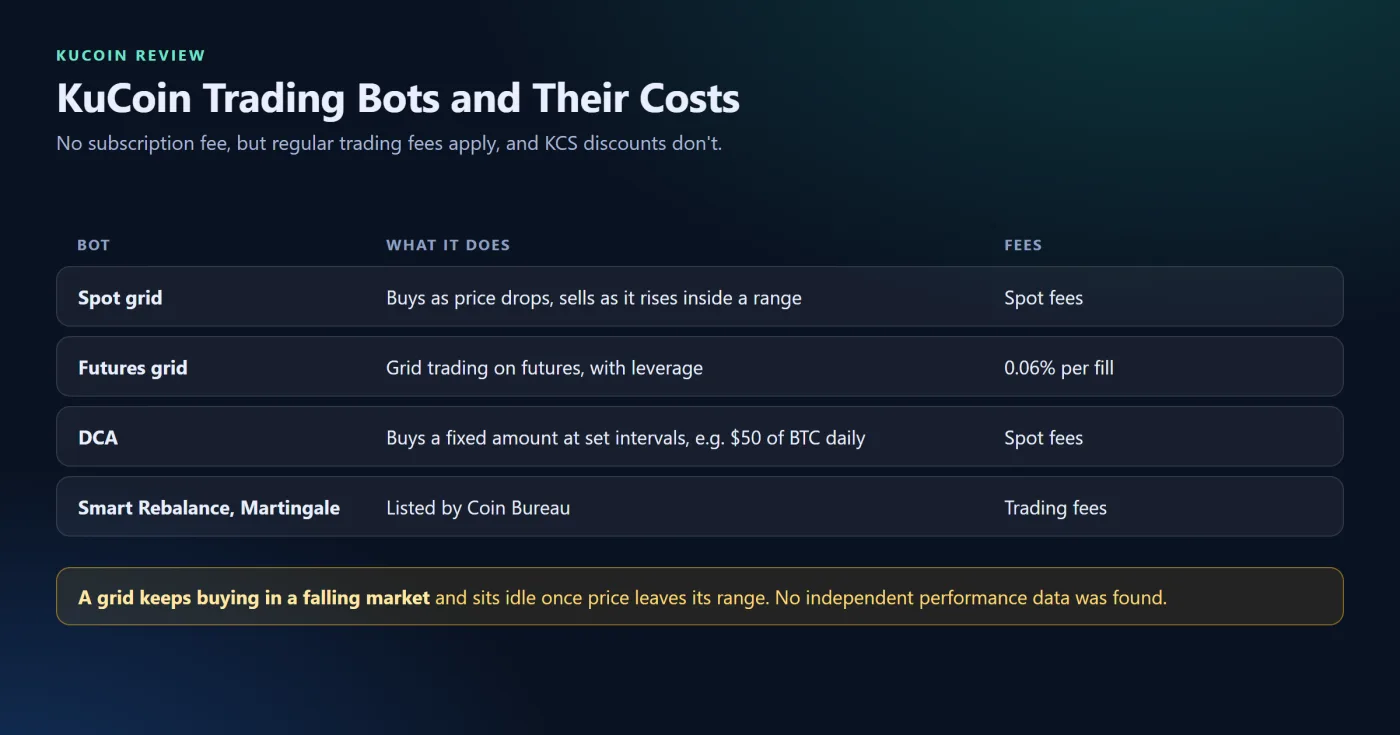
The blog of KuCoin describes three types of trading bots: a classic spot grid, a futures grid, and a DCA bot. A spot grid creates buy orders when the price drops and sell orders when it grows inside a certain range and number of orders. A futures grid adds grid trading to the futures and includes leverage. A DCA bot buys a fixed amount at certain intervals, with an example of $50 daily BTC purchase. The blog claims that the spot grid is "the safest way to trade" and "everything else is done by the AI". There is no performance or risk disclosure provided in the claims, so they should be considered marketing statements.
Coin Bureau lists grid, DCA, Smart Rebalance, and Martingale bots, and no subscription fees are charged. Spot bots pay spot fees, futures bots pay fixed 0.06% per fill fee, and KCS discounts do not apply to bot transactions. By design, a grid bot keeps buying when the price falls, and a sustained drop can leave it with more positions at lower prices. An exit from the set range leaves the bot idle. No independent bot performance data was found among the sources, so no profitability claim is made in this article.
Is KuCoin Worth Using?
No source gives a verdict. Among the positive documented facts about KuCoin are its wide asset offering (about 1,115 according to Coin Bureau), mandatory KYC since August 31, 2023, MiCA license for the EU, and proof-of-reserves ratios. Concerns are 2025 guilty plea and 2026 CFTC ban, the FMA onboarding ban, several regulator warnings, 2020 hack, and a lack of independent reserve audits. A custodial exchange always involves counterparty risk, so keeping only needed balances and withdrawing the rest to self-custody reduces exposure but does not remove it.
What to Check Live Before Using KuCoin
-
Permitted in your country and which entity is serving it.
-
Status of the FMA onboarding ban if you are in the EEA.
-
Current fee structure and if there is a difference between fees of bots and manual transactions.
-
Latest proof-of-reserves data and if there is an independent audit.
-
Security settings of your account, including 2FA and withdrawal whitelisting.
-
That the site address was typed or bookmarked, and that nobody has asked for a recovery phrase, which no exchange needs.
This article is for educational purposes only and is not investment advice. Trading accounts and bots involve risk of loss, and each reader should check the live information. Interfaces are not tested for this article.
Related guides


 Scroll to top