


MEXC Review: Fees, Safety, and Availability in the US


Table of contents

MEXC is a custodial crypto exchange with a Seychelles registration that offers low spot fees (0% maker and 0.05% taker per its own data for November 2025), but it is not available to US residents according to its terms, it does not claim a tier one regulatory license, and it has a history of frozen-account disputes and a large outflow scare in 2025. The safety of MEXC depends on the amount of money kept there and the user's ability to tolerate counterparty risk, since no independent audit of its reserves was found.
This article provides a summary of what the sources say about the fees, availability, safety, new listings, and secure login at MEXC. It does not give a verdict, and it does not rank MEXC against other exchanges. Most numbers come from MEXC itself or from secondary reports, so they are marked as such and should be checked live. "MEXC car rental reviews" refer to an unrelated business and are not covered here.
Is MEXC Available in the US?
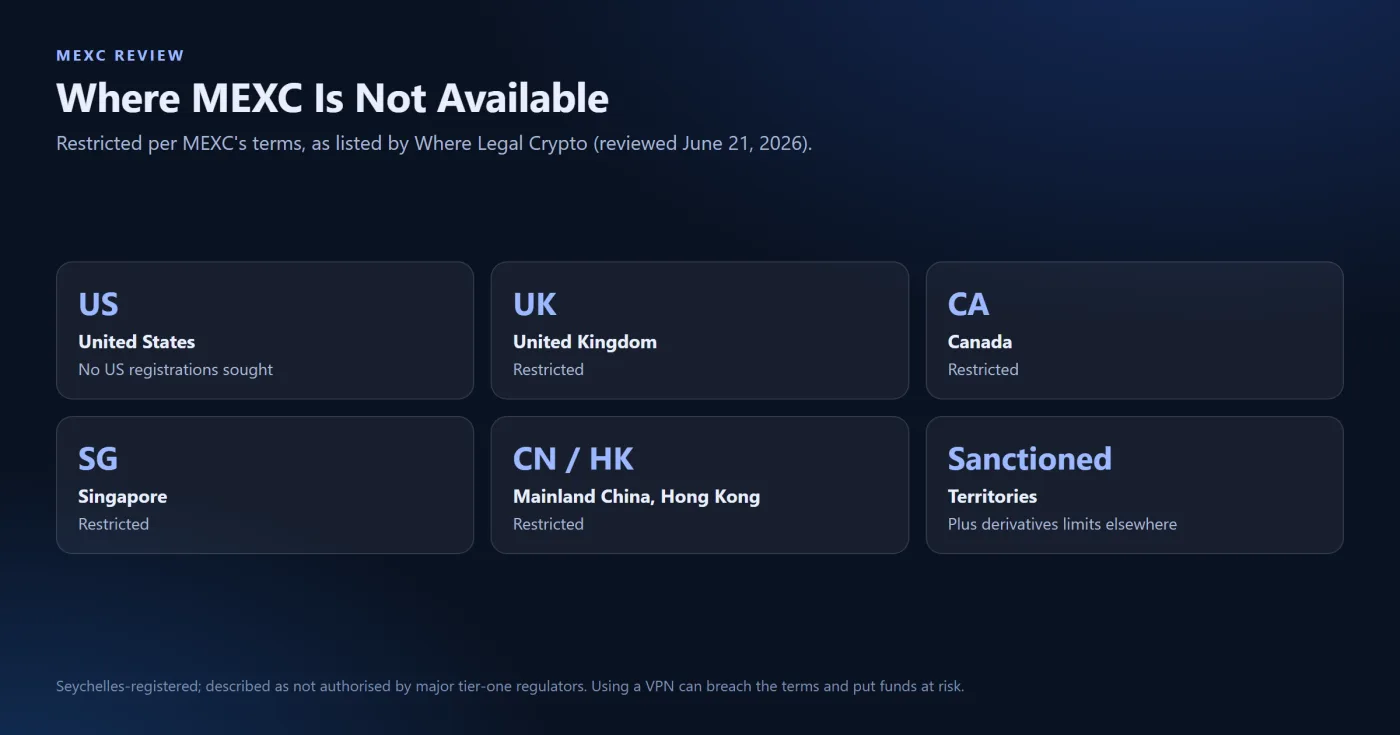
No. A review page from Where Legal Crypto, last reviewed on June 21, 2026, says that MEXC's terms list the United States, United Kingdom, Canada, Singapore, mainland China, Hong Kong, and sanctioned territories as restricted. The page says that MEXC has not sought the required registrations for a US operation and that it is registered in Seychelles with registrations in a limited number of jurisdictions, described as "not authorised by major tier one financial regulators."
The availability also varies by country and type of service, as derivatives trading is not universally available. The list of restricted countries can change, and MEXC's current terms should be checked before opening an account. Accessing a restricted country by using a VPN can violate MEXC's terms and put the access to funds at risk, even though no source checked here actually tested it.
MEXC Fees
Listed Spot and Futures Fees
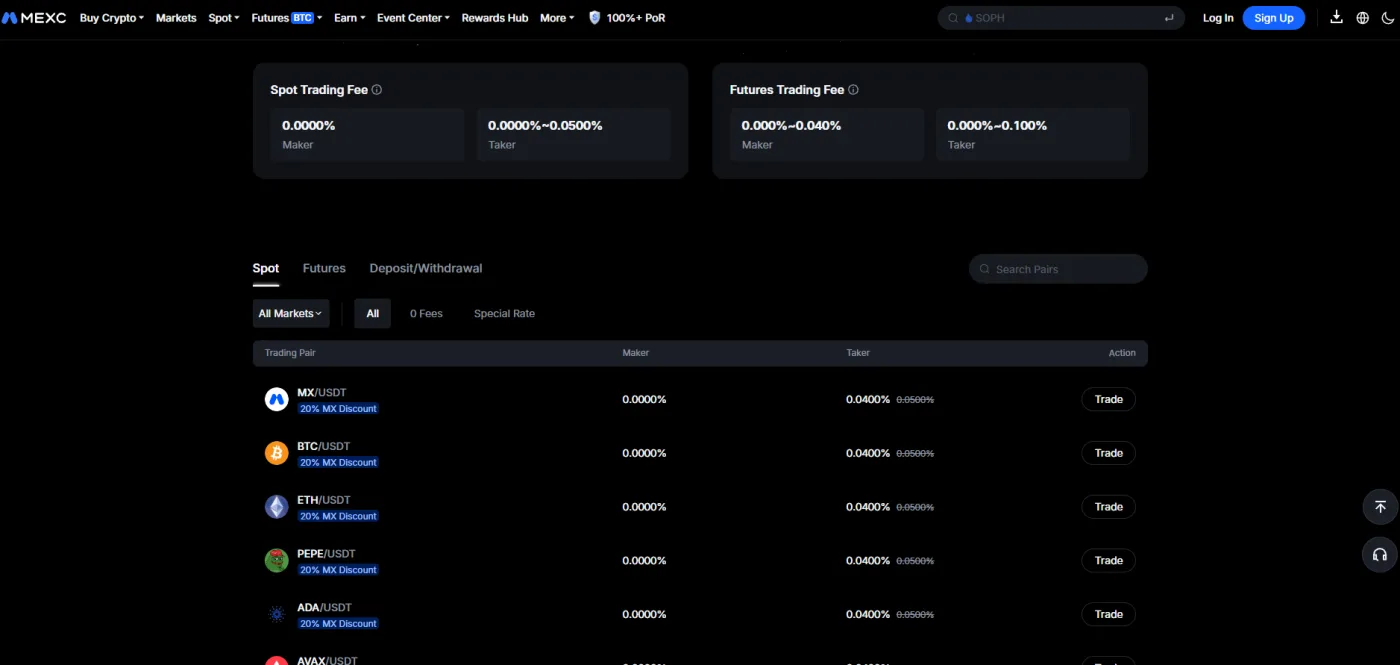
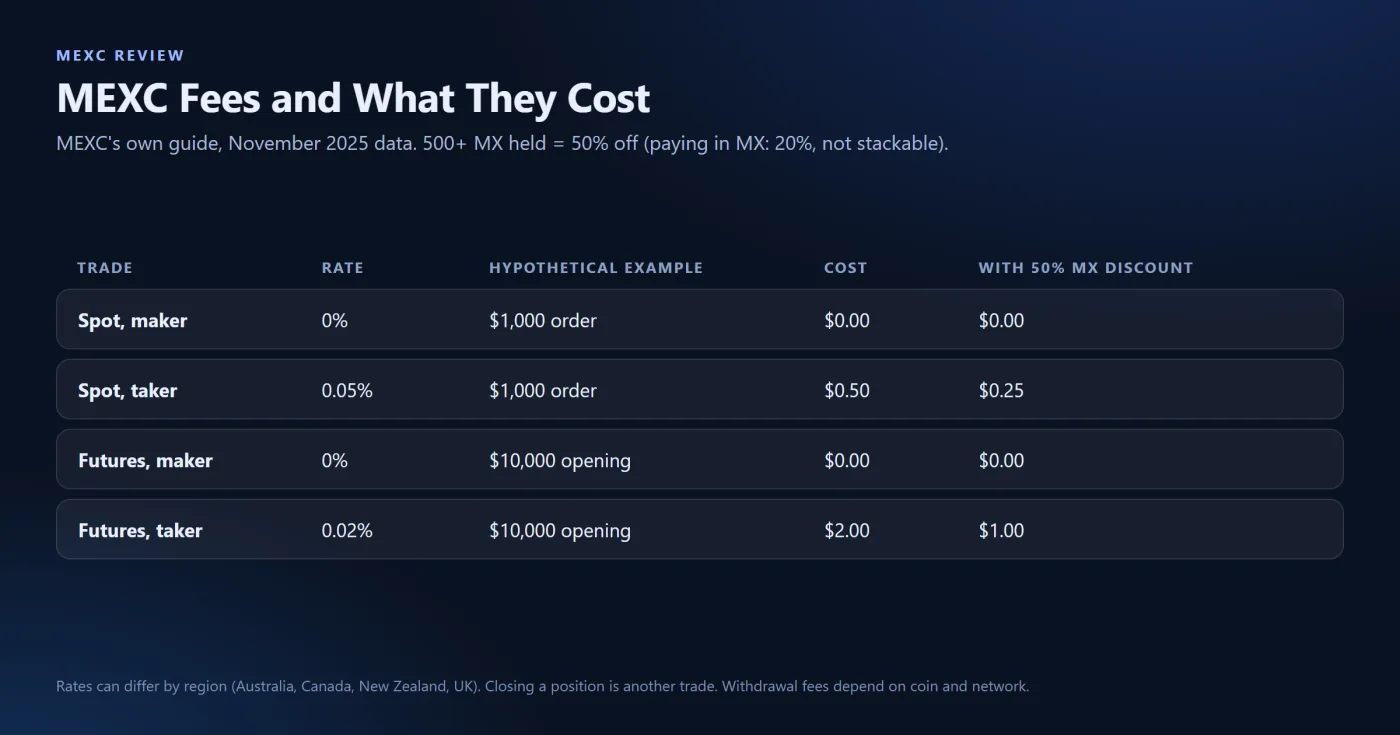
According to its own guide, based on data for November 2025, MEXC has spot fees of 0% for makers and 0.05% for takers, and futures fees of 0% for makers and 0.02% for takers. It says that holding 500 or more MX tokens allows a 50% discount, and paying fees in MX tokens brings a 20% discount that does not stack with the holding discount. Withdrawal fees depend on the coin and the network, and USDT fees are said to be a few cents to a few dollars, with no specific numbers provided. It also says that the rates can vary depending on the region, naming Australia, Canada, New Zealand, and the UK, and that some pairs use a special rate.
The guide was written by MEXC's editorial team, so it is not independent, and the page can be a later update of an earlier guide. The fee schedule on the live fee page is the reference.
A Hypothetical Fee Calculation
This calculation uses the listed numbers and is not a prediction. A $1,000 taker spot order costs $0.50, or $0.25 with a 50% MX discount. A maker $1,000 spot order costs nothing at the listed rate. A $10,000 taker futures position opening costs $2.00 at the listed rate, or $1.00 with the discount. Closing the position requires another trade. Additional cost factors not considered here include funding payments, spreads in thin markets, and withdrawal fees.
Is MEXC Safe?
Custody and Reserves
MEXC is custodial, keeping user assets in its own wallets, and there is no direct hardware wallet integration. User who wants to control the private keys should withdraw to a self-custody wallet. Therefore, the safety of an exchange balance relies on the company's security, honesty, and solvency.
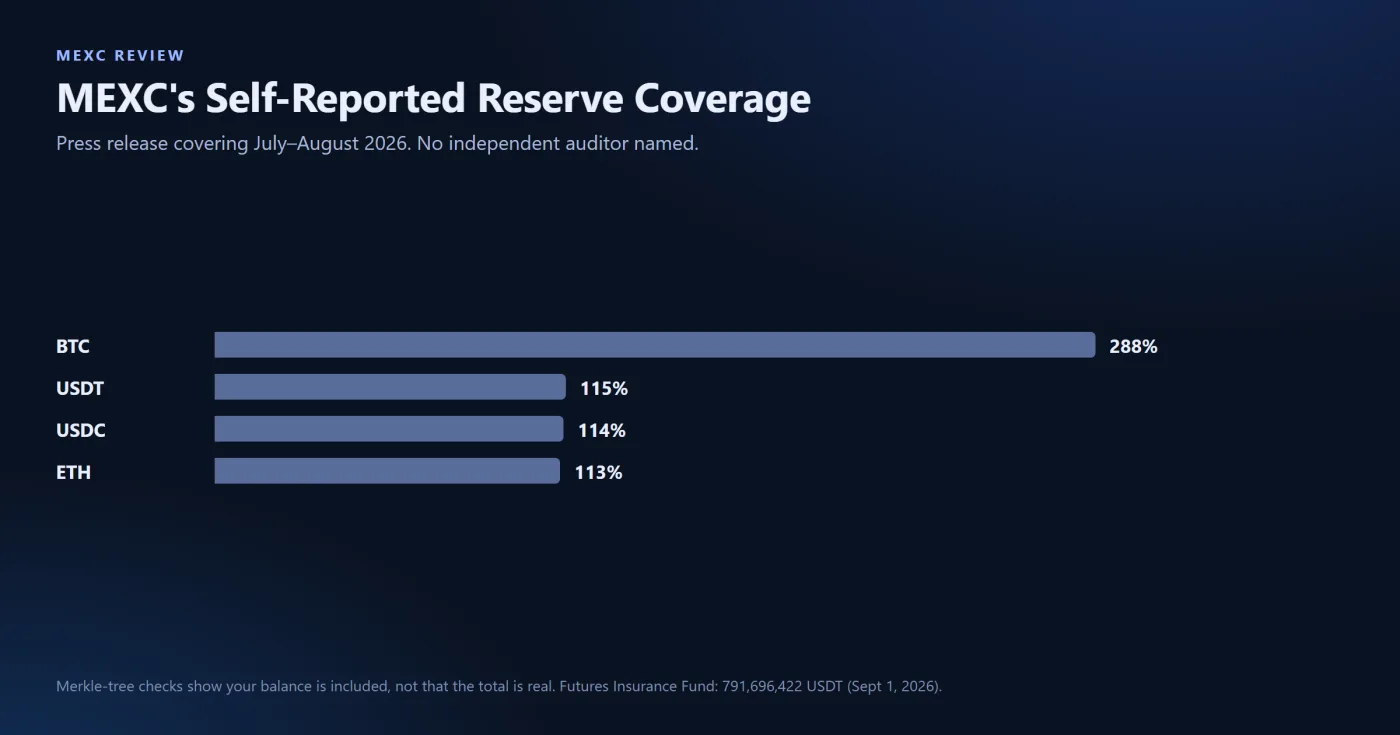
MEXC publishes its reserve data. A press release dated September 16, 2026, distributed via Chainwire and carried by Yellow, covers the period July to August 2026. It says that MEXC has disclosed that it has coverage of about 288% for BTC, 113% for ETH, 115% for USDT, and 114% for USDC, that the Futures Insurance Fund of 791,696,422 USDT was registered as of September 1, 2026, that MEXC has 38,655,490 USDT of intercepted fraud-related funds, and that users can verify that through a Merkle tree. Yellow warns that this is third-party content and does not verify it, and no independent auditor is mentioned in the release. Merkle tree allows the user to check that a balance is part of the total, but it does not provide an independent verification of the total.
The 2025 Outflow Scare
In 2025, a pseudonymous trader going by "The White Whale" said that MEXC froze about $3.1 million worth of funds in his account. Cointelegraph reported that the trader's screenshots of a conversation showed that MEXC's global head of customer service offered him to meet in person in Malaysia, which the trader refused because he saw it as coercive, and that a MEXC spokesperson said that the exchange does not freeze assets without valid reasons. The trader's account is a claim, and Cointelegraph's report is undated.
DailyCoin, citing DeFiLlama, reported that over $2.3 billion was outflowed in less than 24 hours, and that MEXC's chief strategy officer admitted the problem and confirmed that the funds have been released. MEXC has released a proof-of-reserves snapshot stating that its reserves exceed deposits. TradersUnion article gave a wider estimate of outflows, ranging from $2.3 to $5.5 billion, cited unnamed sources, said that MEXC called the insolvency rumors baseless, and reported MEXC's claimed coverage of about 129% for USDT, 128% for USDC, 125% for BTC, and 105% for ETH. Two articles use different time points, either August 24 or the November 2, 2025, snapshot, and they disagree on whether the funds were released: the trader said that they were not released. DailyCoin states that it is not clear whether the claimed reserves exist, since no independent Merkle-verified audit was published.
Account Takeover Case
Crypto.news reported on September 28, 2026 that a user reported an account takeover in which about $340,000 of funds were taken from his account after MEXC approved a request to change the linked email and remove authenticator protection 10 minutes after receiving the request. The user says that the identity documents provided were fake and that the API key had been created before the withdrawal. CertiK, which has relayed these claims, said that it could not identify the method of attack. MEXC reportedly told the user that an agreement had been reached and that the issue was resolved without disclosure of terms. These are one user's allegations and have not been independently verified, but the report highlights the two important protective measures: enabling an API withdrawal whitelist and reviewing API keys after any security change.
MEXC New Listings
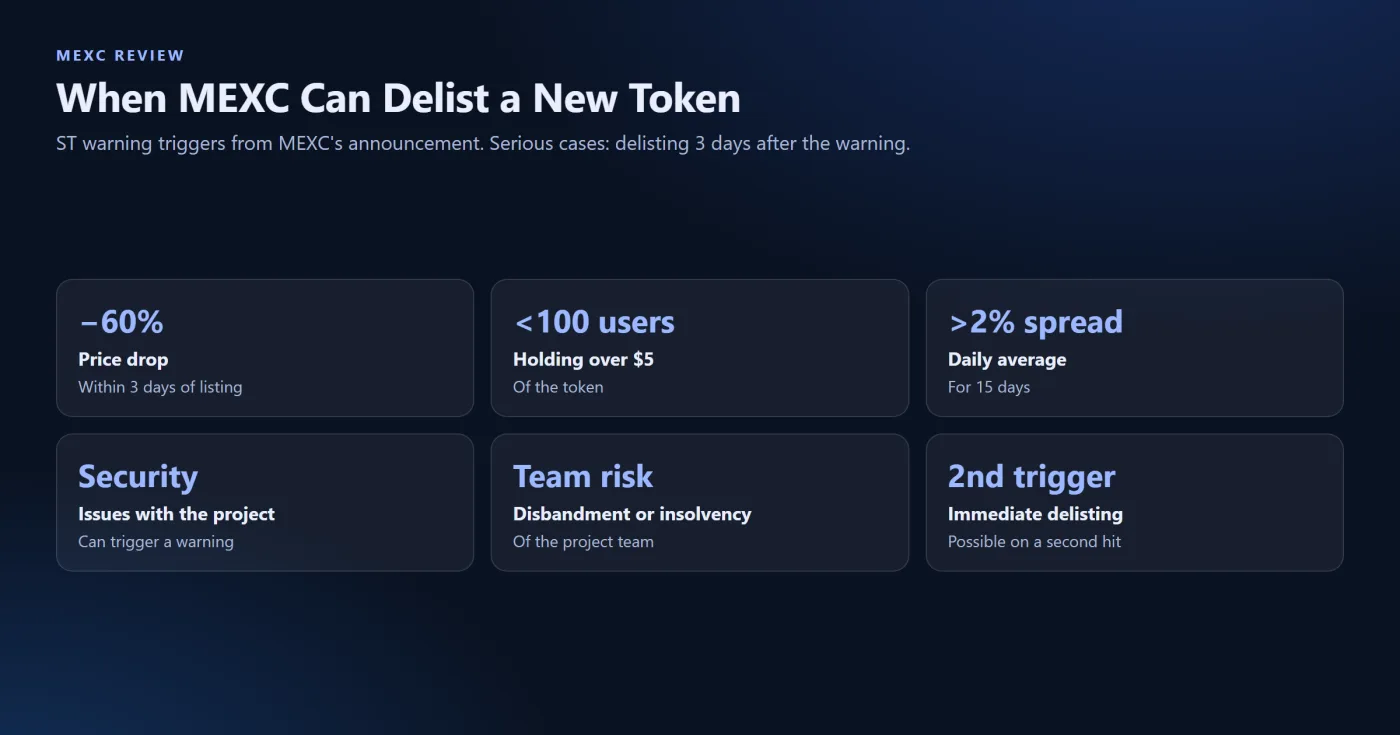
MEXC offers many tokens, including new and low cap ones, and a claim of about 2,800 coins was made in one article but not verified. A MEXC announcement about ST warning rules gives criteria that can trigger the warning and further delisting: more than 60% drop within 3 days of listing, less than 100 users having more than $5 of the token, daily average buy-sell spread more than 2% for 15 days, security issues, and risk of disbandment or insolvency of the project team. It says that when the threat to users is assessed as significant, the project will be delisted 3 days after the warning, and that the second trigger can result in an immediate delisting. The page does not describe any trading restrictions during the warning.
For readers, this means that new listings come with the risk of thin liquidity, big price drops, and sudden delisting. There is no listing success rate data or independent performance data provided in the sources checked, so listing gain numbers from press releases were not included.
MEXC Login and Phishing Safety
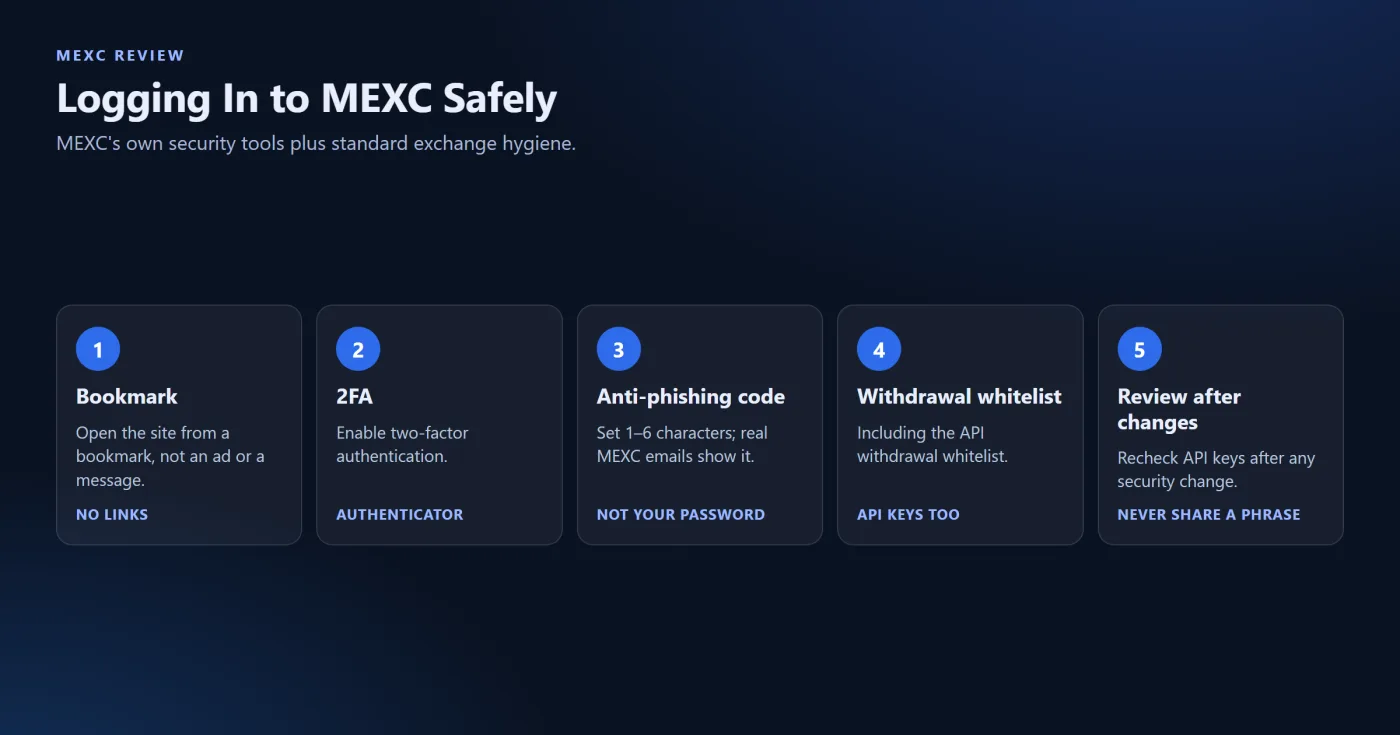
The login process was not tested for this article. MEXC support pages describe the safety measures it offers. Anti-phishing code consisting of 1 to 6 characters can be set in the Security settings, and once set, MEXC's official emails will show it. If the email does not contain the code or contains a different code, it is likely a phishing attempt, and the code should not be the common password.
MEXC scam guide lists red flags: urgent security warnings, similar-looking sender domains, attachments, giveaways requiring payment, and requests to transfer funds to unknown addresses. It says that MEXC never asks for account details or password, and suggests a verification page for the sender. In addition, there are usual safety rules: opening the site from a bookmark rather than a search ad or a message, two-factor authentication, withdrawal whitelist, and never entering a recovery phrase or sending it to support, since an exchange account does not use one.
Is MEXC a Good Exchange?
No source checked here offers a verdict, and the answer will depend on user needs. Points in MEXC's favor, as documented here, are low listed fees, many listed assets, and reserve data with a Merkle tree verification. Points against are absence of a tier one license, absence of an independent reserve audit, reported disputes over freezing of funds, an unverified account takeover case, and restrictions limiting access to many big markets. Smaller balances, shorter holding periods, and withdrawal to self-custody reduce exposure to the counterparty risk, but they do not remove it.
What to Check Live Before Using MEXC
-
Whether MEXC is allowed in the reader's country per its terms.
-
Live fee schedule, including discounts for MX holdings and regional rates.
-
The latest proof-of-reserve data and whether an independent audit has been done.
-
That withdrawals are normal and that the withdrawal fee on the chosen network is known.
-
ST warning status of a token before trading it.
-
Security settings: two-factor authentication, anti-phishing code, and API withdrawal whitelist.
This article is educational and is not investment advice. Account on an exchange carries a risk of loss, and each reader should check live information. Exchange interfaces were not tested for this article.
Related guides


 Scroll to top