


Aptos Staking: Rewards, Lockup, and Validator Choice


Table of contents

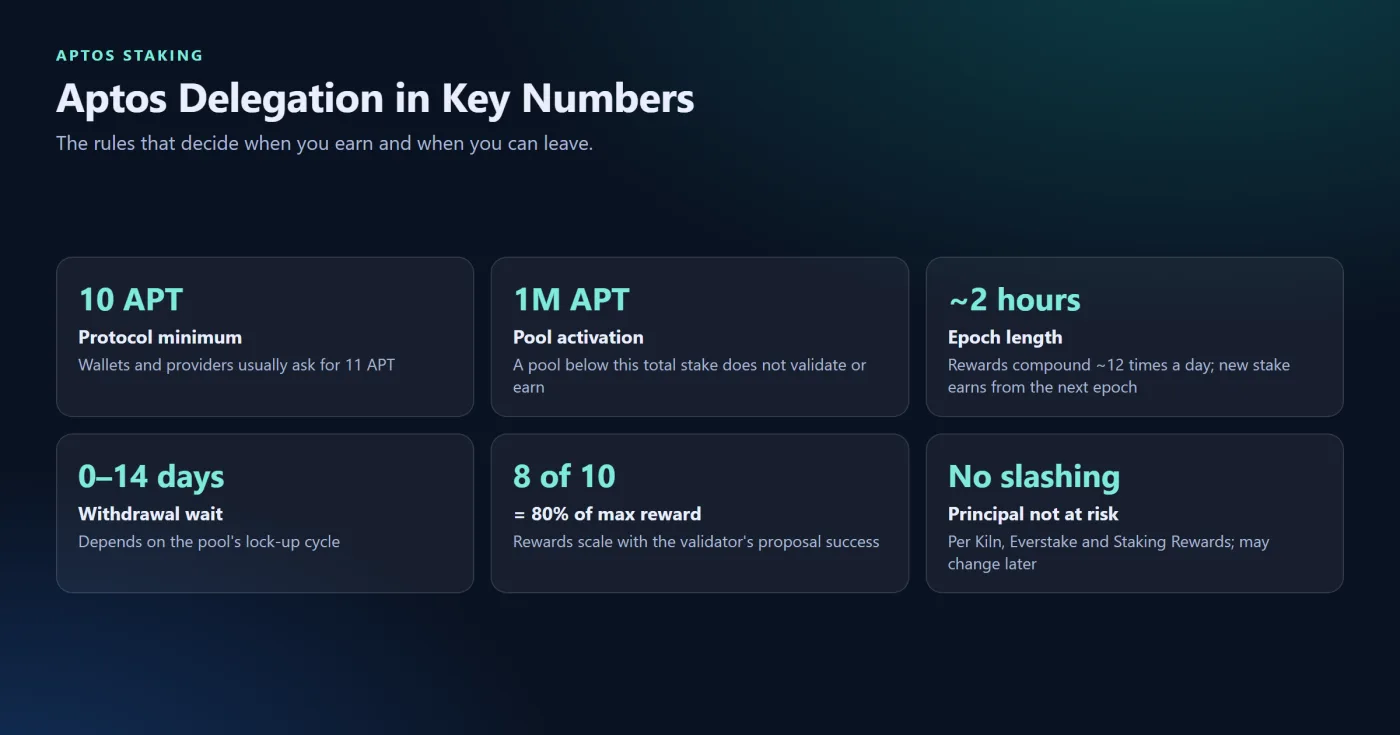
APT staking happens via delegation pools. Users delegate APT to a validator's pool, the pool earns rewards that are automatically compounded at the end of each epoch (approximately every two hours), and users can request an unlock of the stake at any moment and withdraw it once the pool's lock-up cycle is over. The protocol requires a minimum of 10 APT, whereas most wallets and providers ask for 11 APT.
The variable that is subject to change the most is the reward rate. At the beginning, in October 2022, the maximum was 7% yearly, and it has been lowered since, so any single figure needs to be checked against the current network or the provider data before making a decision. This guide separates what the Aptos documentation describes, what the providers claim, and what has only been proposed.
How to Stake Aptos Step by Step
The UI differs between wallets and providers, and the descriptions of the interfaces given below were not tested for this article. This guide follows the order described in the Aptos documentation and provider guides.
-
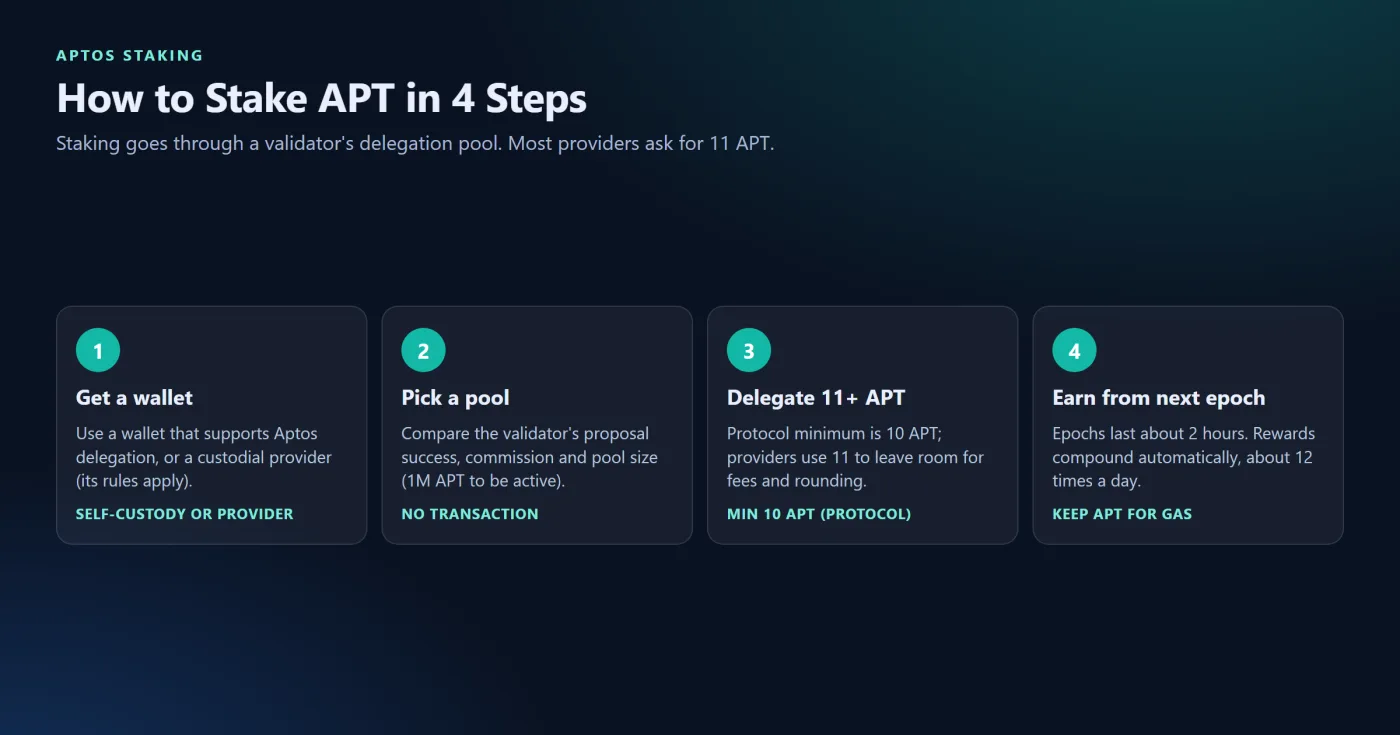
Hold APT in a wallet that supports Aptos delegation, or use an exchange or custodial provider offering Aptos staking. If the provider keeps the keys of your assets, the rules are those of the provider.
-
Choose a validator's delegation pool and select an amount starting from 11 APT. The protocol allows 10 APT, but providers use 11 to leave enough space for the fees and rounding.
-
Confirm the transaction. The stake will be added to the pool and start earning from the next epoch, not immediately.
-
Keep some APT out of the staked amount to pay network gas fees for further actions like unlock and withdrawal.
Do not enter a recovery phrase on any website, in chats, or in forms that promise to "activate" staking. The staking transaction must be approved in the wallet, and no legitimate provider needs the recovery phrase.
How to Unstake and Withdraw Aptos
Unstaking Aptos consists of two steps. The second one depends on the clock of the pool that the delegator does not control.
-
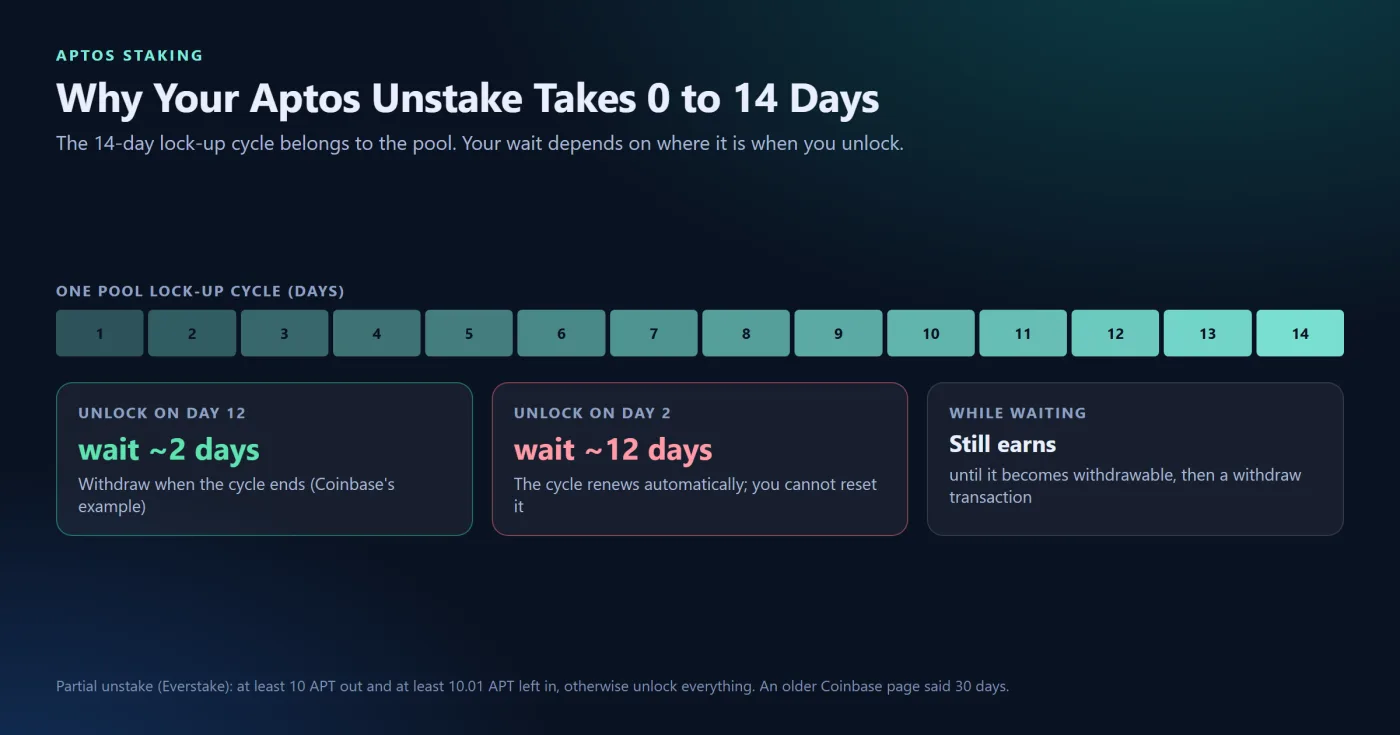
Unlock. Any user can request the unlocking at any moment. After that, the stake stops counting as active, but, according to the Aptos documentation, it still earns rewards till the moment it becomes withdrawable.
-
Withdraw. The assets can be withdrawn only after the lock-up cycle of the pool is over. The lock-up is a fixed period set by Aptos governance and renewed automatically, and delegators have no power to reset it.
As the lock-up cycle belongs to the pool rather than individual delegators, the waiting period for withdrawal depends on the moment when the unlock request is made. According to the current Coinbase delegation guide, the pool has a 14-day cycle that began when the pool was created, and the guide gives an example of unlocking on the 12th day of the cycle and waiting 2 more days. Everstake mentions the waiting period of 0-14 days. An older Coinbase page gives 30 days, which reflects an earlier lock-up setting of the pool and is one of the reasons why guides written at different times do not agree.
There is also a limitation on partial unstaking. According to Everstake, the partial unstaking must consist of at least 10 APT, and at least 10.01 APT must remain after the transaction. Otherwise, the whole position has to be unlocked.
What a Delegation Pool Is
The delegation pool is a smart contract allowing multiple holders to stake in the single validator's pool. The Aptos documentation gives the following roles of the participants: the owner who creates the pool, the operator who runs the validator node, the voter who performs governance votes, the delegators who provide the stake, and the optional beneficiary of the operator's rewards. The pool itself is controlled through the resource account, so nobody has direct access to the pool's funds.
The pool needs to have at least 1 million APT of total stake to become active. Any pool without this amount of funds does not perform validation, and thus does not earn the rewards, and this makes the pool size an additional criterion to check before delegating.
How Aptos Staking Rewards Work
The rewards are calculated per epoch. The rewards rate is set on chain by the network, and the rewards are added to the staking balance as compound interest. According to the Kiln documentation, it happens automatically 12 times a day, and the balance to calculate the rewards of epoch N is the balance at the beginning of the epoch N-1. Thus, the rewards for the newly added stake start one epoch later.
The rewards also depend on the validator's performance. The Aptos documentation on the validator performance explains that if the validator succeeds in each block proposal, it gets the maximal reward, if it succeeds in 8 of 10 proposals, it gets 80% of it, and if it fails in all block proposals, it gets nothing. The pool's commission is taken by the operator, and according to Kiln the commission is charged when the delegators unstake.
How Much Does Aptos Staking Pay?
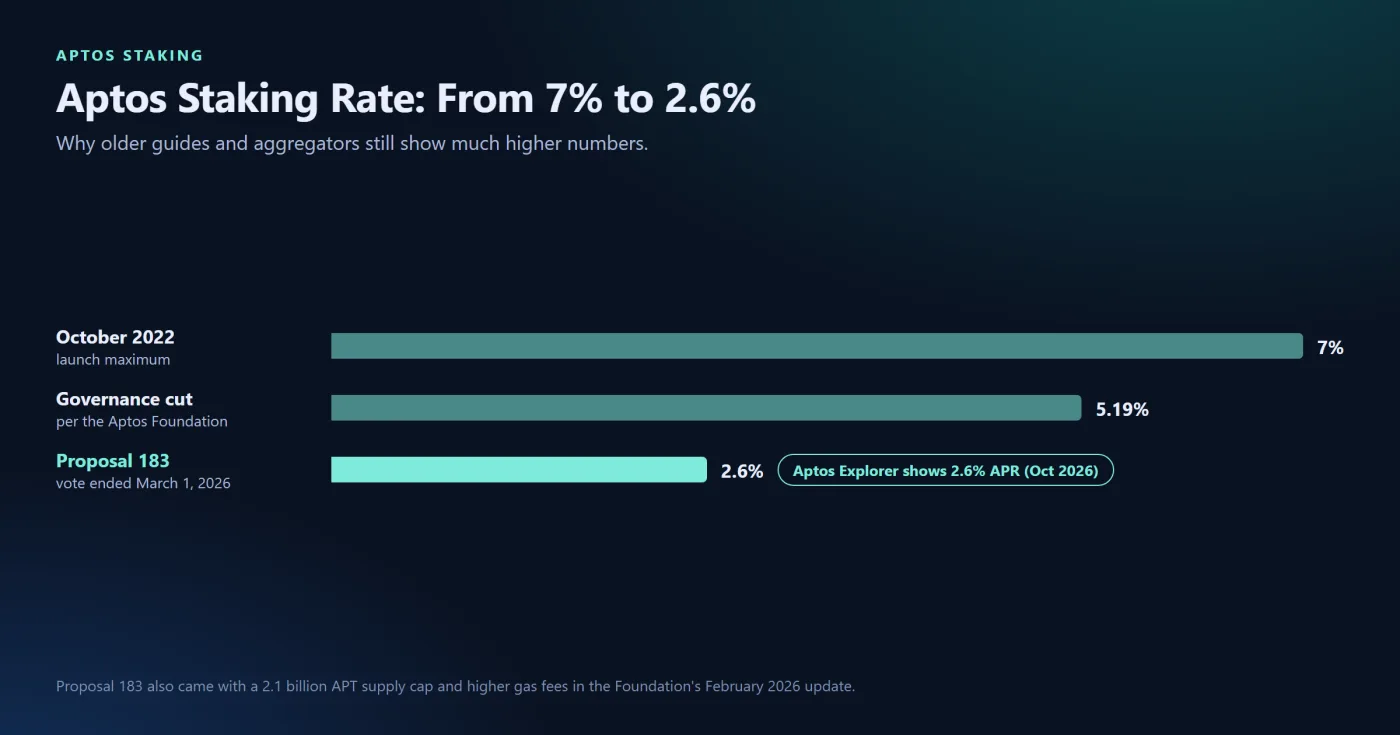
One single figure cannot be provided, as the rewards rate is changing with time and the providers give different values. However, what can be said is the general tendency. The maximum rate started at 7% in October 2022 and was planned to be lowered by 1.5% of its value every year. Later, a governance change reduced it to 5.19%, according to the Aptos Foundation.
In February 2026, the Aptos Foundation issued the tokenomics update stating that it intended to propose the reduction of the staking rate to 2.6%, together with the increase of the APT gas fees and the introduction of the 2.1 billion APT cap on the supply. The voting on governance proposal 183 ended on March 1, 2026, with about 335.2 million APT in favor and about 1,500 APT against. The media coverage of that time stated that it was waiting for execution. Now Everstake shows about 2.60% on its Aptos calculator, which fits that decision, but the execution on chain was not checked for this article. Third-party aggregators may still show older rates close to 7%.
A Hypothetical Example
These numbers are illustrative, not predictive or observed results. Suppose 1,000 APT are staked for one year at the rate of 2.6%. The gross rewards would be 26 APT. If the validator charges a hypothetical 10% commission on rewards, the delegator will receive about 23.4 APT. Actual results vary because the rate can change, compounding adds a small amount, and the APT price moves independently of the rewards.
Rate Changes That Are Still Only Proposals
The same Aptos Foundation post mentions the exploration of the higher rewards for longer staking commitment, a permanent lock of a large amount of APT, and performance-based grants. These were described as ideas under exploration and should not be regarded as implemented features.
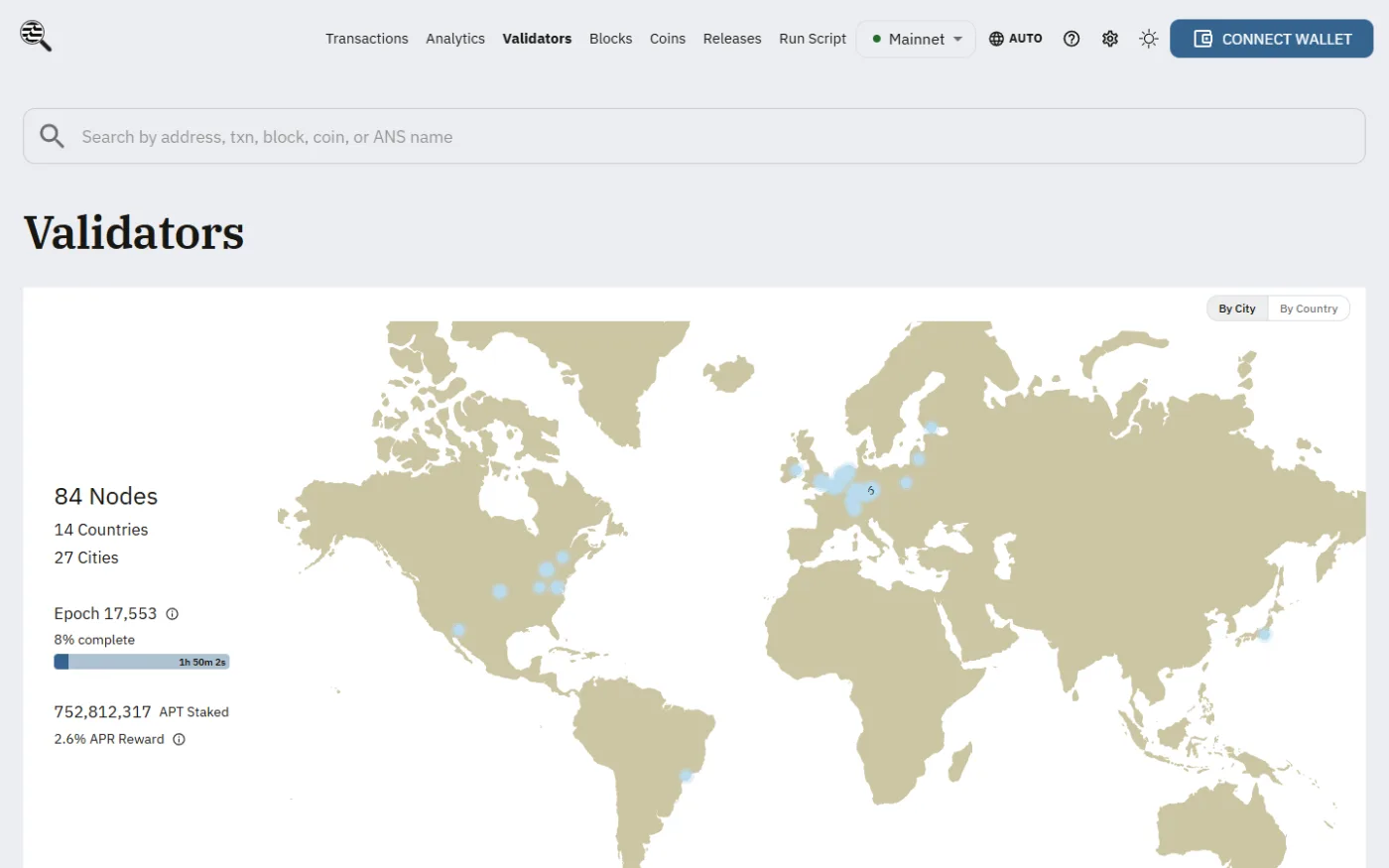
Choosing a Validator
As the validator's performance defines the share of the maximum reward received by delegators, the choice is significant for rewards. Points to compare are:
-
Proposal success rate over a long period, as a low rate directly reduces the rewards.
-
Commission, and when it is charged.
-
The pool's total stake, as it must reach 1 million APT to be active.
-
Operator's identity, experience, and communication regarding the problems.
-
Concentration. Spreading the stake among multiple pools decreases the dependence on one operator, but means more transactions and minimum amounts.
Risks of Staking Aptos
According to Kiln, Everstake, and Staking Rewards, the slashing mechanism is not currently implemented on Aptos, so the delegators cannot lose the principal due to the validator's misbehavior in the manner seen on some other networks. One of the providers says that this may change later, so these current rules are subject to recheck.
The risks that remain are different. Poor performance of the validator reduces the rewards. A pool that falls below the activity threshold stops earning. The lock-up period prevents the delegator from selling during the wait, which is important in the fast market. The APT price can fall by more than the rewards earn. Custodial providers also bring additional fees and counterparty risk. Liquid staking tokens like Amnis Finance's amAPT, which some providers offer, bring smart contract risk and are not evaluated here.
Core contributors and the early backers of Aptos have token vesting schedules, and according to Everstake, one of them ends on October 12, 2026. Supply released from the vesting can affect the market, but the impact on the price is only an opinion rather than the data established by sources.
What to Check Live Before You Stake
Several facts mentioned in this guide are subject to change after publishing. Before staking, check the following on the Aptos Explorer or the provider's page:
-
The current rate and whether proposal 183 has been executed.
-
The current lock-up period and the ending date of the pool's cycle.
-
Validator's recent performance, commission, and total stake.
-
The minimum delegation and the minimum amount after a partial unstaking.
-
Whether the wallet or provider you use lists the pool and shows the same data.
This article is educational and is not investment advice. Staking involves risk, and each reader should compare the live data with their own situation.
Related guides


 Scroll to top