


Solana Inflation Rate: Schedule, Max Supply, and 2026 Vote


Table of contents
Solana has no capped supply. The inflation schedule starts at 8% a year, decreases by 15% of the previous year each year, and is set to reach a terminal level of 1.5% over the long term, according to Solana's official documentation. In a first on-chain governance vote that closed on August 28, 2026, validators approved SGP-0002, which would double the yearly decline from 15% to 30% once the change is activated, but sources say it was not yet live at the time of writing. A June 2026 report put the current inflation rate at 3.82%.
This guide discusses the schedule, the vote, what "no max supply" means, and how to understand unlock data. It does not predict the price of SOL or advise on buying or selling. Figures and supply statistics are subject to change, so live data should be checked.
Solana's Inflation Rate and Schedule
The Official Parameters
The official Solana FAQ on inflation states that the initial rate is 8% per year, that the rate decreases 15% a year (year-on-year), and that the rate settles at a terminal level of 1.5% per year over the long term. The official FAQ page does not specify the current rate, a maximum supply, or how the new SOL is allocated, so this information comes from other sources below.
The Helius blog post dated September 11, 2024 says the schedule started on epoch 150 on February 10, 2021, and the rate was 5.07% on August 30, 2024. Helius is a vendor, and the post approaches time measurement using "epoch years." It describes inflation as new SOL issued to stakers through rewards, which is why the rate matters for staking returns.
The Current Rate
As of June 2026, Solana Compass reported a current inflation rate of 3.82%, and as of May 20, 2026, Solana co-founder Anatoly Yakovenko was quoted in a SolanaFloor article saying the current rate is 3.85%. Both are secondary sources and somewhat outdated, so the current rate should be checked on a Solana explorer or a staking dashboard.
A Hypothetical Dilution Example
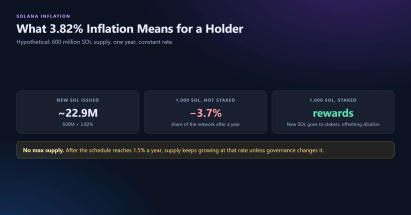
This example uses hypothetical numbers and does not represent any forecasts. If the total supply of SOL is 600 million and the annual rate of inflation is 3.82%, then 22.9 million new SOL will be issued over the course of the year. So, the owner of 1,000 unstaked SOL will own about 3.7% less of the network at the end of the year. Stakers receive issued SOL as rewards, and the dilution of the stake depends on the received rewards, which depend on validator uptime, commission, and the amount of staked SOL.
Does Solana Have a Max Supply?
No. According to Tokenomist's Solana page, no maximum supply is established, and total supply is infinite, although the projected supply for 2035 is about 775.8 million SOL after burning 5.8 million SOL. Solana's official documents describe a terminal rate of 1.5% a year, not a cap, so the supply continues to grow indefinitely at that rate after the schedule reaches a plateau, unless the rules are changed via governance.
Tokenomist is a vendor, its page does not have an "as of" date, and the figures on the page are not fully consistent: for example, it gives two different figures for fully diluted value. The supply statistics on the page should be used only as illustrations.
The 2026 Governance Vote
What Passed
The first on-chain Solana vote took place from epoch 1021 (around August 23, 2026) to the end of epoch 1024 on August 28, 2026, according to Hubra, a staking app. Three proposals were put to vote: SGP-0001, a Solana constitution, which passed with about 86% of votes cast; SGP-0002, which approves SIMD-0550 to double the disinflation rate; and SGP-0003, fee-burn overhaul, which was rejected.
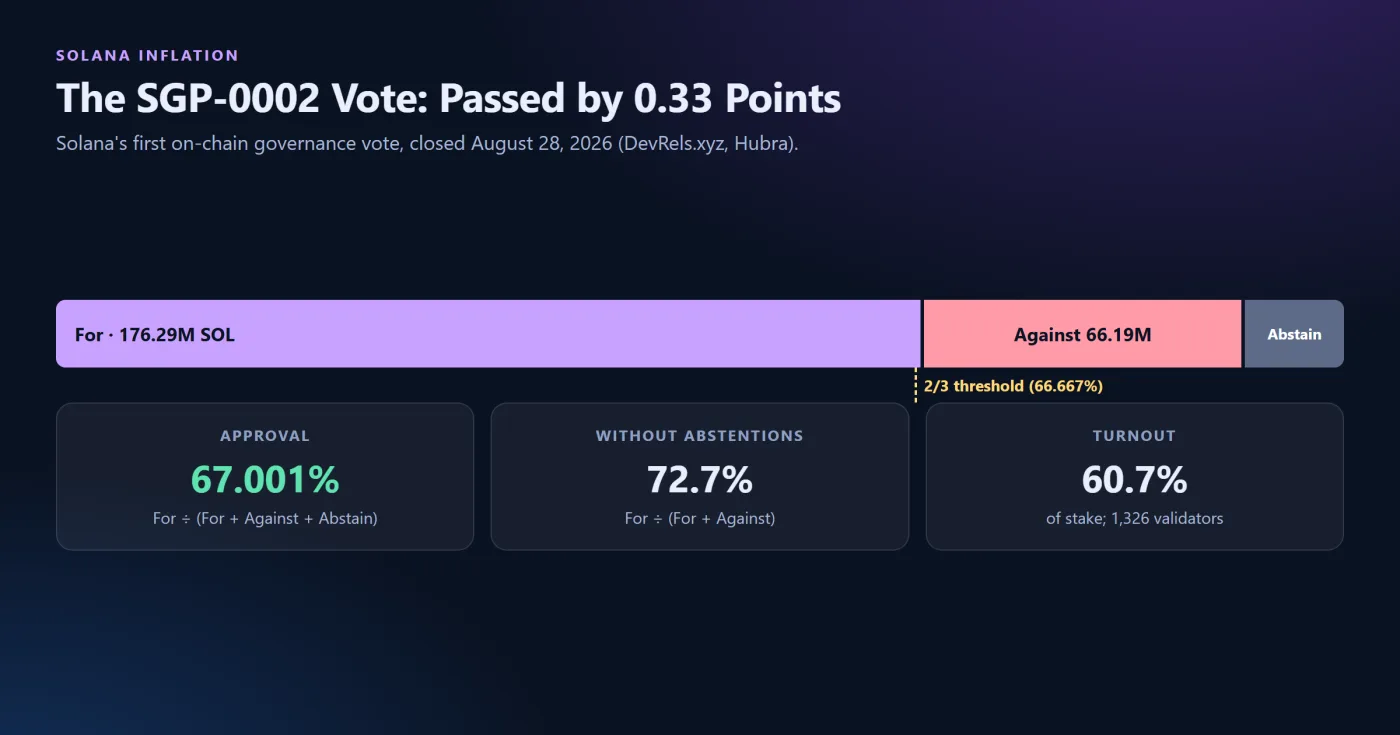
According to DevRels.xyz, SGP-0002 passed with 67.001% approval, surpassing the 66.667% threshold, with a margin of 0.33 points. DevRels.xyz states that there were 176.29 million SOL votes for, 66.19 million against, and 20.63 million abstained, with 60.7% of stake voting. The reported percentage is calculated as For divided by For plus Against plus Abstain, which is the rule used by Hubra, although DevRels.xyz states the formula without abstentions. Counting only For and Against, the approval is 72.7%. Hubra states that 1,326 validators voted, and the rule requires two-thirds of For, Against, and Abstain combined to be For, with abstentions counted towards quorum. Hubra credits staker overrides, such as JitoSOL holders, with helping to win the vote. According to The Defiant, Kraken's largest validator moved about 8.1 million SOL from against to for hours before the final result.
What It Changes, and When
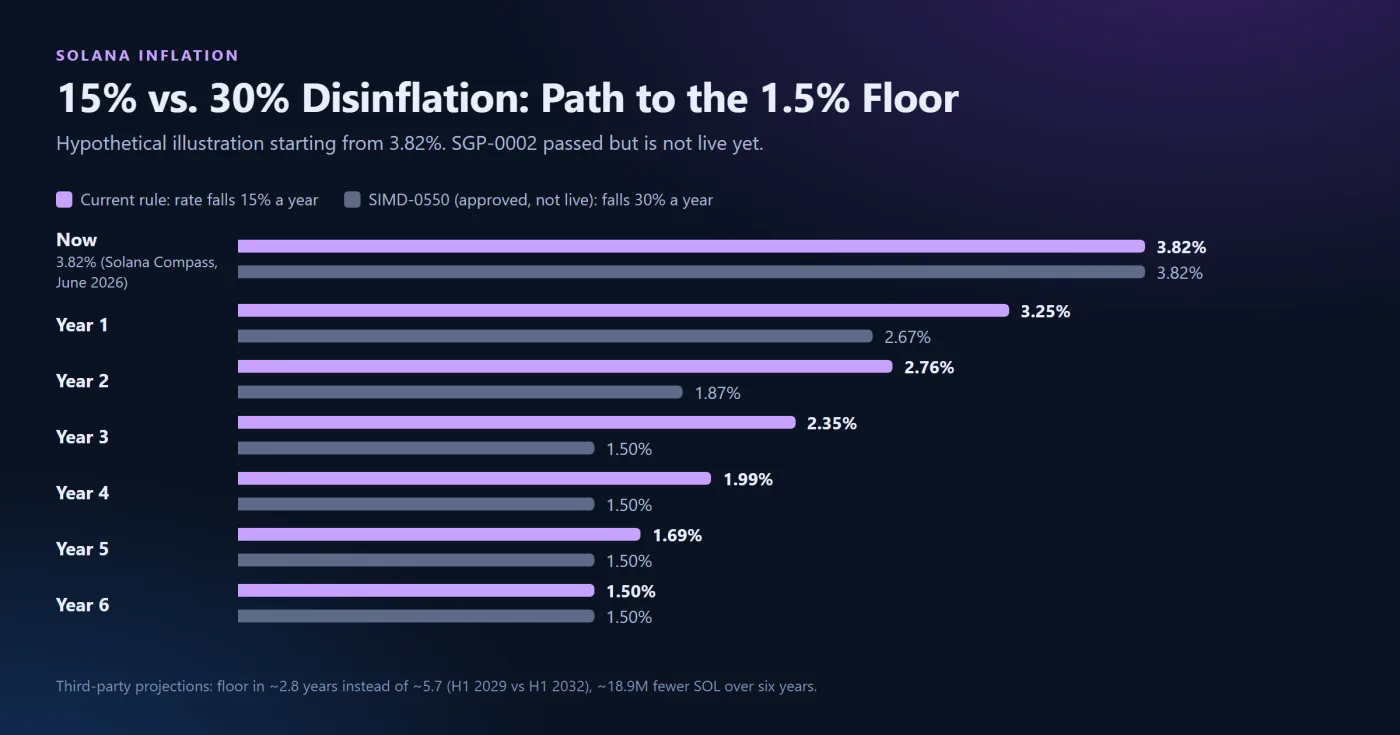
Several sources refer to SGP-0002 as approval of SIMD-0550, which would raise the yearly disinflation rate from 15% to 30%, with the starting and terminal rates left unchanged. They say the time to reach the 1.5% floor would fall from about 5.7 years to about 2.8 years, moving it from around the first half of 2032 to the first half of 2029, and about 18.9 million fewer SOL would be issued over six years. This is a projection by third-party sources.
According to DevRels.xyz, the following is required for the change to become effective: client teams must ship SIMD-0550 in Agave and Firedancer, and validators must activate a feature gate. Until this happens, the issuance follows the previous schedule. Hubra states that the current yields remain unchanged and names SIMD-0607, Agave v4.4, and a feature gate as the dependencies. No activation date was found.
A Reported Discrepancy
According to a news flash by KuCoin, which reprints a CryptoBriefing article dated August 28, 2026, "the double disinflation proposals were rejected in an on-chain vote." According to a second news flash, a Helius proposal passed. The first flash states that SGP-0002 and SGP-0003 failed, which contradicts the vote results published by DevRels.xyz, The Defiant, and Hubra. The latter three sources agree that SGP-0002 passed and SGP-0003 failed, so this article follows them, but the discrepancy demonstrates that vote results should be cross-checked against on-chain data.
The Earlier Attempts
According to SolanaFloor, SIMD-0228, a proposal to replace the fixed schedule with a market-based emission model, was defeated in a vote in March 2025, missing the 66.67% threshold despite the majority approval: more than 74% stake participated in voting on this issue across 910 validators. SIMD-0411, another proposal to double disinflation, was proposed in November 2025 and closed for inactivity in January 2026, per Solana Compass, due to lack of Anza and Firedancer approvals.
Unlock Schedule and Allocations
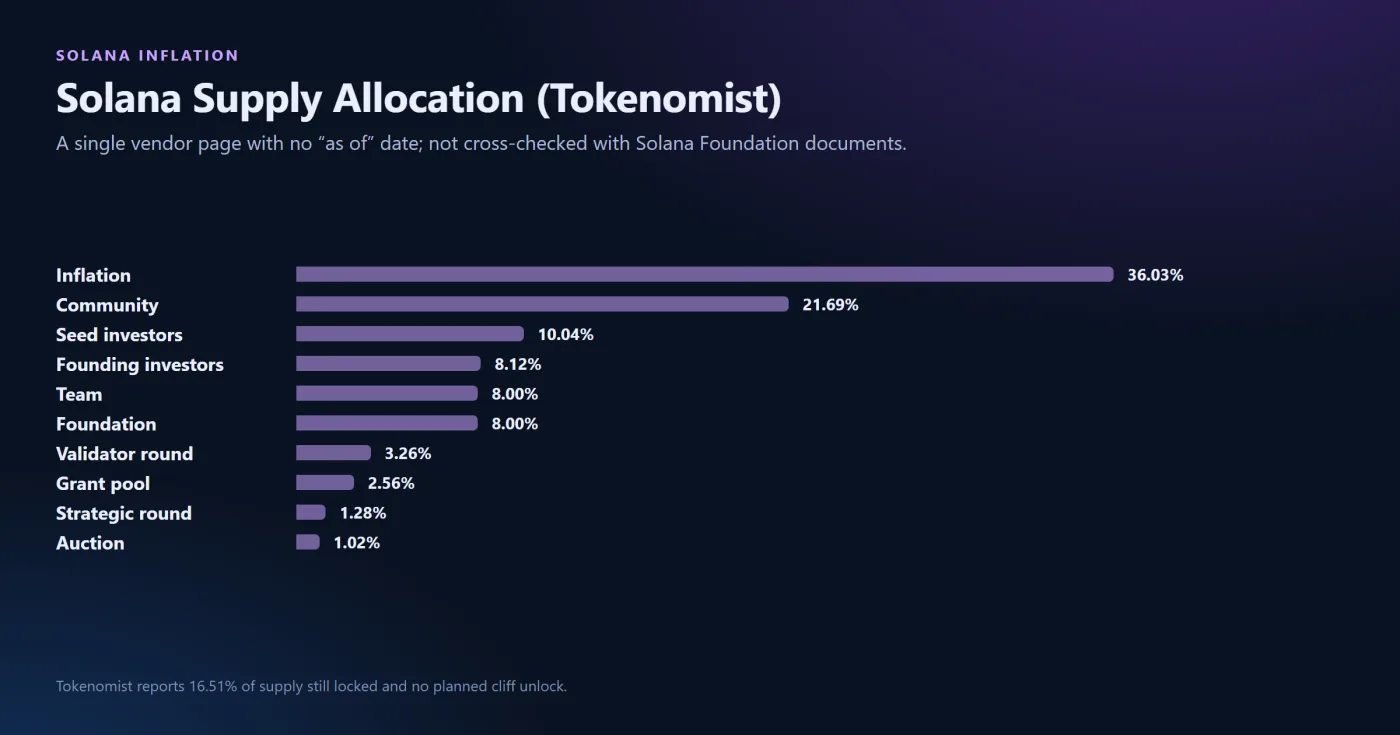
Tokenomist states that the Solana allocations are: team 8.00%, foundation 8.00%, investors in several rounds (seed 10.04%, founding 8.12%, strategic 1.28%, auction 1.02%, validator 3.26%), community 21.69%, grant pool 2.56%, and inflation 36.03%. It states that 16.51% of supply is still locked and there is no planned cliff unlock. It does not show what part of the allocations has been already released and its description of cliff releases and an indefinite schedule is inconsistent. These figures are from a single vendor page and were not cross-checked against Solana Foundation documents.
Risks and Limits
-
Inflation dilutes holders who do not stake, and the sources read give no certain view of future staking participation.
-
The SGP-0002 change is not live, so projections based on it can change if activation is delayed or contested.
-
Third-party tokenomics dashboards can contradict each other, and some figures provided in this article are taken from vendors.
-
The governance can change the schedule, as shown by 2025 and 2026 votes.
What to Check Live
-
The current rate and epoch on a Solana explorer or staking dashboard.
-
The activation status of SIMD-0550 through Agave and Firedancer release notes and the feature gate status.
-
The total and circulating supply from a source that has a date of publication.
-
The current staking yield after the validator commission.
-
The most recent proposals and their results in the official on-chain voting record.
This article is for educational purposes and does not constitute investment advice. Figures are snapshots from the cited sources and should be cross-checked live.
Related guides


 Scroll to top