


What Is Polymarket and How Does It Work?


Table of contents

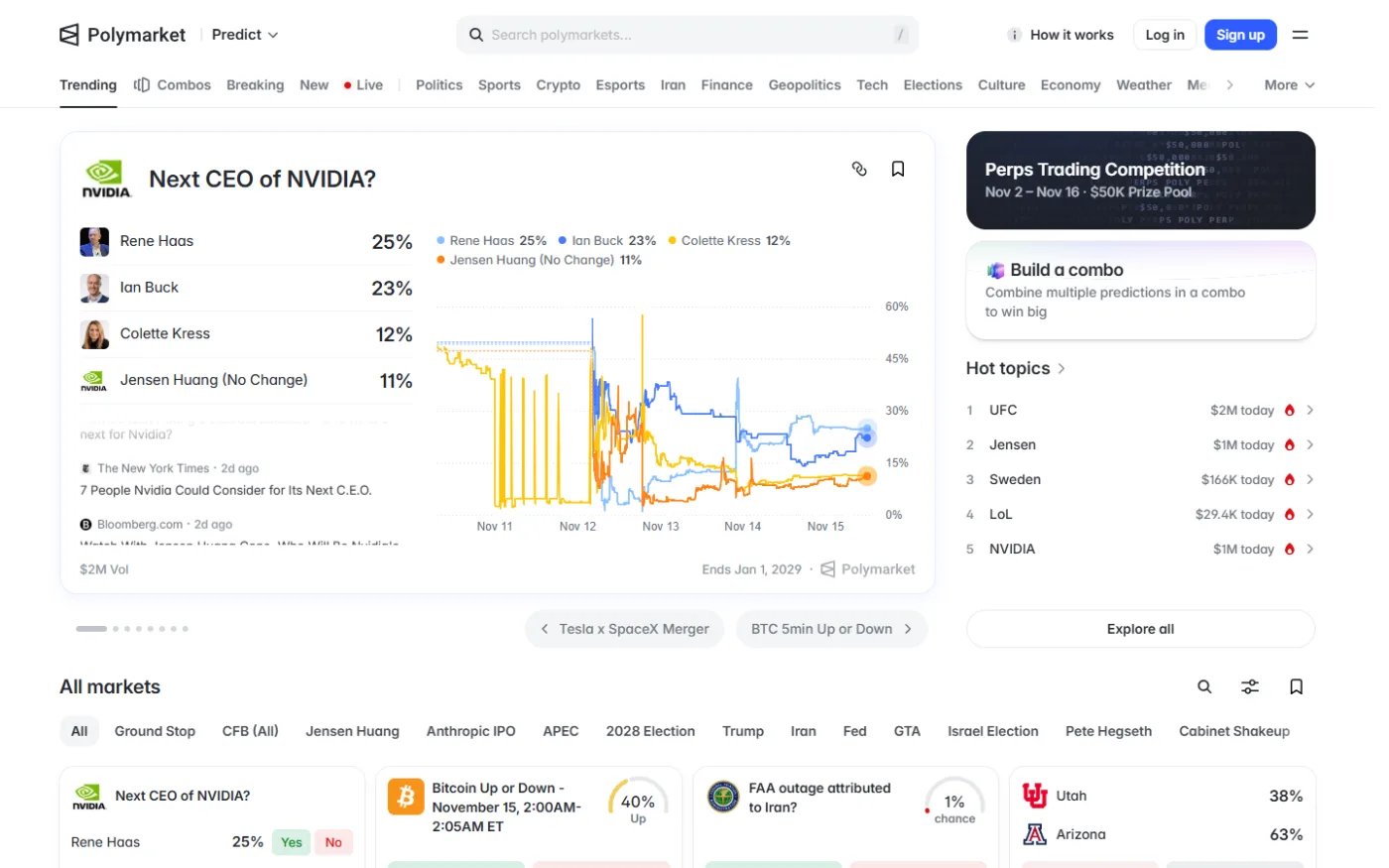
Polymarket is an online prediction market that offers to trade shares in the outcome of a real-life event, such as an election, a sports match or an economic data release. In this case, the shares trade for between $0.00 and $1.00 each, a win earns $1.00, and a loss gets nothing; thus, the price is interpreted as the probability estimate. The documentation page of Polymarket describes it as a peer-to-peer order book where users trade shares with each other, not the house. Since 2026, the platform earns mainly through taker fees from most categories, and US residents are offered services through a separate, CFTC-licensed app that was being opened in stages as of May 2026.
This guide shows how a market works, how Polymarket pays out winning shares, how disputes over resolution are handled, how the platform charges fees, what the US situation is and how to access public market data through Gamma API. It does not recommend trading and does not predict outcomes. Prediction markets carry the risk of losing the whole amount staked. The sources were read on November 9, 2026, and the rules and fees should be checked live before use.
What Polymarket is
Polymarket describes itself in its documentation as a market where prices reflect belief in the probability of an event. A "Yes" share priced at $0.65 implies a market estimate of roughly 65% that the event happens. The price comes from trading, not from forecasts made by the company.
The platform operates on the blockchain technology. According to the documentation page, every dollar of collateral gives rise to one Yes share and one No share that always sum up to the collateral. The issuance and redemption of the shares as tokens are governed by the smart contracts and not a clearing house.
Collateral: pUSD or USDC
Many third-party guides call Polymarket USDC collateral. However, the current documentation page lists the pUSD as the collateral and describes it as an ERC-20 standard token backed by USDC with the enforcement coming from the smart contract. The descriptions are consistent only if the pUSD is a USDC wrapper. Hence, the exact token should be verified from the documentation page before making a deposit.
How trading works
Trading happens on a central limit order book (CLOB). A user may buy Yes or No shares or sell the shares prior to resolution to cash in profits or minimize losses. Trading is a peer-to-peer process, hence one side's gain is another's loss, less fees.
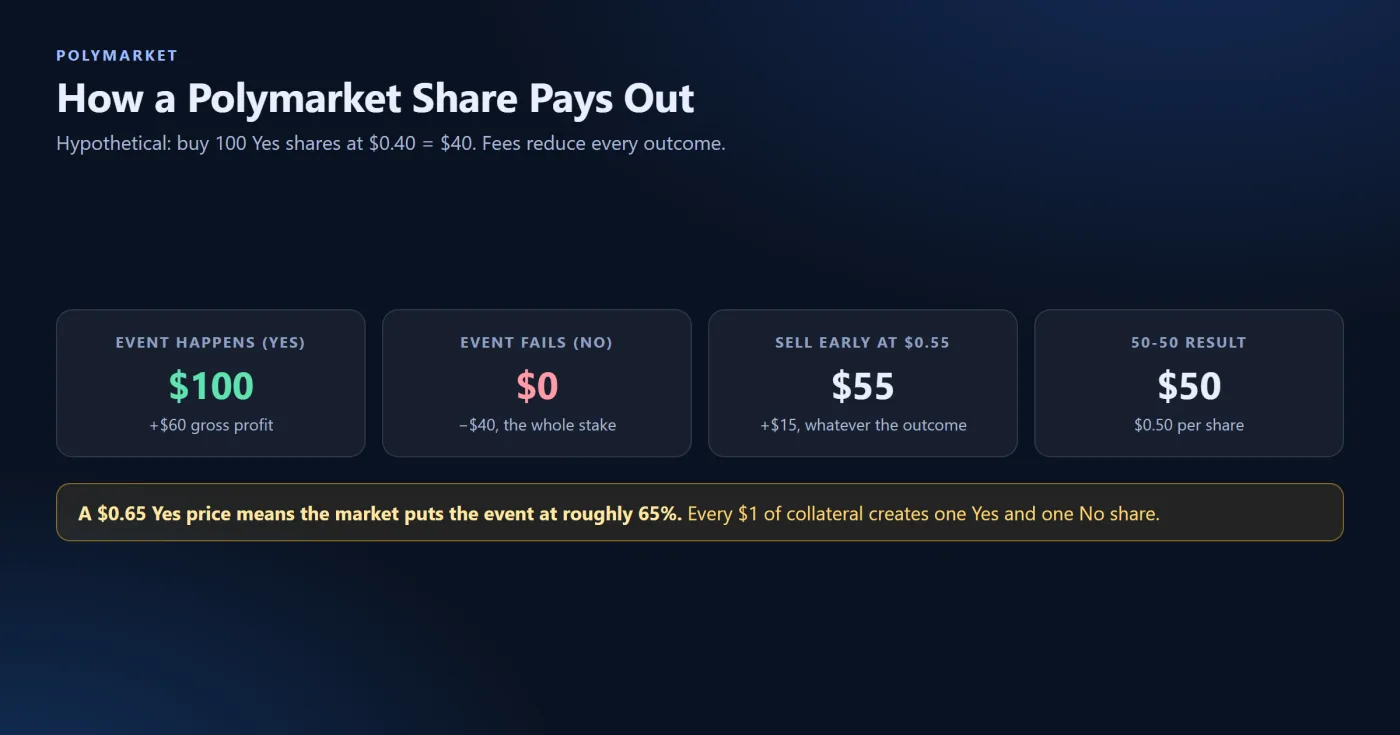
A hypothetical example, not a real market: a user buys 100 Yes shares at $0.40, paying $40. If the outcome is Yes, the shares redeem for $100 and the gross profit is $60. If the outcome is No, the shares will be worth $0, and the user will lose the whole $40 stake. Selling at $0.55 prior to resolution will give the user $55, a $15 gross gain, regardless of the outcome. The fees will lower all the outcomes.
-
The market resolves to one particular outcome, and trading ends.
-
The prices between $0.00 and $1.00 are quoted per share. The difference between the best buying and selling price is called the spread.
-
Holding a position to resolution carries full loss risk, and selling early carries price risk.
How Polymarket pays out
Once a market resolves, the winning shares turn into payable $1.00 per share in the collateral tokens, and losing shares become worthless. According to the documentation, winning shares turn into payable $1 pUSD after the outcome is finalized.
In the rare "50-50" case, which is called Unknown on the Polymarket's resolution page, each token pays out $0.50. Whether the payout arrives in the bank account or on a card depends on the on-ramp or withdrawal route. According to Polymarket's fee guidance, as summarized by Action Network, the fees are not charged by Polymarket for deposits and withdrawals, while gas fees and third-party fees are charged separately.
How markets are resolved
Market resolution is based on UMA optimistic oracle. According to Polymarket's resolution page, the steps are as follows:
-
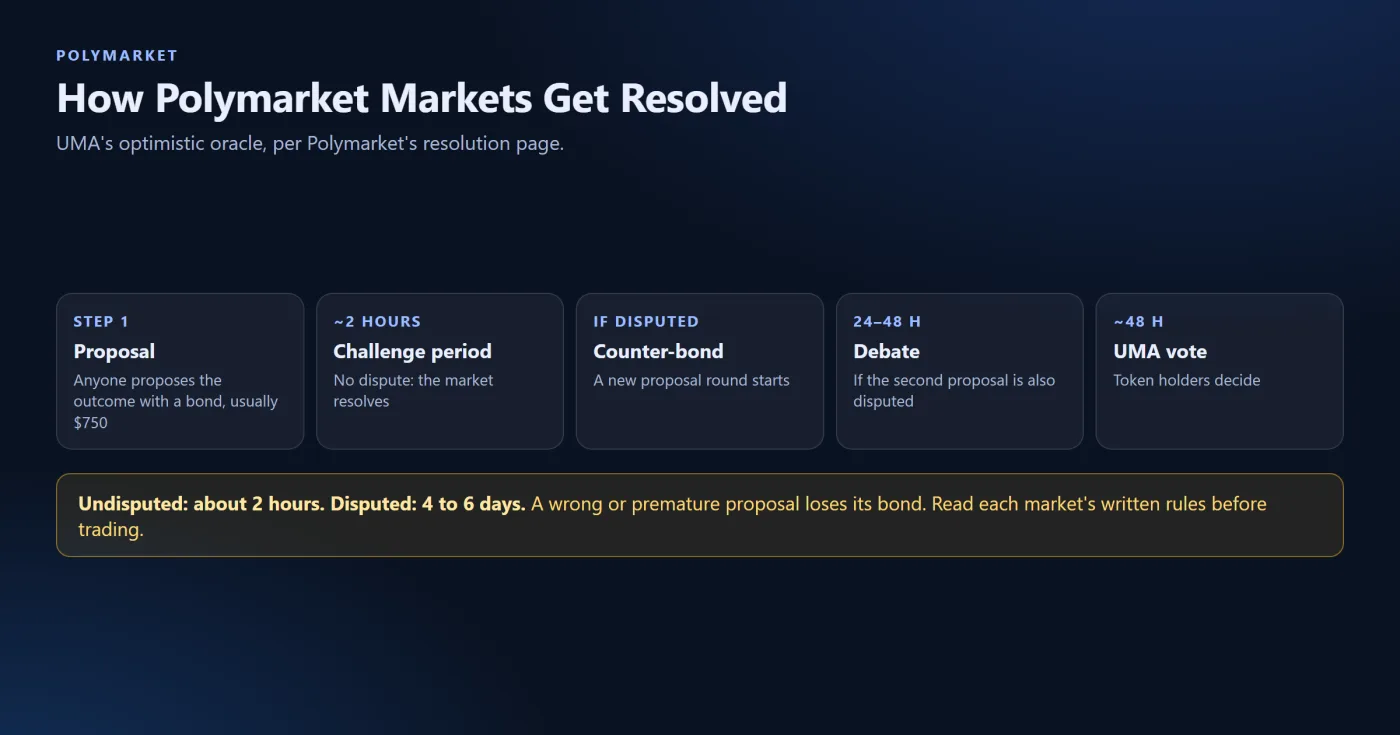
Any user may propose a winning outcome by placing a bond, usually $750 in pUSD. A correct, undisputed proposal returns the bond plus a reward, and a wrong or premature one loses the bond.
-
A two-hour challenge period follows. The market resolves within about two hours if there is no dispute.
-
In case of dispute, the matching counter-bond is required. This starts a new round of proposals. If the second proposal is also disputed, a debate period of 24 to 48 hours is followed by a vote of about 48 hours by UMA token holders.
-
Undisputed resolutions need about two hours while disputed resolutions take four to six days.
According to the same Polymarket page, the company may post an "Additional context" update recorded onchain. However, the company cannot change the fundamental meaning of the question to be answered. Hence, the written rules of the market resolve the payout of the question, and the rules should be read prior to trading.
How Polymarket makes money
Polymarket introduced taker fees in 2026. According to Action Network's fee explainer, which was updated on September 4, 2026, the following points hold:
-
The fee is paid only by takers. Taker fees apply to market and limit orders that cross the spread. Makers do not pay anything for resting limit orders on both the global platform and Polymarket US.
-
Because of the expansion in March 2026, taker fees apply to almost all categories. Geopolitical and world event markets remain free of fees.
-
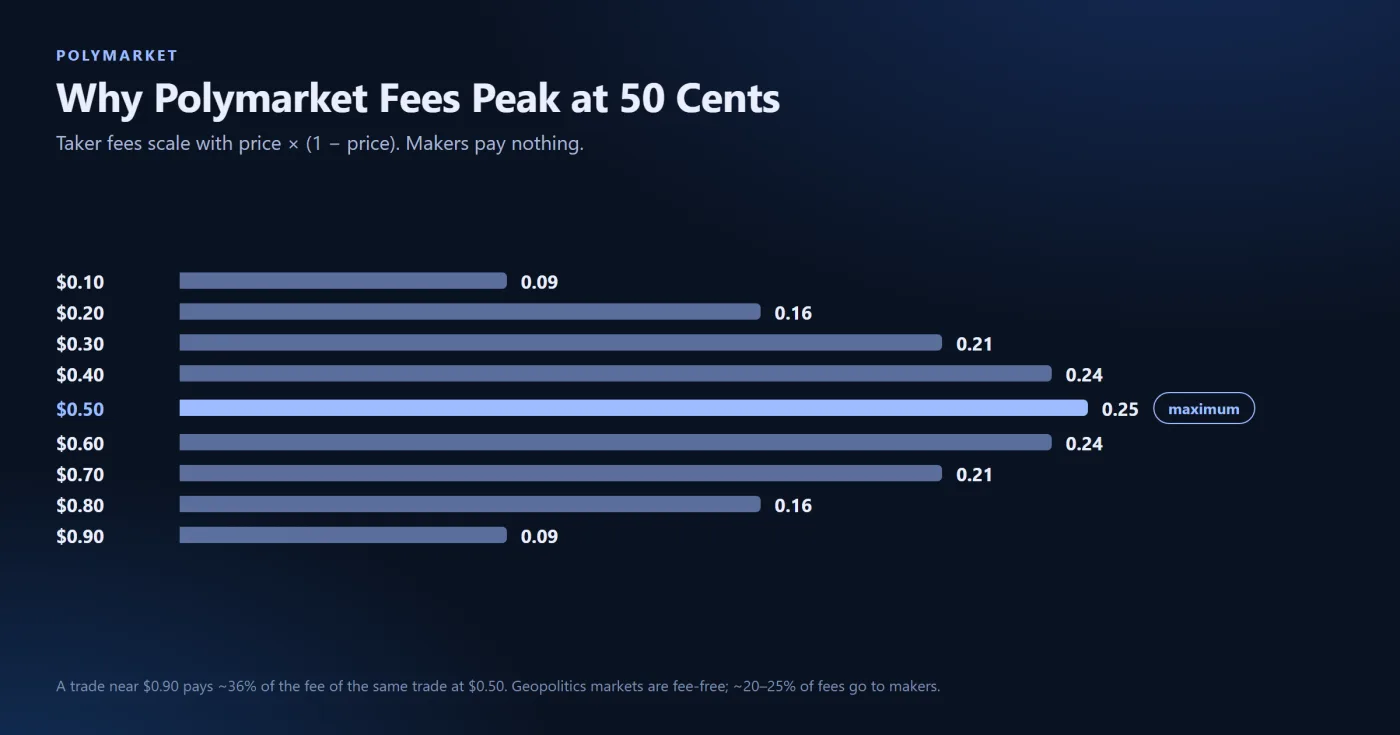
The fee depends on the shares, category rate and the price multiplied by one minus the price, so it is highest near $0.50 and falls toward $0.00 and $1.00.
-
About 20% to 25% of collected taker fees, depending on the category, is paid to makers whose orders were filled during the day.
The Action Network page is commercial content with affiliate links, and its stated rates of about $1.00 to $1.75 per 100 shares were described as a snapshot that has changed more than once. The official fee page could not be accessed in this research, and the live schedule should be taken from Polymarket.
The price-shape effect may be illustrated using simple arithmetic. The factor price times one minus price equals 0.25 at $0.50 and 0.09 at $0.10 or $0.90. Hence, a trade near 90 cents pays about 36% of the fee of an equal-size trade at 50 cents, other things being equal.
Reported revenue
Finbold published a report on the predicted revenue on March 25, 2026, as republished by KuCoin. It projects fee revenue of $800,000 to $1 million per day after changing the fees on March 30, 2026. It assumes about $9.55 billion of trading volume over 30 days and an unspecified fee rate. Using these inputs, about $833,000 per day on approximately $318 million per day of trading volume gives the fee rate of about 0.26%, by this article's arithmetic. The report calls the figures projections, and the authors state that maker rebates mean the gross fee revenue may not equal the net revenue. Thus, any revenue totals should be considered estimates and not the company revenue numbers. No source read here describes other sources of revenue in detail.
How to use Polymarket in the US
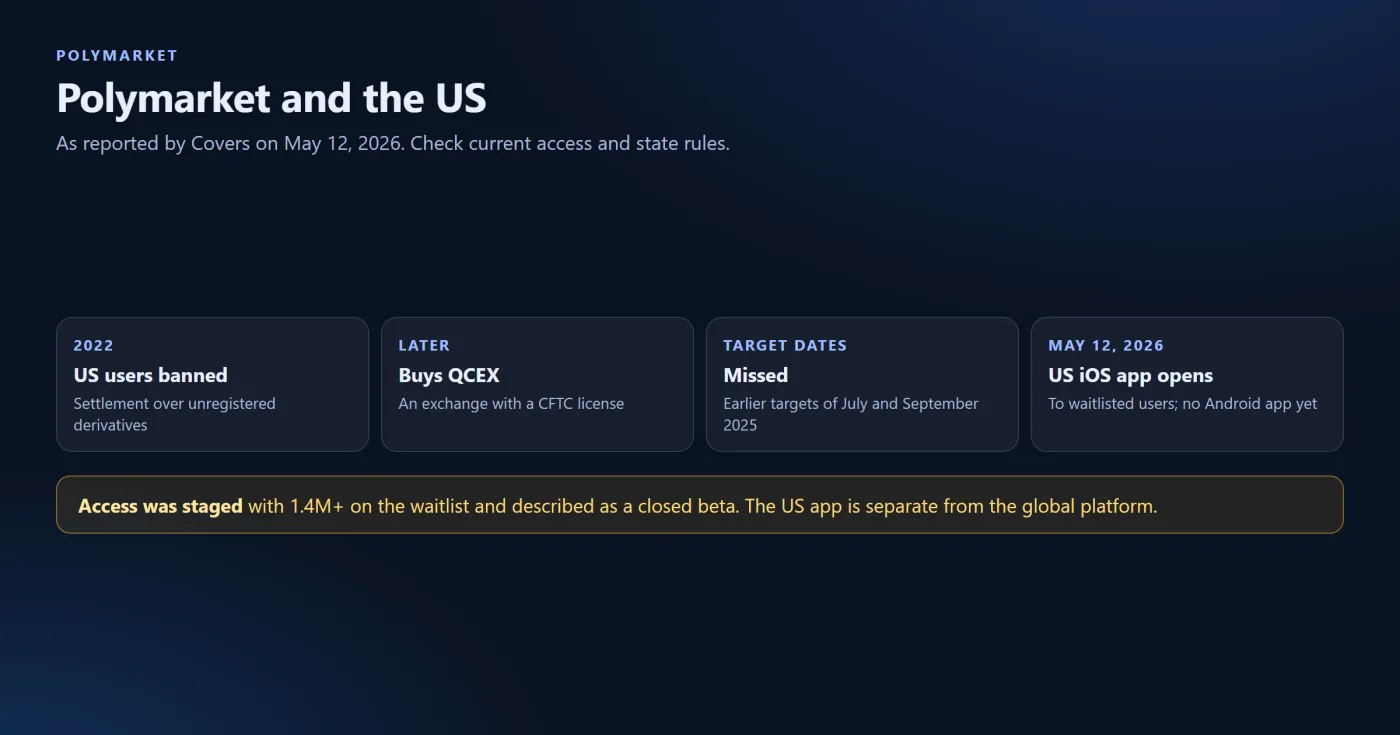
Covers reported on May 12, 2026, that Polymarket was banned for US users in 2022 due to a settlement over unregistered derivatives. However, the company acquired QCEX, which had a CFTC license. Then the license was used to launch a separate US app. According to the same report, the access was opened on May 12, 2026, for waitlisted iOS users who had no invitation code, and there was no Android app at the moment. Signing up was also possible through the US web page of Polymarket.
Several cautions should be noted:
-
The access was still being staged with the report mentioning more than 1.4 million people on the waitlist.
-
The US platform was still in closed beta as stated by one commentator cited in the report.
-
The launch date came late compared to earlier announced targets including July and September 2025.
-
The report cites The Information report with the claims of the turnover and banking problems at QCEX. These claims were not verified here.
-
The report lists sports markets at the launch and does not mention all the markets available.
The US app is separate from the global platform, and it depends on the geographical location and the terms of the platform whether it applies to a particular user. Rules on prediction markets and sports contracts vary on the state level and were not verified in this research, so local rules and the terms of the US app should be checked before opening an account. Taxes on gains also vary by place.
How to read market data with the Gamma API
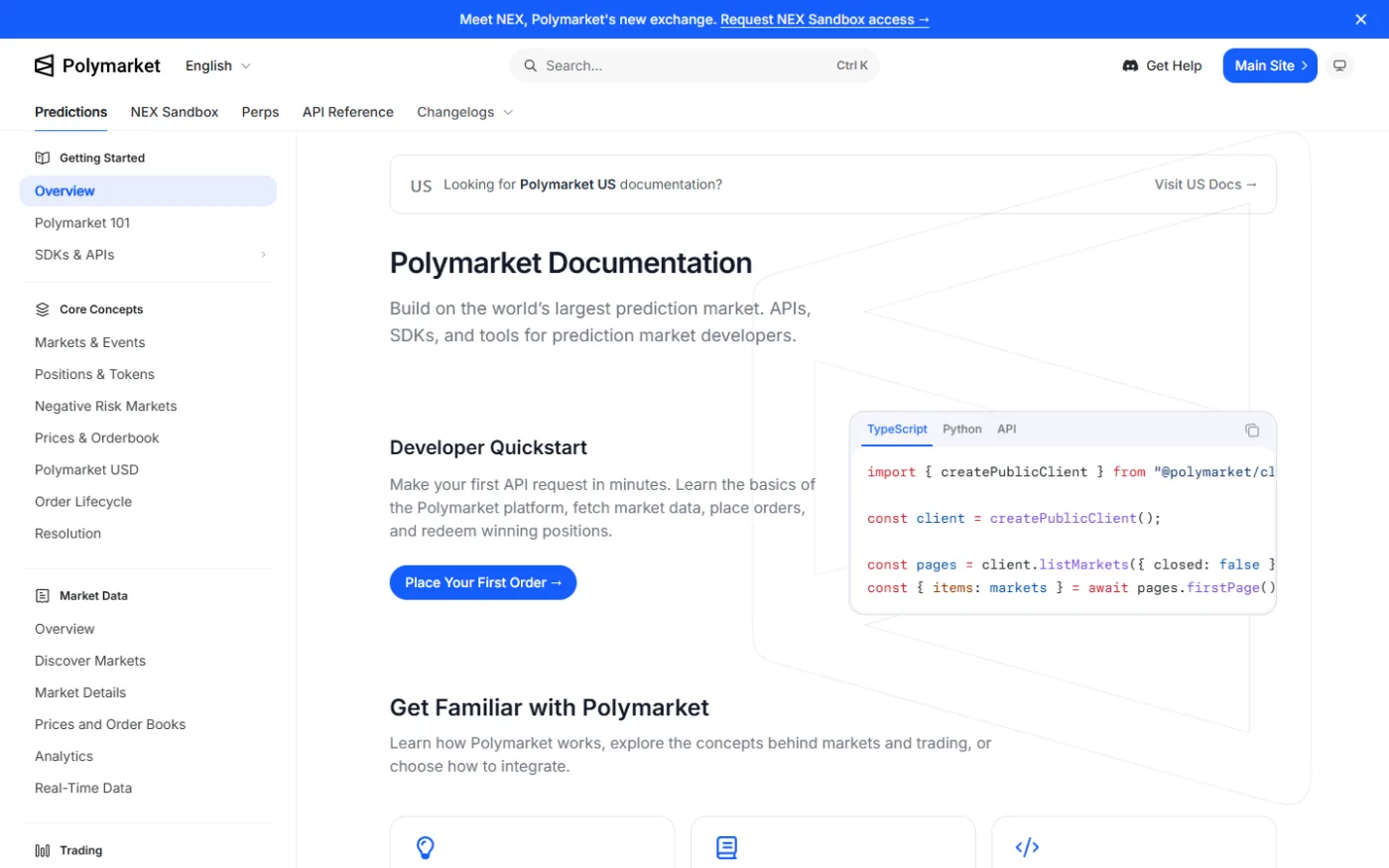
Developers and analysts may access public market data through the Gamma API. According to the documentation page on fetching markets, the base URL is gamma-api.polymarket.com, and the authentication is not required as the data is public.
-
Events: fetch one event by id or slug, or list and filter events using the keyset endpoint.
-
Markets: fetch one market by id or slug, or list markets using the keyset endpoint.
-
Other resources include series, sports metadata, teams, tags and public search endpoint.
-
List endpoints use cursor-based pagination where each response provides a next cursor value that should be included in the next request.
-
A closed filter selects open or closed items, and the default differs between the events and markets endpoints.
Requesting 20 open events uses the events keyset endpoint with closed filter set to false and limit to 20. The documentation page notes that requesting open and closed items needs at least one identifier filter, or else the API returns an error. This page deals only with market data. Order placement is done using separate authenticated trading endpoints that were not read in this research.
What to check before using Polymarket
-
Live fee schedule for the category and for the global or US platform.
-
The resolution rules written on the particular market including the data source and the cut-off time.
-
The collateral token and the withdrawal route, with a small test transaction first.
-
Whether access is lawful for the user's location and which app applies.
-
The amount that may be lost since a position may turn out to be worth nothing.
Polymarket's prices are the result of traders' bets and carry no guarantee of accuracy. None of this is financial or legal advice.
Related guides


 Scroll to top