


Gwei to USD: How to Convert Ethereum Gas Fees


Table of contents
- How to Convert Gwei to USD Step by Step
- What Is Gwei?
- Why Ethereum Gas Fees Are Quoted in Gwei
- What Is Gas on Ethereum?
- Gas Price Versus Gas Limit Versus Total Transaction Cost
- Base Fee and Priority Fee
- Why the Same Gwei Amount Can Cost Different USD Amounts Over Time
- Typical Gas Usage for Different Transaction Types
- A Quick Reference for Common Gwei Amounts
- Why Gas Costs Vary by Network Congestion
- Where to Check Current Gwei Prices and ETH's Price
- Related guides

To convert gwei to USD, you need to multiply your amount in gwei by 0.000000001 and get the equivalent in ETH. Next, multiply the result in ETH by the current price of ETH in USD.
Since the price of ETH keeps changing, you need a live price in order to be able to accurately convert your gwei into USD at any particular point in time.
For demonstration purposes only, if the current price of ETH is 3,000 dollars, 1,000,000 gwei is equal to 0.001 ETH, which is worth 3 dollars. Instead of using that illustrative price, using the current price of ETH will give the accurate value in real life.
How to Convert Gwei to USD Step by Step
-
Divide the amount in gwei by 1,000,000,000 (or multiply by 0.000000001).
-
Get the current ETH/USD price from a live source.
-
Multiply the result from the first step by the current price of ETH in USD.
In the case where the current price of ETH is 3,000 dollars, 500,000 gwei equals 0.0005 ETH, which means it is worth 1.50 dollars. However, depending on what the price of ETH is at the time of the transaction, the above 500,000 gwei could be worth something else. For this reason, the current price of ETH needs to be used in the above conversion to get the accurate value in real life, instead of using a previous price.
What Is Gwei?
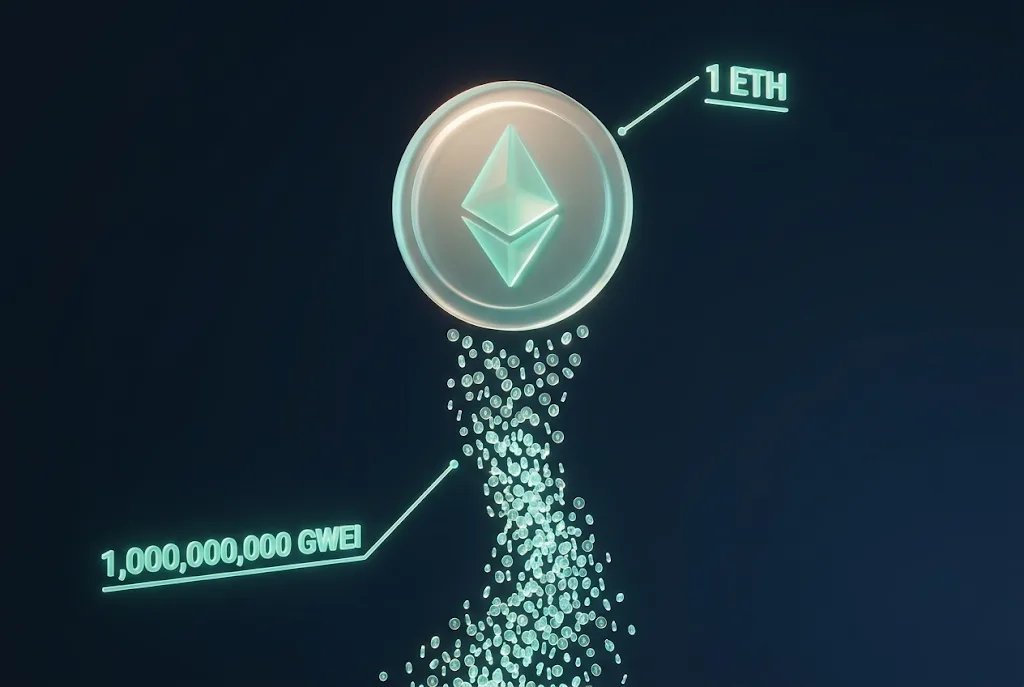
Gwei is a denomination of ETH, Ethereum's native cryptocurrency, similar to how a cent is a denomination of a dollar, except the ratio is far larger. One ETH equals one billion gwei, meaning one gwei equals 0.000000001 ETH.
Ethereum uses gwei specifically for quoting gas fees, the cost paid to have a transaction processed on the network. Expressing this cost directly in ETH would require writing out many leading zeros for every transaction, which is impractical for everyday use, so gwei exists as a more convenient unit for numbers that would otherwise be extremely small fractions of ETH.
Why Ethereum Gas Fees Are Quoted in Gwei
A regular gas fee on Ethereum would amount to something like 0.00063 ETH. Written in gwei, that same amount is a much more readable 630,000 gwei, which is easier for both humans and software interfaces to display and compare without losing precision to rounding. This is similar to why prices for very cheap items are not typically expressed as a fraction of a much larger currency unit. Gwei simply provides a scale that matches the actual size of the numbers involved in Ethereum's fee structure, making wallets, block explorers, and gas trackers easier to read at a glance.
What Is Gas on Ethereum?
Gas refers to the amount of computing work required to process transactions or execute smart contracts in the Ethereum network. A simple transfer of ETH from one address to another requires a fixed, relatively small amount of gas, while a complex smart contract interaction, such as a token swap on a decentralized exchange, requires substantially more, since it involves more computational steps for the network to process.
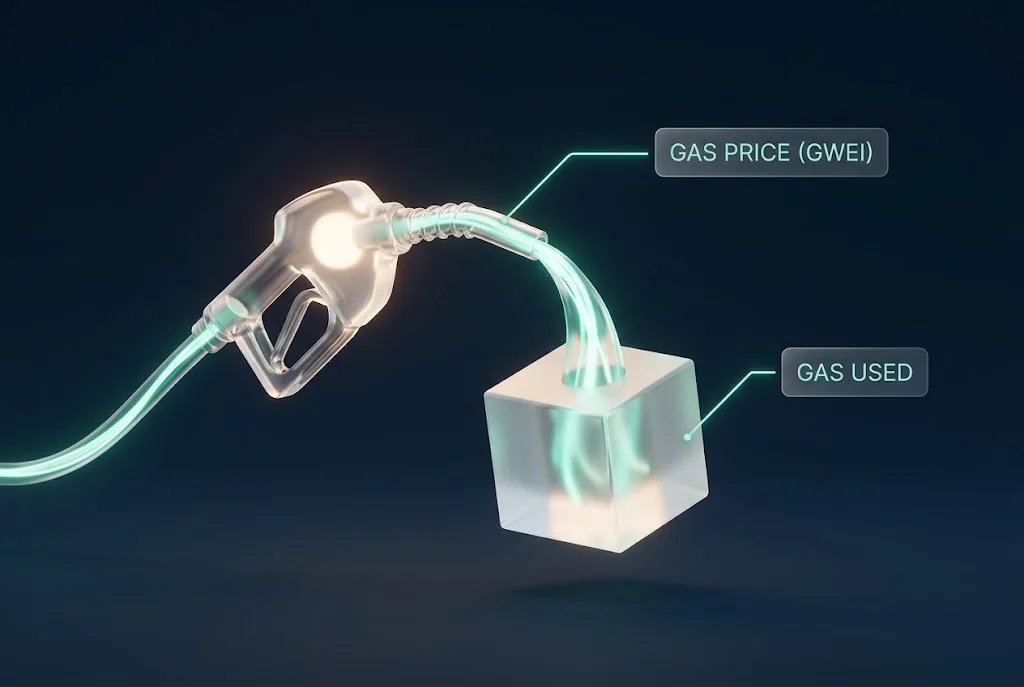
The total cost of a transaction on Ethereum depends on the amount of gas consumed by the transaction, and also the price of each unit of gas consumed. Gas price is expressed in gwei.
Gas Price Versus Gas Limit Versus Total Transaction Cost
There are three variables that determine the cost of a transaction on Ethereum. Gas price is the amount, in gwei, someone is willing to pay for each unit of gas their transaction consumes. Gas limit is the maximum amount of gas a transaction is allowed to use, set to protect the sender from a transaction that behaves unexpectedly and consumes far more computation than intended.
The actual total cost is calculated by multiplying the gas price by the amount of gas the transaction actually uses, which is often lower than the gas limit set for that transaction. Any unused gas within the limit is not charged, though setting the limit too low risks the transaction failing partway through if it needs more gas than allowed to complete.
Base Fee and Priority Fee
Since an upgrade called EIP-1559, Ethereum's gas price has been split into two components. The base fee is the network-controlled price of gas that goes up during times of high congestion and goes down during times of low congestion. The base fee of each transaction gets burned (i.e. permanently removed from circulation).
The priority fee, sometimes called a tip, is an additional amount the sender offers on top of the base fee to encourage validators to include the transaction sooner rather than later. During periods of high network demand, raising the priority fee is the main lever available to get a transaction processed faster, while the base fee itself is not something an individual transaction can negotiate.
Wallets estimate the suggested gas price by calculating the sum of the base fee and the recommended priority fee, although users are free to modify the estimation before sending the transaction.

Why the Same Gwei Amount Can Cost Different USD Amounts Over Time
Since the conversion of gwei to USD depends on the current ETH price, the same transaction fee (in terms of gwei) may cost totally different USD amounts depending on when the transaction is made. A transaction costing 500,000 gwei is worth more in dollar terms when ETH's price is higher and less when ETH's price is lower, even though the gwei figure itself has not changed at all.
This is worth keeping in mind when comparing historical gas cost figures from articles, forum posts, or old screenshots, since a gwei amount alone does not tell the full story without also knowing what ETH was worth in USD at that specific moment.
Typical Gas Usage for Different Transaction Types
Gas amount depends on what a transaction does.
| Transaction | Typical gas used | Why |
|---|---|---|
| Simple ETH transfer | 21,000 | The protocol's baseline for the most basic transaction |
| ERC-20 token transfer, such as a stablecoin | About 45,000 to 65,000 | Runs part of the token's smart contract |
| Token swap on a decentralized exchange | Often well over 100,000 | Several contract calls and calculations |
| NFT mint or a complex dApp action | More still | Depends on the on-chain computation and storage involved |
Using an illustrative ETH price of 3,000 dollars, here is what a standard 21,000-gas transfer costs at different gas prices; both the gas price and the ETH price shape the final dollar cost.
| Gas price | Fee in ETH | Fee in USD at $3,000 per ETH |
|---|---|---|
| 10 gwei | 0.00021 ETH | About $0.63 |
| 30 gwei | 0.00063 ETH | About $1.89 |
| 100 gwei | 0.0021 ETH | About $6.30 |

A Quick Reference for Common Gwei Amounts
When you see several gwei amounts converted side-by-side using the same illustrative ETH price, it will make the scale clearer.
| Gwei | ETH | USD at an illustrative $3,000 per ETH |
|---|---|---|
| 1 | 0.000000001 | About $0.000003 |
| 1,000 | 0.000001 | About $0.003 |
| 1,000,000 | 0.001 | About $3 |
| 1,000,000,000 | 1 | $3,000 |
These figures scale linearly with both the gwei amount and the ETH price, so doubling either one doubles the resulting dollar figure, which makes it straightforward to adjust the math for whatever current ETH price applies at the time.
Why Gas Costs Vary by Network Congestion
Ethereum's base fee rises and falls based on how much demand there is for block space relative to the network's target capacity. During periods of high activity, such as a popular NFT mint or a period of significant market volatility driving heavy trading activity, the base fee can climb substantially within a short period, making every transaction more expensive in both gwei and USD terms regardless of the transaction's own complexity. During quieter periods, the base fee tends to settle much lower, reducing the cost of the same transaction considerably.
This is why the gwei amount alone is not a fixed, predictable number even for the exact same type of transaction performed at two different times.
Where to Check Current Gwei Prices and ETH's Price
You can find the current gas price on most Ethereum block explorers or gas tracking tools, which typically show the current level of base fees and suggest priority fees for different confirmation times. Ethereum wallets also generally display an estimated gas price and total fee before confirming any transaction.
ETH's current USD price is available on any major exchange or market data aggregator, and combining that live price with a current gas price reading is the only reliable way to estimate what a transaction will actually cost in dollar terms at the moment it is sent.
Related guides


 Scroll to top