


Bitget Wallet and Exchange: Fees, Safety, and Legality


Table of contents
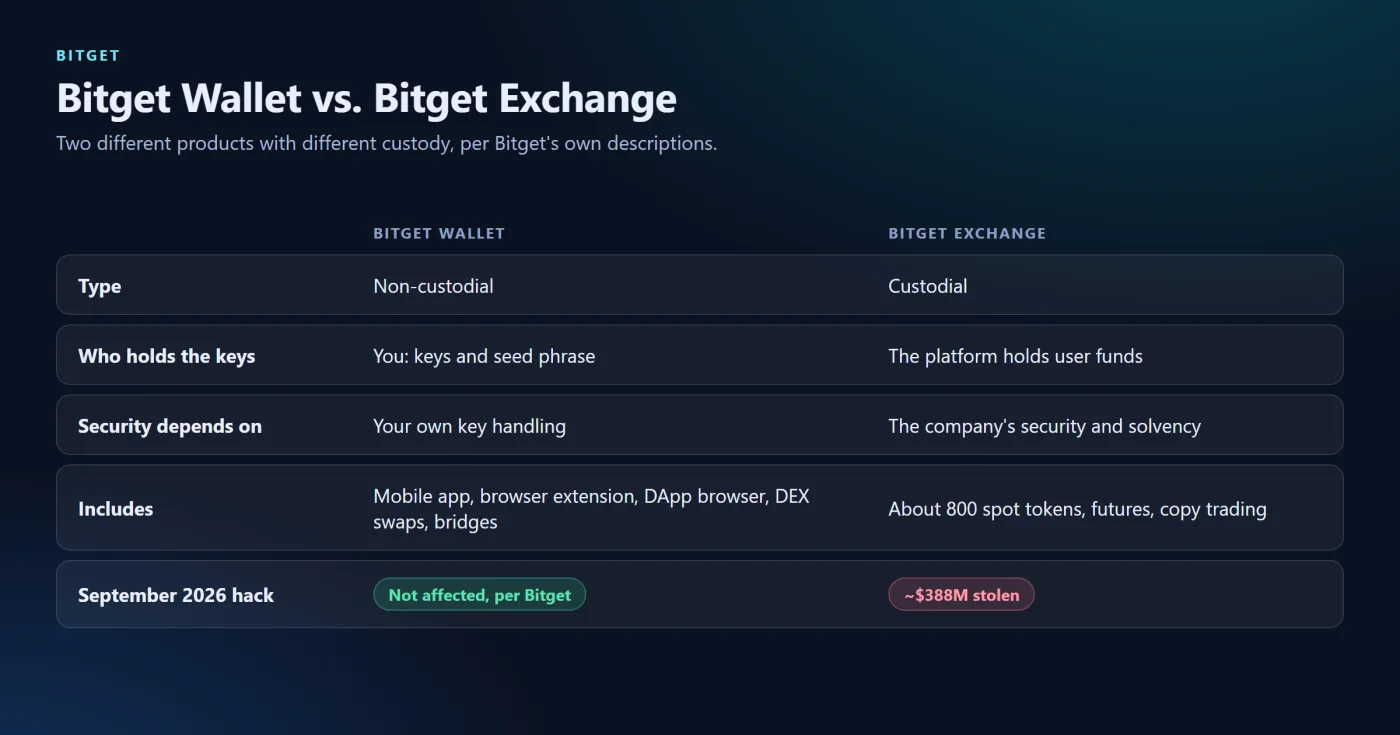
The Bitget Wallet and the Bitget exchange are two different products. The former is described by Bitget as non-custodial (where the user holds the keys), while the latter is custodial (holds user funds) and in September 2026 suffered a theft of roughly $388 million in a hack. In the aftermath, Bitget claims the Bitget Wallet has not been affected, the users' balances have remained intact, and the Protection Fund covers the loss. These are Bitget's statements, while the Bitget exchange is unavailable to the residents of the United States as of a February 2025 Benzinga review.
This article describes how the two products differ, mentions the standard fee rates, discusses the September 2026 event and provides a checklist on safety, legality and referral codes. The article is not a review and does not give a rating. Figures below are snapshots and should be verified live.
Bitget Wallet and the Bitget Exchange
The Bitget Wallet is described by Bitget as a non-custodial wallet, where the user keeps ownership of private keys and the seed phrase. It includes a mobile app for iOS and Android, browser extension, DApp browser, integrated DEXs and cross-chain bridges for swaps and support for over 130 blockchains. These are claims from Bitget's marketing page, which has not been independently verified. The page instructs the user to write the recovery phrase on paper, keep it offline and never share it.
In contrast to the wallet, the Bitget exchange holds the funds of the users on the platform. Therefore, its security is determined by the security of the company and its ability to stay solvent, while a self-custody wallet depends on the user's own key handling. A Benzinga review dated February 17, 2025 describes the Seychelles-based exchange offering about 800 spot tokens, futures and copy trading with two-factor authentication, monthly proof-of-reserves reports and Protection Fund.
Bitget Fees
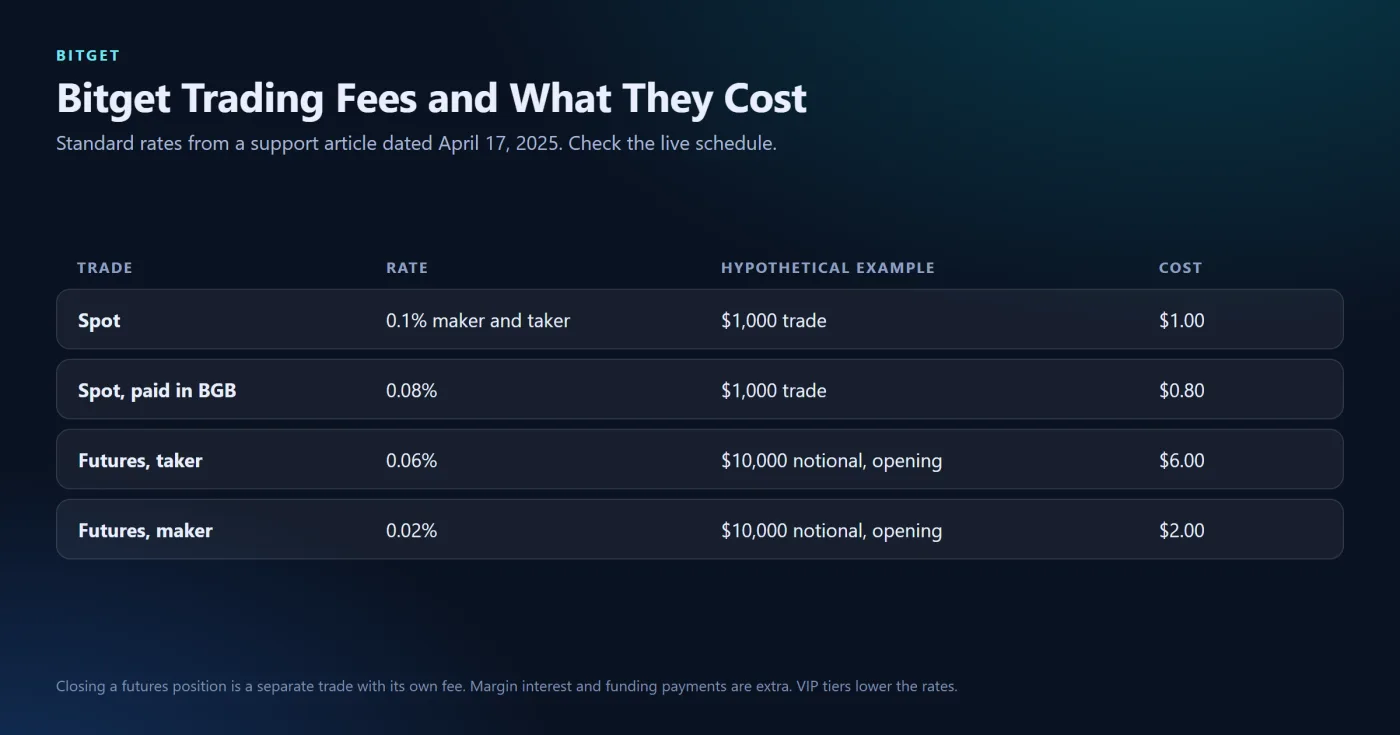
A support article dated April 17, 2025 describes spot maker and taker fees of 0.1% each and falling to 0.08% if paid in the BGB token. Also, futures maker and taker fees of 0.02% and 0.06% respectively are offered, with various discounts available depending on the BGB balance or trading volume. VIP tiers lower fees further, but their thresholds are not stated in the article. Withdrawal fees vary depending on the coin and the blockchain and are listed on the withdrawal page. The article calls itself time-sensitive, so the current schedule should be checked before trading.
A Hypothetical Fee Calculation
This calculation uses the rates listed and is not a prediction. A $1,000 spot trade at 0.1% costs $1.00, or $0.80 at 0.08%. Futures position with notional value of $10,000 opens with 0.06% taker fee for $6.00 or 0.02% maker fee for $2.00. Closing of a position is a separate trade with its own fee, and the margin interest or funding payments are additional costs not listed in the article.
Bitget Wallet swaps use integrated DEXs and bridges, and no wallet swap fee figure was found in the sources read.
The September 2026 Exploit
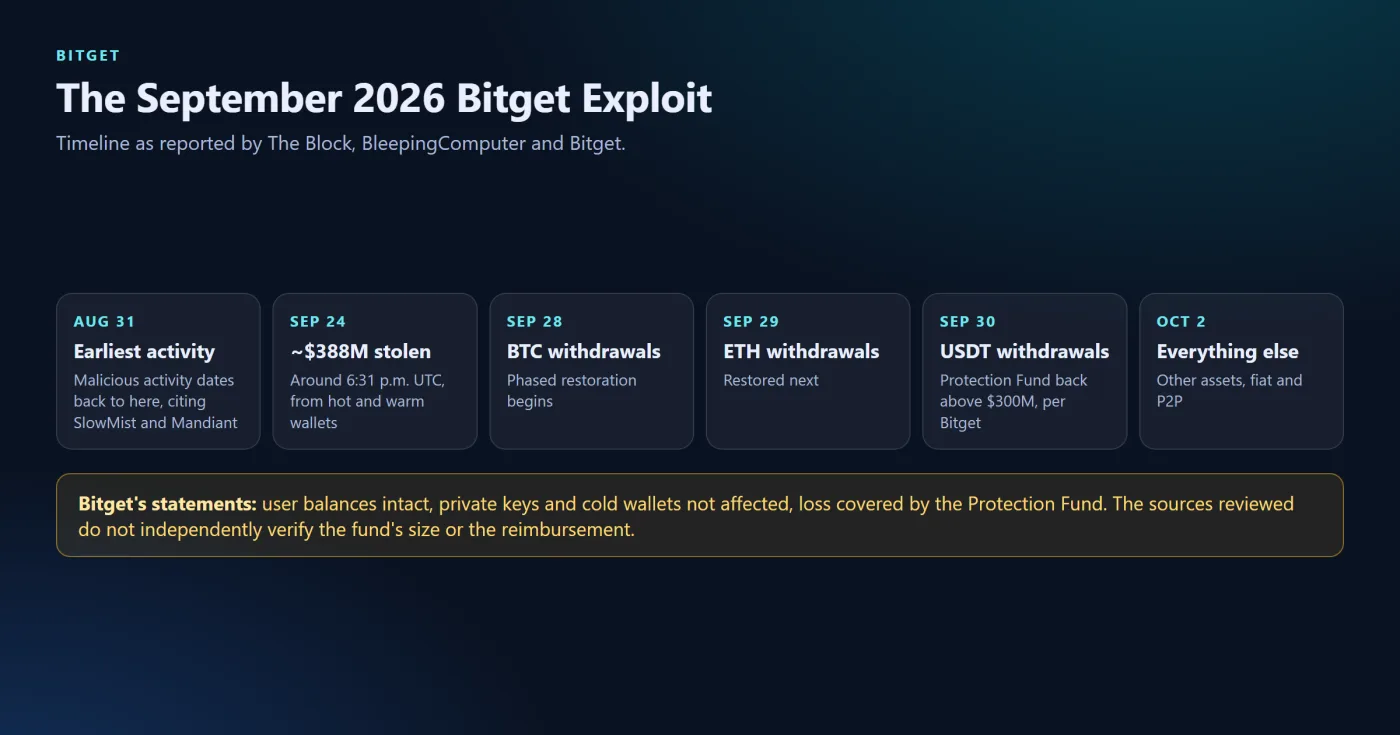
According to The Block, the event happened around 6:31 p.m. UTC on September 24, 2026, and the Bitget loss is estimated at $388 million. Bitget states that the attacker exploited a vulnerability in a third-party security product and used it to gain access to high-level internal credentials and then issued fraudulent withdrawal instructions, which bypassed risk controls. According to Bitget, private keys and cold wallets have not been affected. According to BleepingComputer, citing SlowMist and Mandiant, attackers stole $387.5 million from hot and warm wallets and executed zero-day exploits against two security appliances, and the earliest malicious activity dates back to August 31.
Withdrawals and Coverage
According to Bitget, withdrawals were restored in phases: Bitcoin on September 28, Ethereum on September 29, USDT on September 30 and other assets, fiat and P2P services on October 2. Bitget claims that the loss is covered by the Protection Fund, which has been replenished to above $300 million on September 30, and currently stands at 3,705 BTC, according to the latest update. An earlier sponsored press release had put the fund's August average at $382 million, backed by 5,500 BTC. These are Bitget's statements, and the sources reviewed do not independently verify the fund's size and the reimbursement process.
Attribution and Wallet Impact
The Bitget CEO attributed the attack to the North Korean hackers, according to BleepingComputer, although it could not confirm that independently, and Forklog does not name any group. Bitget claims that Bitget Wallet runs on the separate infrastructure and has not been affected in the incident, according to its own Academy article from October 20, 2026.
Is Bitget Safe or Legit?
There is no independent verdict from the sources reviewed, and the answer depends on the question. The Bitget exchange publishes monthly proof-of-reserves reports with a Merkle-tree check; its August 2026 report states a 122% reserve ratio, but it is a sponsored release and does not mention any independent auditor. In the same release, Bitget states that the ratio above 100% should not be considered a financial audit or a guarantee of solvency. A large hack event, even though it is covered by the company, shows that custodial platforms carry operational risk. A Benzinga review reports no incidents as of February 2025, which the September 2026 event has overtaken.
Is Bitget Legal in the US?
According to Benzinga, the US residents (including those of Puerto Rico, the US Virgin Islands, American Samoa and Guam) cannot sign up to the exchange, along with Canada, the Netherlands and several other countries. According to Finance Magnates, in December 2024, Bitget was licensed in Poland, Italy and Australia, but the regulators are not named and plans to establish a Lithuania hub for MiCA were announced. The license status can change, therefore the registers of regulators and Bitget's country list should be checked and using a VPN to circumvent restrictions may violate the platform's terms of use.
Referral Codes
Referral codes are affiliate offers promising fee rebates or bonuses. This article does not list any referral code. The codes found in search results were mentioned in affiliate blogs, and referral terms of Bitget have not been found. Any rebate or bonus should be verified in the official app, where the terms are stated, and the referral code should not be a reason to choose a platform.
What to Check Live Before Using Bitget
-
The current fee schedule and any conditions for BGB token.
-
The availability of the service in the reader's country.
-
The current status of withdrawals, the latest security report and the status of the Protection Fund.
-
The latest proof-of-reserves report and who verified it.
-
For Bitget Wallet, the official download source and keeping the recovery phrase offline.
Two safety habits apply to both products: never enter a recovery phrase on any website or send it to support, and use two-factor authentication on any exchange account. User interfaces were not tested for this article.
This article is educational and is not investment advice. Trading and futures involve risk of loss, and each reader should verify all the information live.
Related guides


 Scroll to top