


Leverage Trading Crypto: How It Works and the Risks


Table of contents
- Leverage Trading Basics
- Margin, Initial Margin, and Maintenance Margin
- Liquidation: What Happens When a Leveraged Position Fails
- Perpetual Futures: The Most Common Leveraged Crypto Product
- Isolated Margin Versus Cross Margin
- Why 1000x Leverage Is Extremely Risky
- Common Leverage Ratios and What They Actually Mean
- Leverage Trading Bitcoin and Other Major Cryptocurrencies
- Is Leverage Trading Crypto Legal in the United States?
- How to Evaluate a Leverage Trading Platform
- Risk Management for Leveraged Positions
- Related guides
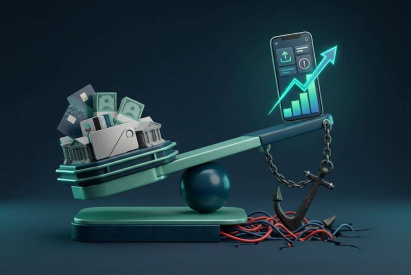
Leverage trading in crypto is when you borrow funds from an exchange to open a position larger than your own capital. It amplifies both potential gains and potential losses in a leverage trading transaction. For example, a trader who deposited 100 dollars as margin and opened a 10x leveraged position now controls 1,000 dollars' worth of Bitcoin, or any other cryptocurrency, so a small price move produces a much larger change in the trader's account balance than trading with the same 100 dollars directly.
That multiplying effect cuts both ways equally, and it is the single most important thing to understand before opening any leveraged position. A price move that would be a minor fluctuation in spot trading can wipe out an entire leveraged position, and in some cases more than the position itself, well before the underlying asset has moved by much at all.
Leverage Trading Basics
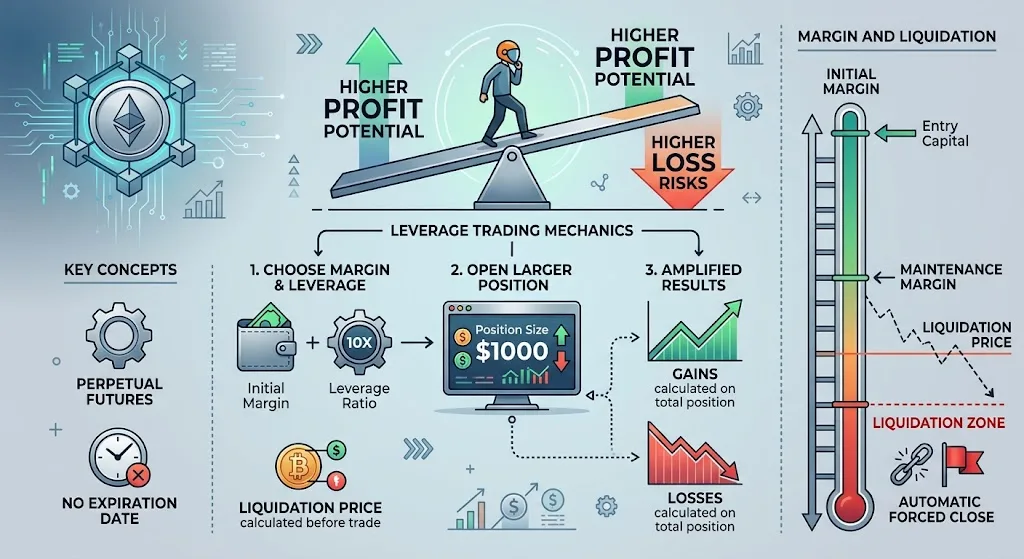
In a leveraged trade there are three connected values: the trader's own capital, called margin, the size of the position being controlled, and the leverage ratio connecting the two. A 20x leverage ratio means the position size is 20 times the margin posted. For example, in a 20x leverage trade the trader risks 50 dollars of his own money to open a 1,000-dollar position.
The exchange lends him the difference between the position size and the posted margin, using the latter as collateral for this loan. If the position moves in the trader's favor, the profit is calculated on the full position size, not just the margin, which is what makes leverage attractive. If the position moves against the trader, losses are also calculated on the full position size, which is what makes leverage dangerous.
Margin, Initial Margin, and Maintenance Margin
Initial margin is the amount of capital required to open a leveraged position in the first place, directly determined by the leverage ratio chosen. Maintenance margin is a separate, usually smaller threshold: the minimum amount of equity that must remain in the position for the exchange to keep it open.
As a losing position's value declines, the trader's remaining equity in that position shrinks toward the maintenance margin level. Once equity falls to or below that threshold, the exchange automatically closes the position through liquidation, regardless of whether the trader wants to hold on longer in hopes of a recovery.
Liquidation: What Happens When a Leveraged Position Fails
Liquidation is the forced closing of a leveraged position by the exchange once losses consume the available margin down to the maintenance threshold. Each leveraged trade has a certain liquidation price that is calculated according to the trade entry price, the leverage ratio and the margin posted. The liquidation price is usually shown by the exchange before entering a trade.
When the market price reaches the liquidation price, the position is closed automatically and the margin posted to the position is lost. Some exchanges also charge a liquidation fee on top of the lost margin, and sometimes, because of fast moving markets, the actual execution price during liquidation can be worse than the calculated liquidation price, occasionally resulting in a loss slightly larger than the original margin.
Perpetual Futures: The Most Common Leveraged Crypto Product
Most leveraged crypto trading happens through a product called perpetual futures, often shortened to perps. Unlike a traditional futures contract, a perpetual futures contract has no expiration date, letting a trader hold a leveraged position indefinitely as long as it avoids liquidation and the trader continues meeting margin requirements.
Funding Rates Explained
The fact that perpetual futures have no expiry date means that the exchange needs a special mechanism to keep the price of the contract as close to the price of the underlying asset as possible. If the price of the perpetual futures contract is higher than the spot price, then traders holding long positions will pay a funding fee to traders who hold short positions and vice versa.
This ongoing payment, typically exchanged every few hours, is a cost that leveraged traders need to account for separately from the exchange's stated trading fees, especially when holding a position open for an extended period.
Isolated Margin Versus Cross Margin
There are two different methods that exchanges use to distribute the margin posted across the positions. Isolated margin limits a specific position's risk to only the margin assigned to that position. It means that the liquidation of one position will not harm any other funds posted to other positions. However, with the cross margin method, the margin of the entire account is distributed across all positions, which can save the trader from early liquidation of his positions but increases the overall risk for the whole account.
The choice depends on how much of an account a trader is willing to risk on any individual position.
Why 1000x Leverage Is Extremely Risky
Some offshore platforms advertise leverage as high as 1000x, and the math behind that number is worth working through directly. With 1,000x leverage the position is 1,000 times bigger than the margin posted, which means a price move of roughly 0.1 percent against the position is enough to trigger liquidation, before accounting for trading fees or funding payments that make the real liquidation threshold even tighter.
A 0.1 percent price move in Bitcoin or another actively traded cryptocurrency can happen within seconds under completely normal market conditions, not because of any major news event. At that level of leverage, a position is functionally closer to a coin flip decided by routine market noise, and the overwhelming majority of positions opened at that extreme end in liquidation.
Common Leverage Ratios and What They Actually Mean
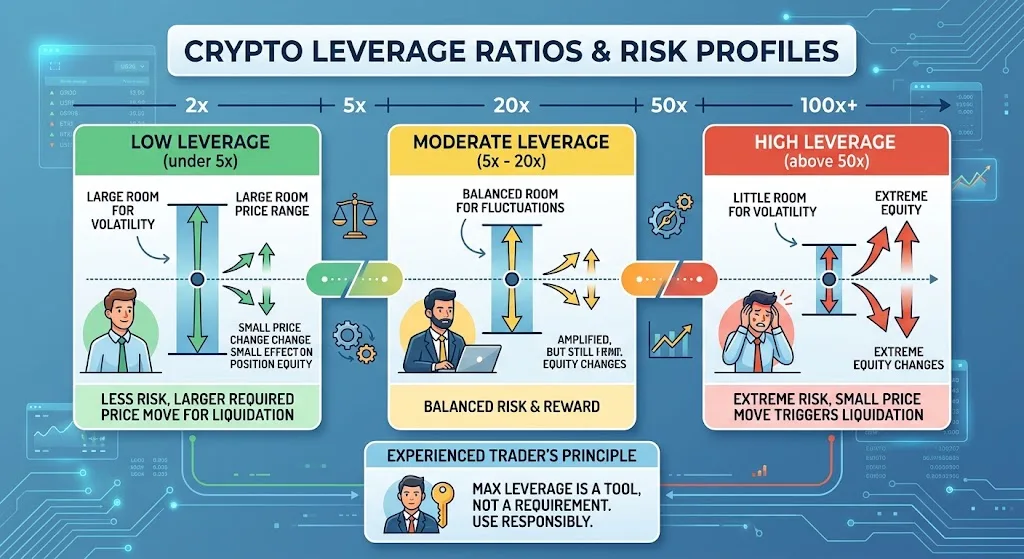
Leverage ratios commonly offered on major platforms range from 2x up to 100x or more, and the practical risk profile changes dramatically across that range.
-
Low leverage, generally under 5x, requires a larger price move against the position before liquidation, giving a trade more room to work through normal volatility.
-
Moderate leverage, about 5x to 20x, is popular among traders who want to leverage their positions but also want to give themselves some room for the price fluctuations.
-
High leverage, above 50x, leaves very little room for normal price fluctuation and is generally associated with short-term, fast-moving trades rather than positions meant to be held for any extended period.
High advertised leverage does not mean that the trader is obliged to use it and many experienced traders rarely use anything more than a small portion of the maximum leverage on the platform.
Leverage Trading Bitcoin and Other Major Cryptocurrencies
Bitcoin and Ethereum account for the large majority of leveraged trading volume across crypto markets. It happens because these two coins are the most liquid and have the most active perpetual futures markets. Deeper liquidity generally means tighter spreads and more predictable execution during liquidation, which matters directly to how much slippage a trader experiences when a position closes.
Leveraged trading is also available on many smaller, less liquid cryptocurrencies, but thinner order books on those assets make sudden, sharp price moves more common, which increases the practical risk of liquidation even at moderate leverage ratios compared with trading Bitcoin or Ethereum.
Is Leverage Trading Crypto Legal in the United States?
For most of the past several years, leveraged and margined spot crypto trading has been largely unavailable to retail traders in the United States through domestic exchanges. This traces back to a Commodity Exchange Act requirement that leveraged retail commodity transactions result in actual delivery of the underlying asset within 28 days to qualify for an exception. Major exchanges including Kraken faced enforcement action over this issue and subsequently suspended margin trading for US customers.
This landscape has shifted substantially. Regulators have moved toward allowing leveraged crypto products through Designated Contract Markets, or DCMs, which are exchanges directly registered with and regulated by the CFTC. As of the current regulatory environment, at least one CFTC-approved platform has launched cash-settled Bitcoin perpetual futures available to US retail traders, and several other exchanges are pursuing similar registration to offer their own regulated leveraged products domestically.
Because this framework is still actively developing, offshore exchanges offering very high leverage generally continue to restrict or block access from US-based traders, since operating without the appropriate US registration carries legal risk for the platform itself. US-based traders interested in leveraged crypto exposure should confirm that any platform is properly registered with the CFTC or another applicable US regulator.
How to Evaluate a Leverage Trading Platform
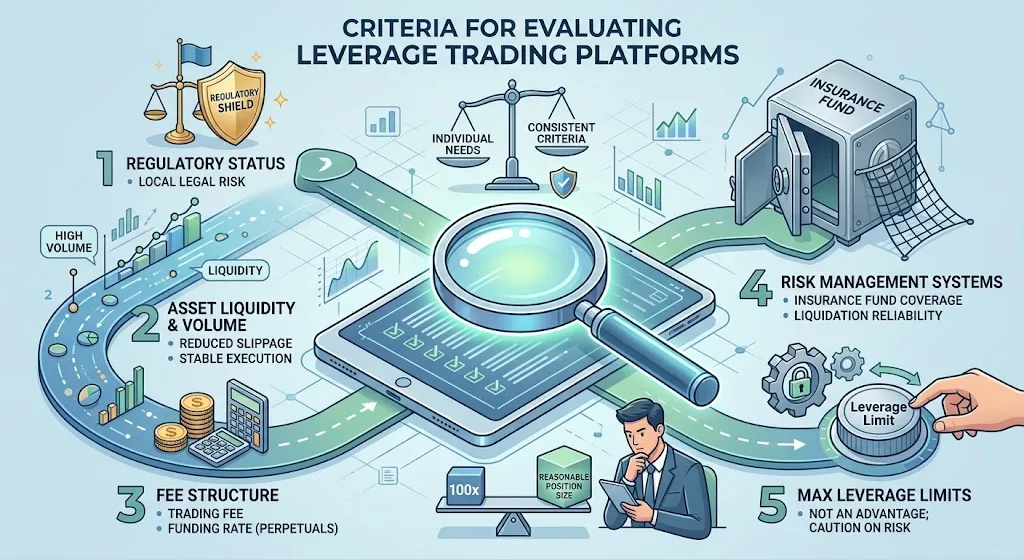
Rather than looking for a single best option, evaluating a leverage trading platform against a consistent set of criteria produces a more reliable answer for any individual trader's situation.
-
Regulatory status matters most for traders in jurisdictions like the United States, where using an unregistered offshore platform can carry legal risk in addition to the trading risk itself.
-
Liquidity and trading volume on the specific asset being traded affect how much slippage occurs during entry, exit, and liquidation.
-
The fee structure, which includes the trading fee and the funding rate for perpetual futures, has a real cumulative cost for positions held open over time.
-
Insurance funds and risk-management systems, which some exchanges maintain to cover extreme liquidation scenarios, can affect how reliably a stated liquidation price actually holds during a fast-moving market.
-
Available leverage limits alone are not a meaningful advantage, since a platform allowing extremely high leverage is not inherently better and can encourage riskier position sizing than a trader intended.
Risk Management for Leveraged Positions
Since leveraged positions can be liquidated quickly, a few practices consistently reduce the chance of an avoidable loss.
-
Calculate the liquidation price before opening a position, rather than after, and confirm it leaves reasonable room for normal price movement given the asset's typical volatility.
-
Use a stop-loss order to close a losing position before it reaches liquidation, which allows exiting on a trader's own terms rather than through a forced, and sometimes less favorable, liquidation execution.
-
Size each position based on a small percentage of total trading capital, so that a single liquidated position does not threaten the account as a whole.
-
Track funding rate costs on perpetual futures positions held over multiple days.
Related guides


 Scroll to top