


BTFD Meaning: What It Stands For in Crypto Trading


Table of contents
- What Does BTFD Stand For?
- How Does BTFD Work?
- Origin of BTFD
- The Idea Behind the BTFD Strategy
- The Risks Involved in BTFD
- BTFD and Contrarian Market Psychology
- Difference Between BTFD and Dollar-Cost Averaging (DCA)
- STFR: The Counterpart of BTFD
- Examples of Using BTFD in Sentences
- When BTFD Tends to Appear Most
- Is BTFD Coin a Real Cryptocurrency?
- Other Crypto Slang Similar to BTFD
- Related guides

BTFD means "Buy The F**king Dip." It is trading slang urging investors to buy an asset after a price drop based on the belief that the decline is temporary and the price will recover. A milder version of the same phrase, BTD, drops the expletive but means exactly the same thing.
The term is regularly used in cryptocurrency circles whenever there is a sudden price drop. Its blunt, meme-like tone is a big part of why it has stuck around across more than one market cycle, usually showing up as a quick, half-joking rallying cry rather than a considered piece of investment advice.
What Does BTFD Stand For?
The BTFD acronym simply asks traders to "buy the dip" with an emphatic expletive in the middle. In the case of "buy the dip," traders are urged to buy assets after a decline in prices in the belief that the decline is a temporary discount rather than a permanent decline in value.
The additional aggressiveness of BTFD compared to the original "buy the dip" is due to the emotional nature of the strategy. Buying during a sharp, scary price drop takes more conviction than buying during calm, steady conditions, and the phrase's aggressive tone is meant to push past the natural fear of watching a portfolio lose value.
How Does BTFD Work?
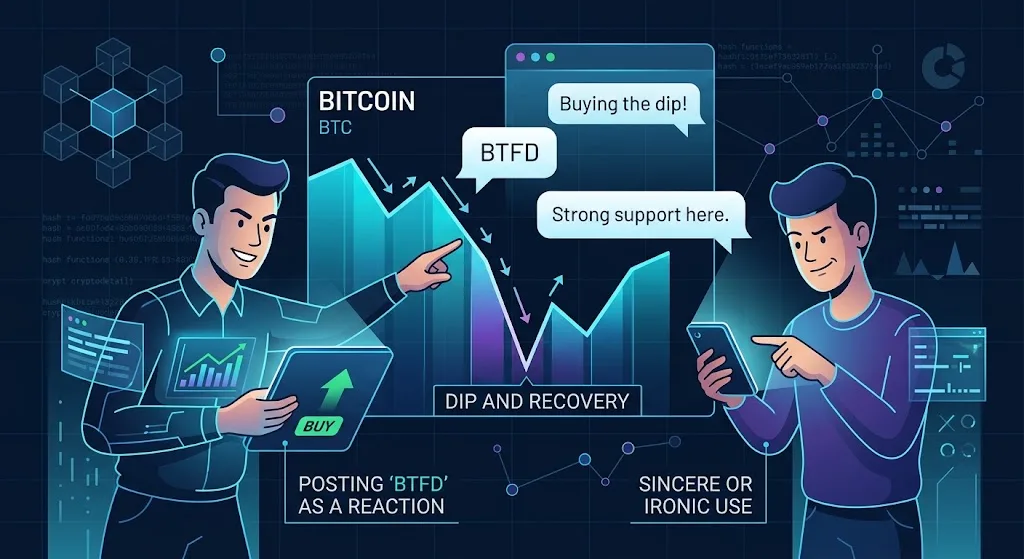
BTFD is usually posted as a comment or reaction whenever there is a sudden price drop, alongside other traders' comments expressing the same conviction. If someone notices Bitcoin or Ethereum price dropping sharply within one day, he or she may post "BTFD" to either announce his or her intention to buy or encourage the community to do the same.
The phrase may be used in a sincere or ironic manner. In the former case, traders believe that buying after the dip will help them earn profits in the future. Ironic or joking use often appears after a string of dips that never recovered, poking fun at the strategy's overconfidence or at a specific person who keeps buying dips that keep getting deeper.
Origin of BTFD
The BTFD acronym existed long before cryptocurrency trading became mainstream. It was first used in other online trading forums back in the 2010s as a way of describing aggressive dip-buying by stock and forex traders. Stock markets were volatile back then, which was a factor in making the acronym popular in Reddit subreddits like WallStreetBets.
Crypto communities adopted BTFD readily once Bitcoin and other cryptocurrencies became more and more volatile, since the phrase's blunt tone matched the emotional intensity of crypto trading culture.
The Idea Behind the BTFD Strategy
The idea of buying the dip is based on the assumption that a sharp price drop in an asset with strong underlying fundamentals or a long-term uptrend is more likely to be a temporary decline rather than the beginning of a permanent downward trend. Thus, a dip becomes a kind of discount on the asset that is expected to grow in the long run.
This idea has real historical examples behind it. Bitcoin has recovered after several severe declines in the past, and some traders that have bought during such a decline were able to earn huge profits once the price started rising again. Sharp crashes tied to a single dramatic event, followed by a broader market recovery over the following months or years, tend to become the reference points people cite when defending BTFD as a strategy, even though they represent a small number of especially favorable cases rather than a guaranteed pattern.
The Risks Involved in BTFD
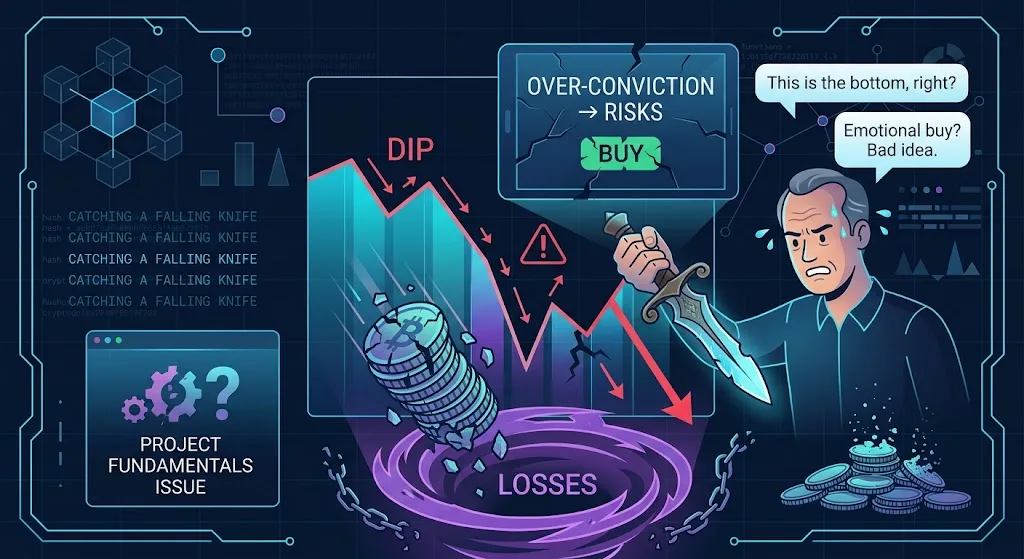
Buying every single dip without any further research may be risky, as not all of them turn out to be temporary. A term traders use for this specific danger is "catching a falling knife," which describes buying into a decline that continues falling well past the point where it looked like a bottom, resulting in a larger loss than if the buyer had waited.
-
A dip caused by a fundamental problem with the project (such as security issues or lack of real usage) may never recover to its initial price.
-
Buying continuously in a downtrend without any strategy may lead to more losses than profits as the trader buys more and more during the declining trend.
-
Emotional conviction, the exact quality BTFD's aggressive tone is designed to inspire, can just as easily lead to poor decisions as good ones if it replaces actual research into why the price dropped in the first place.
BTFD and Contrarian Market Psychology
BTFD is connected to the idea of contrarian behavior in investing that means acting against the mood of the market, which is opposite to most people's actions. While prices are falling, people's fears usually dominate and make them sell the asset. However, contrarian behavior, which BTFD represents, suggests that the moment of maximum fear is actually the best time to buy the asset.
This connects BTFD to one of the key investing principles about being greedy when others are fearful and vice versa. BTFD simply translates this principle into a more casual and crypto-specific phrase.
Difference Between BTFD and Dollar-Cost Averaging (DCA)
BTFD and dollar-cost averaging, often shortened to DCA, both involve buying during a decline, but they differ in discipline and structure. BTFD usually means reacting instantly and emotionally to an unexpected drop in price, while DCA means buying a fixed amount of the asset at regular intervals regardless of the current price and thus smoothing out the average price.
Most traders consider DCA to be a more disciplined and less risky approach because of the absence of emotional decision-making, although BTFD is not necessarily wrong.
STFR: The Counterpart of BTFD
BTFD has a mirror-image counterpart called STFR, short for "Sell The F**king Rip." While BTFD encourages buying during a price decline, STFR is focused on selling during a price rally in the midst of a general downtrend, as a rally is only seen as a temporary relief rather than the beginning of a new trend.
Traders sometimes use both phrases together to describe a specific market phase, showing how trading slang tends to encode entire strategies into short, memorable acronyms rather than longer explanations.
Examples of Using BTFD in Sentences
The examples show how the phrase is used.
-
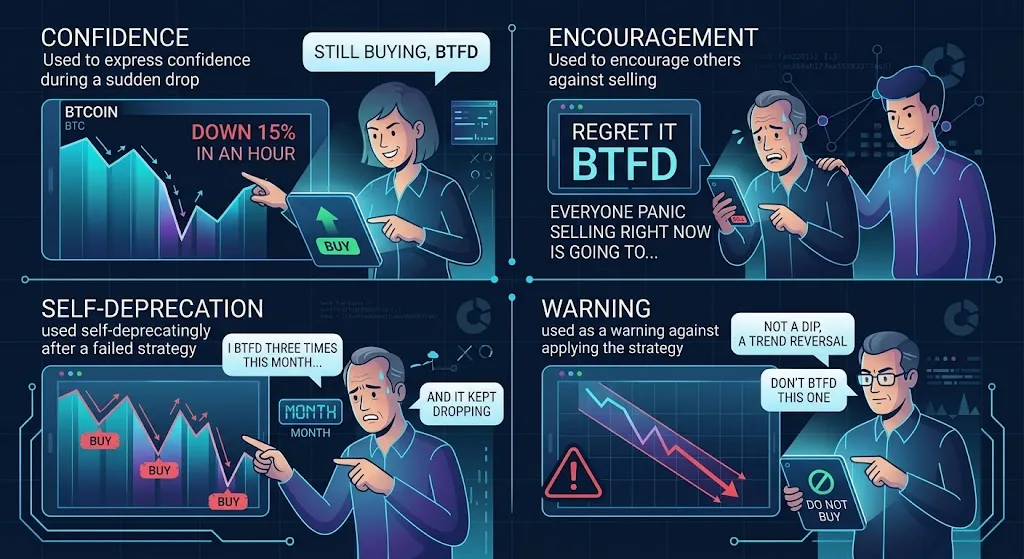
"Down 15% in an hour and I'm still buying, BTFD," used to express confidence during a sudden drop.
-
"Everyone panic selling right now is going to regret it, BTFD," used to encourage others against selling into weakness.
-
"I BTFD three times this month and it kept dropping every time," used self-deprecatingly after a strategy that has not worked out yet.
-
"That's not a dip, that's a trend reversal, don't BTFD this one," used as a warning against applying the strategy in the wrong situation.
The examples show how BTFD is used both as encouragement and, especially after it goes badly, as a joke about a strategy that does not always work.
When BTFD Tends to Appear Most
BTFD tends to appear more often during sudden, sharp price drops rather than gradual ones because of its energetic and instant character that fits crashes better than sliding prices. A single-day drop of ten percent or more in a major cryptocurrency is usually accompanied by BTFD posts all across social media.
BTFD tends to be used less often during bear markets when repeated unsuccessful attempts at dip-buying erode people's confidence. This pattern mirrors how WAGMI and NGMI track market mood: enthusiasm-driven slang clusters around sharp, dramatic moments, while sustained downturns produce more measured, and often more critical, commentary.
Is BTFD Coin a Real Cryptocurrency?
Separate from the slang phrase, BTFD Coin is a meme-based cryptocurrency that takes its name directly from the acronym. Like many meme coins, it is driven primarily by community activity and social media attention rather than any underlying product or technology. It trades mostly on decentralized exchanges.
Anyone encountering BTFD Coin should treat it the same way as any other small, meme-branded token: check actual trading volume and liquidity through an independent market data source, look into who runs the project, and recognize that a catchy name borrowed from popular slang says nothing on its own about a token's long-term value or legitimacy.
Other Crypto Slang Similar to BTFD
BTFD belongs to a whole crypto slang vocabulary.
-
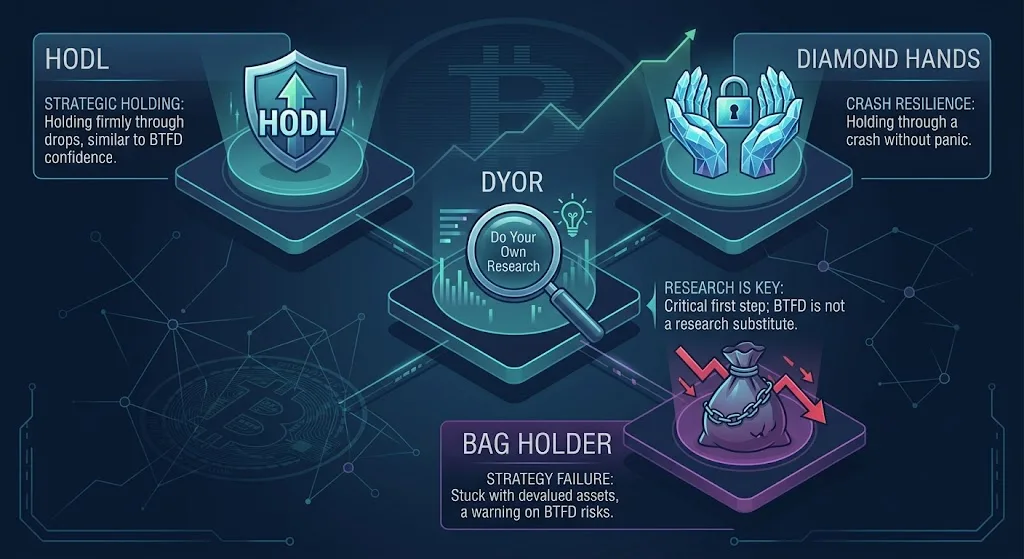
HODL means holding the asset and not selling during the price drops, which is similar to the confidence shown in BTFD.
-
Bag holder is the person who is left with the asset after its price decline and failure to recover, usually used as a warning about BTFD-related risks.
-
Diamond hands describes someone who holds firm through a crash without panic selling, a trait often praised alongside BTFD-style conviction.
-
DYOR means "Do Your Own Research" and is frequently used along with BTFD in order to remind people that BTFD is not a substitute for research.
Related guides


 Scroll to top