


Bitcoin Order Book: How It Works and How to Read It


Table of contents
- How Does an Order Book Work?
- Bids, Asks, and the Spread
- Market and Limit Orders
- Reading Order Book Depth
- How Order Books Set the Price
- Order Books of Centralized Exchanges
- On-Chain Order Books versus Automated Market Makers
- Where to See the Live Bitcoin Order Book
- A Simple Example of an Order Book
- Order Book Manipulation: Spoofing and Wash Trading
- Order Book Imbalance as a Sentiment Signal
- How to Read the Bitcoin Order Book and What to Look For
- Related guides
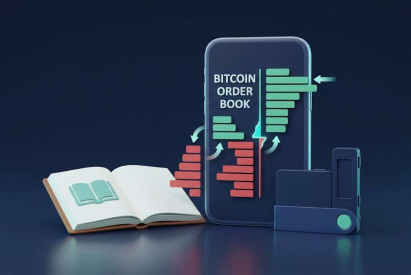
A Bitcoin order book is a live, constantly updating list of buy and sell orders for BTC at specific prices on a given exchange, showing exactly how much someone is willing to buy or sell at each price level. It is the main tool most centralized exchanges, and an increasing number of decentralized ones, use to match trades and determine the current market price.
Each open buy or sell order is in the book until it is matched by an opposite order or canceled by the trader. Understanding the order book properly provides much more information about the market's current state than a price ticker alone.
How Does an Order Book Work?
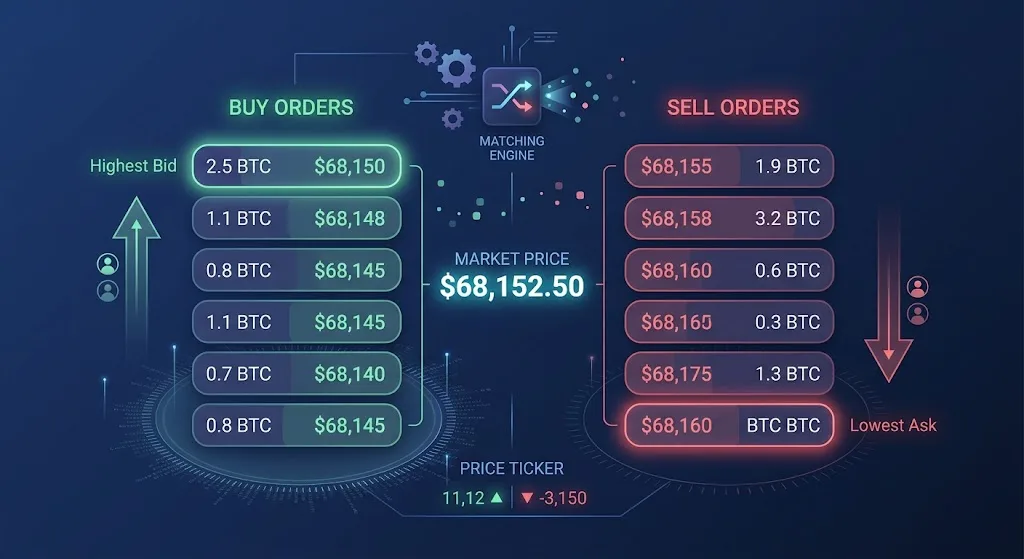
An order book separates all orders for an asset into two groups: buy orders (bids) and sell orders (asks). Bids are arranged from the highest price a buyer is ready to pay to the lowest one, while asks are arranged from the lowest price a seller is willing to accept to the highest one.
If a new order comes to the book and finds a matching opposite order at an acceptable price, the matching engine of the exchange executes the trade and removes the orders from the book. Orders which are not executed right away remain in the order book, providing additional buying or selling interest at particular price levels.
Bids, Asks, and the Spread
The highest bid and the lowest ask present in the book at any particular moment are called the best bid and the best ask. The distance between these two price levels is called the spread. A narrow spread (often only several cents or even less on popular pairs like BTC/USD), usually indicates a highly liquid market with plenty of active buyers and sellers close to the current price.
A wide spread means the opposite – there are fewer orders in the book at particular price levels close to the current price, and therefore entering or exiting the position can be harder and more costly. The spread tends to grow during periods of low activity or sudden changes in the market, when people are reluctant to commit themselves to particular price levels.
Market and Limit Orders
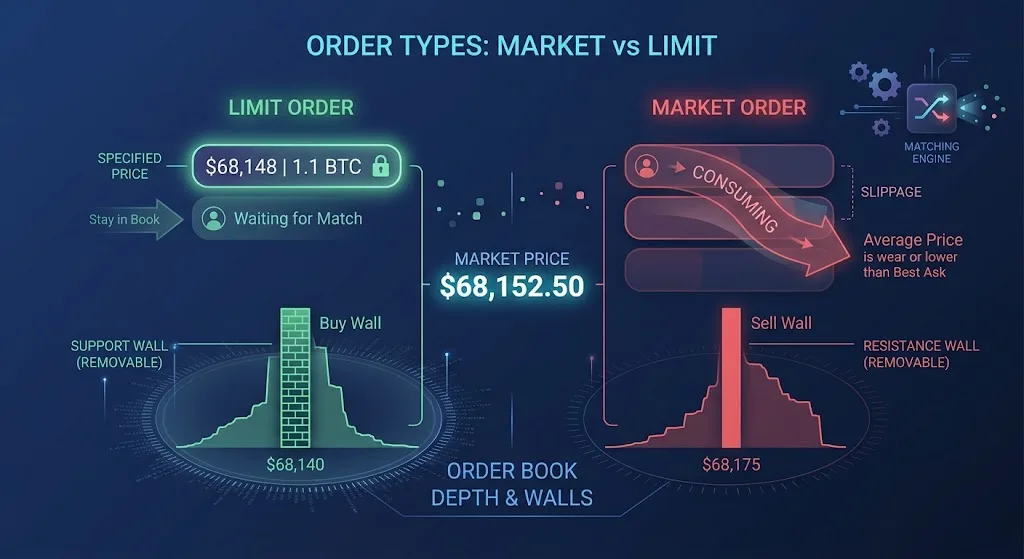
There are two main kinds of orders which behave in an order book differently. A limit order specifies the exact price level, which means it is added to the book and remains there until it finds a matching opposite order or the trader cancels it. A market order, on the other hand, is executed immediately against the orders present in the book at the best available prices.
That is why a market order, which consumes rather than adds liquidity to the book, may pass several price levels of the order book if it is large enough, and result in an average execution price worse than the best bid or ask visible at the moment the order is placed. This phenomenon is called slippage and becomes more pronounced on thinner order books or unusually large orders.
Reading Order Book Depth
Order book depth refers to the total volume of buy and sell orders sitting at each price level, usually displayed as a list or a visual depth chart showing cumulative volume moving away from the current price on both sides. A deep order book means there is a lot of volume in the book close to the current price, which usually indicates that large orders can be executed without too much slippage.
Traders sometimes watch for large clusters of orders sitting at a specific price level, informally called walls, since a large buy wall can act as a point of price support and a large sell wall can act as resistance. However, a wall is not necessarily a permanent feature of the order book because the trader placing a large limit order can cancel it whenever he wants, which is one of the reasons order book depth should be read as a snapshot of current interest rather than a guaranteed floor or ceiling for price.
How Order Books Set the Price
The price displayed on an exchange (and on a price ticker) is the last traded price – the price at which the most recent match between a buyer and a seller took place. Each new trade takes place due to the market order being placed (or the new limit order matching orders already in the book), which means the order book itself is the actual mechanism generating price discovery rather than the ticker reflecting some separate calculation.
That is why order book data provides more information than a simple price chart. The price chart displays the price levels where trades have taken place already, while the order book shows the actual buying and selling interest sitting in the book, ready to be matched, which can give some hints about future price movements, not just the past.
Order Books of Centralized Exchanges
Centralized exchanges operate their order books on private, internal servers, which means trading on such exchanges takes place off-chain, while changes in traders' balances are applied on the exchange's own system. That provides very high speed and low latency of trading because the trades do not need to be confirmed by the blockchain.
The tradeoff is that a centralized exchange's order book depends entirely on that exchange's own infrastructure and custody of user funds, which means the traders have to trust that the exchange maintains order book data correctly and stores balances of its users safely, separately from the trading mechanism itself. Order book data from different centralized exchanges does not get shared, which means that the price of the same asset may differ a little on each exchange at any particular moment.
On-Chain Order Books versus Automated Market Makers
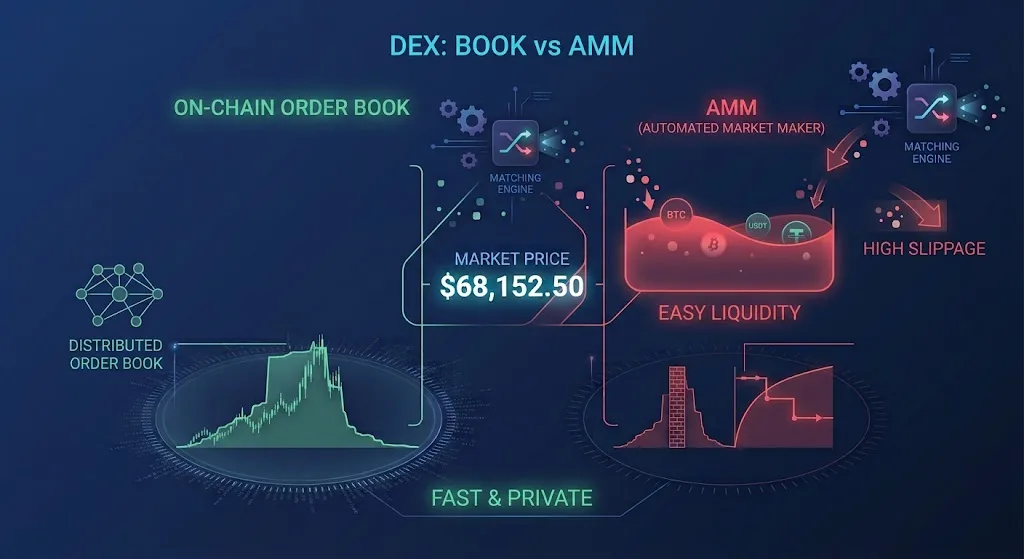
Decentralized exchanges have historically used a different structure called an automated market maker, or AMM, which relies on liquidity pools and a pricing formula rather than a traditional order book matching individual buy and sell orders. Such a model made decentralized trading possible in the first place, but it operates completely differently than order books, because the price changes due to the pool formula when the trades take place rather than due to the matching of orders.
A new generation of decentralized exchanges has created on-chain order books instead, aiming to combine the matching precision of a traditional order book with the self-custody of a decentralized platform. These platforms run their own purpose-built blockchain infrastructure to handle the speed an order book requires, with orders and matching recorded directly on-chain rather than in a pool. Other decentralized order book platforms use a hybrid design, where orders are matched off-chain for speed but settlement still happens on-chain, which introduces a different tradeoff between performance and full transparency compared with a fully on-chain matching engine.
Where to See the Live Bitcoin Order Book
Order book data for Bitcoin is publicly available on the trading interface of essentially every major centralized exchange, usually displayed together with the price chart as a list of bids and asks as well as a depth chart. Most exchanges update this data in real time as new orders arrive and existing ones are matched or canceled.
There are also several independent market data aggregators, which display order book data aggregated from different exchanges. This can be useful for comparing depth and spread across platforms rather than relying on a single exchange's view of the market. Since order books differ from one exchange to another, checking more than one source gives a fuller picture of overall market conditions rather than assuming one platform's book represents the entire market.
A Simple Example of an Order Book
Seeing a simplified version of the numbers makes the concept easier to follow than a definition alone. Imagine a BTC/USD order book showing the following open orders near the current price:
-
Asks (sellers): 500 available at 65,050, then 300 more at 65,060, then 800 more at 65,075.
-
Bids (buyers): 400 available at 65,040, then 600 more at 65,025, then 250 more at 65,010.
In this example, the best ask is 65,050 and the best bid is 65,040, making the spread 10 dollars. A market buy order for 700 units would fill the entire 500 available at 65,050, then continue filling the remaining 200 at 65,060, resulting in an average execution price higher than the best ask alone would suggest.
Order Book Manipulation: Spoofing and Wash Trading
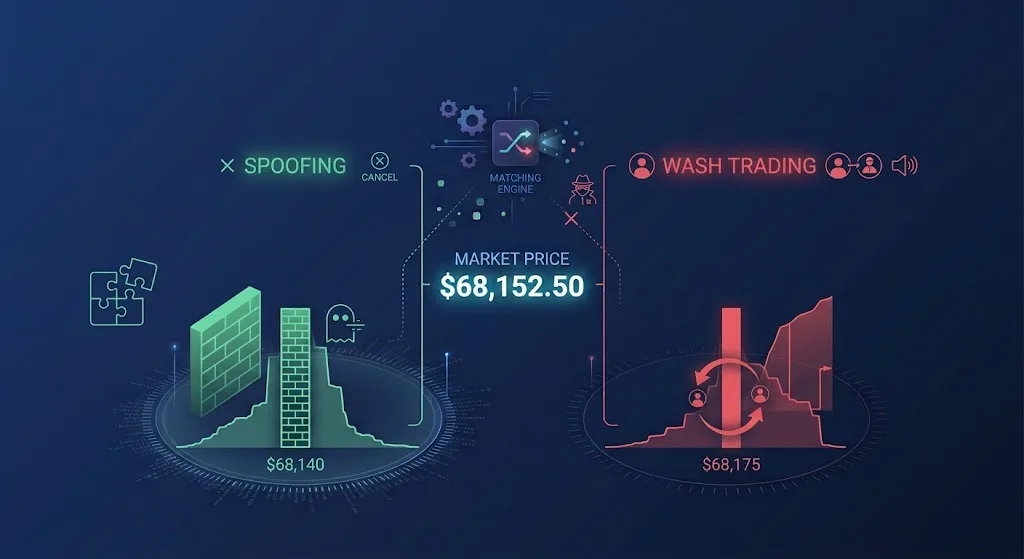
Because order book depth can influence trader psychology, it has also historically been a target for manipulation. Spoofing involves placing a large order with no intention of ever letting it execute, purely to create a false impression of buying or selling pressure, then canceling it once it has influenced other traders' decisions.
Wash trading involves an entity trading with itself, or coordinating with another party, to create the appearance of trading volume and activity that does not reflect genuine independent interest. Both manipulative practices are illegal on regulated exchanges in many jurisdictions, and reputable platforms use surveillance mechanisms to prevent them, but neither is completely eradicated in the crypto market, particularly on smaller and less regulated exchanges.
Order Book Imbalance as a Sentiment Signal
Some traders watch the relative volume sitting on the bid side versus the ask side as a rough gauge of short-term sentiment, often called order book imbalance. The book with considerably larger buy volume in comparison with sell volume at particular price levels close to the current price is sometimes interpreted as the sign of increased buying pressure, while the opposite case suggests decreased buying pressure.
However, this indicator should be treated with caution because large orders can appear and be canceled quickly, and the imbalance present in the book at a particular moment cannot tell anything about orders not present at this moment. It works best as one small piece of context alongside other information, not as a standalone reason to enter or exit a position.
How to Read the Bitcoin Order Book and What to Look For
An order book shows current buying and selling interest, but it works best as one input alongside other market information rather than as a standalone signal. The trading volume, price action on the chart, and overall market context all provide information the order book alone does not capture, since the book only reflects orders that happen to be open at that exact moment.
Because large orders can be placed and canceled quickly, especially by automated trading systems, order book conditions can shift within seconds. Treating a specific snapshot of the book as a fixed prediction of where price will go, rather than as a real-time reflection of current interest that can change rapidly, is one of the more common mistakes newer traders make when first learning to read order book data.
Related guides


 Scroll to top