


Ethereum Validator Queue: What It Is and Why It Waits


Table of contents
- What Is the Ethereum Validator Queue?
- Entry Queue: Waiting to Start Staking
- Exit Queue: Waiting to Unstake
- What Is the Churn Limit?
- How the Pectra Upgrade Changed the Queue Mechanism
- Why the Queue Length Changes So Much
- How to Check the Current Ethereum Validator Queue
- What Is a Validator in Crypto?
- Difference Between Validators and Miners
- Validators in Other Blockchains
- Solo Staking vs Staking Pools and Liquid Staking
- Risks of Running a Validator
- Related guides

The Ethereum validator queue is the line of ETH waiting to either start earning staking rewards or finish unstaking, held back by a network rule called the churn limit that caps how much ETH can enter or exit the validator set in a given period. Depending on current demand, it can last from just several minutes to over a month.
The queue is not a sign of a problem with Ethereum. It is a deliberate design choice that keeps the validator set from changing too quickly, which protects the network's consensus process from sudden, destabilizing swings in who is validating it.
What Is the Ethereum Validator Queue?
Ethereum secures its network through staking, which requires locking ETH into a smart contract to run a validator, the software responsible for proposing and confirming new blocks. Because a sudden flood of new validators, or a sudden mass exit of existing ones, could threaten how reliably the network reaches consensus, Ethereum does not let ETH enter or leave the validator set instantly.
That is why ETH which is waiting to activate a new validator sits in the entry queue and ETH which is waiting to complete an exit sits in the exit queue. Both queues process on a first-in, first-out basis, moving forward only as fast as the network's churn limit allows.

Entry Queue: Waiting to Start Staking
When someone deposits ETH to activate a new validator, that ETH does not begin earning rewards immediately. It joins the entry queue and starts earning only once it has been processed and the validator officially activates. During periods of high demand, particularly when institutional staking flows or large consolidations are moving through the system at the same time, this wait has stretched well beyond a month.
This queue affects both brand-new stakers depositing ETH for the first time and existing validators going through certain kinds of consolidation, since both types of activity draw on the same limited daily entry capacity. A staker depositing during a quiet period might activate within hours, while the same deposit made during a period of heavy demand could sit in line for weeks before the validator actually goes live.
Exit Queue: Waiting to Unstake
The process works similarly in reverse. A validator that submits an exit request keeps earning staking rewards while it waits in line, but it cannot withdraw its full balance until the exit has been processed according to the churn limit. The exit queue has swung dramatically in length at different points, at times growing to hold millions of ETH during periods of heavy withdrawal demand, and at other times clearing down to nearly empty when exit pressure eases.
A validator does not lose its earned rewards by waiting in the exit queue, but the underlying principal remains inaccessible until the exit fully processes, which matters for anyone who needs the ETH on a specific timeline.
What Is the Churn Limit?
The churn limit is the protocol rule setting the maximum amount of ETH that can enter or exit the validator set per epoch, the roughly six-and-a-half-minute unit of time Ethereum's consensus layer is organized around. Since the Pectra upgrade, this limit is set at 256 ETH per epoch on each side, which works out to roughly 57,600 ETH per day of total entry or exit capacity.
That daily figure can look large in isolation, but demand for staking can exceed it substantially during active periods, which is exactly when the queue starts to grow. The churn limit exists specifically to prevent the validator set from changing faster than the network can safely absorb, not to arbitrarily slow down individual stakers.

How the Pectra Upgrade Changed the Queue Mechanism
Ethereum's Pectra upgrade included the proposal called EIP-7251 which raised the maximum effective balance of a single validator from 32 ETH to 2,048 ETH. Before that, in order to stake a significant amount of ETH, an institution had to create dozens or even hundreds of separate 32 ETH validators since the maximum balance of a validator was 32 ETH regardless of the amount that the operator wanted to stake.
This change also affected the queues directly. Churn used to be calculated based on the number of validators moving per epoch rather than the amount of ETH involved, but Pectra shifted the calculation to be based purely on ETH volume, which is the 256 ETH per epoch figure described above. Validators using the newer compounding withdrawal credentials also began auto-compounding rewards into their own balance up to the new 2,048 ETH cap, instead of automatically sweeping out any balance above 32 ETH the way earlier validators did. Consolidating multiple existing validators into one larger validator became possible directly, without needing to fully exit and re-enter through the activation queue.
Why the Queue Length Changes So Much
Several forces move through the same entry and exit queues at once, which is why wait times can shift dramatically within a matter of weeks. Genuine new staking demand, often tied to spot ETH exchange-traded funds and corporate treasury staking programs, competes for the same limited daily churn capacity as consolidations and reward redistribution.
This mix makes the entry queue a blended signal rather than a clean read on new demand alone, since a long queue can reflect mechanical consolidation activity as much as fresh capital entering the network. Exit queue spikes have historically coincided with specific stress events, such as a major protocol exploit prompting a wave of withdrawals, while quiet periods can see the exit queue clear to nearly zero.
How to Check the Current Ethereum Validator Queue
Because the queue length changes so often, checking a live tracker is far more useful than relying on any fixed number. Several dashboards, including community-run sites that pull data directly from Ethereum's consensus layer, display the current entry and exit queue size, the estimated wait time, and the current churn rate in real time.
These trackers typically also show related figures such as total active validators, total ETH staked as a percentage of circulating supply, and the current base staking reward rate, giving a fuller picture of network conditions beyond the queue length alone.
What Is a Validator in Crypto?
A validator is a participant in a proof-of-stake blockchain responsible for verifying transactions and proposing new blocks, in exchange for staking rewards paid by the network. Running a validator generally requires locking up a minimum amount of the network's native cryptocurrency as a financial stake, which the protocol can partially seize as a penalty if the validator acts dishonestly or fails to perform its duties reliably.
This staking requirement is what gives proof-of-stake its security model: a validator with a large amount of value locked up has a direct financial incentive to follow the protocol's rules honestly, since misbehavior risks losing part or all of that staked amount through a penalty called slashing.

Difference Between Validators and Miners
Validators serve a similar core purpose to miners on a proof-of-work blockchain like Bitcoin, confirming transactions and securing the network, but the underlying mechanism differs substantially. Miners compete using computational power, solving a cryptographic puzzle to earn the right to add the next block, which consumes significant electricity in the process.
Validators are instead selected to propose or attest to blocks based largely on the size of their staked funds and, on many networks, an element of randomization, without needing to solve any computational puzzle. This is generally far less energy-intensive than mining.
Validators in Other Blockchains
Many major proof-of-stake blockchains beyond Ethereum use their own version of a validator system, though the specific mechanics vary. Some networks use a queue-based entry and exit system similar to Ethereum's, while others allow validators to join or leave more quickly, or use a fixed, limited number of validator slots that participants compete for through delegated voting from other token holders.
Minimum staking requirements, penalty structures, and reward rates also differ significantly from one network to another, so a mechanism like Ethereum's churn-limited queue should not be assumed to apply the same way on a different proof-of-stake blockchain without checking that network's specific documentation.
Solo Staking vs Staking Pools and Liquid Staking
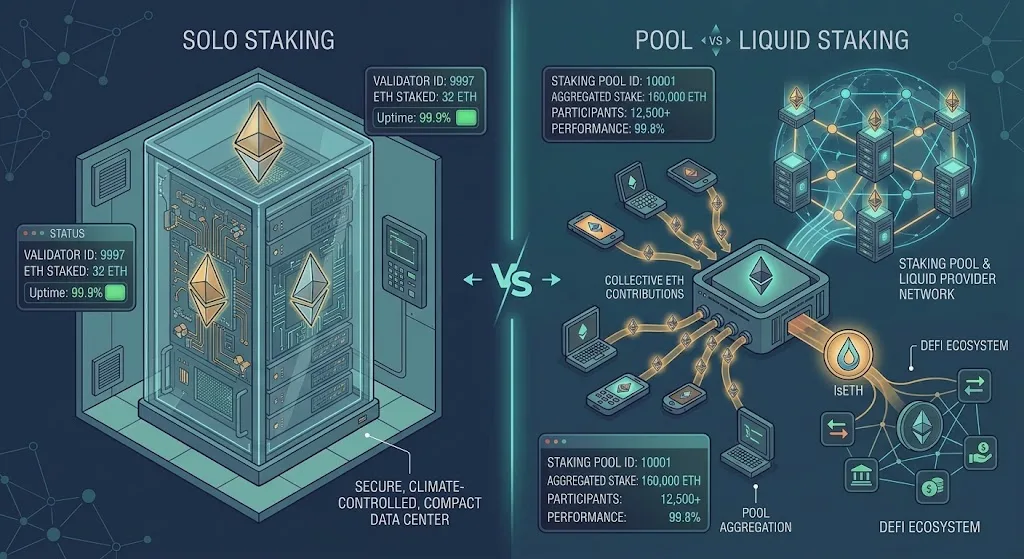
Running a solo validator requires the full minimum activation balance and comes with direct responsibility for the queue wait, uptime, and technical setup involved. Many stakers instead use a staking pool or a liquid staking provider, which combines many smaller deposits into validators the provider operates on everyone's behalf, distributing rewards proportionally without requiring each participant to run their own infrastructure.
Liquid staking also issues a token representing the staked position, which can often be used elsewhere in decentralized finance while the underlying ETH remains staked. This does not remove the entry and exit queue from the equation entirely, since the underlying validators still have to move through the same protocol-level churn limit, but it does shift the operational burden of running validator infrastructure away from the individual depositor.
Risks of Running a Validator
The validator is a serious responsibility which entails certain risks aside from just staking and earning rewards.
-
Slashing penalties apply to validators caught behaving maliciously, such as attempting to validate conflicting versions of the chain, resulting in a partial loss of staked funds and forced exit from the network.
-
Missed attestations, which happen when a validator's software or internet connection fails to respond during its assigned duties, result in smaller, non-slashing penalties that still reduce overall staking returns.
-
Uptime and reliable infrastructure matter directly to profitability, since a validator that is frequently offline earns meaningfully less than one that stays consistently online and responsive.
-
The exit queue means staked funds are not instantly liquid, so anyone planning to stake should account for the possibility of a wait, sometimes a substantial one, before regaining full access to their funds.
Related guides


 Scroll to top