


Best Cold Storage Wallet for XRP: Options and Setup


Table of contents
- What cold storage means for XRP
- Two rules that apply to every XRP wallet
- What the main vendors say about XRP support
- Using a hardware wallet with Xaman
- How to choose without a ranking
- A safe setup sequence
- How many XRP wallets are there
- Why wallet counts are not holder counts
- What to check live before moving funds
- Related guides
No independent comparison ranks cold wallets for XRP, so a single "best" device cannot be named honestly. What can be said is narrower and more useful. Cold storage keeps the private keys offline; Ledger and Trezor both feature XRP support on their pages; and Xaman provides a card-based cold wallet option. No matter the choice of the device, an XRP address exists in the ledger after receiving at least the minimal amount of XRP and exchanges require destination tag to deposit coins. Those two rules cause most beginner mistakes, not the choice of brand.
Here you can find information on what cold storage means for the XRP Ledger, on what each vendor says about its product, on how to set up and test the address, and on why the number of wallets is a poor metric of the number of holders. No recommendations to buy the XRP and no ranking of products are provided here. The statements of vendor pages are promotional texts, so they are labeled accordingly. Figures are dated, and the live values should be checked before any transfer.
What cold storage means for XRP
A cold wallet is a device with private keys stored on it that does not remain connected to the Internet. In the case of XRP, a cold wallet is a hardware wallet or a card with a chip. The internal processor signs the transaction in a cold wallet, and only signed transaction leaves the device. Hence, the private keys never touch the connected phone or computer.
XRP differs from Bitcoin in one point that is important here. The XRP Ledger does not require any mining. Coins are not created by securing the network, so there is nothing to earn by holding XRP in a node or wallet. Storage is purely a custody question – who controls the keys.
A hot wallet, such as a mobile app or an exchange account, keeps keys on an internet-connected device or on the exchange side. Cold storage trades convenience for a smaller attack surface. Nevertheless, cold storage does not eliminate the risks completely. A lost mnemonic phrase, a mistyped address and a fake website can lead to the loss of funds.
Two rules that apply to every XRP wallet
The reserve: an address must be funded to exist
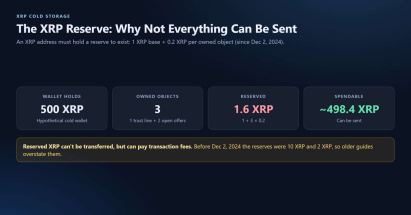
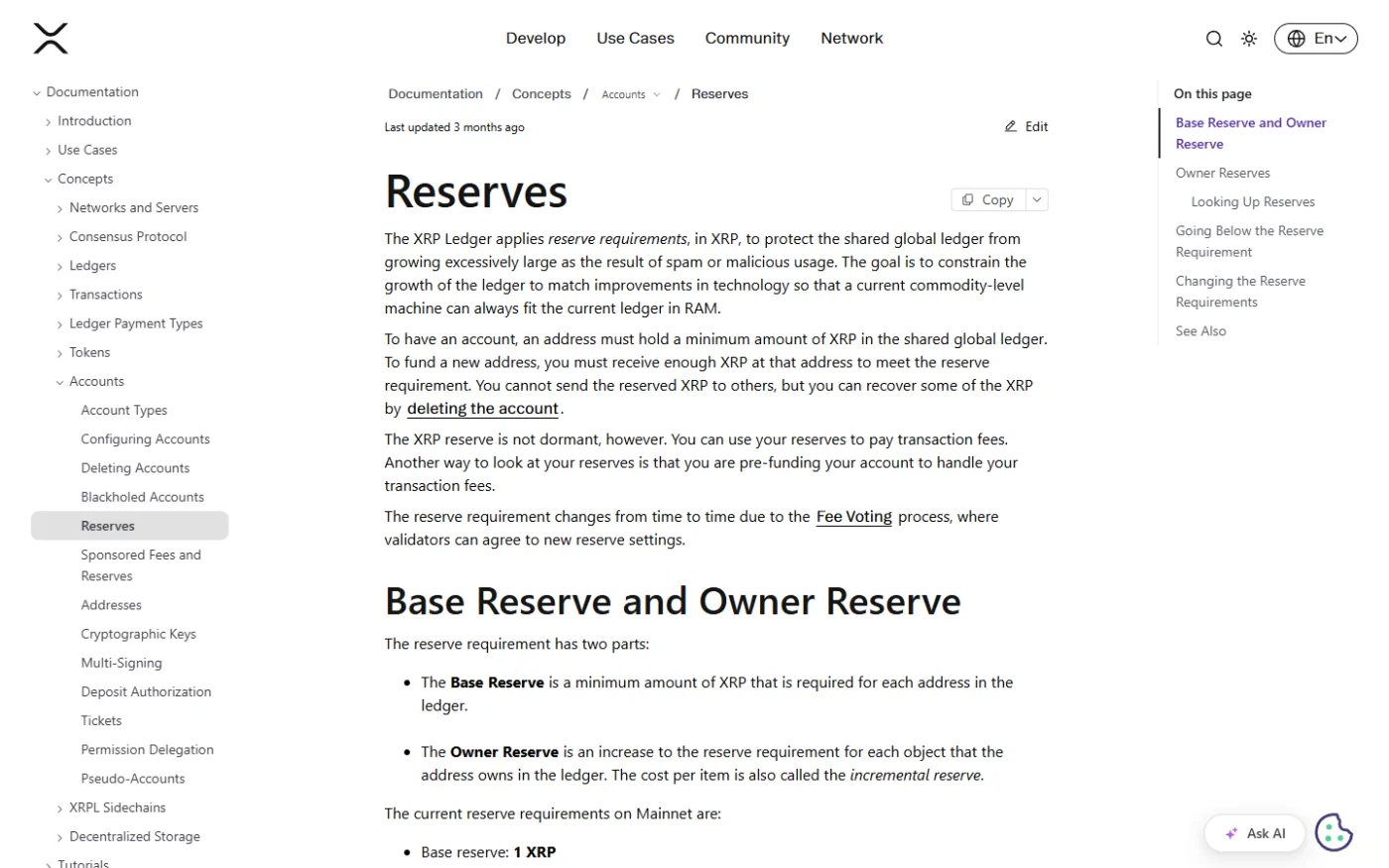
According to the XRP Ledger documentation, each XRP address needs to have a certain amount of XRP to exist on the ledger. The base reserve is 1 XRP on Mainnet. Each owned object in the account (such as a trust line, an offer, an escrow, or a check) adds 0.2 XRP to the owner reserve.
On the same page, there is also a statement that reserved XRP cannot be transferred to other accounts, but it can be used to pay transaction fees. The XRPL team announced that the lower reserves started working on December 2, 2024 after a validator vote. Prior to that, the reserves were 10 XRP and 2 XRP.
The XRP page on Trezor's web-site repeats the practical consequences of this rule – the new address needs at least 1 XRP in order to become active, and this reserve cannot be transferred while the account is alive. On the XRP page on Ledger's web-site, there is also a piece of information that removal of the account costs 0.2 XRP and leaves 0.8 XRP to be recovered, and that the account needs to be re-funded to become active. That deletion detail comes from a vendor page, so it should be checked against the XRPL documentation before relying on it.
A hypothetical example, not a real account: a cold wallet holds 500 XRP, has one trust line and two open offers. This account has three owned objects, therefore the reserve is 1 + (3 * 0.2) = 1.6 XRP, and about 498.4 XRP can be sent. The reserve values should be checked on the reserves page before funding an account.
The destination tag: needed for exchanges, not for your own address
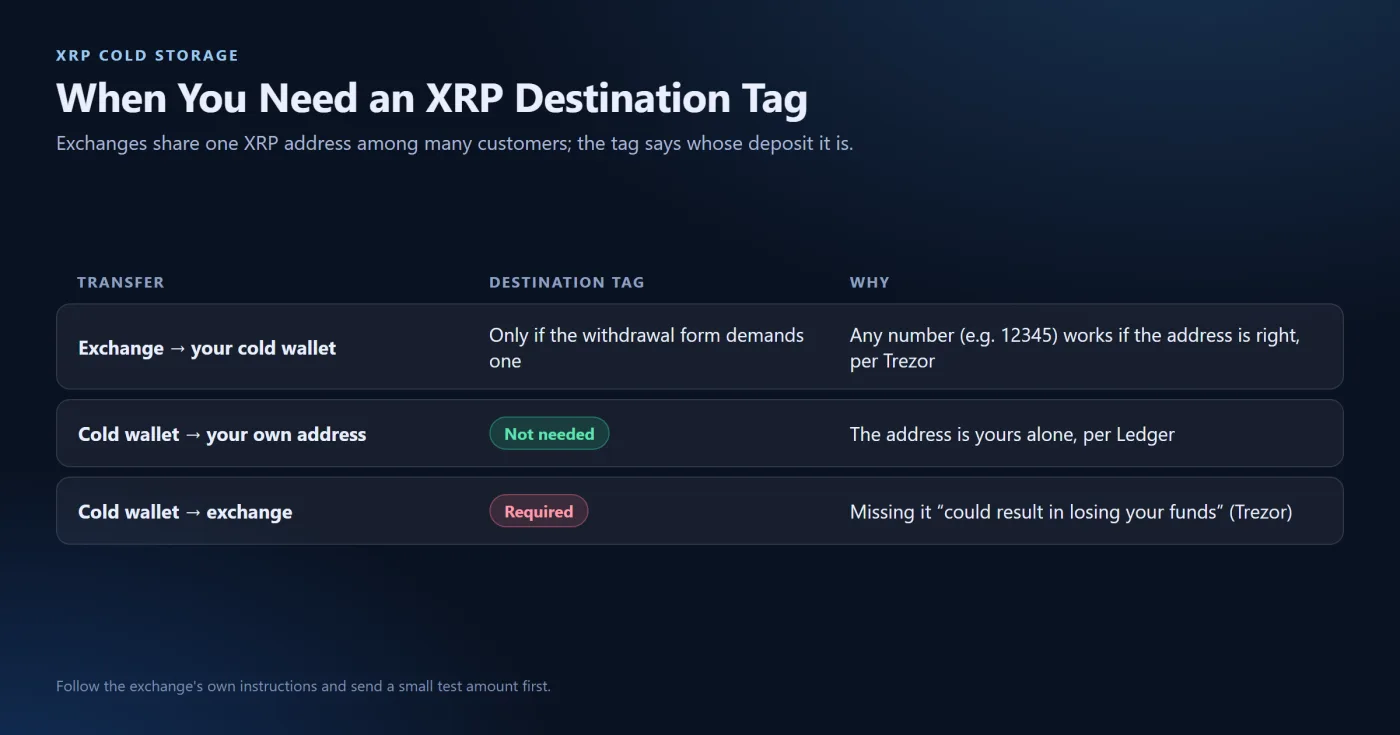
An exchange usually receives deposits from many customers at one XRP address. The destination tag is the number that tells the exchange which customer account should be credited. According to Ledger's page, a tag is not needed when sending to your own Ledger address and is needed when sending to a centralized exchange. The page on Trezor warns that missing the destination tag "could result in losing your funds" and suggests to consult with the exchange first and to test with a small amount.
When withdrawing XRP from an exchange to a cold wallet, some exchanges ask for a destination tag on the withdrawal form. According to the Trezor page, any number, for example 12345, can be used here as long as the address is correct. The instructions of the exchange itself should decide this, and a small test transfer helps to settle the issue.
What the main vendors say about XRP support
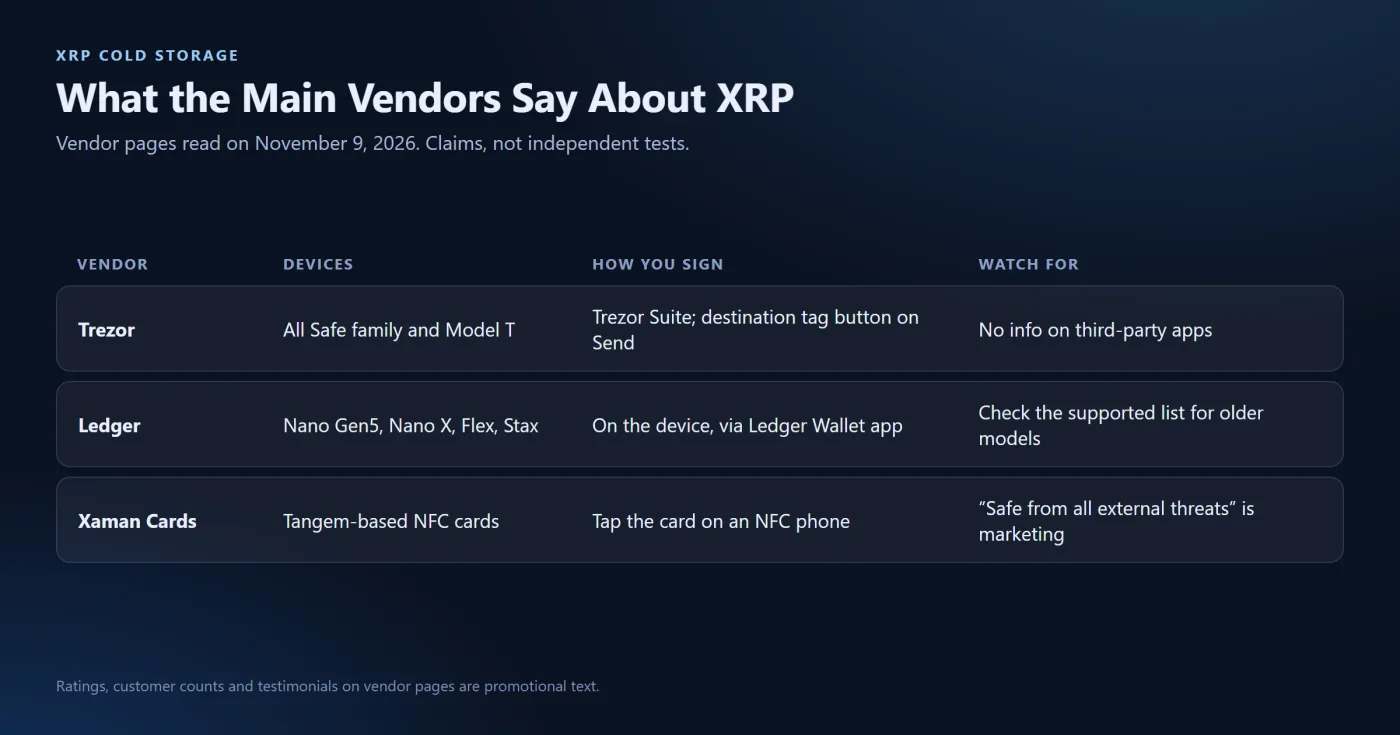
The statements below come from each vendor's page read on November 9, 2026. They show what is claimed, not what has been independently tested.
-
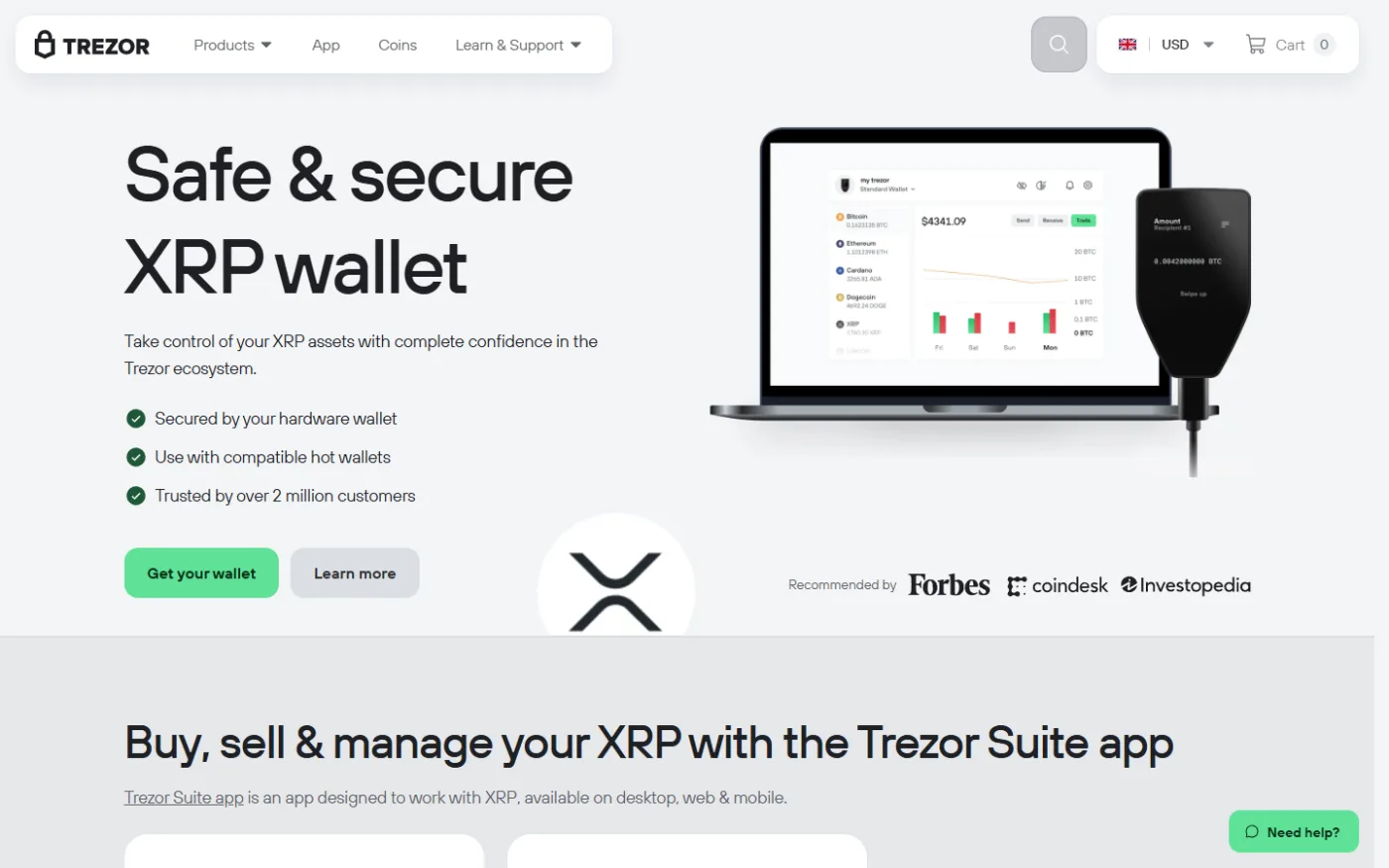
Trezor: "XRP is supported on all Trezor Safe Family and Trezor Model T devices." The sending is done in Trezor Suite, and the Send page contains a destination tag button. There is no information about the third-party apps and any transaction limits.
-
Ledger: The XRP page mentions the Nano Gen5, Nano X, Flex and Stax. Transactions are signed on the device itself before broadcasting them using the Ledger Wallet app (formerly Ledger Live). The XRP page does not explicitly confirm XRP support for every older model, and you should check the supported assets list for the specific device before the purchase.
-
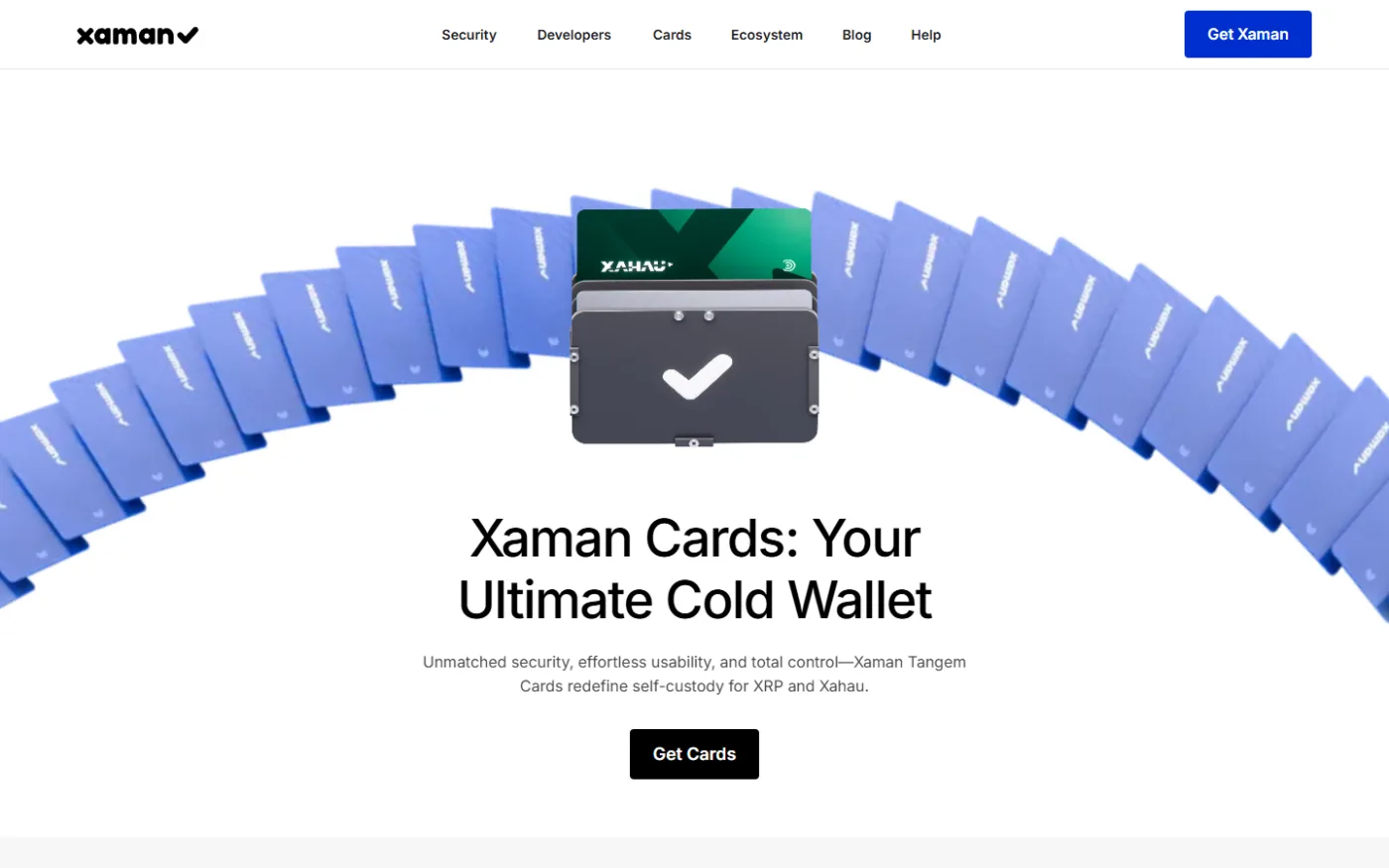
Xaman Cards: Xaman sells Tangem-based cards described as "Your Ultimate Cold Wallet." The page tells that the chip generates the keypair and the key never leaves the card, and that the card signs the transaction with a tap on an NFC-enabled phone. No price is specified on that page.
Each of these pages also contains promotional text. The page on Ledger makes popularity and speed claims without any cited sources. The page on Xaman uses absolute words such as "safe from all external threats." No security product can make such a claim. Ratings, counts of customers and testimonials on vendor pages should be considered as promotional texts.
Using a hardware wallet with Xaman
Xaman is a popular XRPL mobile app. The help center of this app describes how to combine a hardware wallet and the phone app. The steps are as follows:
-
Create a new Full-Access XRPL account in Xaman. It does not require funding.
-
Sign in to the XRP Toolkit with a hardware wallet on a computer, and open Account, then Signers.
-
Assign a Regular Key to the Xaman account and sign the transaction with the hardware wallet.
-
Import the hardware wallet address to Xaman in read-only mode.
As per the help page, the original private keys remain on the hardware wallet. Afterward, Xaman contains a second key (an online key) that can sign transactions for the hardware wallet address via Regular Key. It is handy to perform transactions, but it also means the address is no longer protected by the hardware device alone. At the same time, the help page recommends to read the page of guidance on whether to import an account or not, because importing the account makes it vulnerable to attacks via online channels that a hardware wallet normally avoids.
For long-term cold storage, a simpler approach is not to assign a Regular Key to the hardware wallet address, so it remains protected on the hardware wallet. However, a Regular Key can be changed or even removed from the account with a signed transaction.
How to choose without a ranking
A neutral approach to selection of the product would be to specify your requirements first and then compare various devices according to these requirements. Below there are the questions that do not select the winner, but narrow down the options:
-
The device model: does the vendor support XRP on this model now?
-
The interface: is the software for signing transactions available for the computer or phone you use?
-
The features: are trust lines, destination tags and escrows required, or just plain transactions?
-
The recovery: is the mnemonic phrase saved offline in more than one place, never photographed or typed into a website?
-
The purchase channel: was the device purchased from the manufacturer or authorized reseller in a sealed package?
-
The exit strategy: can the same address be imported to another wallet in case of discontinuation of support of this particular model?
The last point matters because the XRPL account is defined by its keys, not by the brand of device. A mnemonic phrase created in a wallet can be imported into another compatible wallet if the derivation algorithm is supported there, but this should be checked first with a test balance.
A safe setup sequence
-
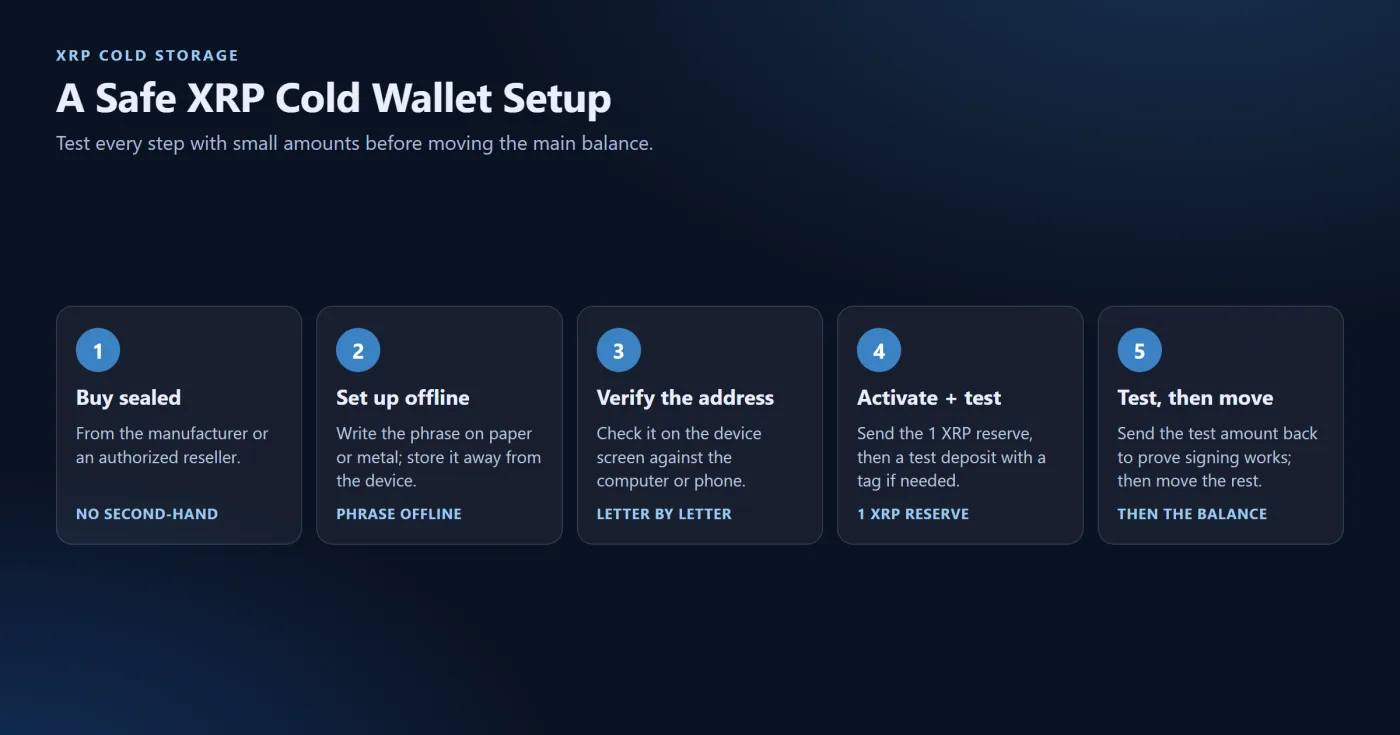
Buy the device from the manufacturer or authorized reseller in a sealed package.
-
Setup offline-first, write the mnemonic phrase on paper or metal and store it away from the device.
-
Import the XRP account and verify the displayed address on the device screen matches the address on the computer/phone.
-
Send the base reserve, at least 1 XRP in current terms, to make the address active.
-
Send a test amount from the exchange, with a destination tag if required by the exchange, and verify that the amount is received.
-
Send the test amount back in order to verify that the signing works.
-
Only then move the larger balance.
The search results for these keywords include look-alike pages on free web-hosting sites that try to imitate official pages of wallet vendors. The mnemonic phrase should be typed only into the device itself. No legitimate wallet support ever requests a mnemonic phrase by email, message or form.
How many XRP wallets are there
Several figures about the number of XRP wallets are available, but they contradict each other, because they measure different things. Here are two dated examples showing the gap between them.
-
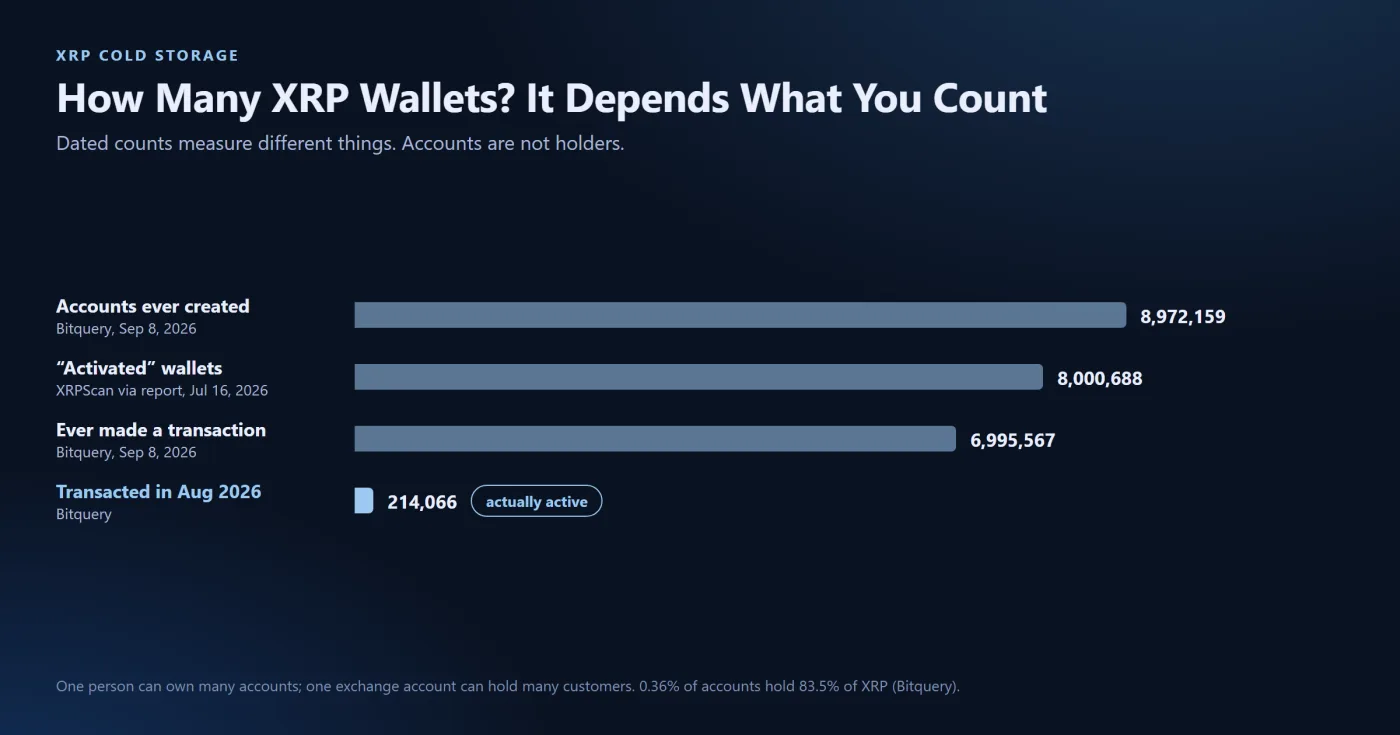
According to the report from The Crypto Basic republished by KuCoin on July 16, 2026, there were 8,000,688 activated wallets, cited from XRPScan. The article does not define "activated" and does not explain whether these wallets are funded or active.
-
The audit of blockchain data provider Bitquery dated September 8, 2026 counted 8,972,159 accounts ever created based on balance snapshot, and 6,995,567 accounts that ever performed a transaction.
The difference is about 970,000 accounts during about seven weeks, and neither of these sources explains how it counts deleted accounts. The gap could reflect definitions as much as growth, so the figures should not be merged into one trend.
The Bitquery audit provides additional information about contents of the numbers. It says that 9.58% of accounts contain a zero balance, the median balance is 12 XRP, and 214,066 accounts performed a transaction in August 2026. It also states that 46% of funded accounts have not been touched since the end of 2024. Finally, it reports that about 32,437 accounts, or 0.36%, hold 100,000 XRP or more and hold 83.5% of XRP on the ledger. Bitquery is a blockchain data provider, and the behavioral classification of accounts cannot prove their ownership as the audit itself mentions.
Why wallet counts are not holder counts
Any "number of XRP holders" should be understood as the count of accounts for the following reasons:
-
One person can control multiple accounts: a cold address, a trading account and a test address.
-
One account can represent multiple people. An exchange account contains balances of all customers sending funds through destination tags.
-
The reserve means that a small balance can be mostly locked, and the count of funded accounts includes such accounts.
-
Escrow accounts and corporation accounts are counted like any other account.
Rich-list web-sites and articles that mention "XRP holders" usually count the addresses above a certain threshold. That is a reasonable proxy for distribution, but it cannot say how many individuals own XRP.
What to check live before moving funds
-
The current values of base and owner reserve on the XRPL reserves page.
-
The supported assets list of the vendor for the exact device model and firmware version.
-
The destination tag requirement and the minimum deposit on the receiving exchange.
-
The address shown on the device screen, letter-by-letter, and the address being sent to.
-
The source of account count, the date, and its definition before quoting any wallet or holder count.
Wallet choice is a custody decision with its pros and cons, and not the financial advice. A device suitable for a small balance is not necessarily suitable for a large one, and the setup depends on the frequency of transactions.
Related guides


 Scroll to top