


Top 10 Bitcoin Mining Pools by Hashrate


Table of contents
- What Is a Bitcoin Mining Pool?
- How Mining Pools Distribute Their Rewards
- Why Does Pool's Hashrate Matter
- The Largest 10 Bitcoin Mining Pools
- Solo Mining versus Pool Mining
- How the Landscape of Pools Changes Over Time
- Why Do Hashrate Numbers Vary Among Different Sources
- How to Choose the Right Bitcoin Mining Pool
- Stratum V2 and Miner-built Block Templates
- Related guides
Foundry USA and AntPool always lead the way among the largest Bitcoin mining pools in terms of hashrate and together with F2Pool, ViaBTC, and SpiderPool, they typically account for the large majority of the network's total computing power. Rankings of mining pools tend to change on a weekly basis due to the redirection of hashrate by miners so any specific list, including this one, is best treated as a current snapshot rather than a permanent order.
However, what needs to be understood first about that redirection is that it reveals quite an interesting aspect of how decentralized (or concentrated) the network's mining power actually is at the moment.
What Is a Bitcoin Mining Pool?
A Bitcoin mining pool is a set of individual miners who collaborate on the aggregation of their hashrates in order to find blocks more consistently than any one of them could alone. Bitcoin mining rewards are awarded to the miner who successfully mines a particular block first, meaning that the small-scale miner faces the problem of potentially mining for days or weeks without receiving anything at all despite spending resources on the process.
Pooling hashrates solves this problem, as the reward will be distributed among the pool participants depending on their hashrate contribution, effectively turning this all-or-nothing process into a regular flow of payouts.
How Mining Pools Distribute Their Rewards
There are different methods used by pools for splitting the mining rewards and they all differ in terms of the level of mining income predictability.
-
The Full Pay Per Share, or FPPS, provides miners with a set fixed amount of reward per share regardless of whether the block was mined or not. Both the block subsidy and the transaction fees are included in the reward. This is the most popular method used by large mining pools because it gives miners the most predictable income.
-
The Pay Per Share, or PPS, operates the same way but calculates the reward differently (only the block subsidy).
-
The Pay Per Last N Shares, or PPLNS, rewards miners only when the pool successfully mines the block, but it takes into account the recent contributions. That is how the pool shifts more short-term variance onto the miner but allows earning a larger share of transaction fees when the pool has good luck.
Why Does Pool's Hashrate Matter
Bitcoin's security depends on no single entity controlling a majority of the network's hashrate, since a pool operator with enough hashrate could theoretically attempt to reorganize recent blocks or exclude certain transactions. The distribution of hashrate among the pools is therefore considered as one of the decentralization metrics.
It is important to note that the majority of the individual miners don't show loyalty to one specific pool. The hashrate can be easily redirected to another pool within minutes, explaining why the market share among the largest pools tends to fluctuate and no single pool has maintained majority control of the network long-term.
The Largest 10 Bitcoin Mining Pools
1. Foundry USA
Foundry USA is currently the largest Bitcoin mining pool, backed by Digital Currency Group. It caters largely to institutional-scale mining operations in North America. Its consistently large share of global hashrate means it finds blocks more frequently than any other single pool, which tends to reduce payout variance for its members. Beyond core pool services, Foundry also offers various financial products related to Bitcoin mining.
2. AntPool
AntPool belongs to Bitmain – the largest ASIC manufacturer in the world. It has been among the largest Bitcoin mining pools for years and its close relationship with Bitmain gives it a large built-in base of miners running Bitmain hardware, alongside a broad international user base spanning both institutional and smaller-scale participants.
3. F2Pool
F2Pool is one of the oldest operating Bitcoin mining pools, having launched in 2013. It supports mining for several cryptocurrencies beyond Bitcoin, and its long operating history has made it a familiar option for miners looking for an established, well-tested platform.
4. ViaBTC
ViaBTC was founded in 2016 and was one of the earlier pools to adopt the PPS payout method. It combines meaningful hashrate scale with a more accessible interface than some institutional-focused competitors, making it a common choice for small and mid-sized mining operations that still want exposure to a pool with a large enough share to find blocks regularly.
5. SpiderPool
SpiderPool is the newcomer among the largest Bitcoin mining pools but it has managed to become one of the largest pools in a relatively short period of time. This is one of the most notable changes in the pool landscape in recent years.
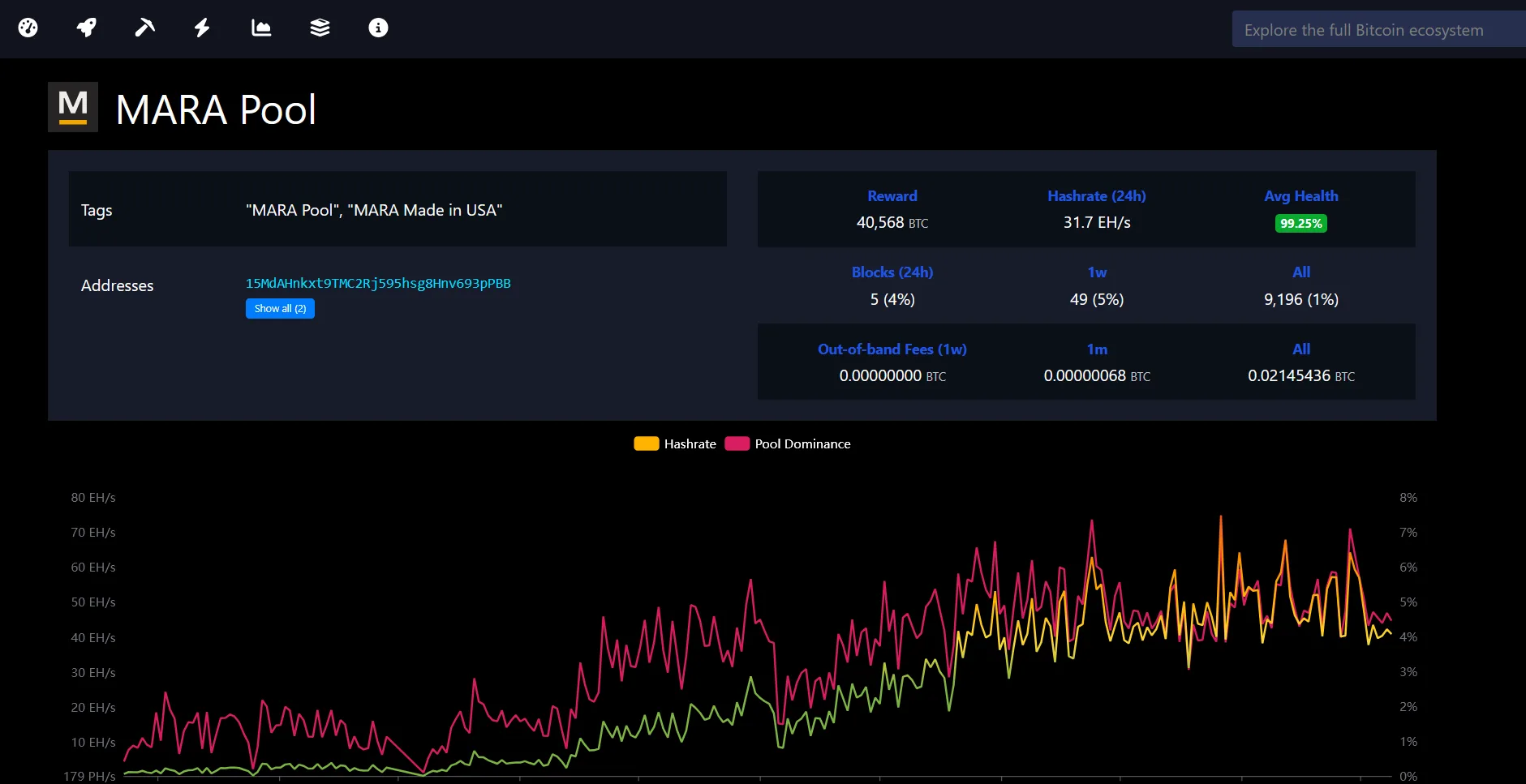
6. MARA Pool
MARA Pool is operated by Marathon Digital Holdings, which is a publicly traded Bitcoin mining company. Unlike most pools on this list, it functions primarily as a vertically integrated pool for Marathon's own mining operations rather than an open pool actively recruiting outside miners.
7. Luxor
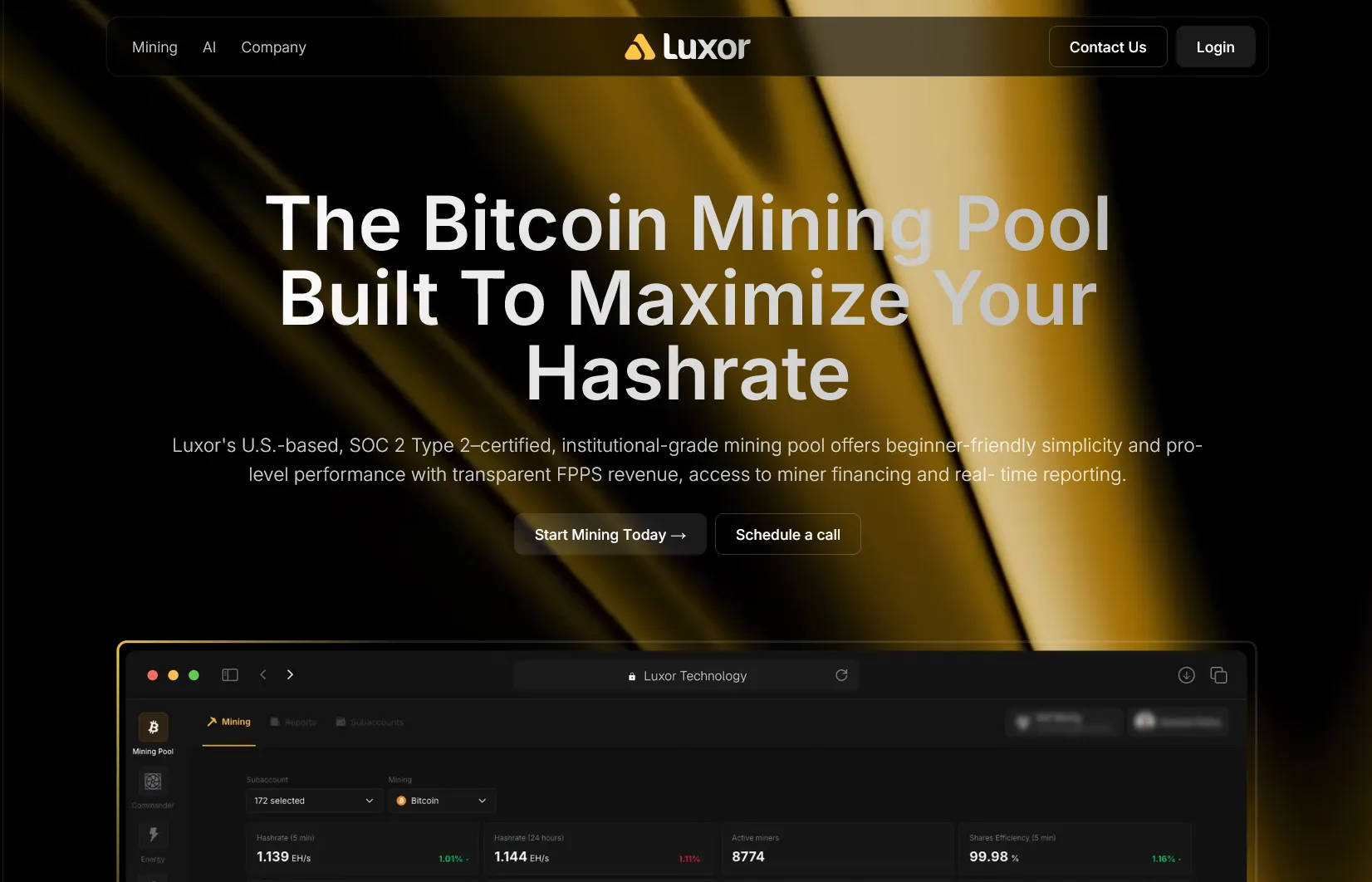
Luxor describes itself as the first US-based Bitcoin mining pool and operates not only as a mining pool, but also as a provider of its own mining firmware, a hashrate derivatives platform for hedging future mining income, and financing options for miners.
8. Binance Pool
Binance Pool is owned by Binance – the largest cryptocurrency exchange in the world in terms of trading volume. Its main advantage is tight integration with Binance's broader trading and financial ecosystem, letting miners move earned Bitcoin directly into trading or other exchange products without an extra transfer step between separate platforms.
9. Braiins Pool
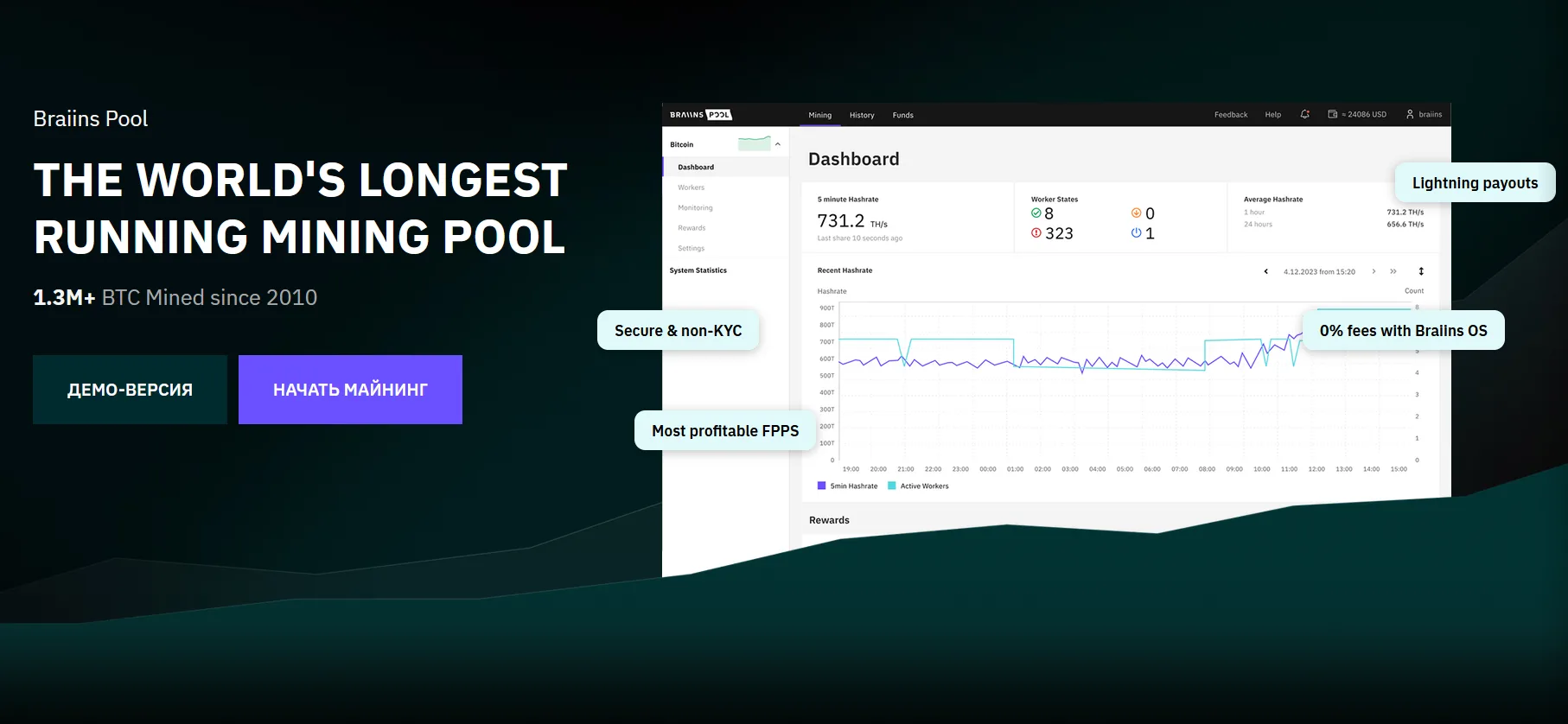
Braiins Pool, formerly known as Slush Pool, holds the distinction of being the first Bitcoin mining pool ever created, launching in 2010. Even though it doesn't have the largest hashrate share anymore, it remains a well-established option, particularly known for open-source mining software and a Bitcoin-only focus that has stayed consistent throughout its history.
10. OCEAN
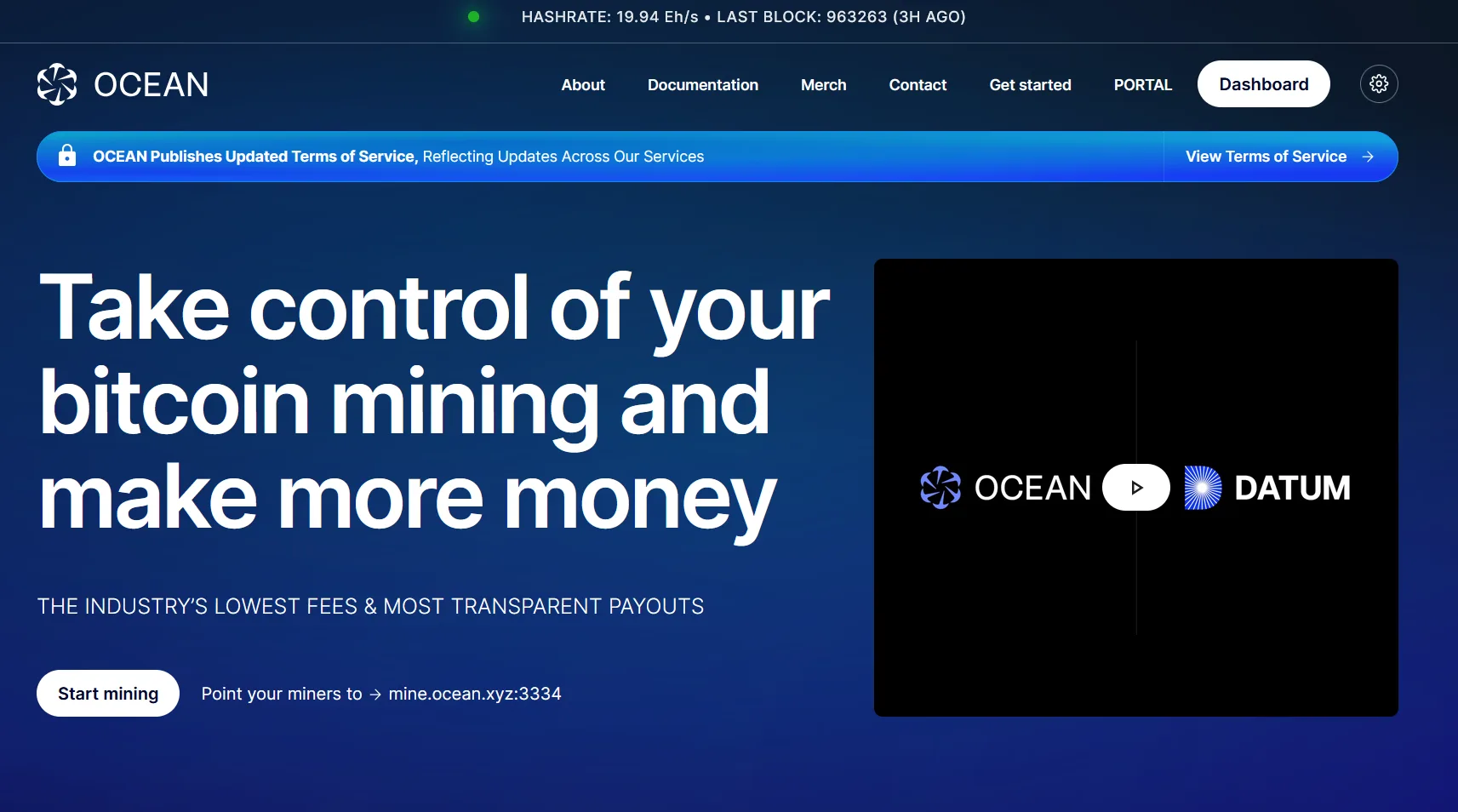
OCEAN takes a different approach from most large pools by prioritizing decentralization over sheer scale. It supports a protocol that lets individual miners construct their own block templates rather than accepting whatever template the pool operator builds.
Solo Mining versus Pool Mining
Solo mining means competing against the entire Bitcoin network alone, keeping the full block reward on the rare occasion a block is found, but otherwise receiving nothing, since the odds of finding a block solo are extremely low.
Pool mining trades away that lottery-style upside for consistency, providing a much more regular flow of smaller rewards proportional to the hashrate contributed to the pool. It is the entire reason pools exist for any miner besides very large industrial operations.
How the Landscape of Pools Changes Over Time
The geographical distribution of Bitcoin mining pools has changed substantially over the years. For quite a long period of time a large share of global hashrate was located in China, where several of the largest mining pools were situated. A regulatory crackdown on cryptocurrency mining in China pushed a significant portion of that hashrate to relocate, with North America in particular becoming a much larger center of mining activity afterward.
This is one of the reasons why pools such as Foundry USA, with a strong North American institutional focus, have grown to such a prominent position. It is also an example of the pattern that has been repeating in the history of mining pools: the landscape of pools never stays the same and the pools that occupy leading positions now won't necessarily stay there forever.
Why Do Hashrate Numbers Vary Among Different Sources
Anybody comparing the hashrate percentages provided by the various mining pool tracking sites will see that these numbers are rarely the same. This happens because the hashrate of each pool is not measurable directly and has to be estimated based on how quickly a pool's blocks appear relative to Bitcoin's difficulty target.
Different trackers use different windows for this calculation, commonly from one day to one week of recent blocks, and pools can appear larger or smaller because of their luck in that window. For this reason, live dashboards such as mempool.space, Hashrate Index, and miningpoolstats.stream are more useful for checking current standings.
How to Choose the Right Bitcoin Mining Pool
Pool size is only one factor worth weighing, and it comes with trade-offs in both directions.
-
Larger pools find blocks more often, which reduces payout variance, but they also concentrate more hashrate under one operator, which raises decentralization concerns for the network as a whole.
-
Fees typically range from around 0% to a few percent, and a lower fee does not automatically mean a better payout, since the payout method itself affects how much variance a miner actually experiences.
-
Minimum payout thresholds vary between pools, which matters more for smaller-scale miners who may wait longer to reach a threshold on a pool with lower total hashrate contribution.
-
Server location affects latency, and pools with servers closer to a miner produce fewer stale shares, which are units of work that arrive too late to count toward a reward.
Stratum V2 and Miner-built Block Templates
A newer mining protocol called Stratum V2 has introduced the option for individual miners, rather than pool operators, to construct the block templates their hashrate works on. Under the older standard, a pool operator decided which transactions to include in a block and therefore controlled the order of transactions temporarily.
Adoption of this protocol has been limited to date among the largest pools, but it represents a meaningful step toward further decentralization of hashrate and transaction selection. Pools built around this approach, such as OCEAN, promote that feature as a core part of their pitch.
Related guides


 Scroll to top